
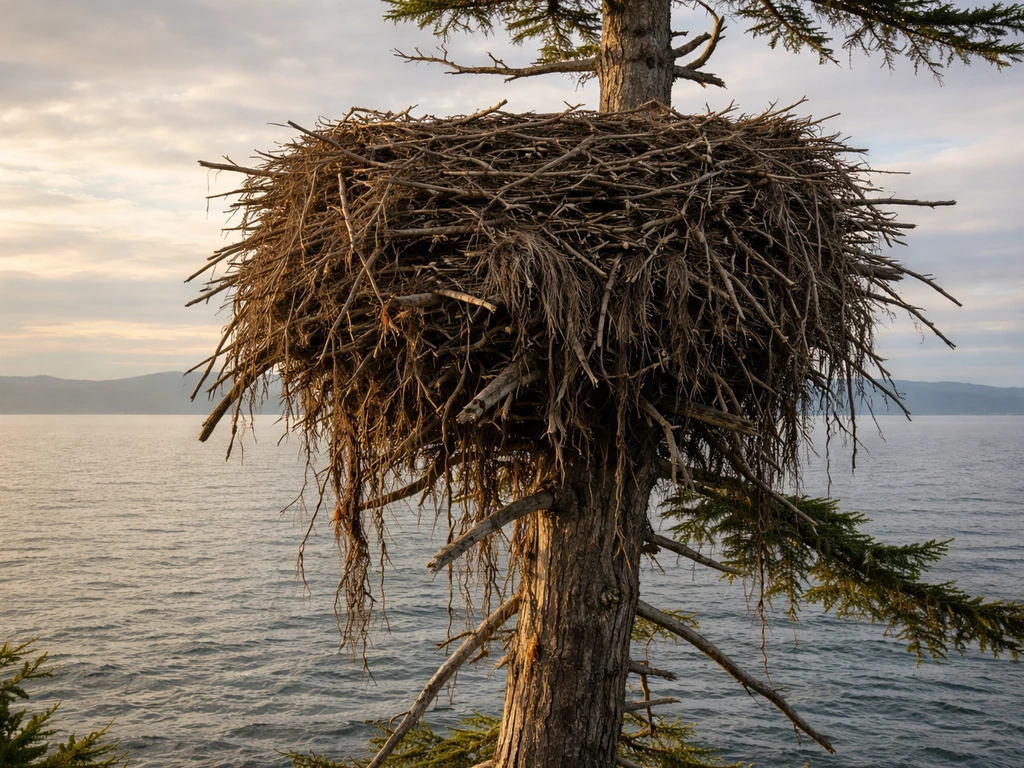
The bird that builds the biggest nest is the bald eagle (Haliaeetus leucocephalus). The Guinness World Record holder is a bald eagle nest found near St. Petersburg, Florida, that measured roughly 2.9 meters (9 ft 6 in) wide and an astonishing 6 meters (20 ft) deep. That is not a typo. A pair of eagles added to that nest for decades, and the weight eventually brought the tree down. So if you have spotted a massive stick platform in a tall tree and you are wondering what built it, bald eagle is the answer you are probably looking for.
What Bird Builds the Biggest Nest? How to Identify It

Maya Bennett
12 Apr 2026
What 'biggest' actually means here

Before diving into species comparisons, it helps to pin down the measurement. 'Biggest' can mean at least four different things: widest footprint, greatest depth (vertical accumulation), total volume, or total mass. Eagle nests win on depth and cumulative mass because the same pair reuses and adds to the same nest every breeding season, sometimes for 30 or 40 years. A white stork nest, by comparison, grows substantially too. A study that measured 145 white stork nests reported modeled volumes ranging from 0.1 to 3.6 cubic meters, which overlaps with large eagle nests, but stork nests rarely reach the vertical depths eagles achieve.
There is also a vocabulary issue worth clarifying. Ornithologists and field guides use 'nest,' 'platform,' and 'roost' loosely in popular writing, and that creates confusion. What bald eagles build is technically an eyrie or aerie: a large stick platform used exclusively for breeding. A 'roost' is a resting site, not a nest. A 'nest structure' in the context of sociable weavers (more on them below) is a communal thatched mass that contains many individual nesting chambers. These are not directly comparable, so when someone asks about the 'largest nest structure in the world,' the answer shifts depending on which definition you apply.
The top contenders for giant nests (and the look-alikes)
If you limit the contest to a single-pair, tree-based stick nest, bald eagles win. But there are other species that build impressively large nests that get mistaken for eagle nests regularly. Here is how the leading candidates stack up.
| Species | Nest Type | Typical Width | Typical Depth/Height | Location |
|---|---|---|---|---|
| Bald Eagle | Single-pair stick eyrie (reused annually) | Up to 2.9 m (9.5 ft) | Up to 6 m (20 ft) | Tall conifers or hardwoods near water, North America |
| Osprey | Single-pair stick platform | 0.9–1.5 m (3–5 ft) | 0.3–1 m (1–3 ft) | Dead snags, channel markers, platforms near water |
| White Stork | Single-pair stick platform (reused) | 0.8–1.5 m (2.5–5 ft) | Up to 3 m (10 ft) over decades | Rooftops, trees, tall structures; Europe, Africa, Asia |
| Great Horned Owl | Typically reuses other nests | Varies (occupies existing) | Varies | Forests across North America |
| Sociable Weaver (communal) | Thatched communal structure (many chambers) | Up to 7 m (23 ft) wide | 1–2 m (3–6 ft) thick | Camelthorn trees, utility poles; southern Africa |
The sociable weaver colony nest deserves a special note. By sheer footprint and total mass, a large sociable weaver colony structure is arguably the biggest nest structure on earth, housing hundreds of birds in individual chambers inside one thatched mass. National Geographic has covered how cooperative building behaviors, including apparent social enforcement among colony members, drive these structures to grow year after year. But because it is a communal structure with dozens or hundreds of breeding pairs inside, most ornithologists keep it in a separate category from the single-pair eagle eyrie when answering 'what bird builds the biggest nest.'
Ospreys are the most common look-alike confusion in North America. Their nests are large, made of sticks, built near water, and reused annually, just like eagle nests. The size difference is significant, though: osprey nests rarely exceed 1.5 m wide and 1 m deep even after many years of reuse, while a mature eagle nest usually dwarfs that. If you enjoy exploring the full range of avian nest architecture, it is worth checking out which bird makes the best nest for a broader look at construction quality across species.
How to confirm the species from the nest itself
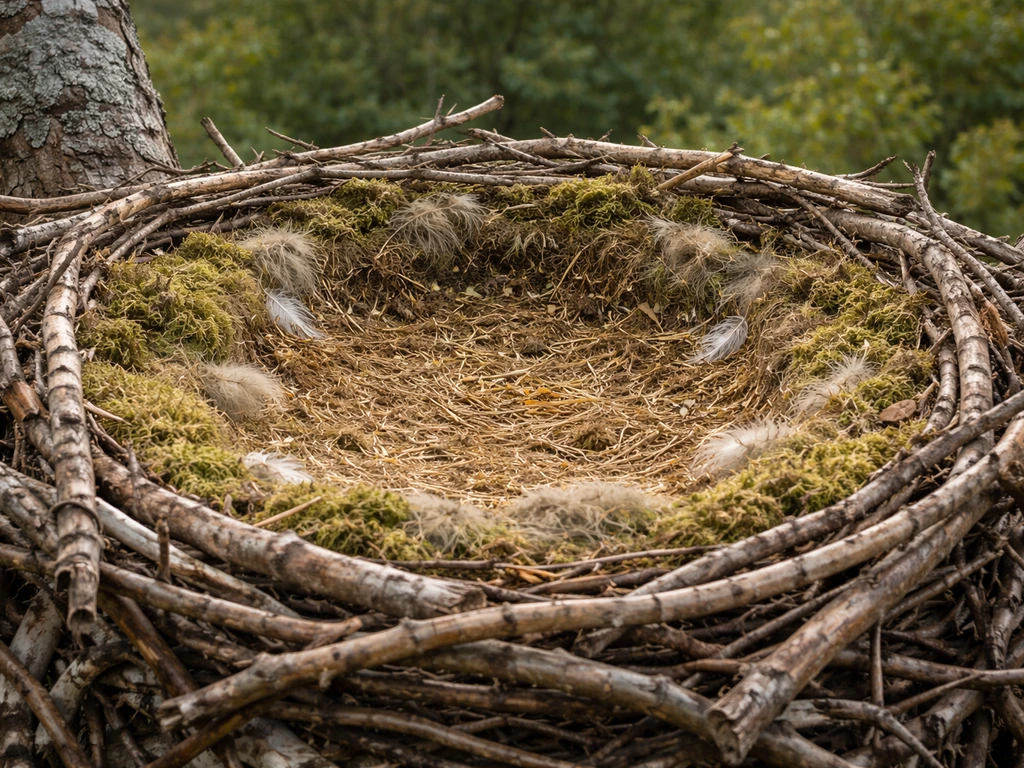
You do not need to see the bird to make a confident ID. The nest leaves plenty of clues on its own. Here is what to look for without getting close enough to cause a disturbance.
Materials and construction
Bald eagle nests are built primarily from large sticks and branches, often 1–2 inches in diameter, lined with softer materials like grasses, moss, feathers, and sometimes seaweed or lichens near coastal areas. The interior cup is noticeably softer than the outer framework. Osprey nests use similar large sticks but are often decorated with unusual items: rope, fishing line, plastic, kelp, and other debris collected from the water's edge.
White stork nests have a similar stick base but the lining tends to be grass, rags, and paper, and they are almost always placed on a man-made structure or rooftop in their native range. If you are seeing a large hanging or woven structure rather than a stick platform, you are likely looking at something entirely different, like an oriole or weaver nest. The article on what bird makes a hanging nest covers those suspended constructions in detail.
Placement and habitat

- Bald eagle nests: Almost always within 1.5 km of open water (lake, river, coast). Placed in the tallest tree available, usually a conifer or large hardwood with a clear flight path. The nest sits at or just below the crown, often in the main fork.
- Osprey nests: Very close to water, often on dead snags, channel markers, utility poles, or purpose-built platforms. Rarely in the interior of a forest.
- Great horned owl: If a massive nest appears seemingly overnight, an owl has almost certainly taken over an old hawk or eagle nest. Look for whitewash (feces streaks) and pellets beneath the nest.
- Sociable weaver: Only in southern Africa, almost always in a camelthorn acacia or on a tall utility pole. The structure looks thatched, not a pile of sticks.
Season and activity clues
Bald eagles begin nest-building and refurbishing well before eggs are laid, often as early as October or November in the southern US and January or February in northern states. By late winter you will typically see both adults visiting regularly and adding fresh material. Eggs hatch from late January through March depending on latitude, and the adults will be visibly defensive if you approach too close. If the nest is active right now in April, you likely have chicks on board, which makes disturbance a much more serious concern. Not all enormous nests are active every year, so a completely still, weathered platform with no fresh green material added is likely an old or abandoned nest.
One quick field note: bald eagles produce distinctive whitewash on branches below the nest and on the ground directly beneath it. Their prey remains, fish bones, fur, and feathers, often accumulate at the nest base and below. If you spot clean bones and fish scales in a pile under a huge stick platform, that is a strong eagle indicator. Compare this to the messier, more eclectic debris you might find under an osprey nest, which often includes tangled fishing line and bits of rope.
Found a massive nest on your property? Here's what to do first
Finding a bald eagle nest on your property is both exciting and immediately complicated. In the United States, bald eagles are protected under the Bald and Golden Eagle Protection Act and the Migratory Bird Treaty Act. That means you cannot disturb, move, damage, or destroy an active eagle nest without a federal permit, full stop. Even if the nest is inconvenient, cracking a branch supporting it or trimming nearby trees in ways that expose the nest can constitute illegal disturbance. The U.S. Fish and Wildlife Service (USFWS) has an entire permit process for eagle incidental disturbance and nest take situations, and getting it wrong carries serious penalties.
The USFWS recommends maintaining a buffer of at least 330 feet from an active bald eagle nest during the breeding season in most contexts, with that buffer extending to 660 feet in areas with high noise or limited screening vegetation. That guidance applies to sustained human activity like construction, vehicle traffic, and logging. A person walking quietly through their own property once is a different scenario, but repeated or loud disturbance close to the nest during the nesting period (roughly November through July depending on region) is where you run into real risk of legal consequences and, more importantly, nest failure.
Your immediate checklist if you find a large nest
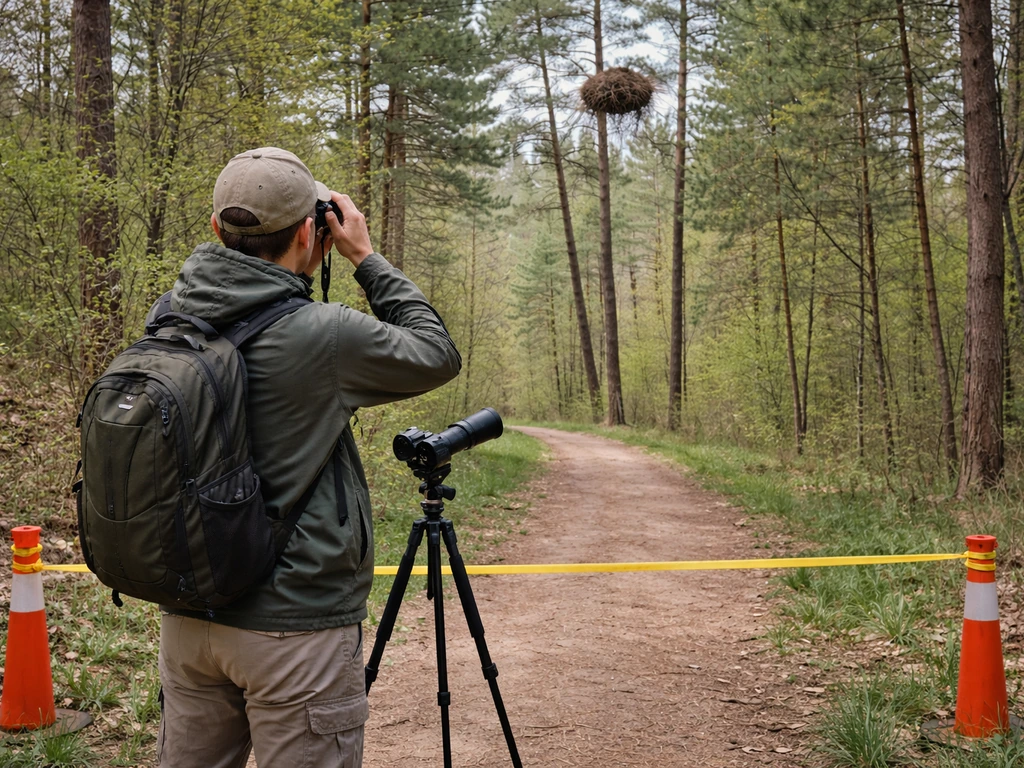
- Observe from a distance first. Use binoculars or a spotting scope. Do not walk under the nest or toward it. If you can confirm the nest from 50+ meters away, do that.
- Take photos with a zoom lens or phone zoom. Document the nest's width, the tree species, any whitewash, prey remains, and visible bird activity.
- Check for active use. Are adults present? Is there fresh green material recently added? Can you hear chick calls? Active nests get the highest level of legal protection.
- Contact your state wildlife agency or USFWS regional office before doing anything else on that part of your property. This is not optional if you plan any tree trimming, construction, or land clearing within a few hundred feet.
- Do not attempt to relocate, dismantle, or 'move' the nest yourself under any circumstances while it is active.
- If the nest appears old and completely abandoned (no fresh material, no activity for a full season), consult your state agency about whether removal is permissible. Some states require documentation of abandonment over multiple seasons.
Living with a giant nest nearby
If the nest is on your land and is active, the best outcome for you and the birds is a deliberate coexistence plan. Eagles that are not harassed regularly return to the same nest year after year, sometimes for decades. That consistency is actually an asset once you get past the initial surprise. Here is what works.
Minimizing disturbance without giving up your property
Time your property activities carefully. Mowing, light vehicle traffic, and yard work at a moderate distance are generally tolerated well outside the core nesting period. The most sensitive window is from nest initiation through fledging, roughly January to July depending on your latitude. If you need to do tree work anywhere near the nest tree, schedule it for late summer or fall after fledglings have left. Always stay well clear of the nest tree itself.
Avoid creating new attractants that could bring the eagles into conflict. Eagles sometimes take small pets or poultry. If you have chickens or small animals, a covered run is a practical solution during the active season. This is not about penalizing the eagles; it is about reducing the scenarios that lead property owners to feel the nest is a problem worth eliminating.
Making the habitat better for long-term nesting
Keeping large, mature trees intact near water is the single best thing you can do for nesting eagles. If you have dead snags nearby (which ospreys and eagles both use), leave them standing unless they pose a genuine structural hazard to buildings. Retaining natural shoreline vegetation rather than manicuring it to the waterline also supports the fish populations eagles depend on.
If you are curious how eagle nest-building compares to the precision engineering of smaller species, it is genuinely fascinating to read about which bird can weave a nest, since the contrast between brute stick-stacking and fine-scale weaving highlights just how varied avian construction strategies really are. On the opposite end of the size spectrum, which bird builds the smallest nest is a fun companion read that puts the eagle's record-setting scale in perspective.
Predator protection around the nest
Adult bald eagles are capable of defending their own nest from most predators, but raccoons can raid eggs and young chicks if they can reach the nest. The best passive protection is simply choosing not to do things that make the nest tree easier to climb: avoid leaving lumber, wire fencing, or ladders leaning against or near the nest tree, and do not encourage children or visitors to approach. In most cases, eagles site their nests in ways that naturally limit ground predator access, but your awareness helps.
Eagles are not the only large-nest builders whose chicks face predation pressure. What bird makes a messy nest covers species whose loosely constructed nests leave eggs and chicks more exposed, which is a useful contrast for understanding why the massive, deep eagle platform actually functions as a fortress rather than just a curiosity.
The beauty of a record-breaking nest
There is something genuinely awe-inspiring about a nest that takes decades to build and eventually grows heavy enough to topple a tree. Bald eagle eyries are the clear winner for the largest single-pair bird's nest by any reasonable measure, confirmed by the Guinness record at 2.9 m wide and 6 m deep. But the sociable weaver colony structure holds its own title for sheer communal ambition, and white storks prove that even medium-sized birds can build impressive platforms when given enough time and a stable anchor point.
If you find one of these giants on your property or in your local patch, treat it as the ecological landmark it is. Document it, respect the legal buffers, loop in your regional wildlife office, and enjoy having a front-row seat to one of nature's most impressive construction projects. For those who want to keep exploring what makes certain nests stand out aesthetically as well as structurally, the article on which bird makes the most beautiful nest is a great next stop.
FAQ
How can I tell what “biggest” means when I see claims online?
A “biggest nest” can be based on footprint, vertical depth, total volume, or total mass. If you are trying to name the bird from a single photo, the easiest practical rule is: look for the deepest, long-term reused stick platform that is lined with soft material (not a hanging structure), and then confirm with whitewash and prey debris below.
What if I cannot see eggs or chicks in the nest, is it still active?
If you see fresh green material (or vigorous add-on sticks) during the breeding season, assume it is active even if eggs are not visible yet. Eagles typically start refurbishing well before laying, so a “no eggs, no problem” assumption can be wrong.
Can bald eagle nests be huge but not active right now?
Yes, an enormous nest can look abandoned. If there is no fresh lining or newly added sticks, and the surrounding branches and ground show weathering rather than recent activity, it may be old. Still, treat it as potentially active until you confirm by timing and signs like active adult visits.
How reliable are whitewash and prey piles in bad weather or snow?
Snow and heavy rain can temporarily blur key clues like whitewash streaks and debris piles. In those cases, check the broader area for regular adult presence at consistent times, and look for stick-addition patterns higher up rather than relying only on what is on the ground after a storm.
What is the quickest way to distinguish an osprey nest from a bald eagle nest?
Ospreys can have large nests, but their lining and nearby debris often include water-edge items like fishing line, rope fragments, and kelp. If the debris under the nest is mostly fish bones and fur feathers with fewer tangled man-made strands, that leans toward an eagle in many real-world cases.
What if the “nest” looks hanging or woven instead of a platform?
If the structure is woven or dangling rather than a sturdy stick platform, it is less likely to be an eagle or osprey. Hanging woven nests are typically associated with other nest types (for example, suspended constructions in smaller passerines), so stop trying to force the “eagle nest” ID.
Is nest size alone enough to identify bald eagles?
Do not rely on size alone. A “large” nest could belong to another big stick-nester, or it could be a reused nest that looks bigger because it is built over time in a favorable tree fork. Combine size with nest placement (tall tree vs rooftop), lining material, and consistent adult behavior.
Does one brief visit count less than repeated disturbance, or can it still be a problem?
Yes, disturbances can be cumulative. Even if you stayed far once, repeated close approaches, loud equipment, or frequent traffic near the nest tree during the nesting season increases the risk of nest abandonment and legal issues under federal protections for active nests.
What should I do if I am uncertain whether the nest is active?
If you are unsure whether a nest is active, the safest approach is to treat it as active during the breeding season and maintain distance. Document from afar, avoid approaching for a better look, and contact your regional wildlife office for guidance rather than guessing.
What is a practical coexistence plan if the nest is on my land and I still need access?
If the nest is on your property and active, create a simple schedule: postpone tree trimming and heavy yard work until after fledging, keep foot traffic limited, and avoid letting pets or small animals roam near the area. If you must do something unavoidable, get wildlife guidance first and plan for a bigger buffer than the minimum whenever possible.
What should I do if I spot a giant nest in a park or near a walkway?
If you find it in a public area, do not manage the situation by moving branches, cordoning too close, or trying to deter the birds yourself. Instead, notify the site manager or local wildlife authority, because US protections and the correct buffer distances still apply in public contexts.
Next Article
Should I Let a Bird Build a Nest? What to Do Today
Decide if to let a bird nest, how to check activity, avoid disturbance, and handle conflicts safely and legally.