A bird nest is a structure built by birds to hold eggs and raise young, and they look wildly different depending on the species, location, and time of year. Some are tidy grass cups wedged into a shrub. Others are massive stick platforms on a chimney top, tiny depressions scraped in gravel, or elaborately woven hanging pouches swaying from a branch tip. If you found something and you're not sure whether it's a bird nest, this guide walks you through exactly what to look for, how to tell different nest types apart, and what to do once you've made the call.
What Does a Bird Nest Look Like? A Visual Checklist

Maya Bennett
13 Apr 2026
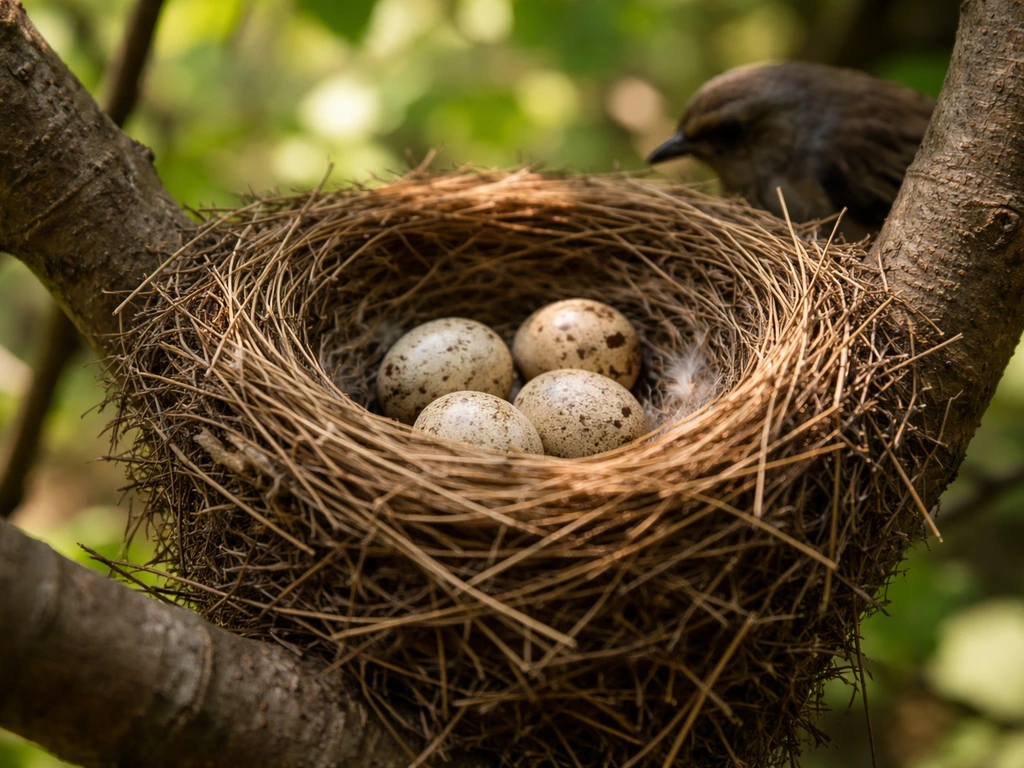
Quick visual checklist to spot a bird nest
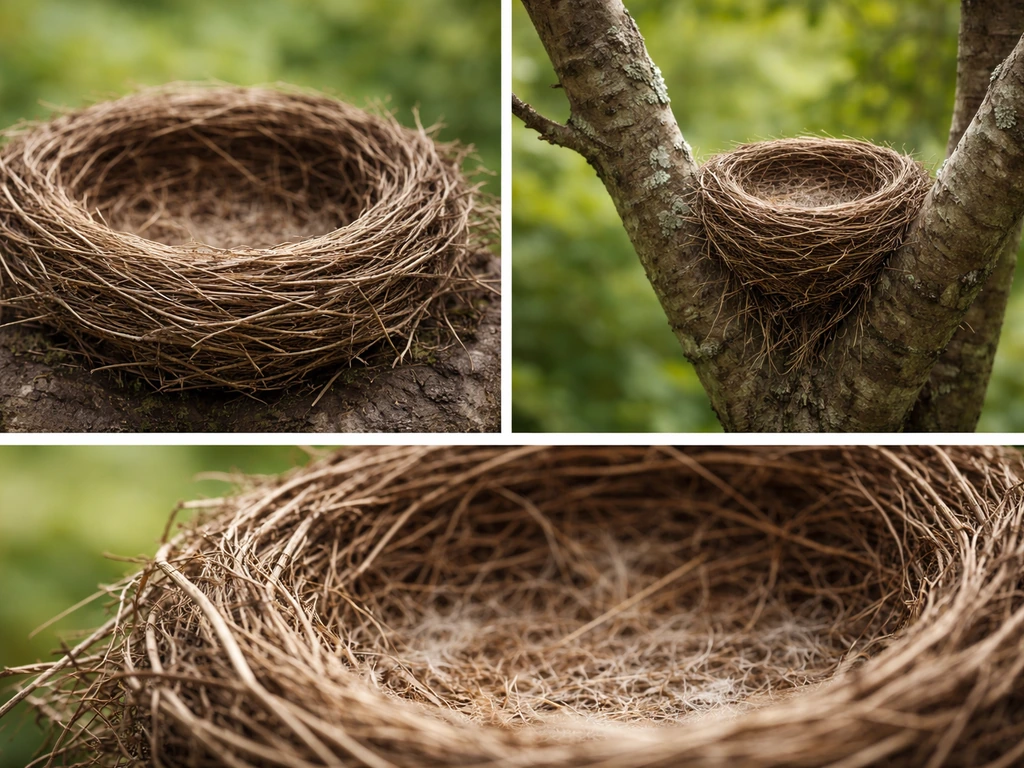
Before diving into nest types, run through this fast checklist. If you can check most of these boxes, you're almost certainly looking at a bird nest.
- Shape: Does it have a recognizable form, such as a cup, bowl, flat platform, dome, or pouch? Bird nests almost always show intentional shaping, not random clumping.
- Cavity or hollow: Is there a central depression, a hole in a tree or wall, or an enclosed chamber where eggs or chicks could sit protected?
- Materials: Do you see grass, twigs, moss, mud, bark strips, feathers, fur, or plant fibers woven or packed together? These are classic nest-building materials.
- Placement: Is it tucked into a branch fork, on a ledge, inside a tree hole, on the ground in a shallow scrape, or hanging from a branch tip? All of these are valid bird nest sites.
- Size: Nests range from a golf-ball-sized hummingbird cup (roughly 1.5 inches across) to a bald eagle platform that can exceed 6 feet wide and weigh over a ton after years of additions.
- Adult bird behavior nearby: Do you see birds landing on or near the structure repeatedly, carrying food, or acting agitated when you approach? This is the strongest active-nest signal.
- Eggs, chicks, or fecal matter: Visible eggs or nestlings confirm it immediately. White fecal sacs dropped near the nest base or a ring of droppings on a branch below the nest are also strong indicators of recent nestling feeding activity.
- Structural neatness vs. debris: A nest has purposeful construction. Random leaf litter or a tangle of windblown twigs usually lacks the layered or woven structure birds create.
Take a photo before you do anything else. A clear image helps you identify the species later and documents the nest's condition in case you need to report it or consult a wildlife authority.
Common nest shapes and where to find them
Nest structure and placement height vary enormously across species. Nests have been documented from several feet below the earth's surface (think burrowing owls) all the way up to 148 feet high in old-growth conifers where marbled murrelets nest. Here's how the main types break down by shape and location.
Cup nests

The classic bird nest shape. American robins are the textbook example: a mud-and-grass cup roughly 6 inches wide and 3 inches deep, usually set in a tree fork or on a building ledge. The inside is smooth-plastered with mud and lined with soft grass. Chickadee nests are also cup-shaped but smaller and packed with moss, fur, and plant down inside a tree cavity or nest box. Cup nests are the most common type you'll encounter in suburban yards.
Platform and stick nests
Platform nests are large, flat structures built either on the ground or high in trees and on man-made structures. American crows build looser, ramshackle stick platforms in tree crowns. Ospreys and eagles build massive stick-and-debris platforms on treetops, utility poles, or purpose-built nest platforms, sometimes adding to the same nest for decades until it weighs hundreds of pounds. If you're seeing a huge stick pile on a treetop or chimney, you're almost certainly looking at a platform nest.
Pendant and woven nests

These are the showstoppers. Pendant nests are elongated sacs woven from pliable plant fibers, grasses, and sometimes spider silk, dangling from the tips of branches where predators can't easily reach them. The Baltimore oriole's distinctive nest is a perfect example: a deep, sock-like pouch about 4 to 5 inches deep, woven from plant fibers and hair, swinging from the outermost branch of a tall tree. If you're curious about a particularly elaborate communal version of this idea, the sociable weaver bird builds a nest that's a massive, apartment-complex structure housing dozens of pairs. When you're wondering which bird nest looks like a hanging basket, pendant nesters like orioles and weavers are always the answer.
Cavity nests
Cavity nesters use holes in trees, wooden posts, or nest boxes. Primary cavity nesters like woodpeckers excavate their own holes. Secondary cavity nesters like bluebirds, titmice, and chickadees use holes that already exist. From the outside, a cavity nest looks like a hole, often with a smooth entry ring worn by repeated landings. Inside, you'll find a cup of soft material: moss, bark fiber, feathers, or fur. The entrance diameter gives you a useful species clue: a 1.5-inch hole almost certainly points to a small songbird, while a 3- to 4-inch opening could mean a screech owl or a flicker.
Scrape and ground nests
Scrape nests are the simplest type: a shallow depression scratched into bare soil, sand, gravel, or short vegetation, sometimes lined with a few pebbles, shells, or bits of plant matter. Killdeer, plovers, and many shorebirds use scrapes. You might walk right past one without noticing it, especially since ground-nesting birds often rely on camouflage rather than concealment. If you find what looks like a small, shallow bowl in open ground with speckled eggs inside, back away carefully and mark the spot so you don't accidentally step on it again.
Dome nests
Some birds build a fully enclosed cup with a roof, creating a dome or globe shape with a small side entrance. Marsh wrens and ovenbirds are classic dome nesters. These are often woven tightly from grasses or sedges and blended into surrounding vegetation, making them genuinely hard to spot. If you find a round, enclosed grass ball about the size of a softball, roughly 4 inches across, with a small side opening, you've found a dome nest.
Materials and construction cues
What a nest is made of tells you a lot about who built it. Birds typically layer their nests: a coarse outer framework, a mid-layer of finer material, and a soft inner lining. Here's what each layer often looks like.
| Nest layer | Common materials | What it looks like |
|---|---|---|
| Outer structure | Twigs, bark strips, coarse grass, mud, moss | Rough, irregular exterior; may look like a loose debris pile from a distance |
| Middle layer | Dry grass, leaves, plant stems, rootlets, paper, string | Denser, more woven or matted; gives the nest its shape |
| Inner lining | Feathers, animal fur, plant down, moss, fine grass, spider silk | Soft, pale, and smooth-looking; the cup itself is often noticeably cleaner than the outside |
| Adhesive/binder | Mud (robins), spider silk (hummingbirds), saliva (swifts), plant resin | May show as a dark, dried crust at the rim or base of the structure |
Hummingbird nests deserve a special mention because they're easy to miss. They're typically about 1.5 inches across, built with plant down and spider silk that stretches as the chicks grow, and covered on the outside with lichen flakes for camouflage. They look like a small lichen-covered knot on a branch. Finch nests are another common backyard find: tightly woven grass cups about 3 to 4 inches wide, often lined with feathers or fur, tucked into dense shrubs or conifer branches.
Construction quality varies a lot. Some nests are architectural marvels, symmetrical and tightly woven. Others look like someone tossed sticks at a tree and a few stuck. Crows, for example, build functional but messy-looking stick platforms that can seem almost accidental until you look closely and notice they're firmly anchored in the tree crotch.
How to tell bird nests apart from common look-alikes

Not every clump in a tree is a nest. Here are the most common things people mistake for bird nests, and how to tell the difference.
| Look-alike | Key differences from a bird nest | Quick ID tip |
|---|---|---|
| Squirrel drey (leaf nest) | Large, messy ball of leaves and twigs, usually 12+ inches across, high in a tree fork; no central cup or egg chamber | Much larger than most bird nests, made almost entirely of dead leaves; squirrels will often be seen using it |
| Wasp or hornet nest | Paper-like gray material, hexagonal cell structure visible if damaged, no soft lining inside; often teardrop or umbrella-shaped | The papery, layered appearance and lack of any soft lining or organic nest material are the giveaways |
| Debris pile / windblown litter | Random accumulation with no intentional shape, no central cup, no layering of materials | No hollow or depression; materials are scattered, not arranged; won't have feathers, fur, or fine lining |
| Mistletoe clump | Parasitic plant growing on a branch; green and leafy when alive, brown and tangled when dead | Has stems and leaves growing from it; birds may nest inside it but the plant itself is not the nest |
| Natural twig tangle | Branch breakage or storm damage creates random clusters; no binding material, no cup shape | Pull one twig gently: in a real nest, materials are woven or pressed together; a debris tangle falls apart immediately |
Wasp nests are probably the most important look-alike to get right before you go poking around. Paper wasps build open, umbrella-shaped combs under eaves; bald-faced hornets build large, enclosed gray paper globes that are 8 to 24 inches long. Neither has any soft lining or a central egg cup the way a bird nest does. If you see a gray, papery, layered structure and no birds visiting it, treat it as a wasp or hornet nest until proven otherwise.
Signs a nest is active vs abandoned
This is the most important determination you'll make, because it changes everything about what you're legally allowed to do. The key thing to know upfront: don't assume abandonment from a single observation. Adult birds may leave the nest for extended periods, especially early in the incubation cycle, and what looks like an empty nest in the morning may have a brooding adult on it by afternoon. NestWatch is emphatic on this point: activity can return after apparent gaps, and a premature conclusion of 'abandoned' is one of the most common mistakes nest observers make. NestWatch also recommends looking for birds carrying food and for white fecal sacs dropped away from the nest, since these strongly indicate feeding activity by nestlings watch for white fecal sacs dropped away from nests.
Here's what to watch for over at least two separate observation sessions, ideally across different times of day:
- Adults landing on or inside the nest, or hovering near it: the clearest active indicator you'll get.
- Adults carrying food (insects, worms, berries) toward the nest structure: confirms nestlings are present.
- Alarm calling or dive-bombing behavior when you approach: many songbirds and most ground nesters will scold or attack when you get within 10 to 30 feet of an active nest.
- Audible begging calls from inside: nestlings are loud. Put your ear toward the nest from a distance and listen.
- Fecal sacs dropped nearby: nestlings produce fecal sacs almost immediately after being fed, so a scattering of white droppings under the nest or on branches below it means chicks have been fed very recently.
- Visible movement inside: in open-cup nests, you may see small heads bobbing or wings stretching.
- Fresh nest material: if you see new grass, feathers, or mud being added, the nest is either under construction or being repaired between clutches.
Signs that lean toward abandonment include: a nest that is visibly deteriorated with collapsed walls or soaked through after a storm, eggs that are cracked or smell strongly (indicating decomposition), and zero adult activity observed across multiple sessions spanning several days with no begging calls or alarm responses when you approach. Even then, consult a licensed wildlife rehabilitator before taking any action, because what looks abandoned may still be a nest where adults are brooding quietly or feeding at intervals you haven't observed.
What to do after you identify a nest
Found a nest? Here's a practical decision path for what to do right now.
- Step back to at least 10 to 15 feet immediately. For ground nesters, 30 feet is safer. Your presence near the nest stresses the adults and can attract predators.
- Use binoculars to observe from a distance. Watching through binoculars whether adults approach to feed or attend the nest is far more informative than walking up close, and it doesn't disturb the birds.
- Take notes or photos. Record the nest's location (GPS or a written description), height off the ground, what it's made of, and any adult birds you see nearby. This helps with species identification later and documents the nest's condition.
- Do not touch, move, or add anything to the nest. Even well-intentioned interventions like repositioning a nest slightly or adding nesting material can cause adults to abandon it.
- Keep pets and children away. A dog's curiosity or a child running toward the nest is enough to flush a brooding adult on a hot day, which can be fatal for eggs.
- If the nest is in a spot where it will be disturbed (an area you need to access for maintenance), pause that work until the nesting cycle ends. Most songbird nesting cycles from egg-laying to fledging run 4 to 6 weeks.
- For basic predator protection, do not place deterrents on or touching the nest itself. If cats are a problem, a temporary wire cage placed 18 to 24 inches around a ground nest, open at the top for adult access, can help. Keep it simple and don't obstruct adult approach routes.
If the nest is in immediate danger (a tree is being cut, a window washer will be at that spot tomorrow), contact a federally permitted migratory bird rehabilitator in your area before anyone touches it. They are the only people legally authorized to handle eggs or nestlings from active nests. You can find licensed rehabilitators through the National Wildlife Rehabilitators Association or your state wildlife agency.
Legal and safety rules you need to know
The federal law baseline
In the United States, the Migratory Bird Treaty Act (MBTA) protects the vast majority of native bird species. Under federal law, a permit is required to destroy an active nest, meaning one that contains eggs or chicks. This applies to homeowners, contractors, and anyone else. If you disturb an active nest without authorization, you may be violating federal law regardless of whether the nest is in an inconvenient location. If you have specific questions about permitted activities in your situation, the U.S. Fish and Wildlife Service recommends contacting your regional Migratory Bird Permit Office directly. Under 50 CFR § 21.12, if an active nest with eggs or nestlings must be removed, you are required to seek the assistance of a federally permitted migratory bird rehabilitator.
State laws add another layer. Massachusetts law, for example, prohibits taking, disturbing, or destroying nests or eggs of birds with narrow exceptions for certain non-native species like European starlings and house sparrows. Florida's Fish and Wildlife Conservation Commission no longer issues active nest removal permits for non-listed species at the state level, meaning a federal MBTA permit from USFWS may still be required. Check your state's wildlife agency website for local rules, because they vary and can be stricter than the federal baseline.
Health and safety around nests
Bird droppings can harbor Histoplasma capsulatum, the fungus that causes histoplasmosis, a respiratory infection. The risk increases significantly when droppings are disturbed and dust becomes airborne, which is most likely when you're cleaning up old nest sites or working in areas where droppings have accumulated over time. If you're dealing with a small, contained nest site, basic precautions (an N95 mask, gloves, and keeping the area damp to reduce dust) are usually adequate. If you're facing a large accumulation of old droppings, the CDC recommends calling in a professional company that specializes in hazardous waste cleanup rather than handling it yourself.
Always wash your hands after any contact with nest material, droppings, or soil near nest sites. Don't handle dead birds or eggs with bare hands. And don't clean up old nest material during the nesting season without first confirming the site is truly inactive.
When to call a professional
Call a licensed wildlife rehabilitator or your state wildlife agency when: an active nest is in a location that creates an urgent safety hazard that can't wait out the nesting cycle; you find injured or orphaned nestlings on the ground; you're unsure whether a nest is active and the stakes are high (e.g., a contractor is coming tomorrow); or you're dealing with a large accumulation of droppings that requires professional remediation. Do not call a general pest control company for an active native bird nest. They are not licensed to handle it, and removing an active nest without authorization creates legal liability for whoever orders the work.
Your practical decision path: is it a nest, is it active, what now?
- Does it have a recognizable shape (cup, dome, platform, pouch, scrape, or cavity) with intentional construction? If yes, it's likely a bird nest. If no, check the look-alike guide above.
- Is it made of organic materials like grass, twigs, mud, feathers, or plant fibers? If yes, bird nest. If it's papery and gray with no soft lining, consider wasp or hornet nest and back away.
- Are birds visiting it, or do you see eggs, chicks, fecal sacs, or hear begging calls? If yes, it's active. Do not touch it. Keep distance. Pause any work nearby.
- Are you unsure if it's active? Observe from a distance with binoculars across at least two sessions before concluding it's abandoned. If still unsure, treat it as active.
- Is it confirmed active and in immediate danger? Contact a federally permitted migratory bird rehabilitator before anyone touches it.
- Is it confirmed inactive (no activity over multiple days, deteriorated structure, no eggs or chicks)? You can generally remove it after the nesting season, but check your state rules first and use basic hygiene precautions.
- Are you dealing with a large droppings accumulation or health concern? Contact a professional hazardous waste company. Don't disturb the site yourself.
FAQ
How can I tell if something is a bird nest versus just a pile of twigs?
If you just want to confirm the object is a nest, look for a consistent “home” structure, not just a pile. Bird nests usually have a built cavity or lining (mud, moss, feathers, or plant down) and are placed in a species-typical spot (tree fork, ledge, cavity, or hanging from a branch tip). Random twigs with no inner cup, lining, or egg-safe depression is less likely to be an active bird nest.
What counts as proof that a nest is actually abandoned?
Use a “no contact, no assumption” rule. Birds can be absent from the nest for hours, especially outside peak feeding times, and still be active. Instead of checking once, observe from a distance at two different times of day (for example, morning and late afternoon). If you see no adults and no alarms over multiple sessions across several days, the odds increase, but uncertainty still warrants contacting a licensed rehabilitator.
Can an old-looking nest still be in use?
Yes. Many nests continue to be used or enlarged over time, especially stick platforms made by crows, eagles, and ospreys. Even if it looks old or messy, it can still contain a current brood, or it may be reused later in the year. Treat large stick structures on treetops and man-made platforms as possibly active until you confirm with observation.
How do I confidently distinguish a bird nest from a wasp or hornet nest?
Look for the outer materials and how they function. Wasps and hornets often build papery combs or enclosed gray paper globes with a layered texture, and you typically will see frequent insect traffic. Bird nests, even when loosely built, usually incorporate an egg-safe inner lining like mud, moss, fur, feathers, or plant down, and bird presence is what drives activity around the structure.
I found a shallow depression on the ground, how can I tell if it is a scrape nest with eggs?
Ground scrapes and dome nests can be extremely hard to spot because the “structure” can be just a shallow depression or a well-camouflaged woven ball. If you see speckled eggs in open ground, do not move them or the surrounding materials. Back away, mark the spot for yourself, and keep people and pets away until you can confirm what species is nesting there.
If there were nests here before, can I assume the site is empty now?
In many cases, birds may reuse nest sites within the same general area, but species and timing matter. A site that was used last year can be empty right now, but it can also be occupied again depending on the species. Before cleaning or modifying anything, confirm whether birds are currently bringing nest material or show consistent adult activity around that specific site.
What should I do if I disturb a nest accidentally?
If you accidentally bump the nest site, minimize further disturbance and keep watch from a distance. Avoid repeated visits, shining lights directly at it, or trying to “fix” damage. If eggs or nestlings are injured, or if you suspect it is active and safety requires immediate action (for example, a contractor is scheduled), contact your state wildlife agency or a federally permitted migratory bird rehabilitator for guidance.
Is it dangerous to clean up old bird droppings under a nest?
Droppings cleanup is the main additional risk people miss. If there is heavy buildup of old nest droppings, avoid sweeping or dry wiping because it can aerosolize dust. For small, contained amounts, dampening the area and using an N95 mask plus gloves can reduce exposure, but large accumulations are better handled by a professional hazardous waste cleanup company.
Can the size of a cavity entrance reliably identify the bird species?
Yes, and it matters. A cavity entrance size can give strong clues, but for legal and safety decisions you still should not assume the species or activity based on the entrance alone. If you need to manage an issue near a cavity nest in a tree or a structure, confirm current activity with observation and then contact the appropriate wildlife authority if access is required.
If the nest looks damaged after a storm, is it still safe to treat it as active?
A nest can be intact but still be active, so “looks ruined” is not always a reliable indicator. Storm-damaged nests sometimes remain in use, and eggs can be present even if the nest looks collapsed from the outside. When the stakes are high (construction, removal work, or uncertainty about activity), treat it as active until you have a professional determination.
Next Articles
Should I Let a Bird Build a Nest? What to Do Today
Decide if to let a bird nest, how to check activity, avoid disturbance, and handle conflicts safely and legally.
Can You Make a Nest for a Bird? Safe, Legal Steps
Learn safe, legal ways to help birds nest with proper materials and nest boxes, avoid active nests, and prevent harm.
Who Teaches a Bird to Make a Nest, and What You Can Do
Birds nest by instinct, not human training. Find who to contact and how to help nests safely and ethically.