
The most likely bird making a mud nest near your home right now is a barn swallow, cliff swallow, or eastern phoebe. All three use mud as a primary building material, but the shape, size, and placement of the nest tell you exactly which one you're dealing with. Here's how to figure it out quickly and safely.
What Bird Makes a Mud Nest? Identify and Handle Safely

Maya Bennett
9 Apr 2026

Quick ID: Common Birds That Build Mud Nests
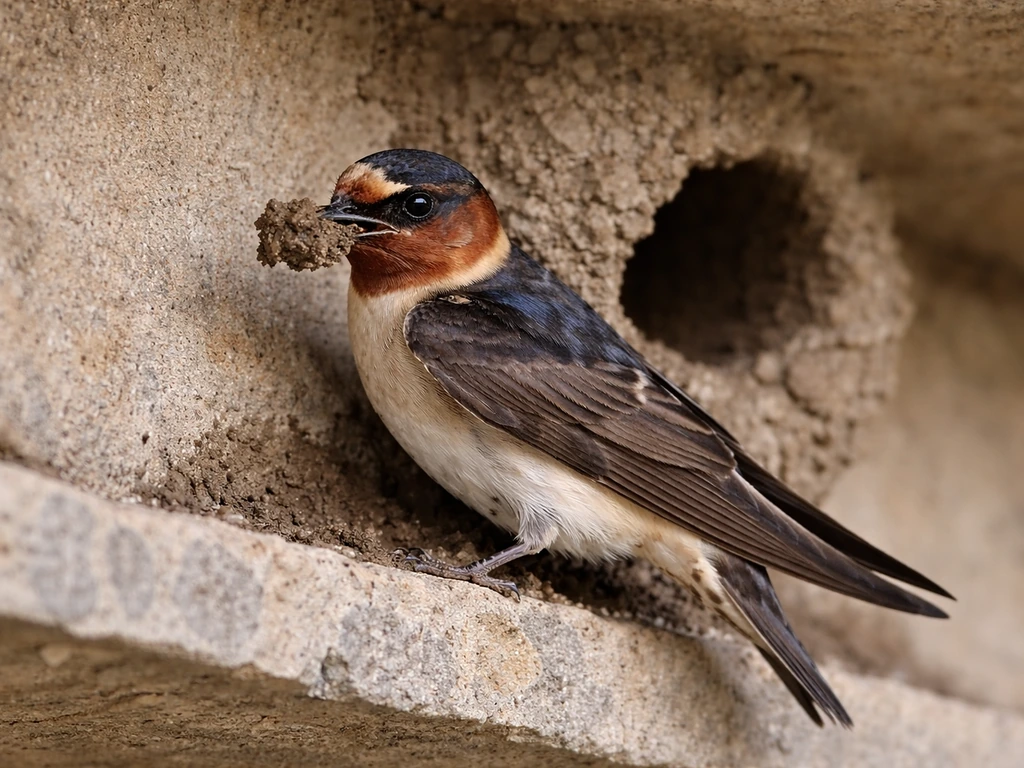
Three species account for the vast majority of mud nests people find on or around buildings and natural structures in North America. A fourth group, bank-style swallows, uses muddy or sandy banks but doesn't build a classic mud cup you'd spot on a wall.
- Cliff swallow (Petrochelidon pyrrhonota): builds a fully enclosed, gourd-shaped mud nest using 900 to 1,200 individual mud pellets. Found in colonies under eaves, on cliff faces, and under bridges.
- Barn swallow (Hirundo rustica): builds an open half-cup of mud pellets layered with grass stems, then lined with feathers. Typically plastered onto a ledge, beam, or wall under an overhang.
- Eastern phoebe (Sayornis phoebe): builds a smaller open cup with a solid mud base combined with moss and leaves, roughly 2.5 inches across and 2 inches deep. Usually solitary, often on a ledge near water.
- Bank swallow and northern rough-winged swallow: excavate or use burrows in earthen banks rather than attaching a mud structure to a surface. You won't find their nests stuck to your barn wall.
Chimney swifts are worth mentioning here because people sometimes confuse them with swallows. Swifts build a tiny half-saucer nest inside chimneys using only twigs glued together with saliva, not mud at all. If the nest is inside a chimney and has no mud, you're looking at a swift.
Mud-Nest Shape Clues: Round vs. Other Forms
Shape is your fastest ID tool when you're looking at a mud nest from a distance. The cliff swallow nest is the most distinctive: it's fully enclosed and shaped like a retort or gourd, bulging out from the wall with the entrance hole near the bottom. Audubon Field Guide describes the cliff swallow nest as dried mud shaped like a gourd, with a large chamber and a small entrance on the side. That entrance may have a short tube extending outward, sometimes up to about 2 inches long. The whole structure is made of pure mud pellets with very little organic material mixed in, which gives it a smooth, grainy appearance compared to other nests.
A barn swallow nest looks completely different. It's an open half-cup, more like a mixing bowl cut in half and pressed against a vertical surface. You can see the eggs or chicks from below because there's no roof. The mud pellets are visible on the outside, but if you look closely you'll also see horizontal layers of grass stems running through the mud, which is a barn swallow signature that cliff swallow nests lack.
An eastern phoebe nest is smaller and sits on a ledge rather than being cemented to a vertical wall face. The base is solid mud, but the upper walls are built from moss and leaves rather than packed mud pellets. It often looks mossy or greenish from the outside. If you're curious about other species that use organic materials as the star of the show, there's a great comparison in this guide on what bird uses moss to build a nest, which covers the moss-first builders in detail.
| Species | Shape | Mud Use | Key Visual Clue |
|---|---|---|---|
| Cliff swallow | Enclosed gourd/retort | Pure mud pellets, 900-1,200 pellets | Bottom entrance, sometimes with a short tube; fully enclosed |
| Barn swallow | Open half-cup | Mud pellets layered with grass stems | Open top, grass visible in mud layers, lined with feathers |
| Eastern phoebe | Open cup on ledge | Solid mud base only; moss/leaves above | Mossy green exterior, smaller (2.5" wide x 2" deep) |
| Bank/rough-winged swallow | Burrow interior cup | No attached mud structure | Nest hidden inside an earthen bank or crevice |
Nesting Materials and Placement: Walls, Ground, Reeds, and Cavities
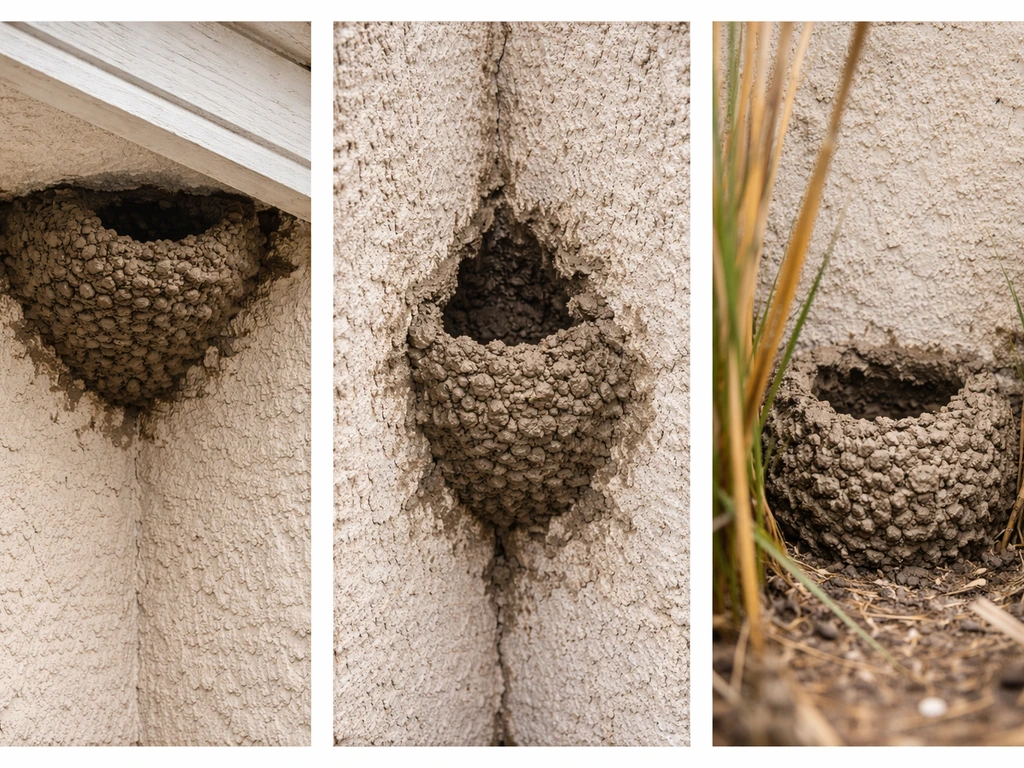
Where the nest sits is almost as useful as how it looks. Cliff swallows and barn swallows both favor man-made structures, but their attachment points differ. Cliff swallows plaster their gourd-nests onto shaded vertical surfaces: blank" rel="noopener noreferrer">the underside of bridge decks, the upper corners of barn interiors, cliff overhangs, and the eaves of buildings. They're colonial, so if you see one, expect dozens nearby. When cliff swallows encounter a structure that already has an opening or crevice, they sometimes build a mud front across the face with their characteristic entrance tunnel built right over the gap.
Barn swallows also use bridges and buildings but prefer to sit their nests on a horizontal ledge or beam rather than purely on a vertical face. Inside barns, rafters and crossbeams are prime real estate. Under bridges, they use concrete ledges. The nest is always exposed from above, which is how the lining of grass and feathers stays visible.
Eastern phoebes almost always choose sites near water: under a bridge, on a ledge inside a culvert, under an overhang above a creek, or on a porch near a pond. They're solitary nesters. The mud-based cup sits directly on the ledge surface rather than being cemented to a vertical wall.
Bank swallows and northern rough-winged swallows nest in burrows. Bank swallows colonize steep river cliffs, lake shores, sand pits, and road cuts, excavating tunnels into the bank face. Northern rough-winged swallows tend to use existing cavities in clay or gravel banks rather than digging fresh tunnels, with some cavities reaching about 40 inches deep, lined with grasses and twigs. You won't mistake these for eave nests, but it's worth knowing about them if you're searching a riverbank rather than a building. For a broader look at nesting strategies that don't involve mud at all, the article on what bird builds a nest with sticks covers the other major building approach.
Region and Season: Where to Look and When
All three main mud-nest builders are migratory, and timing matters a lot. Cliff swallows arrive in the northern U.S. roughly in April, with Nebraska arrivals typically falling around April 16 to 18, and they don't reach Alaska until May. They migrate south again mainly in August and early September. If you're in the northern states in mid-April right now, fresh cliff swallow mud nests are actively being built as you read this.
Eastern phoebes arrive earlier than swallows. In the southern U.S., breeding can start as early as mid to late March. In the northern U.S. and southern Canada, nesting typically gets going in mid to late April. Phoebes are one of the first insect-eating migrants to return in spring, so if you found a mud nest in early March in the South or early April in the North, a phoebe is the most likely candidate.
Barn swallows have a wide breeding range across most of North America and are present through summer into early fall. They tend to arrive slightly later than phoebes and build quickly once they settle on a site.
Regionally, cliff swallows are most common in the West and Great Plains but range across most of the continent near cliff faces or open country with structures to use. Barn swallows are nearly ubiquitous wherever there are open areas and structures. Eastern phoebes are primarily an eastern and central species. If you're in the Pacific Northwest and find a mud nest, cliff swallow or barn swallow is far more likely than phoebe.
How to Confirm Without Disturbing the Nest

The best identification tool you have is a pair of binoculars and a phone camera with a zoom lens. NestWatch's code of conduct is clear: observations should never jeopardize bird well-being, and in most cases it is illegal to touch or physically disturb an active nest or its contents. The goal is to gather information from a comfortable distance so that adults don't flush off the nest.
- Set up at least 15 to 20 feet away and use binoculars or a camera zoom to examine the nest structure. Note the shape (open cup vs. enclosed gourd), the surface texture (smooth mud vs. mud with visible grass), and the entrance location.
- Watch for adult birds coming and going. Swallows are fast and acrobatic in flight; phoebes are slower and pump their tails up and down, which is an easy field mark. Note the bird's body size relative to the nest entrance.
- Check whether nesting is colonial (multiple nests close together, constant swallow traffic) or solitary (one quiet cup, one pair of birds). Colonial = swallow, almost certainly cliff swallow if the nests are enclosed.
- Photograph the nest from multiple angles if possible: side profile for shape, underneath for entrance location, and close-up for texture. These photos are invaluable if you later need to consult a local expert or wildlife agency.
- Note the substrate: Is the nest cemented to a vertical concrete or wood surface? On a horizontal ledge? Inside a burrow? This alone can rule out two or three species instantly.
NOAA's wildlife viewing guidelines reinforce that adults leaving the nest is your clearest sign of disturbance. If the bird flies off every time you approach, back up further. Your documentation does not require getting close. Many people also find it helpful to sketch a quick diagram: draw the wall or ledge, mark the nest position, and note the entrance direction. This kind of field note is surprisingly useful when you're comparing your find to species profiles later. If you're still uncertain what you're looking at after all this, the article on what bird made this nest walks through a broader identification framework.
What to Do If You Find a Mud Nest on Your Property
Know the Law First
All swallows and eastern phoebes are protected under the Migratory Bird Treaty Act (16 U.S.C. § 703). The law prohibits taking, killing, or possessing these birds and also covers their nests and eggs. This is not a technicality, it's an active federal protection. Removing or destroying an occupied mud nest without a permit is illegal. The U.S. Fish and Wildlife Service handles migratory bird permits, and they're the right call if you genuinely need to remove a nest from a safety-critical location. Contact your regional USFWS Migratory Bird Permit Office before touching anything.
Some activities don't require a permit, but the threshold is narrow. USFWS has a list of authorized activities that are allowed without a permit, but it's specific and worth reading carefully before assuming your situation qualifies. When in doubt, call the permit office directly.
Active vs. Inactive Nests
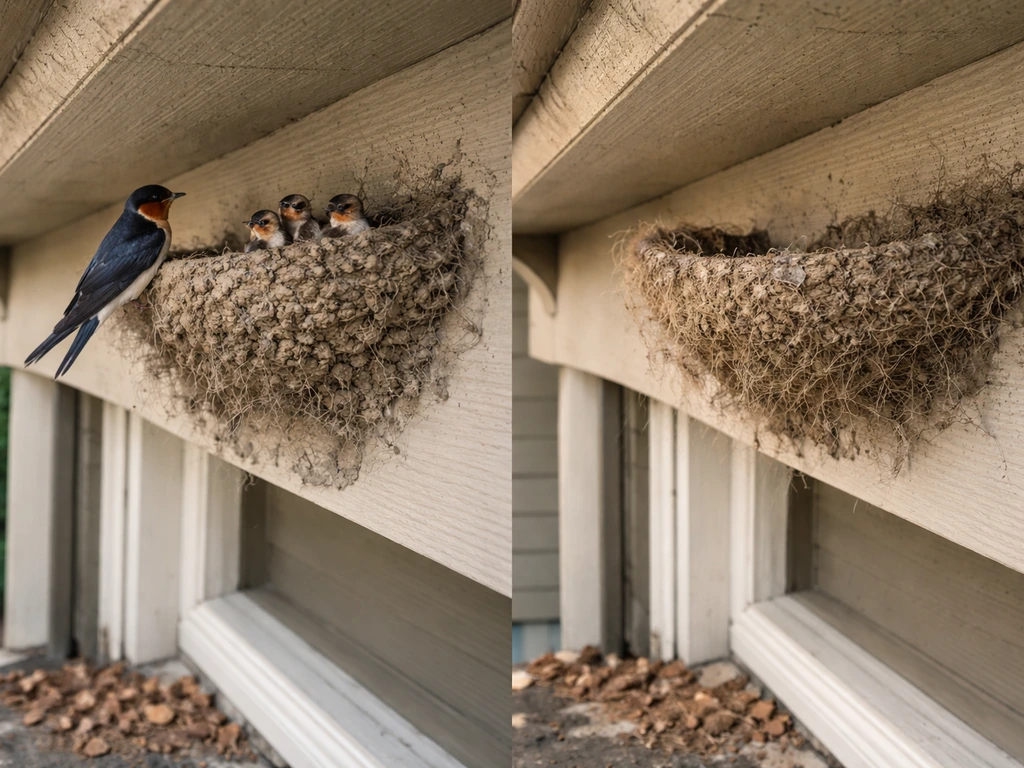
An active nest is any nest that has eggs, chicks, or adults that are clearly using it right now. An inactive nest is one that has been fully abandoned after the breeding season. The practical and legal calculus is completely different between the two. If eggs or chicks are present, leave the nest alone. Period. Even if it's in an inconvenient location, wait until the breeding cycle is complete, which is typically 4 to 6 weeks from egg-laying to fledging for swallows.
Safety Considerations
Mud nests on walls or under eaves rarely pose structural risks, but there are legitimate concerns. Large cliff swallow colonies can create a significant volume of droppings beneath the nest site, which can be a slip hazard and creates cleanup work. If the nest is directly over a door that people use constantly, mark the area with temporary barriers during the active nesting period rather than disturbing the nest. After the season, clean the area thoroughly.
Relocation Ethics
Relocating an active mud nest is almost never successful and is generally not worth attempting. Swallows in particular have strong site fidelity and will often return to the same spot the following year regardless. If a nest is in an inactive state and you must move it, document everything, consult USFWS first, and understand that birds are unlikely to use a relocated structure. The USFWS Migratory Bird Permitting Handbook explains the relocation permit categories if you want to understand what's formally authorized.
Practical Troubleshooting: Attracting or Discouraging Mud-Nest Birds Ethically
If You Want to Encourage Nesting
Barn swallows and cliff swallows are insect specialists and consume enormous numbers of flying insects, including mosquitoes. Having them nest near your property is genuinely beneficial. To encourage them, keep access open to barns, sheds, or outbuildings through the spring. Provide a muddy water source (a shallow puddle near a path, a low-sided tray with wet soil) during April and May when birds are actively collecting mud pellets. Cliff swallows can build a complete gourd nest in just a few days when mud is plentiful. Eastern phoebes are attracted to ledges near water, so a wooden beam or shelf installed under an overhang near a pond or stream is often used within a season or two.
If You Need to Discourage Nesting in a Specific Spot
The only ethical and effective time to act is before nesting begins. Once a nest is active, your options are legally limited. Before birds arrive in spring (by late March in the South, early April in the North), you can use physical exclusion: hang polyethylene netting or bird-deterrent spikes on the specific ledge or surface you want to protect. These don't harm birds; they just prevent attachment. Smooth surfaces are also harder for birds to cement nests onto, so applying a slick sealant or plastic sheeting to problem areas before arrival is a low-effort prevention.
For cliff swallow colonies, one management concept worth knowing is that knocking down old, empty nests after the breeding season (and before house sparrows can roost in them over winter) can reduce the appeal of the site for returning colony members the following spring. This is a post-season action only and is consistent with legal guidelines since the nests are inactive. It won't guarantee birds won't return, but it removes the structural scaffold they'd otherwise build on.
Never use chemical repellents, sticky substances on nest surfaces, or anything that could contact or harm birds directly. These approaches often cause injury and can violate federal law. If you're dealing with a complex colony situation and want to understand the full range of tools, the Florida Fish and Wildlife Conservation Commission recommends contacting the USFWS Region 4 Migratory Bird Permit Office (or your relevant regional office) to clarify what's permitted before taking any action.
It's also worth knowing that mud isn't the only unusual building material birds work with. If you've spotted another nest nearby that looks woven together or stitched from leaf material, check out this article on which bird stitches leaves to make its nest, which covers tailorbirds and similar species. And if the nest near your mud nest appears to be held together with something silky, it may be spider silk rather than mud, a strategy described in detail in the guide on which bird makes its nest even with spiders cobwebs.
Predator Protection for Active Nests
If you've decided to support a mud nest on your property and want to protect it from predators, the safest approach is indirect. Trim back any branches that give squirrels or snakes a direct route to the nest. Install a cone-shaped baffle on any vertical post or pipe supporting a structure near the nest. For nests under eaves, there's rarely a practical climbing route for ground predators, but starlings and house sparrows can harass swallow colonies by trying to claim nests. Regularly checking the area and shooing away nest-claiming intruders during the early season is helpful.
For readers curious about other nest types found on or near the ground in similar habitats, the article on which bird makes its nest of pebbles and the overview of which bird sews a nest out of leaves round out the picture of nest diversity you might encounter in the same area. And if you want to compare all the construction approaches side by side, including tailorbirds, weavers, and the more structural builders, the piece on which bird stitches leaves to make its nest is a useful companion.
Do This Right Now: A Quick Action Checklist
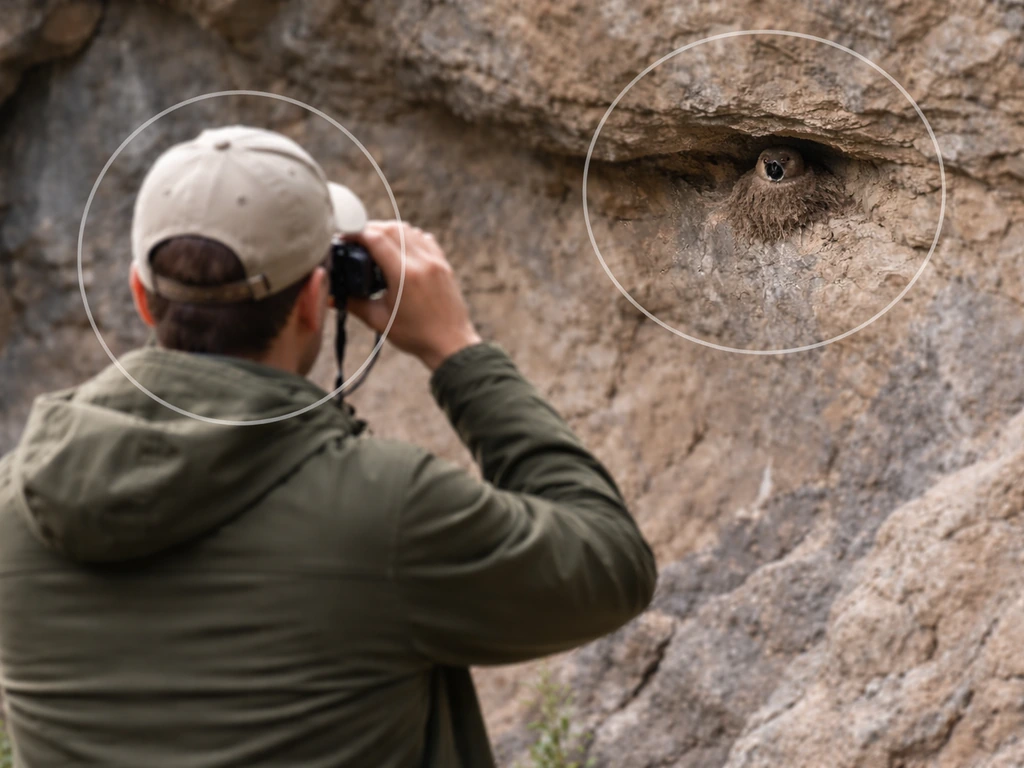
- Stand back at least 15 to 20 feet and observe the nest with binoculars. Don't approach close enough to flush adults.
- Check the shape: enclosed gourd (cliff swallow), open half-cup with grass in mud (barn swallow), or mossy open cup on a ledge (eastern phoebe).
- Check the location: vertical wall face under an eave or bridge, horizontal ledge near water, or earthen bank burrow.
- Watch the adult bird's behavior: tail-pumping means phoebe, fast acrobatic flight means swallow, colonial traffic means cliff swallow.
- Photograph the nest from at least two angles for your records.
- Determine whether the nest is active (eggs/chicks/adults present). If yes, leave it completely undisturbed.
- If the nest is in a problematic location and is active, mark the area for human safety (temporary barriers, signage) and wait for the breeding cycle to complete before taking any action.
- If you need to remove a nest for a legitimate safety reason, contact your regional USFWS Migratory Bird Permit Office before touching anything.
- If you want to prevent nesting next season, plan your physical exclusion measures for late winter, before birds return in spring.
- Keep a simple log: date observed, nest shape, location, bird behavior, and photos. Share with a local Audubon chapter or birding group if you want expert confirmation.
Mud-nest builders are among the most architecturally impressive birds in North America, and finding one near your home is genuinely worth appreciating. Whether it's a cliff swallow meticulously pressing a thousand individual mud pellets into a gourd, a barn swallow layering grass into a half-cup on your barn beam, or a phoebe quietly cementing a mossy cup to a bridge ledge, you now have everything you need to identify the species, document it safely, and handle the situation correctly. If you're still puzzling over a nest that doesn't match any of these descriptions, it might be time to look at less common building strategies, like the weaving approach covered in the guide on which bird sews a nest out of leaves, which might point you toward an entirely different family of builders.
FAQ
How can I tell a chimney swift nest from a mud nest if I can’t get a close look?
A quick clue is whether the nest is plastered to a wall or ledge and made of compacted pellets (swallows, phoebes) versus placed inside a chimney with a twig-only structure glued with saliva (chimney swift). If you can see any mud pellets on the outside or a mossy upper layer, treat it as a mud-nest builder rather than a swift.
What if I can’t see eggs or chicks, but I’m not sure whether the mud nest is active?
If the birds are still coming and going, or you see fresh mud work, droppings appearing beneath the site, or active feeding, assume it is active even if you do not see eggs. In that case, back off and wait, because “inactive” requires clear evidence of abandonment after the season.
Can weather or lighting make one mud nest look like another, and how do I reduce misidentification?
Avoid relying on color alone. Cliff swallow nests are usually smooth and grainy from pellet mud, while barn swallows often show distinct horizontal grass stems embedded in the mud. Eastern phoebe nests often look mottled or mossy because the upper walls are built with moss and leaves.
What’s the fastest way to distinguish a cliff swallow mud nest from a barn swallow mud nest from a distance?
If the entrance tunnel and the fully enclosed gourd shape are present, it is almost certainly a cliff swallow, not a barn swallow. Barn swallow nests are open from the top and you can typically view the contents from below, while cliff swallow nests remain enclosed with the hole near the bottom.
What should I do if the nest is over a doorway people must use (and I want to stay legal)?
For barn swallows, management that does not disturb the nest matters most. Use temporary barriers to protect people and avoid working directly under the nest during the nesting window, then clean afterward. If the problem is on a beam you want to keep, use pre-arrival exclusion in the next season rather than touching an active nest.
Is an “empty-looking” mud nest always safe to remove?
If you see an old nest structure that appears empty, treat it as a potential returning site, especially for cliff and barn swallows. The safer approach is to mark the area and plan one post-season cleanup only after the breeding period ends, then recheck early the following spring for any repairs or reuse.
Why shouldn’t I relocate a mud swallow nest, even if it seems inactive?
Relocation usually fails because swallows show strong site fidelity and will often rebuild at the original location. Even if you move the material, they may reject it and return anyway, which can increase disturbance and safety/legal risk. The practical move is prevention before arrival, or professional guidance through the permit process if truly necessary.
When is the best time to use exclusion (netting or deterrent spikes) for mud-nesting swallows?
Timing matters because exclusion works only before birds attach. In the North, start prevention in early April or earlier depending on local arrival, and in the South you may need late March. If you miss the window and the nest is active, your options tighten sharply, so confirm timing before acting.
What are the safest predator-deterrent options if the nest is near a garage or garden?
If you’re trying to protect the site from predators, focus on access control rather than bait or contact products. Trim branches that provide a direct route, and install a cone-shaped baffle on vertical supports near the nest, because these reduce climbing without harming birds.
What are common mistakes people make when trying to identify a mud nest by appearance alone?
Yes, a mud-nest species can be misread if someone introduced another material. Common mistakes include mistaking mud mixed with grass stems for mossy phoebe material, or assuming any enclosed gourd is mud when it might be a different bird’s nest. Use both structure (enclosed vs open) and building texture (pellets, grass layers, mossy upper walls) together.
How do I handle the mess and slip hazard under a large cliff swallow colony without harming birds?
Barn swallow and cliff swallow colonies can create heavy droppings under nesting sites, which can be a slip hazard and cleaning burden. The least disruptive approach during active nesting is to cordon off only the direct drop zone with temporary barriers, then clean thoroughly after fledging.
Next Articles

Should I Let a Bird Build a Nest? What to Do Today
Decide if to let a bird nest, how to check activity, avoid disturbance, and handle conflicts safely and legally.
Can You Make a Nest for a Bird? Safe, Legal Steps
Learn safe, legal ways to help birds nest with proper materials and nest boxes, avoid active nests, and prevent harm.
Who Teaches a Bird to Make a Nest, and What You Can Do
Birds nest by instinct, not human training. Find who to contact and how to help nests safely and ethically.