
You can remove a bird nest safely and legally, but the answer hinges on one thing: whether the nest is active. If there are eggs or chicks inside, federal law almost certainly prohibits you from touching it. If it's empty and the breeding season is over, you can typically take it down yourself with a few basic precautions. Everything else, the bird species, the materials, the location, flows from that single starting question.
How to Remove a Bird Nest Safely and Legally

Maya Bennett
9 Apr 2026
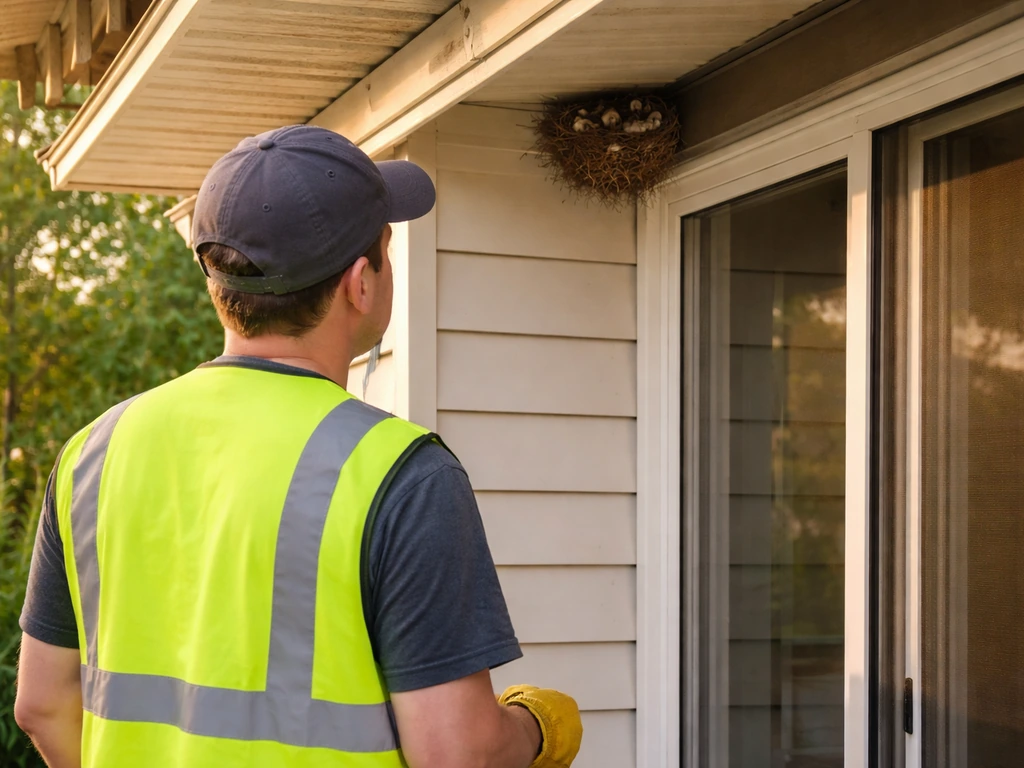
Quick check: is the nest active and are there eggs?
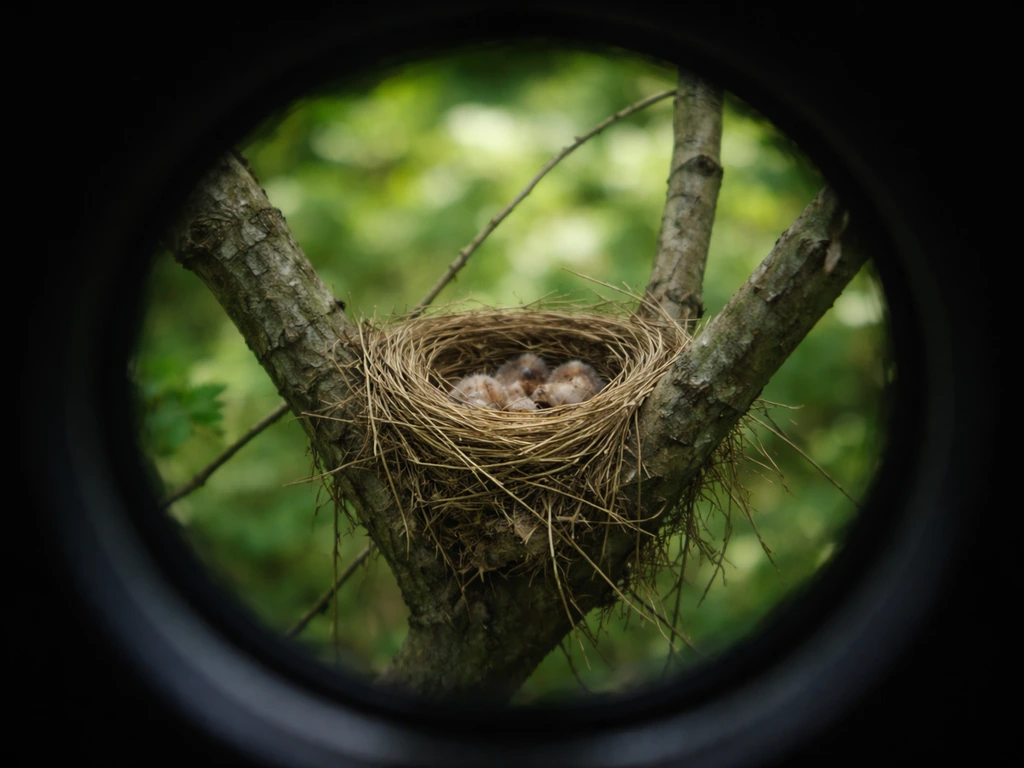
Before you do anything else, figure out what you're actually dealing with. An "active" nest, in the legal and biological sense, means one that currently contains eggs or live chicks. It also includes a nest where adults are still incubating or actively brooding. A nest that looks built but is empty may or may not be active, because some species line the nest days before laying begins.
Use binoculars or your phone camera with zoom to observe from a distance. Cornell Lab's NestWatch program specifically recommends monitoring difficult-to-reach nests from the ground with binoculars or a camera rather than climbing up and disturbing them to get a look. If you see an adult sitting in the nest for extended periods or returning regularly with food, treat it as active. If the nest looks freshly built with no adults visiting over 24 to 48 hours of observation, it may be abandoned or pre-laying.
- Active nest: contains eggs, chicks, or a brooding adult that returns consistently
- Abandoned nest: no adult visits in 48+ hours, no eggs or young visible, nest may look weathered or damaged
- Pre-laying nest: freshly built, no eggs yet, adults still visiting and adding material
- Old nest: clearly from a previous season, dried out, possibly with insect activity or structural collapse
When in doubt, wait and watch. Taking a photo with a timestamp each day for two or three days is the simplest way to document what's happening without putting yourself or the birds at risk.
Identify the nest type and bird/material clues
You don't need to be an ornithologist, but knowing roughly what built the nest tells you a lot about what you're allowed to do and what to expect next. Nest construction materials are one of the best quick clues. Mud nests on your eaves or rafters, often cup-shaped with a smooth interior, are typically the work of barn swallows or cliff swallows, both of which are migratory and fully protected. Smithsonian Gardens describes these as classic "urban mud nests," and you'll notice the dried mud has a rough exterior but a neatly lined cup inside. Smithsonian Gardens also identifies barn swallow, cliff swallow, and cave swallow as birds that build mud nests, describing these as “urban mud” nests on structures.
A nest made of small twigs, straw, bark strips, and green leaves lining the bowl is a strong indicator of purple martins, according to the Purple Martin Conservation Association. They also tend to nest in colonies in birdhouses or gourds rather than in your gutters or attic. Meanwhile, a large, bulky stick nest high in a tree with no obvious cup lining is more likely a hawk, crow, or in certain regions, a bald or golden eagle, which carry their own separate and stronger legal protections.
Location matters too. A nest inside your chimney made of stiff, twig-like sticks arranged horizontally is almost certainly a chimney swift. A cup nest tucked in a hanging fern or window wreath is usually a small songbird like a wren, robin, or house finch. If you're unsure, snap a photo and run it through a bird ID app or post it to a community like NestWatch.
| Nest type | Common materials | Likely builder | Typical location |
|---|---|---|---|
| Mud cup | Dried mud, grass, feathers | Barn swallow, cliff swallow | Eaves, bridges, rafters |
| Twig/leaf cup | Twigs, bark, green leaves | Purple martin, robins | Birdhouses, tree forks |
| Stick platform | Large sticks, bark, vegetation | Hawks, crows, eagles | High tree crotches, structures |
| Chimney twig shelf | Stiff twigs glued with saliva | Chimney swift | Inside chimneys |
| Grass/hair cup | Grass, moss, fur, string | Wrens, finches, sparrows | Shrubs, wreaths, hanging plants |
| Scrape/hollow | Minimal material, pebbles | Killdeer, some shorebirds | Open ground, gravel |
Immediate safety steps and what not to do
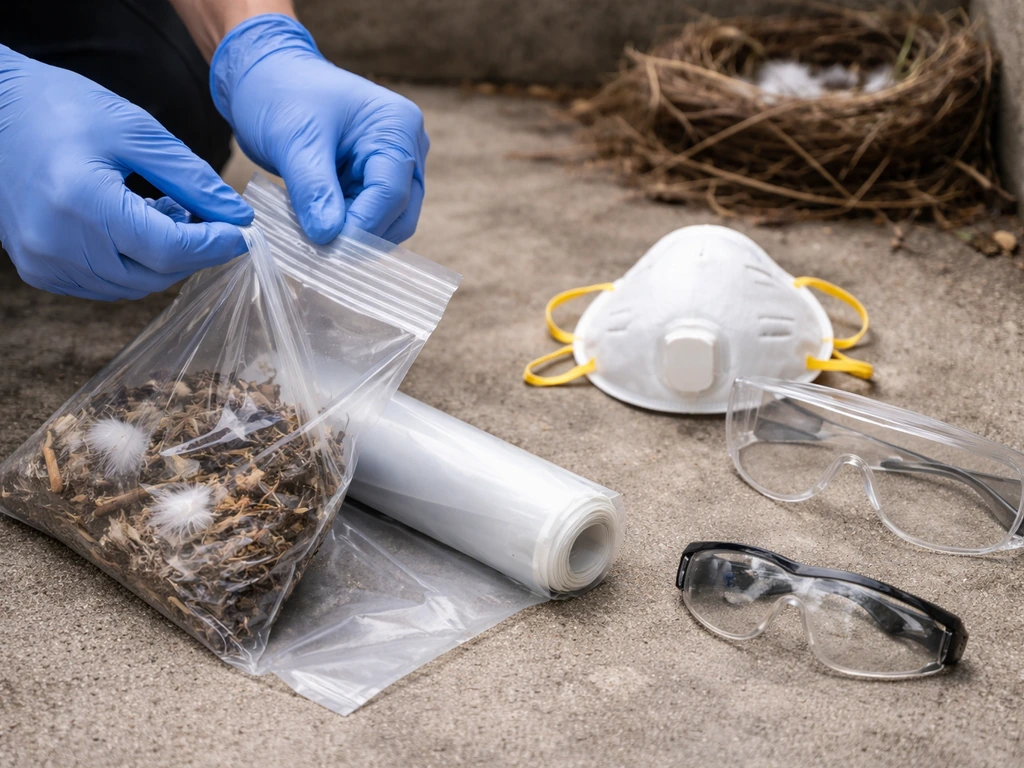
The moment you find a nest, especially one that may be old or abandoned, your own health is the first thing to manage. Bird nests and the droppings around them can harbor Histoplasma, the fungus responsible for histoplasmosis, a serious lung infection. The CDC notes that bird and bat droppings can contain Histoplasma spores and that cleaning or disturbing these materials can aerosolize those spores and send them straight into your lungs. This matters most when a nest has been in place for a long time and there are accumulated droppings underneath it.
Bird mites are the other hazard people underestimate. Northern fowl mites can survive off a host for up to about three weeks, while chicken mites have been reported to persist in the environment for up to eight months without a host. That means even after the birds leave, a mite-infested nest sitting in your attic or on your porch can still become your problem. Do not handle a nest bare-handed or bring it indoors without inspecting it.
- Wear an N95 or P100 respirator before disturbing any old nest or droppings
- Use nitrile or rubber gloves; never handle a nest or droppings with bare hands
- Dampen the nest and surrounding debris lightly before removal to reduce dust and spore dispersal
- Do not vacuum dry droppings; this aerosolizes spores directly
- Seal the removed nest in a plastic bag before disposing of it
- Do not bring a nest indoors, even an old one, without checking for mites or parasites first
- Wash hands and change clothes after any nest removal work
What not to do is just as important as what to do. Do not knock the nest down impulsively before checking its status. Do not attempt to cap your chimney while swifts or other birds are using it. Do not use pesticides or chemicals directly on or around a nest. And do not assume that because a nest looks small or inconvenient, you're automatically allowed to remove it.
Legal and ethical rules for removing nests and eggs
This is where a lot of homeowners get into trouble without knowing it. The Migratory Bird Treaty Act (MBTA) is the primary federal law in the U.S. governing bird nest removal, and it explicitly makes it illegal to destroy a nest that contains eggs or chicks. The U.S. Fish and Wildlife Service is clear: you need a federal permit to destroy an active bird nest. Most songbirds, swallows, swifts, and migratory species fall under MBTA protections. This covers the overwhelming majority of nests homeowners are likely to encounter.
Bald and golden eagles get even stronger protection under the Bald and Golden Eagle Protection Act (BGEPA). This law prohibits taking eagles, their nests, or their eggs without a permit, and USFWS spells out that criminal penalties apply for unlawful taking, possession, or transport of eagles, their parts, nests, or eggs. If you find a large stick platform nest in a tree near a lake or river and suspect eagles, do not touch anything and call your regional USFWS office.
It's also worth knowing that if you're curious about what happens legally and practically when a nest is disturbed without permission, the consequences can extend well beyond the removal itself. Understanding what happens if you knock down a bird nest is useful context before you decide how to proceed.
There are some nests that are not protected. House sparrows, European starlings, and rock pigeons (common pigeons) are non-native, invasive species not covered by the MBTA. Their nests and eggs can legally be removed at any time in the U.S. However, state laws can add protections, so it's worth a quick check with your state wildlife agency before acting. Canada has its own Migratory Birds Convention Act with similar protections, and the UK's Wildlife and Countryside Act covers nearly all wild birds during nesting.
- Protected (MBTA): most songbirds, swallows, swifts, warblers, raptors, waterfowl — cannot remove active nests without a permit
- Extra protection (BGEPA): bald eagles and golden eagles — separate and stronger permit requirements
- Not federally protected (U.S.): house sparrows, European starlings, rock pigeons — nests and eggs can be removed legally
- Always check your state or local laws, which may add additional protections for any species
How to remove bird nests safely: timing and allowed methods
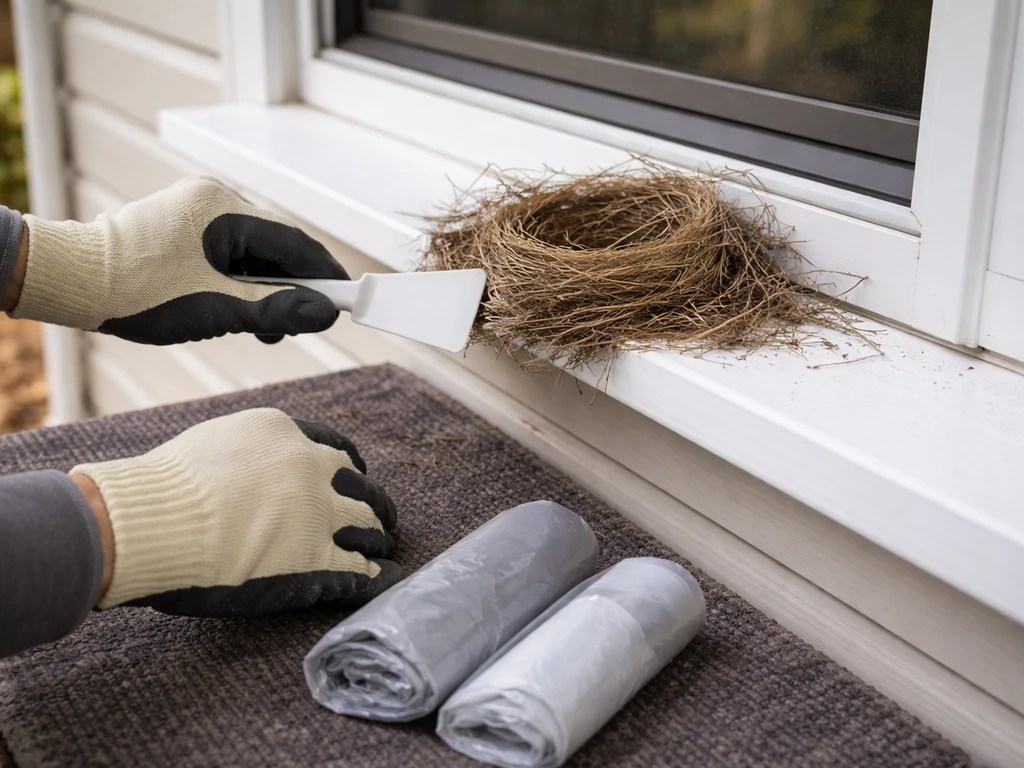
The safest window to remove a nest is after the breeding season is fully over and the nest has been confirmed empty. For most North American songbirds, nesting activity winds down between late July and early September. By October, most nests are genuinely abandoned. That said, some species nest multiple times per season, so a nest that looks empty in June may be reused in July. Confirm the nest has had zero adult activity for at least a week before taking it down.
For nests that are confirmed empty and not protected by the MBTA or state law (or are from non-native species), removal is straightforward. Gear up with a respirator and gloves, lightly dampen the nest, remove it, and seal it in a plastic bag for disposal. If the nest is in a hard-to-reach spot, take a look at guidance on how to get a bird nest down safely from elevated or awkward locations before you start climbing.
For nests built on structures you need to clean or repair, like gutters, eaves, or attic vents, the same timing rule applies. Wait until after nesting season, confirm the nest is empty, then remove it and immediately block or seal the entry point so the location isn't reused next spring. If you're dealing with a nest inside a chimney and you're not sure what species built it, read up on how to get bird nest out of chimney before doing anything, because chimney swifts are a special case that requires a completely different approach.
- Confirm the nest is empty and the breeding season has ended (observe for at least 5 to 7 days)
- Put on an N95 respirator, gloves, and old clothes you can wash afterward
- Lightly mist the nest and any droppings below it with water to suppress dust
- Carefully remove the nest structure and place it directly into a sealed plastic bag
- Wipe down the surface with a mild disinfectant solution
- Seal any gaps, holes, or ledges the bird used to access the nesting site
- Wash your hands and change clothes after finishing
If the nest is in a tree rather than on a structure and you're trying to discourage future nesting, the approach is different, because you typically can't, and shouldn't, seal a tree. For those situations, there's specific guidance on how to get rid of bird nest in tree that covers what's practical and what isn't.
How to move nesting birds without harming them
If you've found an active nest in a spot that's a genuine problem, your options narrow considerably. Legally and ethically, you mostly have to wait. But there are situations where a nest has fallen or been dislodged, and in those cases, careful replacement is the right move. If you find a nest that has fallen from a tree or eave, what to do if bird nest fell out of tree covers the specific steps for safely returning it to the right spot.
For active nests in spots where you need to do construction or repairs, the most ethical path is to schedule work around the nesting cycle. Most nesting attempts for songbirds take 4 to 6 weeks from egg-laying to fledging. Mark the date you first notice eggs, add 30 to 45 days, and plan your work to start after that window. If you flag the situation with a contractor, they can usually adjust the sequence of work to avoid the active nest area.
Chimney swifts deserve special mention here. USFWS guidance is explicit: do not cap a chimney or install a wire screen to keep out swifts while they are nesting. Chimney swifts nest during June and July, and any attempt to block the chimney during that window will trap birds inside or abandon active nests illegally. The USFWS also states that if nestling chimney swifts fall from your chimney, you should contact a licensed migratory bird rehabilitator, not attempt to handle the birds yourself.
Exclusion (gently preventing birds from accessing a nesting site) works well but only outside of active nesting periods. You can use physical barriers like netting, hardware cloth, or foam sealants to block access points, but only after the nest is confirmed empty and the birds have moved on. Attempting exclusion while nesting is active can trap adults and young inside, which is illegal and harmful.
For anyone wondering about more drastic approaches, it's worth being honest: there is no legal or practical method to simply destroy an active nest of a protected species without a federal permit. If you're researching options and wondering how to destroy bird nest material after the season is over and the birds are gone, that's a different conversation entirely, and one that's straightforward once legal conditions are met.
Preventing repeat nesting: deterrents, sealing, and seasonal timing
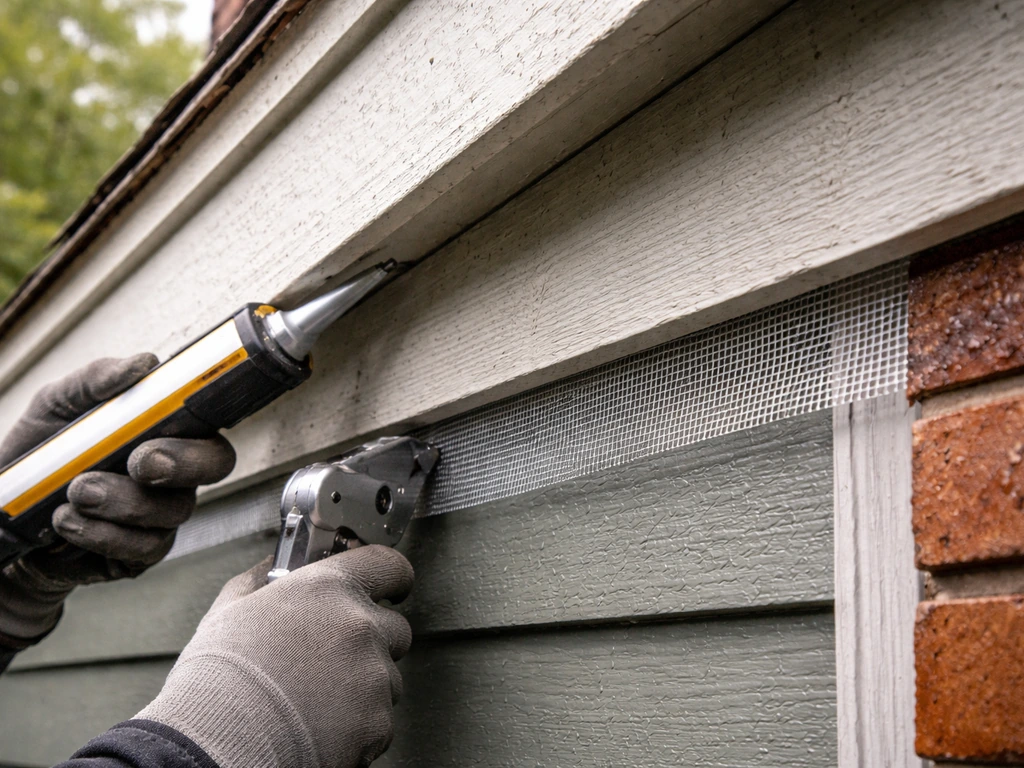
Once a nesting season ends and you've safely removed the nest, the goal is to make the location unattractive or inaccessible before birds scout for sites the following spring. Most migratory birds return to the same general area, and sometimes the same exact spot, each year. Acting in the fall or winter gives you the best window to make changes without any legal complications.
Physical exclusion is the most reliable long-term deterrent. Seal gaps in soffits, eaves, and vents with hardware cloth (use 1/4-inch or 1/2-inch mesh) or appropriate weatherproofing materials. For ledges where swallows or pigeons repeatedly nest, bird spike strips are effective and humane when installed on flat surfaces where birds land before nesting. Angled boards or sloped ledge covers on window sills and AC units also eliminate flat landing spots.
Visual deterrents have mixed results but can help when combined with physical changes. Reflective tape, predator decoys (like owl statues that move in the wind), and hanging CDs or mylar strips near problem areas can discourage scouting birds. The key word is "scouting": these work best before a bird has committed to a site. Once nesting begins, visual deterrents are largely ignored.
Habitat modification is the most underused but genuinely effective approach. Cutting back dense shrubs near your entry points, trimming tree branches that give easy roof access, and removing standing water near nesting areas all reduce the attractiveness of your property. If you're dealing with a tree specifically and want longer-term strategies, there's detailed guidance on how to get rid of bird nest in tree that covers tree-specific approaches.
Timing your prevention work seasonally is essential. In most of North America, the early nesting season for year-round residents like house sparrows begins as early as February or March. Migratory species typically arrive and begin scouting from April onward. That means your exclusion and deterrent work should be done by late January or early February at the latest. Fall is ideal: right after the nesting season ends, clean up old nests, seal access points, and install deterrents so they're in place well before birds start looking.
- September to January: best window to remove old nests, seal access points, and install deterrents
- February: complete all exclusion work before year-round residents begin scouting
- April to August: most migratory species are actively nesting; avoid disturbing access points during this period unless nest is confirmed empty
- Year-round: monitor eaves, chimneys, vents, and gutters monthly so you catch new nests before eggs are laid
One final point: if you've done everything right and birds are still finding ways in, or if you're dealing with a protected species and genuinely need the site cleared, it's time to call a licensed wildlife control professional or contact your regional USFWS office. They can advise on depredation permits and, in some cases, assist with relocation or exclusion under the correct legal framework. Going that route costs more time and sometimes money, but it keeps you on the right side of federal law and, honestly, it's just the right thing to do for the birds.
Understanding what destroys bird nests naturally, from weather to predators, can also help you think about environmental factors that may already be working in your favor, or against the birds you're trying to protect. And if you're a gamer who stumbled here looking for something entirely different, the guide on Days Gone how to destroy bird nests in the game is a separate topic covered elsewhere on the site.
FAQ
What if I remove a “looks empty” nest but birds start using it again a few days later?
If you remove an inactive nest but the species is still actively using the site (for example, a second nesting attempt or newly arriving adults), you could still run into legal trouble if eggs or chicks are present. The safe method is to confirm at least several days of no adult attendance, then immediately add exclusion so the location cannot be reused the same season.
How can I tell if a nest is truly abandoned when I cannot see inside?
The “empty” vs “active” distinction is about eggs or live chicks, not whether the nest is old-looking. A nest can appear abandoned and still be active if adults are away briefly. That is why the best practice is multi-day observation from a distance (and documenting with a timestamped photo or short video).
I found a tiny nest on a porch step, can I remove it if it’s inconvenient?
Do not assume that being small, low, or in a cluttered area means it is unprotected. Many songbirds and swallows build nests in sheltered spots and are protected during nesting. If you cannot verify species and activity status, treat it as protected and wait or call a licensed wildlife professional for an ID and activity assessment.
What’s the safest way to clean up old nest material and droppings afterward?
For contaminated material, do the cleanup without shaking it or using high-pressure sprays that create aerosols. Lightly dampen first, bag debris promptly, and avoid sweeping or vacuuming dry nest material. If you have heavy droppings buildup, consider a respirator rated for particulates and, for major infestations, professional help.
Are house sparrow or pigeon nests always legal to remove everywhere?
Not necessarily. Some non-native nests are removable, but state or local rules can still add restrictions, and some “pest-like” species can be protected depending on where you are and the species involved. Quick check with your state wildlife agency (or a local wildlife control operator who handles permits) is the safest path before you remove anything.
I have to replace gutters or do roofing work, what should I do about a nest in the way?
If a nest is on a planned repair route (roof, siding, gutter replacement), the legal and practical approach is scheduling around the nesting window. Mark the date you first noticed eggs, then count forward past the typical fledging period before starting work, and coordinate with the contractor so they do not disturb the area early.
Can I install exclusion barriers immediately, even if I am not sure the birds are gone?
Yes, but only if you can do it without trapping or harming birds. Wait until the nest is confirmed empty, then seal access points. If you cannot be sure it is empty, install temporary observation or a barrier that does not prevent exit, and verify again before sealing.
What should I do if a nest falls onto my patio or walkway?
If a nest falls or gets dislodged, the safest next step depends on whether there are eggs or nestlings present. If anything inside is alive, avoid handling and contact a licensed migratory bird rehabilitator. If it is clearly empty and protected removal is still required, remove it with protective gear and then block the entry point.
Is there any legal DIY option to get rid of an active protected nest quickly?
Refusing to touch the nest is safer for you and for the birds. For active nests, the practical options are usually waiting, scheduling repairs around the cycle, or seeking a permit and guidance from a professional. “Destroying” an active protected nest without authorization is generally not legal, so the decision aid is to stop and verify activity first.
After I remove the nest, how do I prevent the same spot from being reused next spring?
Yes. Birds often reuse the same ledge or entry points, even when the original nest is removed. The best deterrence is to combine timing (fall or winter work), physical exclusion (hardware cloth or approved weatherproofing), and removal of nesting attractants. Visual deterrents help most before scouting begins.
Do I need to worry about disease if I never touched the nest but it’s in my attic?
Those materials can still be a problem even if you never touched the nest, especially in enclosed spaces like attics. The key is to minimize dust generation and avoid disturbing accumulated droppings. If you need to access the area, wait for cleanup guidance, use proper respiratory protection, and consider a professional for large contamination.
What’s different about removing a nest in a chimney used by chimney swifts?
Yes, if you have a chimney swift situation. Do not cap the chimney or install screening while swifts are nesting, and do not attempt to handle any fallen nestlings. The correct next step is to contact a licensed migratory bird rehabilitator when active birds are affected or if nestlings fall from the chimney.
When should I stop DIY and contact a professional or wildlife office?
If you cannot identify the species and the nest is in a high-risk area (chimney, eaves, inaccessible vents, or near a waterway where raptors may nest), the practical call is to pause and get help. A licensed wildlife control professional or your regional wildlife office can determine whether it is active and which permitting path applies.
Next Articles
Should I Let a Bird Build a Nest? What to Do Today
Decide if to let a bird nest, how to check activity, avoid disturbance, and handle conflicts safely and legally.
Can You Make a Nest for a Bird? Safe, Legal Steps
Learn safe, legal ways to help birds nest with proper materials and nest boxes, avoid active nests, and prevent harm.
Who Teaches a Bird to Make a Nest, and What You Can Do
Birds nest by instinct, not human training. Find who to contact and how to help nests safely and ethically.