Most bird nests survive ordinary storms just fine, because birds are remarkably good engineers. A well-built nest is anchored, drained, and insulated in ways that handle rain and moderate wind without any help from you. The nests that fail tend to be on compromised branches, in exposed sites, or already weakened before the storm hit. Knowing which category you're dealing with, before and after a storm, tells you whether to watch and wait or actually do something.
How Do Bird Nests Survive Storms? Key Reasons and Tips
Maya Bennett
14 May 2026
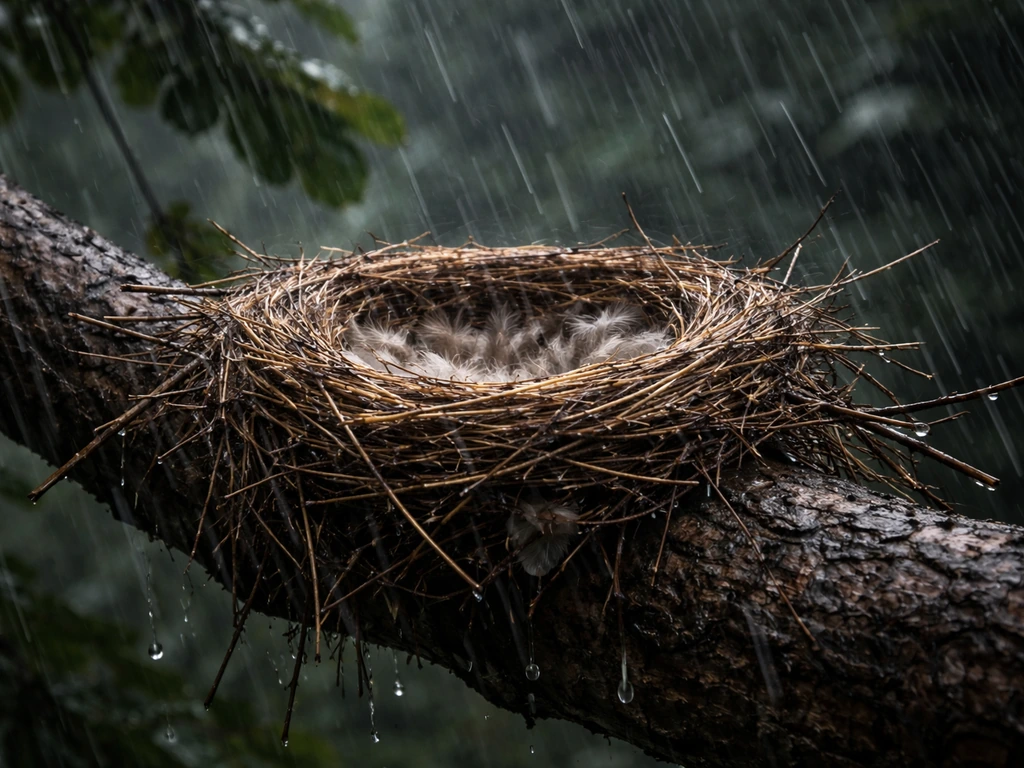
How birds build nests to handle wind and rain
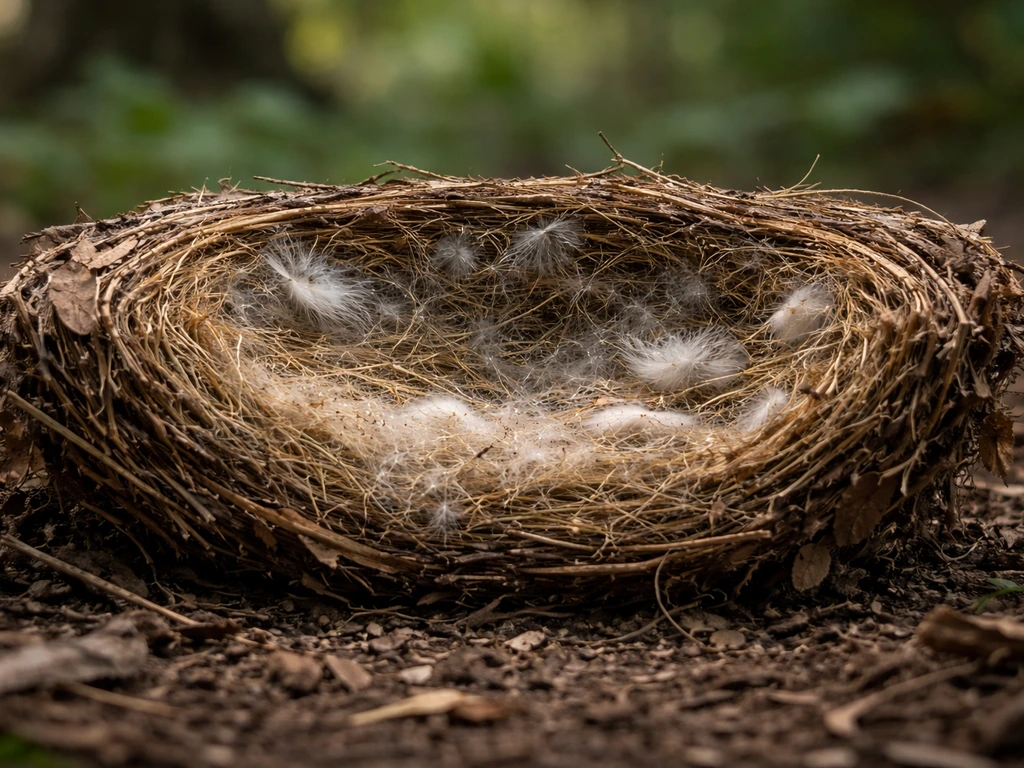
Birds don't just pile up sticks. A typical cup nest has several distinct layers, each doing a specific job. The outer shell uses coarse twigs, bark strips, and leaves for structural rigidity. An inner layer of mud acts as a binding agent, hardening around the woven materials to lock the shape. The innermost lining of fine grass, down, hair, and feathers insulates eggs and chicks from cold and moisture. Each layer contributes something measurable: the mud shell resists deformation, the woven fibers absorb load without snapping, and the lining maintains the microclimate that keeps eggs viable.
Spider silk is one of the most important storm-resistance materials in a bird's toolkit, and it's easy to underestimate. Hummingbirds, for example, press silk directly onto the nest's foundation branch as an anchor during construction, essentially gluing the nest to the substrate. Warblers and other small passerines use silk to bind the outer walls into a tough, flexible cup that bends under wind load without cracking. This elasticity is a key reason small cup nests can swing in heavy gusts and spring back intact.
Placement decisions also drive storm survival. Birds instinctively choose sites that reduce exposure: a nest tucked in a branch fork rather than suspended from a single twig, positioned on the lee side of a trunk, or screened by dense foliage. Predatory snakes also rely on finding secure, concealed spots, which helps them locate bird nests and raid them sheltered, well-drained, structurally sound sites. Depth-to-diameter ratio matters too, a deep cup keeps eggs from washing out in heavy downpours and limits the direct rainfall hitting the lining. Drainage is partly passive, since many nest materials wick or shed water downward, and partly structural, with the cup shape channeling runoff away from the center.
The storm forces that actually break nests
Not all storm damage works the same way, and understanding the mechanics helps you assess risk more accurately after a storm passes.
- Wind: Sustained wind and gusts are the primary structural threat. The risk isn't usually the wind hitting the nest directly — it's wind causing tree or branch failure. Research on tree failure consistently identifies wind as the main driver of stem, root, and branch collapse. A nest on a healthy, well-rooted branch in a sheltered fork can handle hurricane-force gusts. A nest on a dead limb or a recently cracked branch is at risk in a moderate storm.
- Flooding and runoff: Ground-nesting species are most vulnerable here. Rising water or saturated soil can submerge a nest outright, which is documented as a direct nest-failure mechanism especially for shrub and reed-bed nesters near water. Even elevated cup nests can suffer if heavy runoff channels through the nest substrate.
- Hail: This is underappreciated. Documented hailstorm events have caused significant songbird nest mortality, with hail size and wind shear working together as predictors of nest survival. A severe hail event — even one that seems short — can physically destroy nests and eggs, and injure adults sitting on the nest.
- Falling debris: Branches, pine cones, and broken twigs dropping from above can dislodge or crush a nest that was otherwise structurally fine. After storms, it's worth checking for debris that landed in or around a nest even if the nest looks roughly intact.
- Temperature and wet insulation: Wet nest walls lose insulating efficiency. Research using simulated rainfall has demonstrated measurable reductions in nest-wall insulation properties after wetting. A nest that's soaked through may look fine but is providing less thermal buffering, which matters most for very young chicks who can't yet regulate body temperature.
- Lightning: A direct strike on a nest is rare, but birds sheltering in trees during storms can be killed if the tree is struck. Lightning is a low-probability but high-consequence hazard for nests in tall isolated trees.
How different nest types and species handle storms
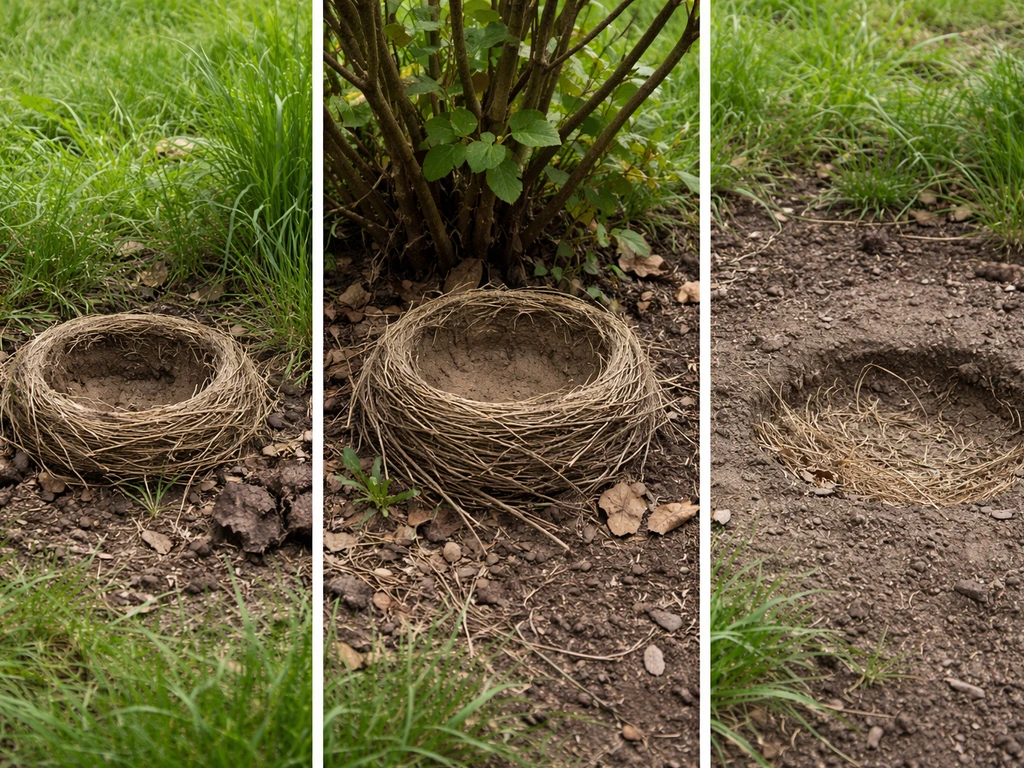
Nest architecture varies enormously across species, and that variation maps almost directly onto storm vulnerability. A robin's mud-reinforced cup and a killdeer's scrape on bare gravel have almost nothing in common when a storm hits.
| Nest Type | Common Species | Main Storm Risks | Natural Resilience |
|---|---|---|---|
| Cup/bowl nest (tree) | American Robin, Song Sparrow, Yellow Warbler | Branch failure, falling debris, water logging of lining | Mud-reinforced walls, silk anchoring, deep cup sheds rain |
| Ground nest/scrape | Killdeer, Ovenbird, many shorebirds | Flooding, runoff, predator exposure after vegetation flattened | Cryptic placement, shallow drainage, parents brood continuously |
| Cavity nest | Bluebirds, Chickadees, Woodpeckers | Cavity flooding if entrance faces driving rain, tree failure | Enclosed structure shields eggs from rain, wind, and hail directly |
| Platform/roof nest | Osprey, Great Blue Heron, some Ravens | Structural overloading with debris, wind leverage on large mass | Bulky stick construction added to each year; very stable in anchored sites |
| Mud/dome nest | Cliff Swallow, some Flamingos | Mud erosion from prolonged rain, structural slumping | Thick walls, often sited under overhangs for rain protection |
| Hanging/pendant nest | Baltimore Oriole, Verdin | Tearing at attachment point in sustained wind | Woven fiber and silk attachment; pendulum motion absorbs gusts |
Cavity nesters get a significant advantage in storms. The enclosed space protects eggs and chicks from direct rain, hail, and most wind. The main risk is a flooded nest box or cavity if the entrance hole faces into driving rain, or if the supporting tree fails. That's worth checking on your nest boxes before storm season. Ground nesters are at the opposite end of the risk scale: their nests are naturally cryptic and placed in relatively stable microclimates, but they're fully exposed to flooding and have no overhead protection from hail or debris.
How birds themselves improve their odds, timing, behavior, and instinct
Birds aren't passive during storms. Several natural behaviors directly improve nest and egg survival, and understanding them helps you interpret what you're seeing in your yard.
Nest timing is a big one. Many species have evolved to place their nesting window in the window of highest local food availability and lowest severe weather frequency. When late-season storms hit early nesters, the mismatch shows up as nest failure. Conversely, species that nest later in summer often miss the peak of spring severe weather. Site selection itself is a behavioral storm-resistance strategy: birds that consistently choose sheltered, well-drained, structurally sound sites pass on genes for that preference, so the behavior is self-reinforcing over generations.
During active storms, incubating adults stay on the nest far longer than usual. Incubation constancy in temperate songbirds averages around 74% of daylight hours under normal conditions, but during cold or wet weather, adults will push that much higher to maintain egg temperature and physically shelter the clutch with their body. This is why you'll sometimes see a bird sitting motionless on a nest in heavy rain, it's doing exactly what it should be doing. Research on arctic seabirds also shows that wind exposure directly increases incubation effort, meaning parents actively compensate for storm conditions rather than abandoning the nest.
After a hailstorm, some species have been observed at partial-incubation behavior, returning quickly to damaged nests and attempting to resume incubation even when some eggs are destroyed. This resilience is worth keeping in mind before assuming a storm-hit nest is abandoned, parents may simply be taking a brief break before returning.
How to tell if a nest is truly at risk during a storm
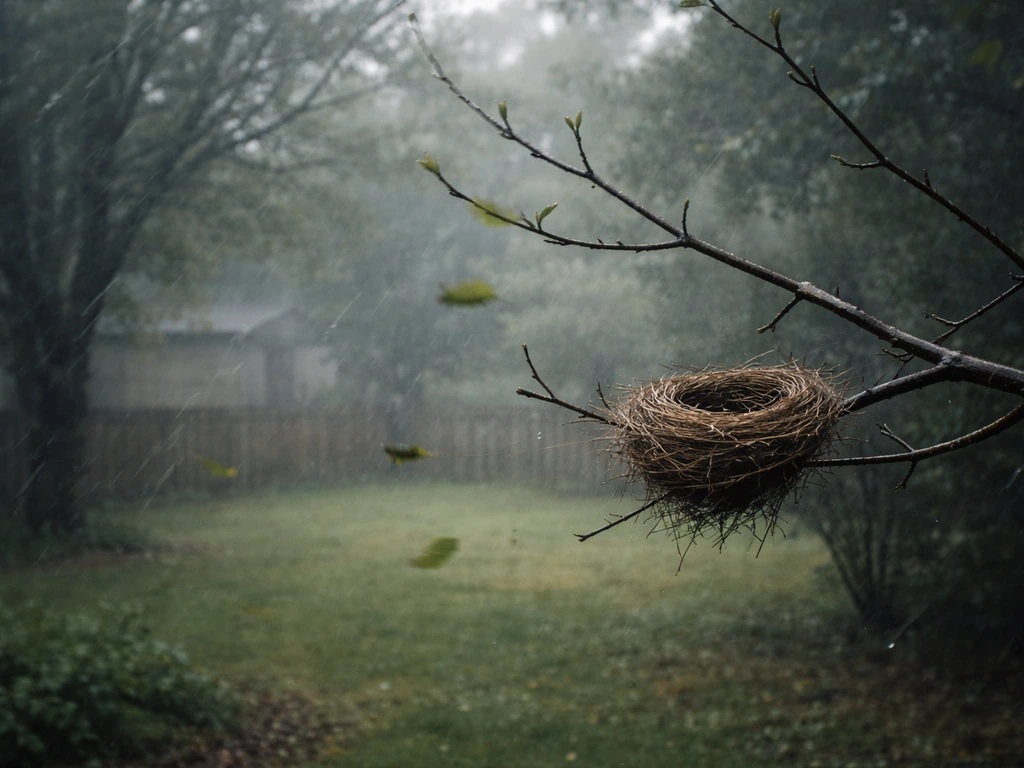
The most important thing you can do during a storm is observe from a distance rather than approach. Most nests that look precarious are not actually in danger. Here's a practical triage checklist you can run through with binoculars or from a window.
Signs that look alarming but are usually normal
- Nest swaying or rocking: This is normal load-distribution behavior, especially in hanging or silk-anchored nests. If the nest returns to position after each gust, it's doing its job.
- Parent missing during the storm: Adults sometimes leave briefly during peak intensity and return when conditions ease. If the parent returns within 30 to 60 minutes after rain stops, the nest is fine.
- Nest looks wet or darker than before: Wet nests can lose insulating efficiency, but being wet does not mean the nest is damaged or that eggs won't survive. The nest dries once the parent returns.
- Fledgling on the ground nearby: If the bird is fully or mostly feathered and hopping around, it's a fledgling, not a fallen nestling. Fledglings leave the nest intentionally and their parents are usually nearby. Leave them alone.
Genuine risk indicators to watch for
- Nest visibly dislodged: If the nest has shifted significantly from its original position or is hanging by a single attachment point, it may fail in the next storm or wind event.
- Nest on a damaged or cracked branch: After a storm, check the supporting structure. A branch with a fresh crack, exposed sapwood, or a v-shaped crotch split is a tree-failure risk. Wind is the primary driver of branch failure, and a compromised branch that survived this storm may not survive the next.
- Standing water inside the nest cup: Eggs sitting in pooled water won't develop normally. This is a genuine emergency, especially if parents are not returning to drain or dry the nest.
- Featherless or sparsely feathered nestlings on the ground: These birds cannot thermoregulate and will die without intervention. See the section below on what to do.
- Parent not returning for more than 2 hours after the storm passes: This extends to situations where you can confirm a parent is deceased nearby. Sustained parental absence, not a brief storm break, is the signal that something is wrong.
- Hail event combined with nest exposure: If you just experienced a storm with large hail and the nest was in an exposed location with no overhead cover, there's elevated risk of direct physical damage even if the nest looks roughly intact from a distance.
For context: rain alone rarely destroys well-built nests. The topics of whether nests can get wet and what happens during rain specifically are worth understanding on their own, because the answers are less alarming than most people expect. Storms become dangerous for nests mostly through a combination of factors: physical force plus structural compromise plus parent disruption.
What homeowners should do ethically and legally during a storm
The legal framework here is real and matters. Most wild bird nests are protected under the Migratory Bird Treaty Act (MBTA), 16 U.S.C. §§ 703–712. When a nest contains eggs or live birds, you cannot remove, disturb, or possess it without a federal permit. Even an empty nest has some protections in certain contexts. The USFWS has clarified that destroying an unoccupied nest (no eggs, no birds) is not prohibited by the MBTA alone, but state laws may add additional protections depending on where you live. Bottom line: if there are eggs or chicks in a nest, treat it as legally protected and do not touch it without authorization.
What to do
- Observe from a distance before and after the storm. Binoculars from a window are ideal. Note whether parents are returning and whether the nest structure looks intact.
- If a nestling (featherless or nearly featherless) has fallen and you can locate the nest above, you can gently place the bird back in the nest. The myth that parents will reject a touched chick is false — birds have a limited sense of smell and will not abandon chicks that have been handled briefly.
- If the nest itself has fallen but is intact, you can secure it in a small container (like a woven basket or shallow box) lined with dry grass and place it as close to the original location as possible, then monitor for parent return.
- Contact a licensed wildlife rehabilitator if chicks are injured, bleeding, shivering after the storm passes, or if the parent has not returned for two or more hours post-storm. The USFWS directs people to rehabilitators rather than DIY care for exactly these situations.
- If you suspect a nest is on a structurally compromised branch, photograph it and contact a certified arborist before doing anything. A professional can assess tree risk without disturbing the nest.
What not to do
- Do not remove an active nest (with eggs or chicks) from its location, even with good intentions. This is a federal offense under the MBTA without a permit.
- Do not attempt to incubate eggs yourself. Egg incubation requires precise temperature and humidity control that DIY methods cannot maintain reliably.
- Do not approach the nest repeatedly to check on it. Frequent human presence near a nest increases predator attraction and stresses adults, sometimes causing abandonment.
- Do not prune or cut branches with active nests during breeding season, even if those branches look storm-damaged. Wait until the nest is confirmed empty.
- Do not bring wild nestlings or fledglings indoors and attempt to raise them yourself. This is illegal without a rehabilitation permit and rarely results in a bird that can survive in the wild.
After the storm: checking habitat, monitoring parents, and cleaning up safely
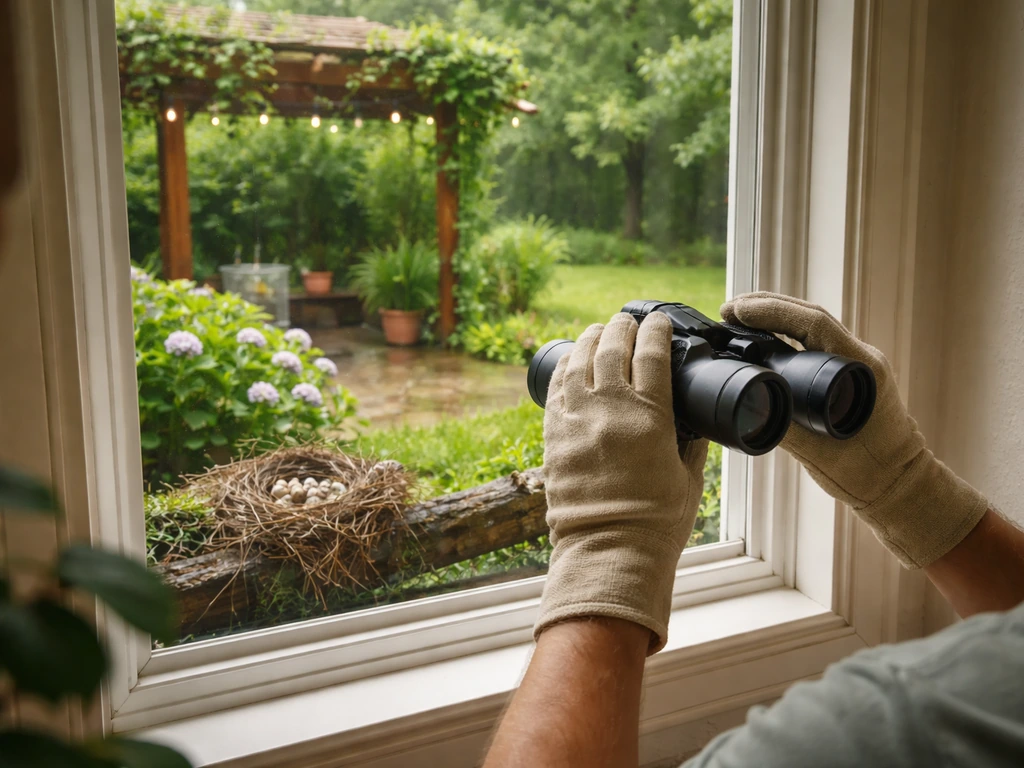
Once the storm has passed and conditions are safe for you to be outside, a methodical post-storm check takes about 15 minutes and tells you almost everything you need to know.
- Do a visual scan from a distance first. Before approaching any area with a known nest, spend five minutes watching from 10 to 15 meters away. Note whether adults are visiting, carrying food, or sitting on the nest. Normal parental activity is a strong indicator that the nest is intact and occupied.
- Check the supporting tree or structure. Look for fresh cracks in branches, hanging limbs (called widow-makers), torn bark, or visible root heave at the base of the tree. These are tree-failure warning signs independent of the nest — a structurally compromised tree is a hazard to you and the nest. If you see these signs, don't approach further and consult an arborist.
- Look for debris in or around the nest. Fallen twigs, leaves, and pine cones can add weight to a nest or block the entrance of a cavity nest. If you can remove debris from around — not inside — the nest without getting close enough to stress the parents, do so.
- Photograph before touching anything. A photo record of the nest's condition before and after your intervention is useful if you later need to explain your actions to wildlife authorities or a rehabilitator.
- Check for displaced nestlings on the ground. Featherless or pin-feathered birds on the ground need to be returned to the nest or given to a rehabilitator. Fully feathered birds on the ground are almost certainly fledglings and should be left alone.
- Monitor for parent return for at least two hours. Do this from inside or from enough distance that your presence doesn't factor into the parents' decision to return. Note the time of first return and whether the bird enters the nest.
- For yard cleanup: remove fallen branches and debris from the general area, but avoid raking or disturbing leaf litter directly under a nest tree if ground nests or fledglings may be present. Ground-nesting species and recently fledged young use leaf litter for cover and thermoregulation.
- If predator pressure has increased after the storm (because cover vegetation was flattened or removed), consider temporary deterrents around nest boxes like baffles on poles. Predators like raccoons and crows actively exploit post-storm conditions when nests are more exposed — something worth keeping in mind, since storm disruption and predator pressure often arrive together.
If you find eggs that have clearly been ejected from a nest and are undamaged, resist the urge to re-nest them unless you can confirm which nest they came from and the nest is still intact. Placing eggs in the wrong nest is harmful. When in doubt, call a licensed wildlife rehabilitator in your area, the USFWS website and most state wildlife agencies maintain directories.
The broader takeaway is that birds are far more storm-ready than they look. If crows are a concern in your area, you can use targeted deterrents that protect bird nests from crows without harming the birds. Evolution has selected hard for nest designs and behavioral responses that handle weather, and most nests you're worried about will be fine. Your job as a homeowner or birdwatcher is mostly to stay out of the way, watch carefully, and know the specific signals, a featherless bird on the ground, standing water in the cup, a two-hour parental absence, that actually call for action. Raccoons can raid bird nests, so it helps to consider predator pressure alongside storm damage when you assess risk. When those signals show up, act quickly and get professional help rather than improvising. That combination of restraint and targeted response is exactly what conservation-minded stewardship looks like in practice.
FAQ
Do bird nests ever fail even when the storm isn’t extreme?
Yes. Ordinary storms can still cause failure if the nest was already compromised (loosened branch, partial prior damage, or poor drainage), or if parents are forced off the nest long enough for cooling or egg washing. The key signal is prolonged parental absence plus visible flooding or dislodged nesting material, not the presence of rain alone.
How can I tell whether a storm-damaged nest is still being cared for?
Look for short, consistent returns rather than expecting constant sitting. If one parent resumes incubation or brooding within a few hours (often sooner for some species after hail), the nest may be recoverable. If birds show no activity for longer than about two hours in moderate weather, or if the eggs are clearly exposed and drying, risk is higher.
What should I do if I find eggs outside the nest after a storm?
Do not simply put them back. If the eggs are undamaged, correctly identifying the original nest matters, because placing eggs in the wrong nest can reduce survival for both clutches. If you cannot confidently confirm origin and intactness, contact a licensed wildlife rehabilitator for guidance.
Is it safe to move branches or secure a nest after a storm?
Usually no. Even “helpful” touching can breach protections and can destabilize the nest further. Only consider actions that prevent human harm to yourself and, ideally, do not touch the nest, eggs, or birds. If you suspect the supporting branch is actively failing, call a wildlife professional or arborist who can assess without disturbing the clutch.
Should I cover a nest during a storm to save it?
In most cases, no. Covering often leads to more disturbance, trapped moisture, or accidental exclusion of adults. Natural nest cavities and cup designs are built to manage rain and wind, so the safer approach is distance observation and letting the parents decide how to maintain the clutch.
Do cavity nests and nest boxes need the same post-storm checks as open-cup nests?
No. With cavity nesters, prioritize checking for flooding at the entrance and whether the box or tree is still stable. A seemingly intact box can still fail if the entrance faces driving rain, if water pooled inside, or if the mounting tree loosened.
Will wet nesting material harm eggs or chicks?
Often it does not, because many nest linings and binding layers are designed to regulate moisture. The higher risk is when eggs become directly exposed to sustained downpour or when the nest is washed out and loses its shape and contact with brooding adults. If you see standing water pooling in the cup, that is a stronger red flag than general dampness.
Does hail always mean a nest is abandoned?
Not always. Some species may shift to partial-incubation or attempt to resume incubation quickly after hail, even with some egg loss. Treat “silence” and complete exposure as more meaningful danger indicators than the presence of hail damage alone.
How do I handle situations where I suspect a nest is protected but I am not sure whether it has eggs?
Assume it is protected if it appears active or you see signs of nesting (incubation behavior, fresh fecal deposits near the nest, or nestlings). When uncertain, do not disturb it and contact local wildlife authorities or a rehabilitator to confirm status and legality before taking any action.
What is the best time window for a post-storm assessment?
Do a careful check after conditions are safe for you, and keep it brief. The article suggests about 15 minutes. If you find severe damage, intervene sooner by contacting professionals rather than revisiting repeatedly during unsafe weather, which can increase parent disruption.
Can crows or other predators increase after storms, and does that change what I should do?
Yes. Storms can reduce cover and alter access routes, making nests easier to detect. If you have predator pressure in your area, combine distance monitoring with targeted, non-harmful deterrents rather than physical nest interference.