The bird most likely making that hanging nest is a Baltimore oriole or an Orchard oriole, if you are in North America. Both species build true suspended, woven pouches that dangle from branch tips, and they are the go-to answer for most people who spot a sock-like nest swaying in the breeze. That said, a few other species also produce genuinely hanging structures, and a handful of common nests can fool you into thinking they are hanging when they are not. Here is how to figure out exactly what you are looking at and what to do about it today.
What Bird Makes a Hanging Nest? Identify the Culprit Fast

Maya Bennett
15 Apr 2026
Common birds that make hanging nests
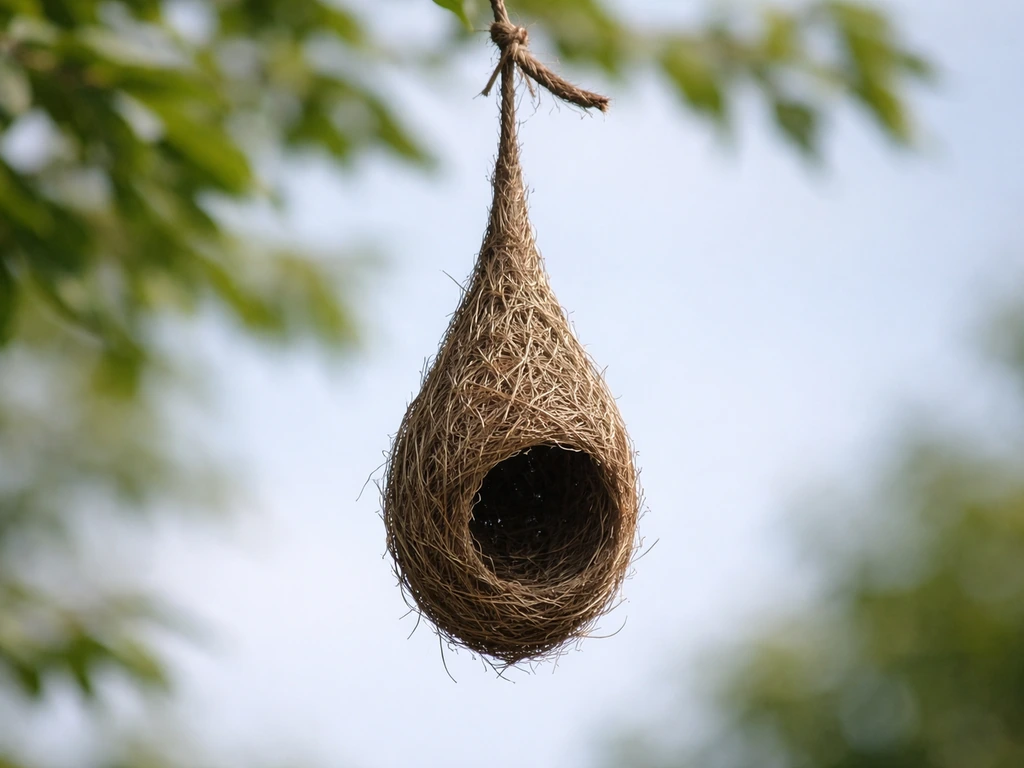
A true hanging nest, sometimes called a pendant nest, is an elaborately woven sack that dangles from a branch rather than sitting on top of it. The Smithsonian defines pendant nests as elaborately woven sacks that dangle from branches, categorically distinct from platform nests or cavity nests. In North America, orioles are the classic builders. Beyond orioles, weaverbirds (family Ploceidae) are the world champions of hanging nest construction. The Baya weaver, for example, builds a pendulous, retort-shaped nest with a long vertical tube leading to a side entrance, often suspended over water. The Black-necked weaver takes it further, adding a downward-facing entrance tunnel roughly 15 cm long hanging from a globular egg chamber. Weavers are not native to North America, but if you are outside the continent or near an introduced population, they are a real possibility.
- Baltimore oriole: deep, sock-like woven pouch, hung from the tip of a high branch, typically 20–30 feet up
- Orchard oriole: shallower basket woven from green grass, suspended in a forked twig, usually 10–20 feet up
- Baya weaver (outside North America): retort-shaped pendant with a long entrance tube, often over water
- Black-necked weaver (Africa): globular nest with a coarsely woven downward-facing tunnel entrance
How to identify a hanging nest
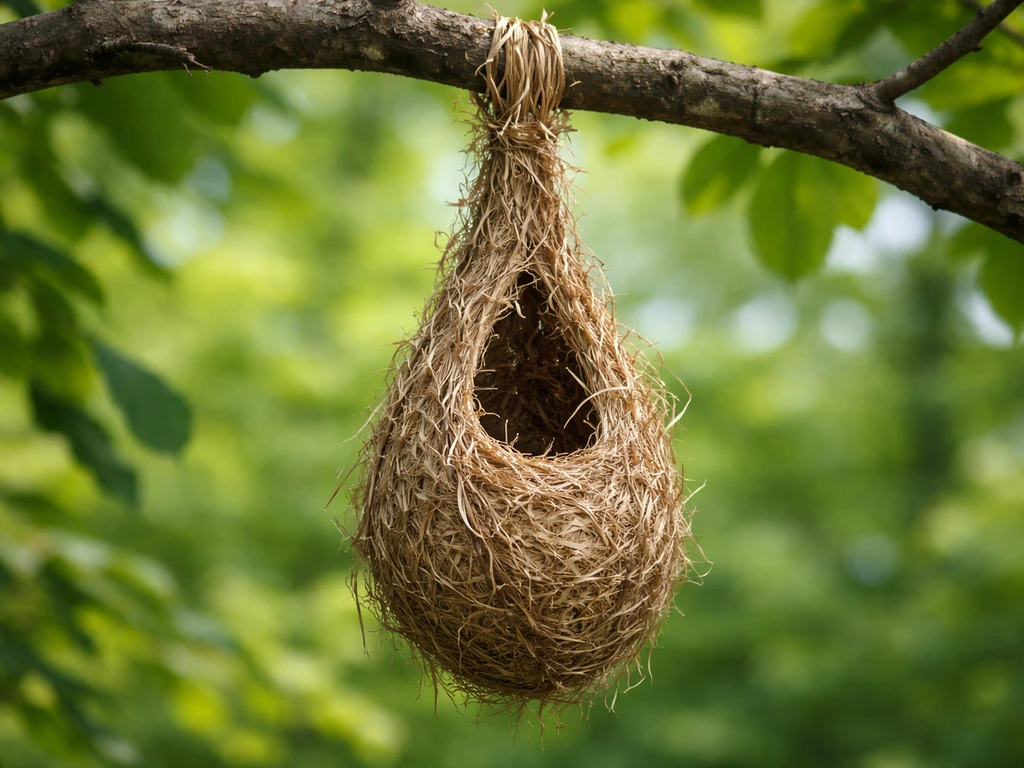
Before you start matching species, you need to gather five quick observations about the nest itself. Take a photo from below and one from the side without getting closer than necessary, and jot down these details in your phone's notes app. The five things to record are: attachment method, location and height, overall shape and depth, entrance position, and materials.
Attachment method
A genuine hanging nest is anchored to a branch from above, meaning the nest hangs down from the attachment point rather than sitting in or on a structure. Baltimore oriole females start by draping long fibers over a branch and tangling them in place, creating a top-knot from which the whole pouch suspends. If the nest is resting on a ledge, tucked into a corner, or propped up by surrounding branches, it is not a true pendant nest.
Location and height
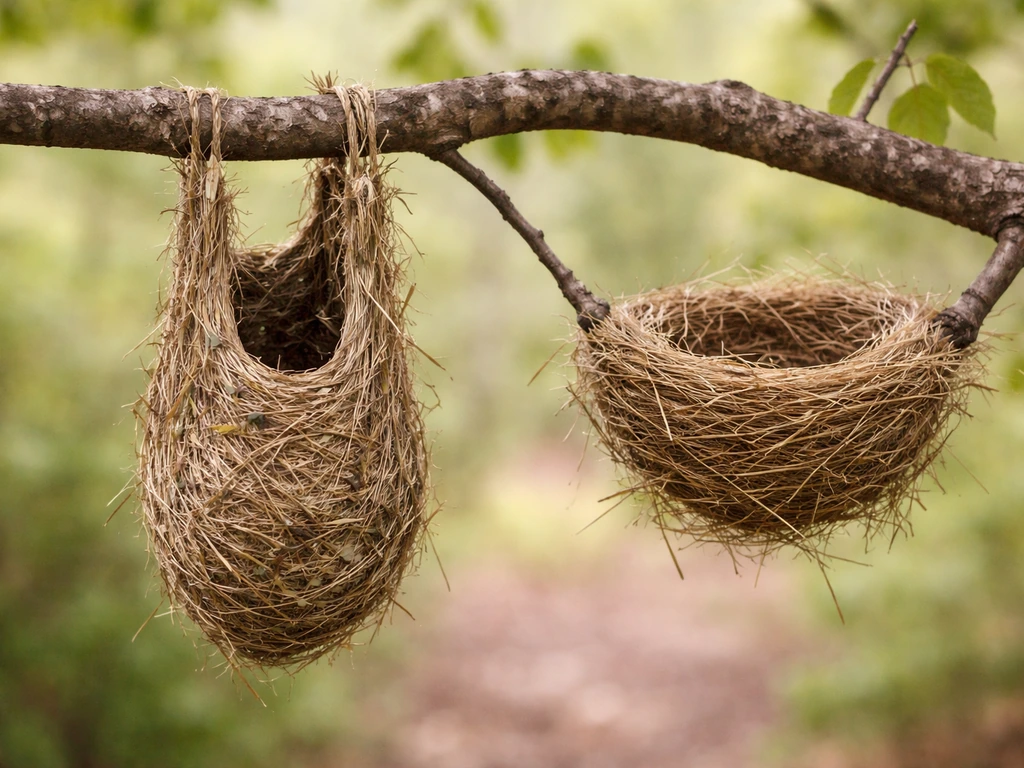
Most North American hanging nests are high up and exposed. Baltimore orioles prefer the outer tips of tall deciduous trees, often elms, maples, or cottonwoods, at heights where wind sway is noticeable. Orchard orioles tend to hang their nests 10 to 20 feet up, often in orchards, riparian trees, or shade trees near open areas, suspended from a fork near the end of a horizontal branch.
Shape and depth
Shape is one of the clearest indicators. Baltimore oriole nests are a tightly woven, bundle-like pouch located on the end of a branch and hanging down, resembling a gray or tan sock. Orchard oriole nests are shallower: roughly 4 inches across and 3 inches deep on the outside, with an inner cup about 2.5 inches across and 2 inches deep. Weaver nests tend to be rounder and more globular, with a pronounced entrance tube.
Entrance position and materials
For orioles, the entrance is at the top of the pouch, narrowing into the woven body below. The Audubon Society notes that North American oriole nests have deep cups and narrow entranceways that are basket-like in form. Materials are also telling: Baltimore orioles weave with slender plant fibers, string, and hair, producing a silvery-gray or pale tan pouch. Orchard orioles weave almost exclusively from long blades of green grass that turn yellow as they dry, giving a straw-colored appearance. If you see a grassy, yellowish basket hanging in a forked twig, Orchard oriole is the strong favorite.
Matching the nest to the most likely species
Work through these steps in order to narrow it down. Most people can identify the species after step three.
- Confirm it is truly hanging: the nest must dangle below its attachment point with no supporting structure underneath. If it is sitting on a flat surface or tucked under eaves, skip to the look-alikes section.
- Check the height: above 25 feet in a tall tree with a deep, sock-like gray or tan pouch points strongly to Baltimore oriole. Between 10 and 20 feet in a forked horizontal branch with a shallower, grassy basket points to Orchard oriole.
- Look at the materials: silvery plant fibers, string, or hair = Baltimore oriole. Green or straw-colored woven grass = Orchard oriole.
- Check the depth: hold your hand up for reference if you can. A pouch longer than your hand (more than 4 inches deep) leans Baltimore oriole. A shallower cup closer to 3 inches deep is more typical of Orchard oriole.
- Note the entrance: oriole entrances are at the top, narrow, and blend into the weave. A long downward-pointing tube entrance in a globular nest is a weaver (outside North America).
- Watch for the adult bird: Baltimore orioles are bright orange and black (males). Orchard oriole males are chestnut and black, females are yellowish-green. Seeing the adult confirms everything.
Look-alikes: nests that seem hanging but are not
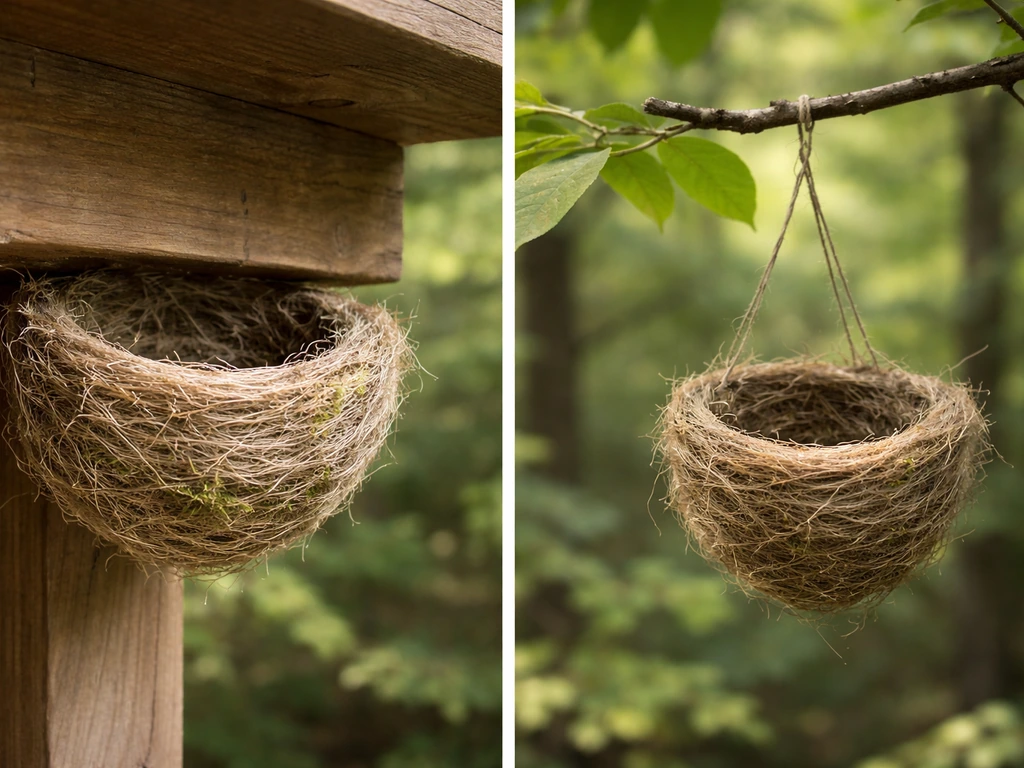
Not every nest that appears to dangle is a true pendant nest. The red-eyed vireo is the most common source of confusion in North America. Its nest is a cup suspended in a small horizontal Y-fork of a branch, which can look like a hanging structure from below. The difference is that the vireo nest is an open cup sitting in the fork, not a woven pouch hanging from above. The attachment is the fork itself, and the nest does not swing freely. Red-eyed vireo nests tend to be smaller and more delicate, often decorated with bits of lichen and paper, and the cup is open at the top rather than having a narrow woven entrance.
Platform nests placed under eaves or on ledges can also fool you, especially when viewed from below at an angle. These nests rest on a flat support and are not woven in a pendant style. House sparrow and barn swallow nests are frequent examples. Similarly, a cavity nest inside a hollow branch or a nest box is not a hanging nest regardless of how the branch itself is oriented. If you are comparing what you see to other nest-building strategies, it helps to consider what bird makes a messy nest, since platform builders like starlings or sparrows often produce loosely piled structures that look disheveled rather than woven.
| Nest type | Attachment | Shape | Entrance | Common builder |
|---|---|---|---|---|
| True pendant/hanging | Fibers looped over branch from above | Deep pouch or sock, swings freely | Narrow, at top of pouch | Baltimore oriole, Orchard oriole, weavers |
| Suspended cup (look-alike) | Rim attached to Y-fork of branch | Open cup sitting in fork | Open top, no woven entrance | Red-eyed vireo, some wood-warblers |
| Platform under eave (look-alike) | Rests on ledge or beam | Flat or bowl-shaped, does not sway | Open top | Barn swallow, house sparrow |
| Cavity nest (look-alike) | Inside hollow branch or box | Not visible from outside | Hole in wood or box | Woodpeckers, bluebirds, chickadees |
What to do today: safe observation and the do/don't rules
If you have just found a hanging nest and want to figure out what is in it, the first rule is simple: observe from a distance. The National Park Service advises letting wildlife be wild, observing from a distance, and avoiding the use of bird calls or attractants near nesting birds. A pair of binoculars from 20 to 30 feet away will tell you far more than walking up to the branch will, and it will not flush an incubating bird or alert a predator to the nest's location.
Here is the practical do/don't list for today:
- DO: photograph the nest from below and the side without moving branches or leaves
- DO: note the height, tree species, and whether you see the adult bird visiting
- DO: watch quietly for 10 to 15 minutes from a comfortable distance to see the adult return
- DON'T: touch the nest, its contents, or the branch it hangs from
- DON'T: play oriole calls on your phone near the nest to attract the adult
- DON'T: bring pets or children close enough to cause the sitting bird to flush
- DON'T: trim or prune the branch the nest is attached to during breeding season
NestWatch (Cornell Lab of Ornithology) states that in most instances it is illegal to touch or physically disturb an active nest or its contents. This is not a suggestion, it is federal law in the United States under the Migratory Bird Treaty Act, which makes it unlawful to take migratory birds, their nests, or their eggs. The word "take" includes disturbing, moving, or destroying. Most songbirds, including all native orioles, are protected. If you are unsure whether a nest is active, treat it as active until you can confirm otherwise.
When to call wildlife authorities: contact your state wildlife agency or the U.S. Fish and Wildlife Service if the nest is in immediate danger from construction or utility work, if the nest has fallen and contains live eggs or chicks, or if you need written guidance on whether a planned activity (like tree trimming) requires a permit. The FWS notes that permits and authorization are generally required for activities that involve migratory bird nests and eggs, and their permitting office can clarify your situation quickly.
Protecting the nest from predators and human disturbance
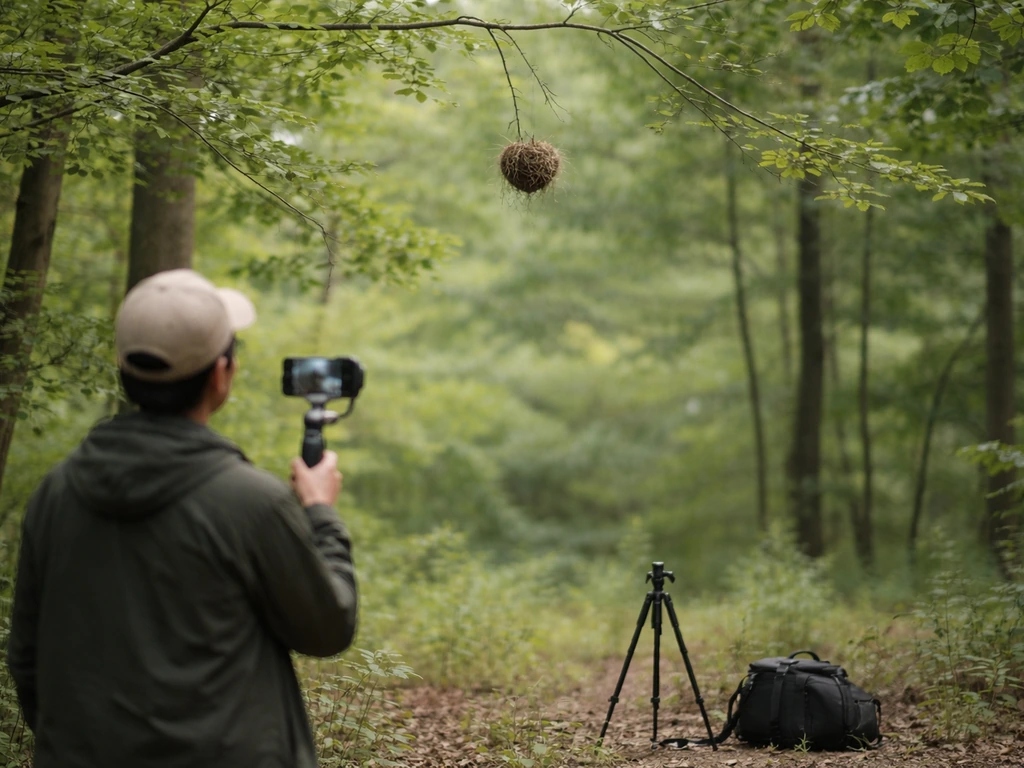
One of the things that makes oriole nests so effective is that their placement already does a lot of the predator-proofing work. A nest swinging from a thin branch tip at 25 feet is hard for a raccoon or snake to reach and nearly invisible from above due to the overhanging canopy. Your job is mostly to avoid undoing those natural advantages.
The biggest human-caused threats to hanging nests are branch trimming, lawn equipment noise causing adults to abandon nests, and well-meaning but too-close observation. Canada's environmental guidelines state that if occupied migratory bird nests are present, activities that could disturb or destroy them should be avoided, adapted, rescheduled, or relocated, and harmful activities during breeding season should be avoided entirely. In practice, this means marking the tree with a loose ribbon so landscapers know to avoid it, postponing any nearby pruning until after the fledglings have left (usually 4 to 6 weeks after eggs hatch), and keeping foot traffic away from directly beneath the nest.
For predator protection, the nest's natural position is usually its best defense. Avoid placing feeders or water sources directly beneath the nest tree, as these attract foot traffic from squirrels and other mammals that might also investigate the nest. If you have outdoor cats, keep them indoors during breeding season. Cats do not climb to Baltimore oriole height easily, but fledglings that leave the nest prematurely or land on the ground after their first flights are extremely vulnerable.
On the question of relocation: do not move an active hanging nest yourself. It is illegal without a federal permit in the U.S., and oriole nests are so precisely woven to their specific branch that moving them almost always damages the structure or causes abandonment. If the nest absolutely must be moved because of imminent construction, contact a licensed wildlife rehabilitator or your state wildlife agency to handle it. The legal prohibition under the MBTA is the baseline, but the practical reality is that relocated pendant nests rarely survive intact.
If you are curious about how this nest compares to the engineering feats of other species, it is worth knowing that orioles are genuinely impressive builders but not the only ones doing remarkable work. You can explore which bird can weave a nest to understand just how specialized this skill is across the bird world, and how orioles and weavers compare to other talented constructors.
How hanging nests compare to other remarkable nest styles
Hanging nests are impressive, but they sit within a much broader range of avian architecture. If the nest you found is not actually hanging but instead looks like a massive pile of sticks or a sprawling platform, you might be looking at a totally different kind of builder. Understanding what bird builds the biggest nest helps put the oriole's compact, precision-woven pouch in context: the contrast between a 3-inch oriole basket and a Bald Eagle nest that can weigh a ton is a good reminder of how varied avian construction strategies really are.
People also sometimes wonder which species produces the most structurally sound or carefully built nest overall. The answer depends on what you value, but if you want to compare hanging nests to other strategies on criteria like durability, insulation, and camouflage, the guide on which bird makes the best nest breaks that down across multiple species. And if the nest you found seems almost impossibly tiny rather than hanging, the comparison to which bird builds the smallest nest (hummingbirds, in most cases) is a fun and useful reference point.
Aesthetics matter to a lot of nest-watchers too. Oriole nests are functional masterpieces, but they are not the most visually striking nests in the bird world. If you are curious about that angle, the article on which bird makes the most beautiful nest covers species whose nests use color, decoration, and shape in ways that go well beyond pure function.
The bottom line: if you are looking at a woven, sock-like or basket-like pouch dangling from a branch tip and swaying in the breeze, you are almost certainly looking at an oriole nest. Narrow it down to Baltimore or Orchard using the height, depth, and material clues above, keep your distance, and enjoy one of the most skillful feats of construction in the North American bird world. If the nest needs protection or you have a situation that might require removal, go through official channels. It protects the birds, and it protects you.
FAQ
How can I tell an oriole hanging nest from a red-eyed vireo’s nest when both can look suspended?
If the nest is a woven pouch that’s suspended from a draped “top knot” at the end of a branch, it’s an oriole pendant nest. If it’s an open cup sitting in a fork, it’s likely a red-eyed vireo, even if it looks like it’s hanging from below.
What’s the most common mistake when identifying a hanging nest from below?
A nest under a porch overhang or eave can appear to dangle from certain angles, but pendant nests are anchored from above with the pouch hanging freely. If you can see it resting on a flat support or tucked into a corner, treat it as a platform-style nest rather than a true pendant.
I can’t see the entrance clearly. Can I still identify Baltimore vs Orchard using only the outside shape?
Measure or estimate the nest depth and entrance shape from photos rather than climbing. A Baltimore nest is typically deeper and sock-like, while an Orchard nest is shallower with a cup-within-a-pocket look, and its exterior is often straw-colored from drying green grass.
What if the nest seems to be in a Y-fork but still sways in the wind?
Orioles usually place nests high and exposed in tree canopy, while many other “looks hanging” nests are tied to a horizontal fork. If the attachment is clearly a Y-fork and the cup sits in it, that points away from a true hanging pouch.
Could a weaverbird be responsible for a hanging nest even if I’m in the US or Canada?
In North America, weavers are generally only a realistic possibility outside the continent or near introduced populations. If you’re in the US or Canada and the nest matches the sock-like or basket-like pendant pattern, it’s far more likely an oriole than a weaver.
What should I do if a hanging nest falls onto the ground with eggs or chicks inside?
If the nest has fallen but contains eggs or chicks, the priority is safety and compliance. Don’t attempt to rehang it yourself, contact your state wildlife agency promptly, and keep pets and people away from the area until guidance is provided.
Does playing bird calls help me identify the nest builder faster?
Bird calls, playback, or attractants can cause adults to flush and draw attention to the nest area. For identification, use binoculars or zoom photos from a distance, then stop monitoring activities that could increase disturbance.
I need to trim nearby branches. How do I minimize risk to an active hanging nest?
Landscapers and utility crews are the most common cause of nest loss during maintenance. Mark the tree boundary clearly for anyone working nearby, postpone pruning until after fledglings leave (often 4 to 6 weeks after hatching), and avoid equipment operation that vibrates or creates loud noise near the nest.
What signs tell me a hanging nest is active versus abandoned?
If you’re unsure whether the nest is active, assume it is. Look for adults entering and leaving, fresh nesting material additions, or recently fed young before concluding it’s abandoned.
Why should I avoid relocating a hanging nest myself, and who should I contact instead?
In the US, moving or disturbing an active nest can be illegal even if you mean well, and pendant nests are tightly bound to their specific branch structure. If relocation is truly necessary due to imminent construction, contact a licensed wildlife rehabilitator or your state wildlife agency for permitted handling.
What environmental changes around my yard help protect a hanging nest?
Predator-proofing is partly the nest’s height and suspension. Avoid placing feeders, birdbaths, or walking paths directly beneath the nest tree, and keep outdoor cats indoors during breeding season to reduce opportunistic predation.
Next Articles
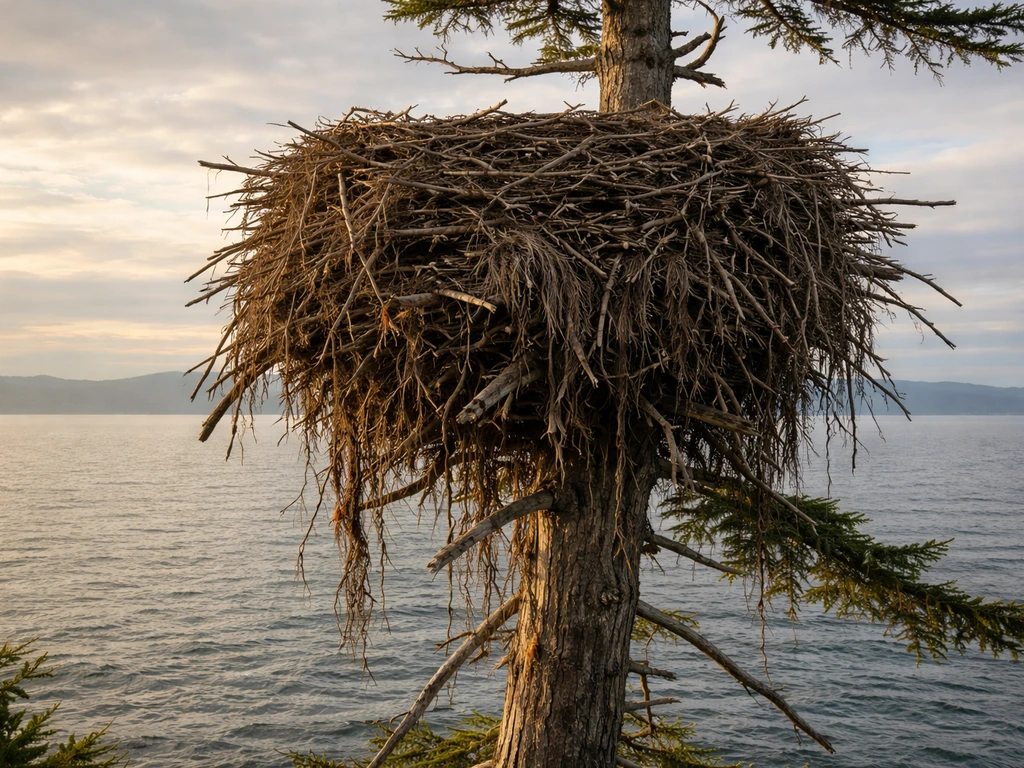
What Bird Builds the Biggest Nest? How to Identify It
Find the bird that builds the biggest nest, learn how to tell it apart, and what to do safely if you spot one.
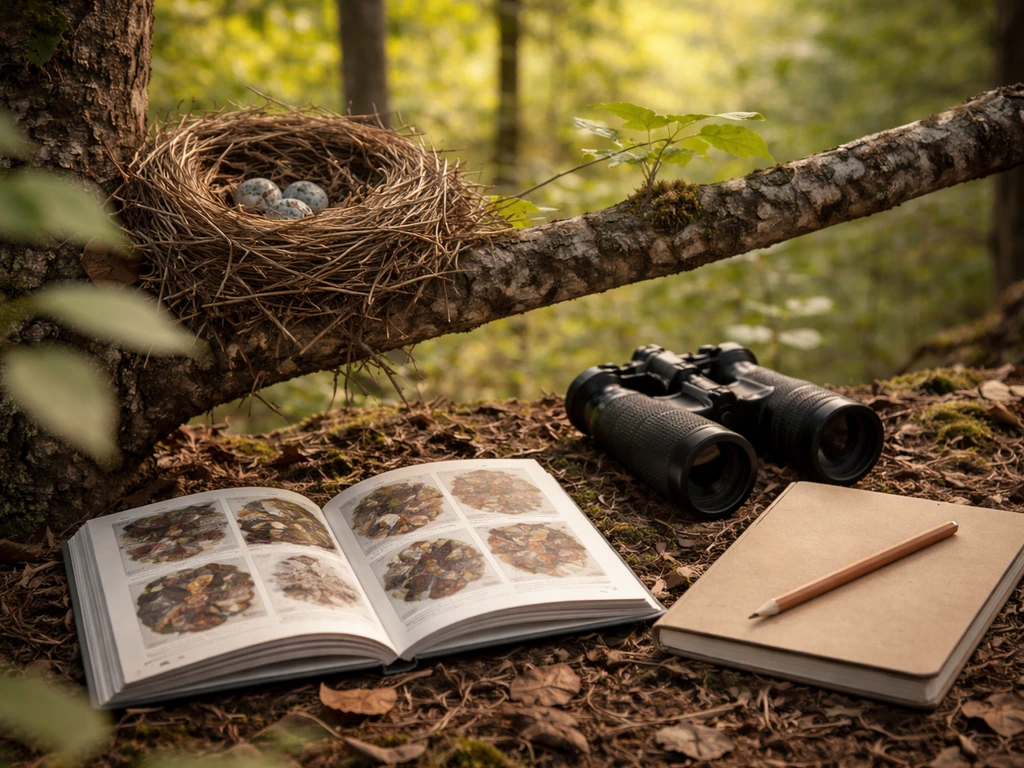
Peterson Field Guide to North American Bird Nests: How to Use It
Use Peterson bird-nest guide to identify nests by structure, eggs, and placement ethically and legally, with next-step t

How to Identify Bird Eggs Safely and Ethically
Safely and ethically identify wild bird eggs using shell traits, nest context, and next steps for documentation and repo