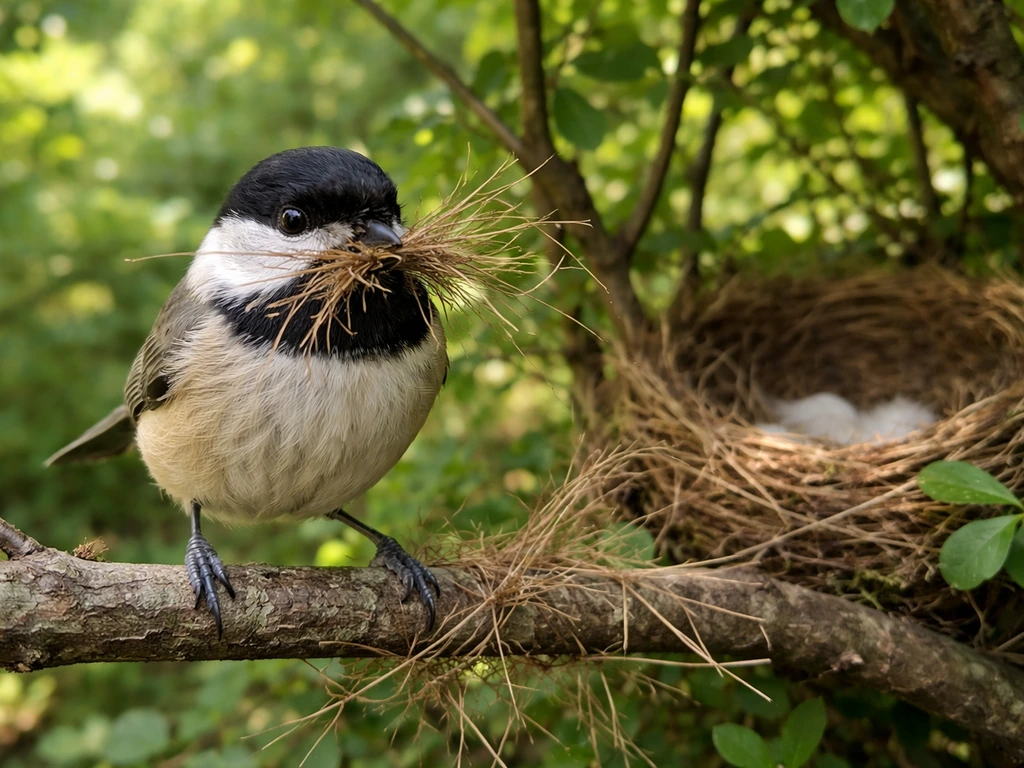
Yes, a nest is a bird's home, but only temporarily and only in very specific ways. Birds don't live in nests the way you live in a house. A nest is built for one job: keeping eggs and newborn chicks safe until they can survive on their own. Once that job is done, most birds abandon it entirely. That said, while an active nest holds eggs or dependent chicks, it is absolutely functioning as a home, and in most countries it's legally protected as one.
Is a Nest a Home for a Bird? How to Tell and What to Do

Maya Bennett
15 May 2026
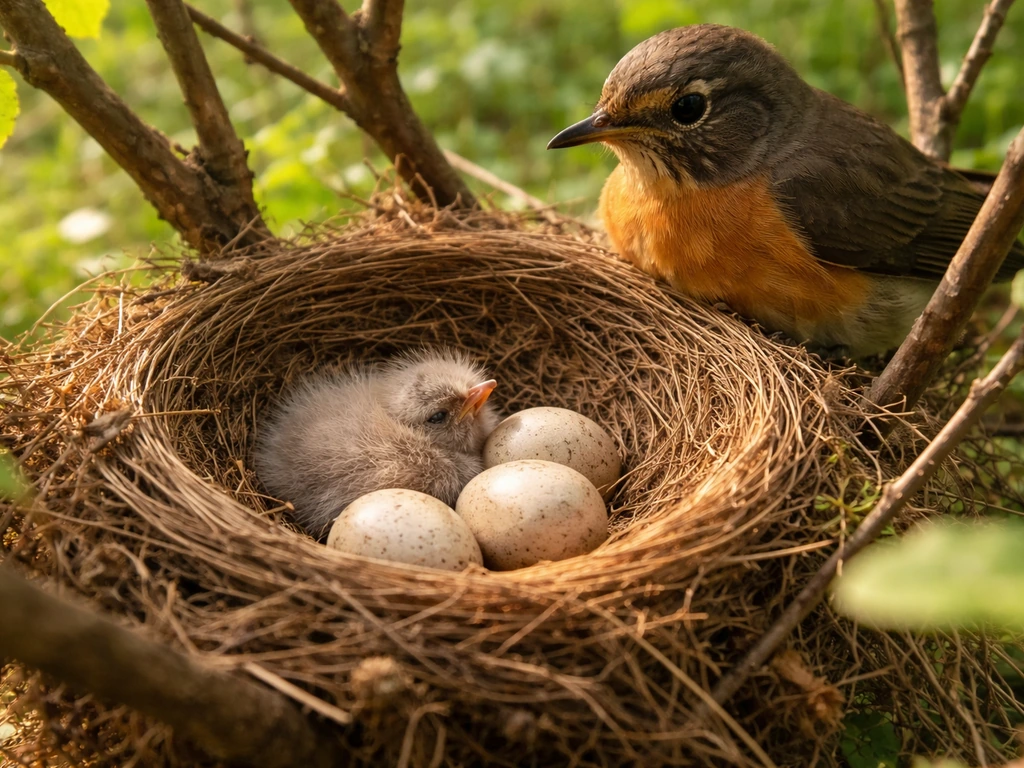
What birds actually use a nest for
The primary purpose of a nest is reproduction, not shelter. A bird builds or finds a nest to lay eggs, incubate them with body heat, and raise chicks to the point where they can fledge (leave the nest and survive independently). That process can take anywhere from about 10 days for a small songbird like a House Wren to several months for a large raptor like a Bald Eagle. During that window, the nest is intensely active, with adults visiting constantly to incubate, brood, and deliver food.
Roosting is a different story. Some species, particularly cavity nesters like woodpeckers and chickadees, do return to nest cavities or roosting boxes to sleep outside of breeding season. A few species like Eastern Bluebirds will pile into a box together on cold nights purely for warmth. But the open cup nests you find in shrubs, on ledges, or in gutters? Those are almost never used for sleeping once nesting is done. They degrade quickly from weather and parasites, and most birds don't bother with them again.
Some species do reuse nests across seasons. Bald Eagles add material to the same platform nest year after year, creating structures that can weigh over a ton. Ospreys, Ravens, and some hawks also return to the same site. But even in these cases, the nest is only a functional 'home' during the active breeding period, not year-round.
It's also worth knowing that not all bird nests look like what you'd expect. Beyond the classic woven cup, nests come in several structural types: scrape nests are just a shallow depression in the ground used by shorebirds and gulls; cavity nests are holes in trees or nest boxes used by owls, bluebirds, and woodpeckers; burrow nests are tunnels dug into soil by kingfishers and bank swallows; and platform nests are large flat structures used by herons and eagles. Each type functions the same way: a protected space for eggs and chicks.
How to tell if a nest is active or truly abandoned
This is the single most important thing to figure out before you do anything with or around a nest. Getting it wrong can have legal consequences and can cost birds their lives. The U.S. Fish and Wildlife Service defines an active nest as one with intact eggs, live chicks, or an adult bird present on the nest. If any of those three conditions are true, the nest is active, and in the US it is protected under the Migratory Bird Treaty Act.
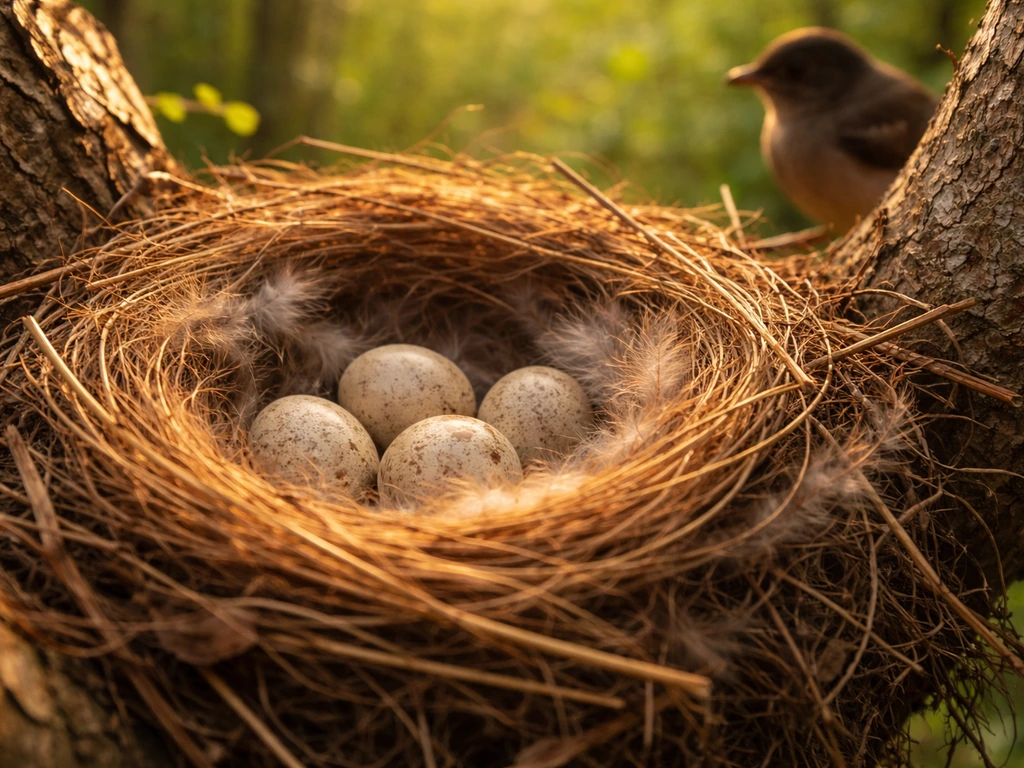
Here's where people get tripped up: a nest can look completely empty and still be active. Adults leave to forage, and they may stay off the nest for 20 to 30 minutes at a time, especially in warm weather when eggs don't need constant body heat. So a nest with eggs but no bird visible is still an active nest. Watch from a distance of at least 30 feet for 30 to 60 minutes before drawing any conclusions.
Signs the nest is active right now
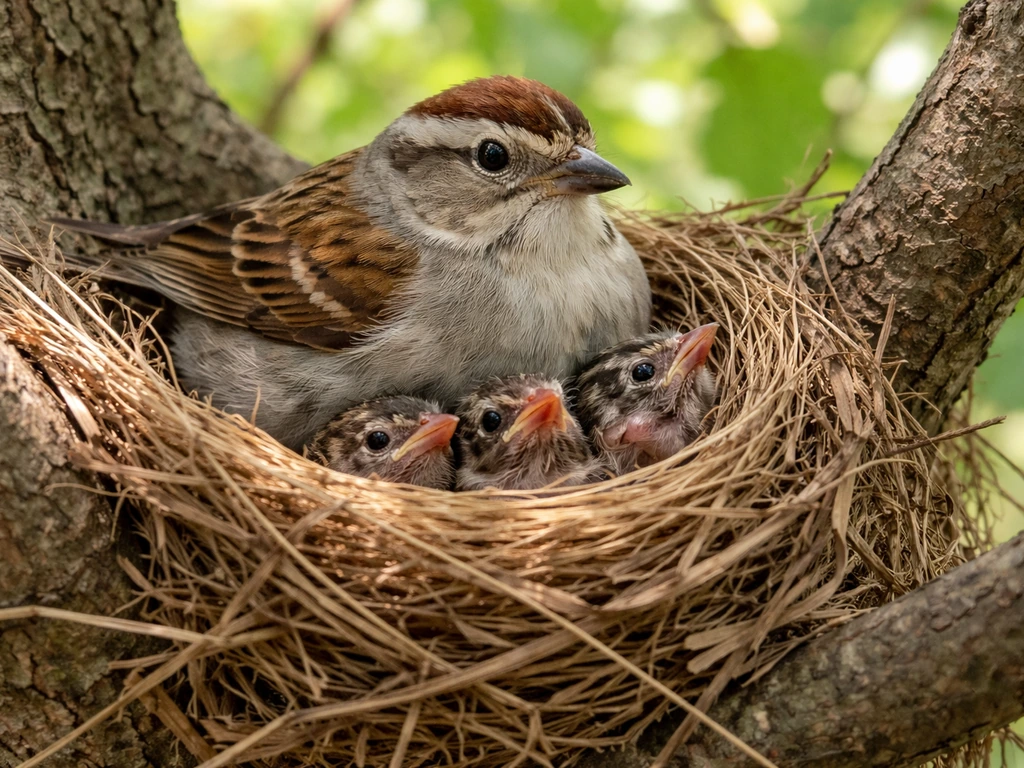
- Eggs or chicks are visible inside
- An adult bird is sitting on the nest (incubating or brooding)
- Adult birds are making repeated visits to the nest with food
- You can hear chick calls or begging sounds from the nest
- The nest material looks fresh, tightly woven, or recently added to
- There is fresh fecal matter (white wash) below or around the nest
- Adult birds are exhibiting alarm calls or distraction displays near you
Signs the nest is genuinely abandoned
- No adult visits after a full day of careful observation from a distance
- Eggs are cold, cracked, or have been sitting unincubated for more than 2 weeks with no activity
- Chicks are known to have fledged and no adults have returned for several days
- Nest structure is deteriorating: flattened, water-logged, covered in mold or debris
- It's mid-winter and the species is a known non-cavity-roosting type
- No alarm behavior from any adult bird when you approach slowly
One edge case worth flagging: partially built nests. Sometimes a bird starts a nest and abandons it before laying eggs, usually because the site was disturbed or the pair separated. A partially built nest with no eggs and no adult visits over several days is generally considered inactive. But if you find a nest with new material being added, that is an active nest under construction, and it's protected in the UK under the Wildlife and Countryside Act 1981, which covers nests that are 'in use or being built.'
Quick identification and safety do's and don'ts when you find a nest
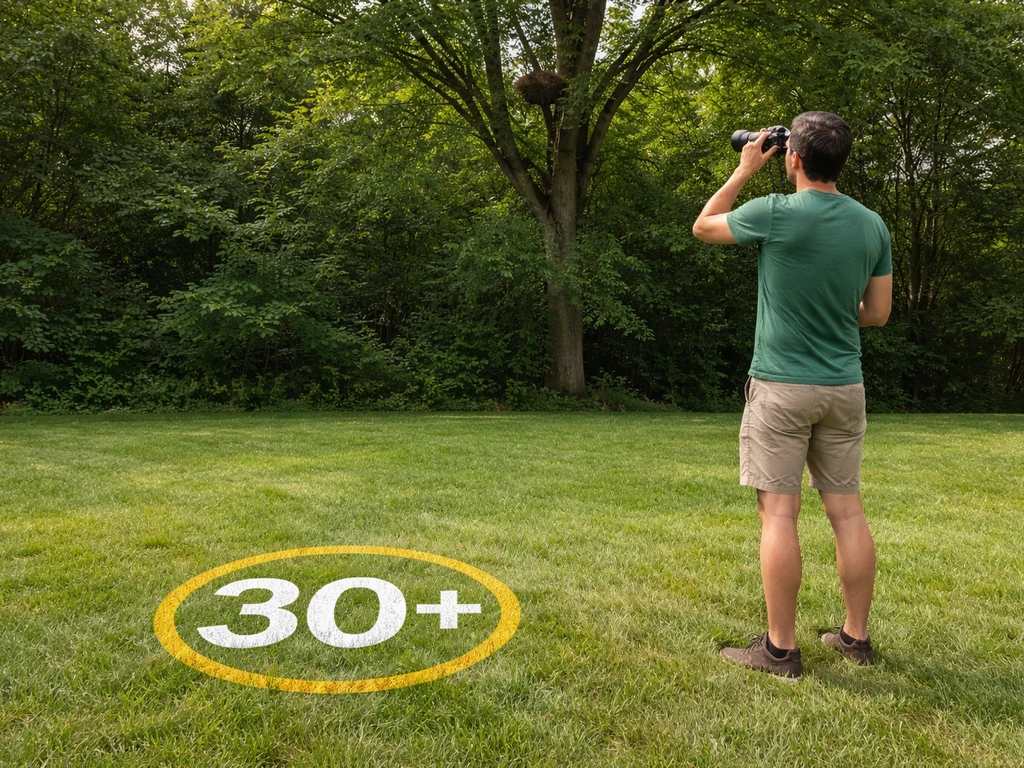
The moment you spot a nest, your first move should be to stop and observe, not approach. Here's a practical field routine you can follow anywhere: a backyard, a park, a construction site, or a building ledge.
- Stop at least 30 feet away and take a photo with your phone's zoom. Note the location, height off the ground, and what the nest is attached to.
- Observe for 30 to 60 minutes without moving closer. Note any adult visits, alarm calls, or chick sounds.
- Record what you see: nest size (rough estimate like 'fist-sized' or 'dinner plate'), materials (grasses, mud, twigs, feathers, human-made materials), and the presence or absence of eggs or chicks.
- If you need to identify the species, use a birding app like Merlin (Cornell Lab) by noting the adults visiting, not by handling the nest.
- Make a decision based on your observations: active (leave it completely alone), uncertain (come back and observe again the next day), or clearly inactive (proceed with caution and legal awareness).
| Situation | What to do | What NOT to do |
|---|---|---|
| Nest with eggs, adult present | Leave immediately, observe only from a distance | Approach, touch, photograph at close range, disturb vegetation around the nest |
| Nest with eggs, no adult visible | Watch from 30+ feet for 60 min before concluding anything | Assume it's abandoned; touch or move eggs |
| Nest with chicks | Keep all people and pets away; monitor quietly | Handle chicks, clean nest, add or remove material |
| Nest looks empty, recently built | Observe for adult returns over 24-48 hours | Remove or reposition the nest |
| Clearly old, degraded, empty nest (off-season) | Document and then you may remove if needed | Collect or transport the nest (possession rules apply in the US) |
When you can interfere, and when you absolutely cannot
The legal answer depends on where you are, but the practical answer is almost always the same: if the nest is active, you cannot legally or ethically interfere in the US, UK, or EU. In the US, the Migratory Bird Treaty Act makes it blank" rel="noopener noreferrer">illegal to destroy an active nest, defined as one containing intact eggs or live chicks. The law covers nearly all native North American bird species. The UK's Wildlife and Countryside Act 1981 goes a step further, blank" rel="noopener noreferrer">protecting nests that are in use or being built, not just those with eggs inside. The EU Birds Directive similarly prohibits deliberate destruction, damage, or removal of nests and eggs across member states.
The one clear exception, in the US at least, is an inactive nest. The USFWS explicitly states that destroying an empty, inactive nest is not prohibited under the MBTA, as long as you don't possess or transfer the nest material. That means you can take down an old, empty robin nest from your porch railing in January, but you can't legally keep it on your mantelpiece as a decoration without running into possession rules.
There are also specific exceptions for pest species and permits for certain professional activities like construction, but those require working with wildlife agencies and obtaining written authorization. If you're a homeowner or birdwatcher without a permit, your options during active nesting season are essentially: observe, protect from a distance, and wait.
Ethically, even when something is technically legal, the conservation-first standard is to err on the side of the bird. If you're not certain a nest is inactive, treat it as active.
Practical help if the nest is threatened
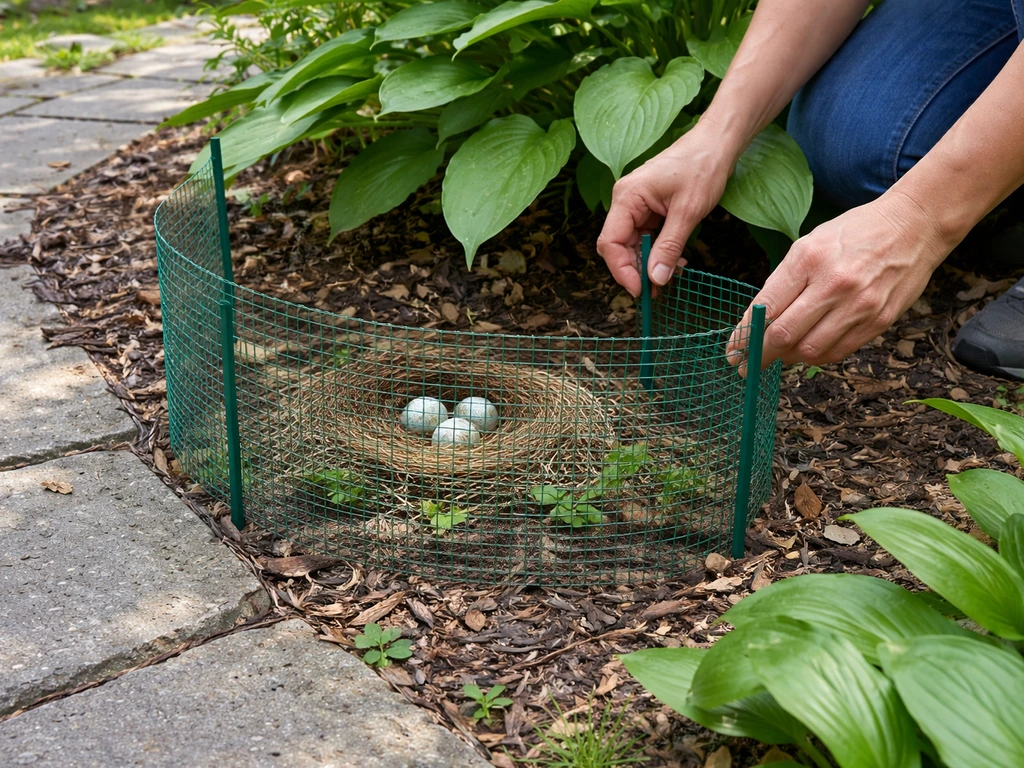
You can't move the nest, but there's often more you can do than you might think. The goal is to reduce the threat at its source while leaving the nest exactly where it is.
Predator threats (cats, raccoons, snakes)
If a cat is repeatedly circling a low-nesting bird's territory, the most effective and legal thing you can do is keep the cat indoors or in an enclosed run during peak nesting season (typically April through July in the Northern Hemisphere). You can also place a smooth metal baffle on the pole or tree trunk below a nest box, which physically prevents climbing predators from reaching the nest. For ground-nesting birds being targeted by cats or raccoons, temporary fencing (a loose ring of chicken wire about 3 to 4 feet in diameter around the nest site, staked at a distance) can deter casual predators without blocking adult bird access.
Weather threats (heavy rain, heat, wind)
If a nest is in a tree and a branch is at risk of breaking in a storm, contact a licensed arborist to evaluate whether the branch can be safely supported or braced without disturbing the nest itself. You should not prune near an active nest. For nests in exposed spots hit by direct sun in extreme heat, you can rig a temporary shade screen (a piece of shade cloth or burlap) attached to stakes or a fence at least 3 feet away from the nest and elevated so it blocks midday sun without obstructing adult flight paths. Do not drape anything over or touching the nest.
Construction and renovation conflicts
If you find an active nest in an area where work is scheduled, the most effective move is to halt or redirect work in that area until the nesting cycle is complete. For small songbirds, that's typically 4 to 6 weeks from the start of incubation to fledging. Mark a clear exclusion zone of at least 50 feet around the nest and brief anyone working on-site. If the timeline is truly immovable, contact your state wildlife agency or the USFWS for guidance on whether any authorized mitigation (not relocation) options exist for your situation.
What not to do: the most common mistakes
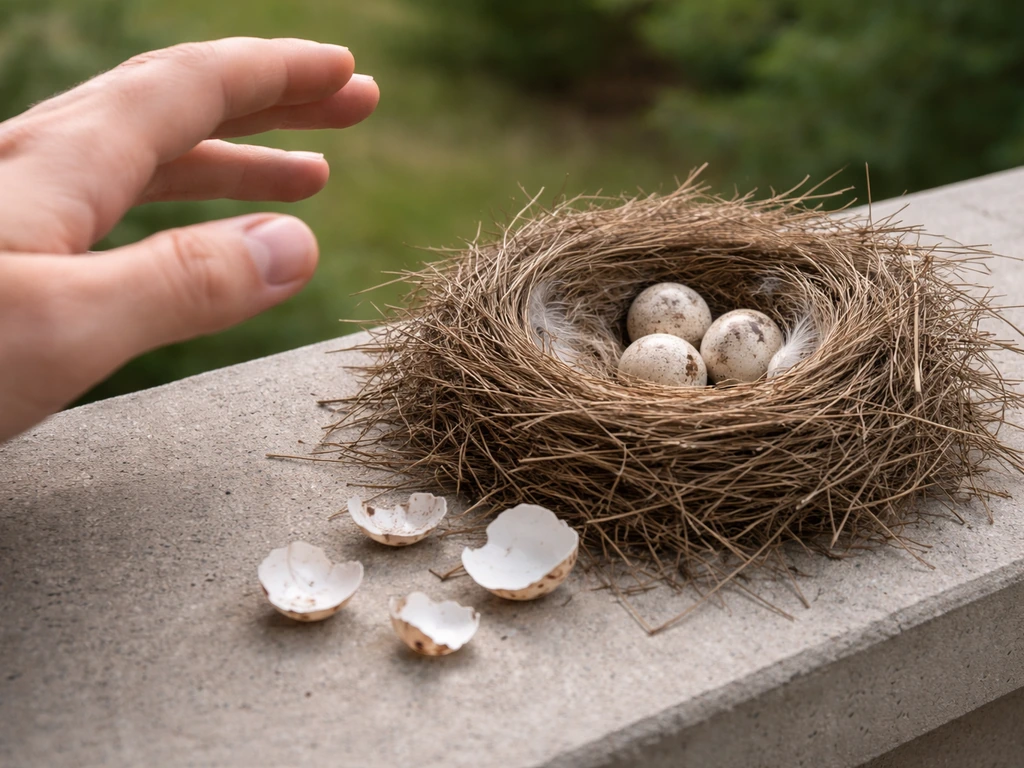
Most nest-related problems caused by well-meaning people come from the same impulse: wanting to help in a hands-on way. You can help a bird build a nest by focusing on safety and habitat-friendly support instead of handling the nest itself. Here's what to avoid, and why.
- Don't touch eggs or chicks. The myth that parent birds abandon young touched by humans is mostly false for most species, but handling does cause real stress, can lead to hypothermia in very young chicks, and is illegal when the nest is active.
- Don't relocate the nest. Even a few feet of movement can cause parents to abandon it, because birds use precise visual landmarks to find their nest. Moving it is also illegal while the nest is active.
- Don't clean out the nest while chicks are present. Removing fecal sacs, adding nesting material, or trying to 'improve' the nest disrupts behavior patterns adults rely on.
- Don't photograph at close range or with flash. Getting within a few feet for a photo, especially during incubation, raises the risk of flushing the adult bird and chilling the eggs.
- Don't remove an active nest to prevent a repeat next year. If a location keeps attracting nesting birds and you want to discourage it, make the site less attractive before nesting season begins, not during it.
- Don't try to raise a chick yourself without a permit. Rehabilitating wild birds requires a federal or state wildlife rehabilitation license in the US. If you find a chick on the ground, contact a licensed wildlife rehabilitator first.
How to observe and monitor a nest safely
Watching an active nest from a respectful distance is one of the most rewarding things you can do as a backyard naturalist, and it gives you the information you need to make good decisions. If you're wondering whether you can make a nest for a bird, the safest approach is to encourage natural nesting options and never interfere with an active nest can you make a nest for a bird. The key rules are distance, brevity, and consistency.
Set up an observation spot at least 30 feet from the nest, ideally with something between you and the nest (a window, a hedge, a parked car) so the adult birds don't register you as a threat. Watch for a defined window each day, say 15 to 20 minutes in the morning and 15 minutes in late afternoon, rather than making repeated passes. Take dated notes or use a simple app like eBird to log what you observe: number of adult visits per hour, presence of food (indicating chicks are present even if you can't see them), and any signs of disturbance.
If you want to track the nest more closely, a small weatherproof wildlife camera mounted on a stake or fence post (pointed at the nest from a distance, not placed directly on it) lets you review footage without disturbing the birds at all. This is genuinely the best tool available to a backyard observer today.
Who to contact when you need help
- US: Your nearest USFWS Ecological Services Field Office for legal questions about nesting disturbance, especially in a construction or development context.
- US: A licensed wildlife rehabilitator (find one at the National Wildlife Rehabilitators Association directory) if you have a downed chick or injured adult.
- UK: The RSPB Wildlife Enquiries line or your local Wildlife Trust for advice on protected nesting species.
- EU: Your national environmental or nature protection agency, as enforcement of the Birds Directive varies by member state.
- All regions: Cornell Lab of Ornithology's All About Birds site and Merlin app for species identification and nest-stage timelines, which can help you estimate how many more weeks a nest will be active.
One final thing worth knowing: the question of whether to let a bird build a nest somewhere in the first place, or whether to help a bird establish a nesting site, is a separate decision with its own set of considerations. Instead of training birds, the safest approach is to support natural nesting by providing the right habitat and nest sites for the species you want to attract provide the right habitat and nest sites.
If you're thinking about those angles too, they're worth exploring on their own. But if you've already found an active nest right now, the answer is clear: leave it alone, observe from a distance, protect the site from threats at the source, and wait it out. A typical backyard songbird nest cycle runs 4 to 6 weeks from first egg to fledging. That's not long to give a family of birds their home.
As the phrase suggests, birds often need a place to make a home for the night as a bird might give a family of birds their home.
FAQ
How can I tell if a nest is truly abandoned if I don’t see any birds on it?
Not necessarily. Many adults briefly leave to forage, and you might not see any birds even when eggs are still present. If an adult has visited within the last hour or two, or you see repeated food delivery, treat the nest as active. When in doubt, use the same distance and patience rule, 30 feet away and 30 to 60 minutes of watching before concluding it is abandoned.
Is it okay to touch a nest to relocate it away from danger?
Avoid it. Even touching or moving nearby branches, vegetation, or nest material can count as interference, and it can also cause adults to desert the nest. The safer approach is to protect the nest from threats (for example, keep cats indoors, install a baffle on the predator path, or fence ground access) without changing the nest environment.
If I watch regularly, how close can I get and still be helpful instead of disruptive?
Yes for observation plans, but it must stay consistent. Repeatedly walking close, returning many times, or changing your viewing spot can stress adults and increase predation risk because birds spend less time incubating and brooding. Pick one observation point and a short daily window, and keep noise and bright flash photography to a minimum.
Do nest boxes only matter during nesting season, or can they be used for roosting too?
A “nest box” can be used for more than breeding, especially by cavity nesters that roost there in cooler months. If you see birds entering and exiting, droppings near the entrance, or quiet overnight activity, assume it may be used and delay cleaning until after the breeding season and local guidance says it is safe.
If a nest looks old, can it still be protected or reused this year?
Yes. Some birds reuse nest sites in later seasons, so “old” nests in the same location might still be part of a future breeding cycle. Instead of removing anything, confirm whether the structure is being repaired or added to, if new material appears or adults show up, treat it as active under local protections.
What should I do if a nest is in a dangerous location and I need it cleared?
If you cannot confirm it is inactive, do not remove it yourself. Also, do not collect nests “for ID,” because possession rules can still apply even if you think it is empty. If it is in a safety-critical spot (for example, near power lines or blocking an exit), contact a licensed wildlife professional or the local wildlife agency for what they consider acceptable mitigation.
What are the safest practical actions I can take around an active nest?
Homeowner actions should be threat-focused, not nest-focused. Common safe moves during active nesting include keeping pets indoors, using a smooth baffle for nest boxes, adding temporary fencing for ground nests, and stopping work until the nesting window ends. Actions like pruning, scraping, spraying around the nest area, or using loud deterrents can unintentionally harm adults or chicks.
How long should I expect a nest to be active before I can safely resume normal yard work?
For most backyard songbird species, 4 to 6 weeks from the start of incubation to fledging is a good planning range, but it varies by species and weather. The key decision aid is nest activity, if eggs are intact or adults are still delivering food, the nest is active and protected, even if you think the “typical timeline” has passed.
Can a nest be partially built or look empty but still be active under the law?
Yes, and it matters. In the US, an “empty” nest can still be an active nest if it contains intact eggs or live chicks, and adults may be off the nest when you check. Also, partially built nests can become active if new material is being added, so avoid assuming inactivity based on appearance alone.
How can I document a nest (for interest or species ID) without increasing risk to the birds?
Use quick, non-invasive documentation. Count adult visits at your chosen observation window, note food deliveries (a sign chicks may be present), and record changes in the entrance activity. If you use a camera, mount it away from the nest so it does not vibrate, block flight paths, or force you to approach repeatedly to adjust settings.
Next Article
Can You Help a Bird Build a Nest How to Guide
Ethically help a nesting bird: identify needs, add safe materials and habitat, avoid handling, and troubleshoot setbacks