Weaver birds are the answer, and the specific species depends entirely on where you live. In South and Southeast Asia, the Baya weaver (Ploceus philippinus) is the classic bottle-nest builder. In sub-Saharan Africa, the Village weaver, Southern masked weaver, and Nelicourvi weaver all construct similar pendant or retort-shaped nests. In southern Africa's dry savanna, the Sociable weaver builds communal structures with individual flask-shaped entrance tunnels up to 25 cm (about 10 inches) long.
Which Bird Makes a Bottle-Shaped Nest? How to Identify It

Maya Bennett
26 Apr 2026
If you are in North America, you will not find a true bottle-shaped weaver nest in the wild, though a Baltimore oriole's deep pendant pouch is the closest structural lookalike you are likely to encounter. Audubon notes that Baltimore oriole nests are deep woven pouches with narrow entranceways about 2, 3 inches wide, which help provide better protection due to their deep cups and narrow entrances [deep pendant pouch is the closest structural lookalike you are likely to encounter](https://www. audubon.
org/magazine/how-orioles-build-those-incredible-hanging-nests).
The bottle-nest builders by region
| Species | Region | Nest shape & key trait | Typical season |
|---|---|---|---|
| Baya weaver (Ploceus philippinus) | South & Southeast Asia | Retort/bottle shape; long vertical entrance tube leading to a side-entry chamber | Monsoon season (roughly June–September) |
| Village weaver (Ploceus cucullatus) | Sub-Saharan Africa | Pendant oval; bottom entrance tube 4–8 cm long | Varies by latitude; colonies year-round in tropics |
| Southern masked weaver (Ploceus velatus) | Southern Africa | Compact pendant; bottom entrance hole | September–January (austral spring/summer) |
| Nelicourvi weaver (Ploceus nelicourvi) | Madagascar | Classic retort shape; entrance hose attached high on the side, at least as long as the nest body (12–22 cm) | Wet season |
| Sociable weaver (Philetairus socius) | Namibia, South Africa | Communal haystack with individual flask-shaped tunnels up to 25 cm | Mainly dry season; nests are permanent structures |
| Baltimore oriole (Icterus galbula) | Eastern North America | Deep woven pouch/pendant; open cup top, not a true tube entrance | May–July (breeding season) |
If your region is not listed above, the nest you found is probably not a true bottle-shaped weaver nest. It may be a lookalike, which the section below will help you sort out quickly.
How to confirm a bottle-shaped nest on site
A genuine bottle-shaped (retort-shaped) nest has a very specific silhouette that you can check without touching anything. Here are the five structural traits to look for before you do anything else.
1. Overall shape and entrance placement
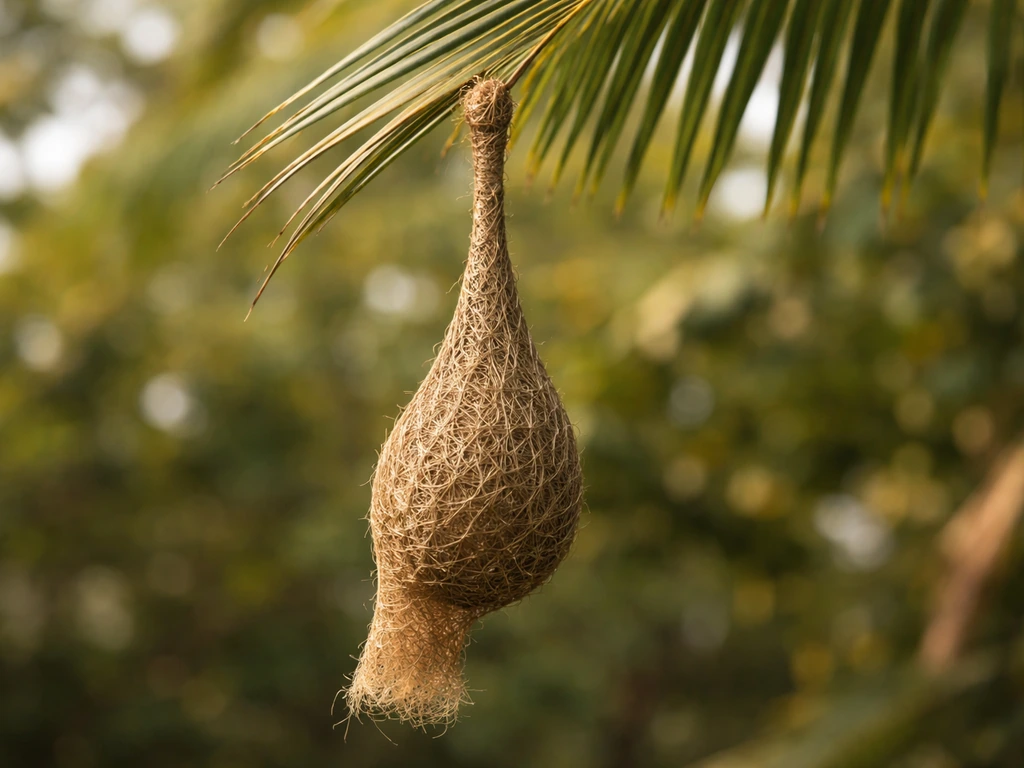
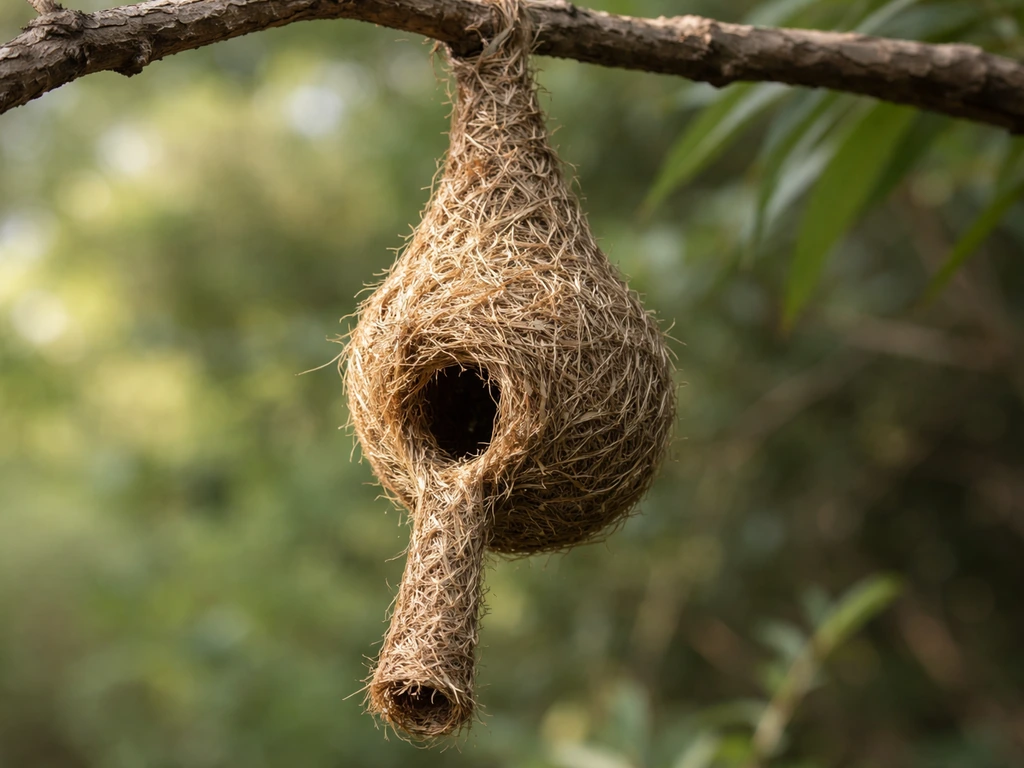
The body of the nest is an ovoid or globular chamber, and the entrance is not simply a hole in the side or top. It is an extended tube or 'neck' that protrudes away from the main chamber, either pointing downward or out to the side. For a Baya weaver, that vertical entrance tube is unmistakable. For Village weavers, the tube extends from the bottom. For the Nelicourvi weaver, the entrance hose is attached high on the side and is at least as long as the nest body itself. If the opening is just a small round hole with no neck or tube, you are likely looking at a different nest type entirely.
2. Suspension and attachment method
Weaver nests hang freely. They are woven onto a branch tip, palm frond, reed, or telephone wire so the nest swings independently. Baya weaver nests are almost always suspended over water, often from thorny acacias or palms. If the nest is wedged into a fork, built inside a cavity, or resting on a horizontal surface, it is not a bottle-shaped weaver nest.
3. Materials and weave
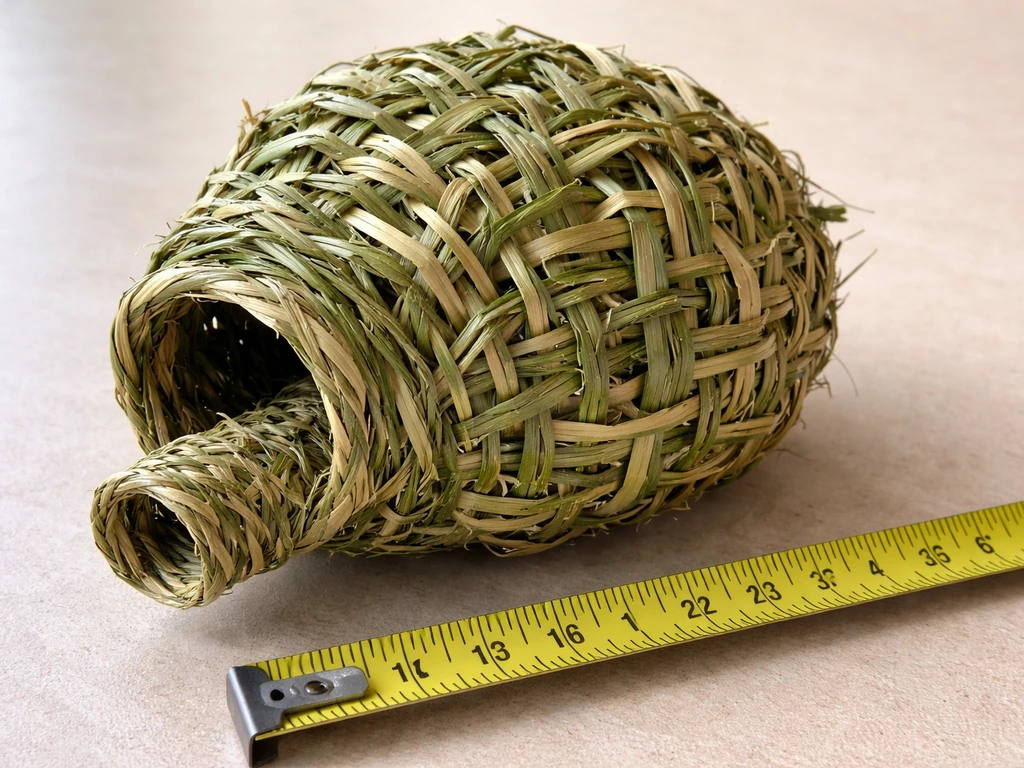
Weaver nests are tightly woven from long grass strips, palm fibers, or reed leaves. Run your eyes along the surface: you should see a consistent interlaced weave with no mud, no moss, and no feathers mixed in. The inside of a Sociable weaver tunnel is lined with soft material including plant fluff, fur, and sometimes cotton, but the outer structure is dry grass. A muddy or mossy exterior rules out the weaver family immediately.
4. Size reference
Village weaver nests measure roughly 14–17 cm long and 11–13 cm high, with an entrance tube of 4–8 cm. Nelicourvi weaver nest bodies are 12–22 cm high with a diameter of 10–18 cm. If you can safely photograph the nest next to a known object for scale (a water bottle, your hand, a ruler), do so. Size matters for ruling out smaller cup nests or larger platform nests.
5. Colony vs. solitary
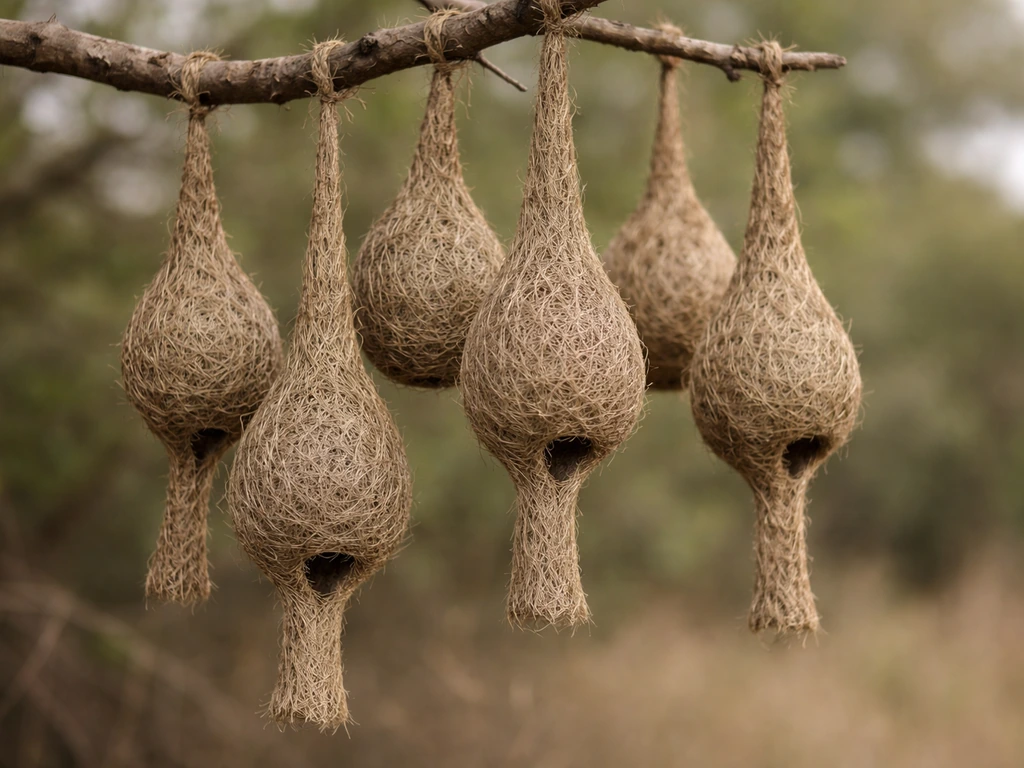
Most weaver species nest in colonies. If you see multiple pendant nests on the same tree or in the same grove, that strongly supports a weaver identification. A single isolated pendant nest in the right habitat is still worth investigating, but solitary nesting in your region may point you toward a different species or a lookalike.
Common lookalikes and how to rule them out fast
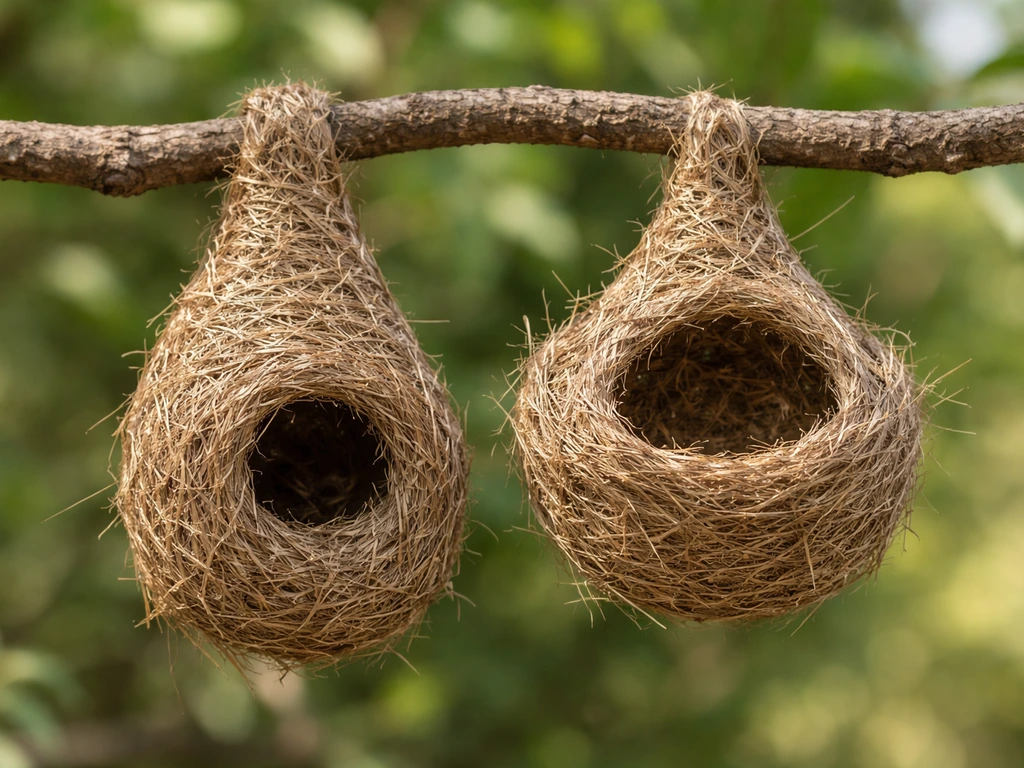
Several nests can look vaguely bottle-shaped at a glance, especially from a distance. Silhouette alone is not enough, and the Audubon Society notes that many nests can be deceptively disguised depending on placement and angle. Here is how to quickly separate the real thing from the runners-up.
- Baltimore oriole nest (North America): A deep woven pouch that hangs from a branch tip, but there is no entrance tube. The opening is at the top of the pouch, not a side or bottom tunnel. It is a pendant cup, not a bottle.
- Hanging cup nests (many species): Some nests look bottle-shaped when covered with leaves or debris. Check: is there actually a tube leading to the opening, or just an open cup that happens to look enclosed? Push nothing, just observe the entrance from multiple angles.
- Mud nests with narrow openings (cliff swallow, some horneros): These can look like a flask from a distance, but the material is hardened mud and the structure is attached flush against a wall or cliff face, not suspended freely.
- Cavity nests in hollow branches or pipes: A narrow entrance to a dark interior can appear tunnel-like, but the 'tube' is the cavity itself rather than a woven extension. Look for whether the entrance structure is woven or just a natural hole.
- Nests in man-made structures: Nests tucked into pipes, vents, or bottles look bottle-shaped because of the container, not because of the bird's design. If the outer 'bottle' shape is rigid and non-organic, the bird moved in, not built it.
If you are also trying to identify cup-shaped, cone-shaped, or small round nests nearby, those are distinct architectural categories with their own species sets. Many readers also want to know what bird makes a small round nest, which is a different architecture with its own likely builders.
If you are specifically trying to figure out which bird makes a cup-shaped nest in bushes, use the separate cup-nest guide to match the architecture and the builder cup-shaped, cone-shaped, or small round nests. A bottle-shaped or pendant nest like these is typically made by weaver-family birds rather than by a different cup-nest maker cup-shaped, cone-shaped, or small round nests.
The bottle or pendant shape is specific to weaver-family birds (and a few orioles) in a way that those other nest forms are not.
Where to find these nests and when
Baya weaver (South and Southeast Asia)
Look for Baya weaver nests in open farmland, grasslands, and scrub near water, particularly around rice paddies, sugarcane fields, and riverbanks. The birds favor thorny acacias and palm trees as anchor points, and they strongly prefer to hang nests over or very near water, which provides some predator protection. Breeding peaks during the monsoon season, roughly June through September. In April and May, males begin constructing the outer helmet stage of the nest to attract females, so early-season nests may look incomplete.
African weavers (Village, Southern masked, Nelicourvi)
Village weavers inhabit forest edges, gardens, and wetlands across sub-Saharan Africa and breed in noisy colonies. The Southern masked weaver nests from September through January in southern Africa, preferring acacia woodland and suburban gardens with large trees. In Madagascar, the Nelicourvi weaver occupies humid forest and is harder to spot because it nests lower in vegetation and is not a colonial breeder.
Sociable weaver (Namibia and South Africa)
The Sociable weaver's giant communal nest (which can weigh over a metric ton and house hundreds of birds) is found in Namibia and the Northern Cape of South Africa, usually on large camelthorn acacias or utility poles. The flask-shaped tunnels are visible from below. Unlike most weavers, these nests are used year-round for roosting, not just breeding, so you can find active nests in any season.
What to do if you find an active nest
The first and most important rule: do not touch it. Whether you are in the US, Canada, or elsewhere, active bird nests have legal protection. In the United States, most migratory bird nests are protected under the Migratory Bird Treaty Act (MBTA), and destroying an active nest (one with eggs or chicks) is illegal without a federal permit.
In Canada, amendments effective July 30, 2022 to the Migratory Birds Regulations prohibit damaging, destroying, disturbing, or removing any migratory bird nest that contains a live bird or viable egg. In Canada, the [Migratory Birds Regulations, 2022 prohibit damaging, destroying, removing, or disturbing a migratory bird nest](https://laws-lois. justice. gc.
ca/eng/regulations/SOR-2022-105/section-5. html? wbdisable=true) with specific conditions and exceptions elsewhere in the regulations. Even possessing a nest or egg without a permit is illegal under NestWatch's Code of Conduct guidance for the US, Canada, and Mexico.
Here is what you can safely do right now:
- Observe from a distance of at least 5–10 meters. Use binoculars or a telephoto lens rather than moving closer. Weaver birds are especially sensitive to repeated disturbance during the early nest-building and egg-incubation stages.
- Photograph the nest before approaching any closer. Capture: the full nest silhouette, the entrance tube angle and length, the attachment point, the surrounding habitat, and any birds you see entering or exiting.
- Note the time, date, and GPS location (your phone's camera may do this automatically). Record what birds you see nearby. This documentation is useful if you later contact a local naturalist or wildlife authority for a species ID.
- Check if the nest appears active. Signs of activity include: fresh grass or fiber additions to the structure, a bird sitting inside or entering, and fresh droppings below the nest.
- If you are unsure whether the nest is active or abandoned, treat it as active and leave it alone. An empty-looking nest may still have eggs or be temporarily unattended.
- Report unusual or unfamiliar nests to your local birding society, nature center, or a platform like NestWatch (Cornell Lab) or eBird, using your photos and notes.
Ethical protection for homeowners
If a bottle-shaped or pendant nest has appeared on your property, you have some real options to protect it without breaking the law or putting yourself at risk. Here is what you can actually do.
Predator mitigation
The birds have already done the smart thing by hanging the nest over water or from a thin branch tip. You can reinforce this by keeping cats indoors during the breeding season, especially in the hours around dawn and dusk when fledglings are most vulnerable. If the nest is in a tree you can access, a baffle or cone predator guard on the trunk below the nest anchor point can deter climbing predators like rats and snakes without disturbing the nest itself. Do not install anything that requires you to touch or move the nest branch.
Lawn and garden work near the nest
Postpone any pruning, trimming, or mowing directly beneath or adjacent to the nest until the breeding cycle is complete. For most weaver species, the full cycle from egg-laying to fledging is roughly 5–6 weeks. Mark the date you first noticed activity on your calendar and plan to resume normal maintenance after 6 weeks, or when you confirm the nest is empty and the birds have moved on. Do not use noisy power equipment within 10 meters of an active nest during incubation.
Legal basics you need to know
In the US, you cannot legally remove or destroy an active weaver or oriole nest without a permit from the US Fish and Wildlife Service, even if it is on your property. Inactive, abandoned nests (no eggs, no chicks, no active use) have different rules, but confirm the nest is truly abandoned before doing anything. In Canada, the prohibition on disturbing active nests applies regardless of where the nest is located, including private land. If you have a genuine safety concern (a nest is blocking a ventilation system, for example), contact your local wildlife authority or a licensed wildlife removal professional before taking any action yourself. Permits are available for limited circumstances, but they require a formal application.
When to call for help
Contact a local wildlife rehabilitator if you find a chick that has fallen from a pendant nest. Contrary to popular belief, briefly returning a fallen chick to the nest will not cause the parents to abandon it. If the nest itself has been damaged or blown down during a storm, a licensed wildlife rehabilitator can advise on whether the nest can be gently repositioned or whether the chicks need to come into care. Do not attempt to reconstruct or relocate a nest yourself without professional guidance.
FAQ
How can I tell if a pendant nest is truly bottle-shaped, or just similar at a distance?
A true bottle-shaped weaver nest should have a main globular chamber plus a distinct “neck” entrance tube that protrudes (downward or out to the side). If the entrance is only a small hole with no tube, it is likely a different nest type, even if it looks bottle-like from far away.
If I’m in North America, what bird should I suspect if I find a bottle-shaped-looking nest?
In North America, “bottle-shaped weaver” nests are not expected in the wild, so the closest lookalike is usually an oriole pendant pouch. Check for a protruding entrance tube from a chamber (weaver-style) versus a more pouch-like hanging nest (oriole-style), and confirm there is no muddy or mossy exterior.
Can I gently touch or open the nest to confirm which species made it?
No, you should not touch or move it to confirm. Instead, use photo-based clues: look for an entrance tube length, overall ovoid chamber size, and suspension method (hanging from a branch tip, reed, or wire). If you need safer verification, step back and use zoom rather than handling the nest.
What are common “false positive” signs that a bottle-shaped nest is not from a weaver?
Weaver nests are characteristically tightly interlaced and dry on the outside, with no feathers, no mud, and no moss in the outer weave. If the exterior is obviously damp, slimy, or covered with moss, you can rule out weaver-family bottle nests.
What measurement or structural detail matters most when choosing between Baya and Nelicourvi weavers?
Measure the entrance tube versus the chamber, and use habitat timing. For example, a Baya weaver’s vertical tube is a key clue, while Nelicourvi weaver nests tend to have a tube attached high on the side and with a neck length at least comparable to the body height.
How accurate do my measurements need to be to tell small cup nests from bottle-shaped nests?
Size overlap happens, but scale helps. Weaver bottle nests are generally smaller than large platform structures and not as bulky as some communal or roosting nests, so compare against a fixed nearby object (water bottle, ruler) and look at the presence of a neck tube, not just the overall shape.
What if I only see one bottle-shaped nest, not a whole colony?
Some weavers nest in colonies, but a single nest can still be a weaver. If you find only one pendant nest, rely more heavily on silhouette traits (neck tube and hanging suspension) and materials (dry, tightly woven outer structure) rather than the number of nests.
Can bottle-shaped weaver nests look unfinished, and does that change how I should handle the site?
Yes, there is seasonal variation in appearance. Early in the breeding cycle, males may have started the outer stages, so the nest may look incomplete. If you see a partially built chamber or only part of the tube, treat it as likely active and delay maintenance until the breeding cycle ends.
If the nest is wedged into a fork or placed on a horizontal branch, does that rule out weaver bottle nests?
It can. “Genuine” bottle or retort nests are woven and suspended, not wedged into a fork or placed on a horizontal surface. If it is firmly embedded in a cavity or sitting like a ledge, treat it as a different architecture and do not assume it is a weaver nest.
How do I know whether the nest is currently active enough to justify delaying pruning or mowing?
Feeding or migration timing does not determine legality, but it affects what you should do practically. If eggs, chicks, or clear begging/fledging behavior is present, keep everyone away and stop work beneath the nest. If the nest is truly abandoned and there are no viable eggs or live chicks, you may be able to manage the area according to local rules, but confirm first.
What should I do immediately if a chick falls from a pendant or bottle-shaped nest?
If a chick falls, contact a local wildlife rehabilitator, and do not attempt repeated “relaunching” or rebuilding. Also prevent further harm by keeping pets indoors and limiting human traffic near the nest area until help arrives.