If there's activity in a tree trunk near your yard right now, the most likely culprits are woodpeckers (either excavating a fresh cavity or reusing an old one), followed by cavity-nesting species like chickadees, nuthatches, small owls, and Wood Ducks. Some cavity nesters also make use of gourds, so they may be among the birds that nest in gourds. Which species you're dealing with depends heavily on five things: the entrance hole diameter, the height off the ground, the cavity type (freshly chiseled vs. naturally decayed), what materials are coming in or out, and how the birds are behaving around it. This guide walks you through each of those in order so you can land on a likely species today.
Which Bird Makes a Nest in a Tree Trunk? How to Identify

Maya Bennett
22 May 2026
How to tell a trunk-cavity nest from a branch nest
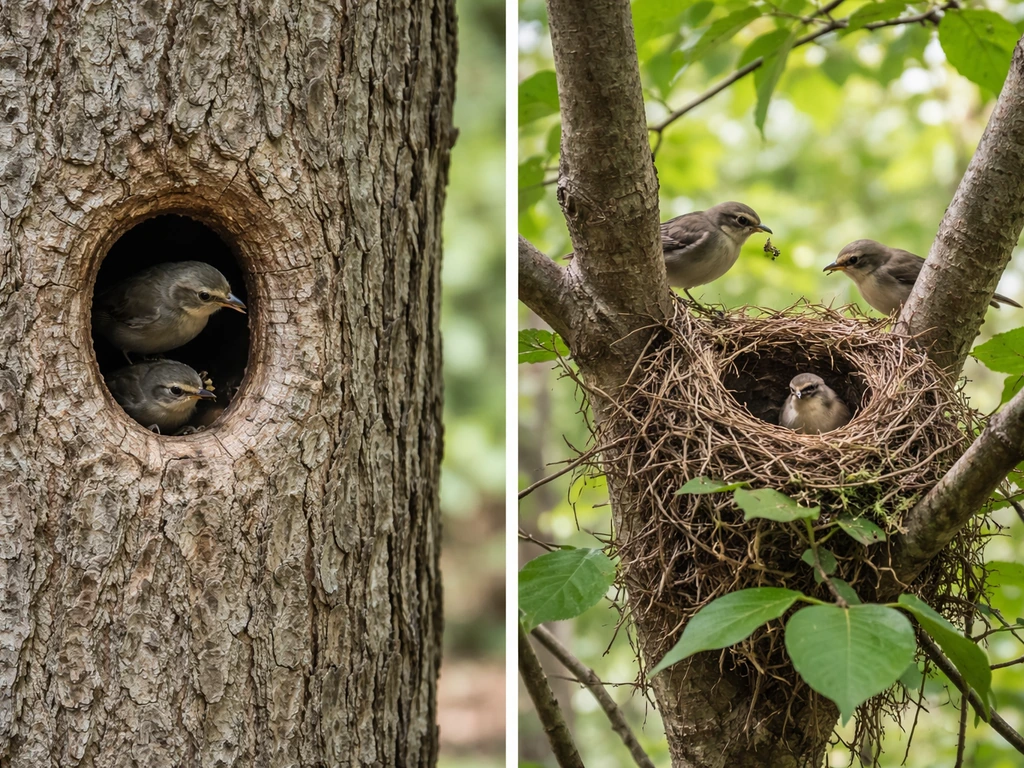
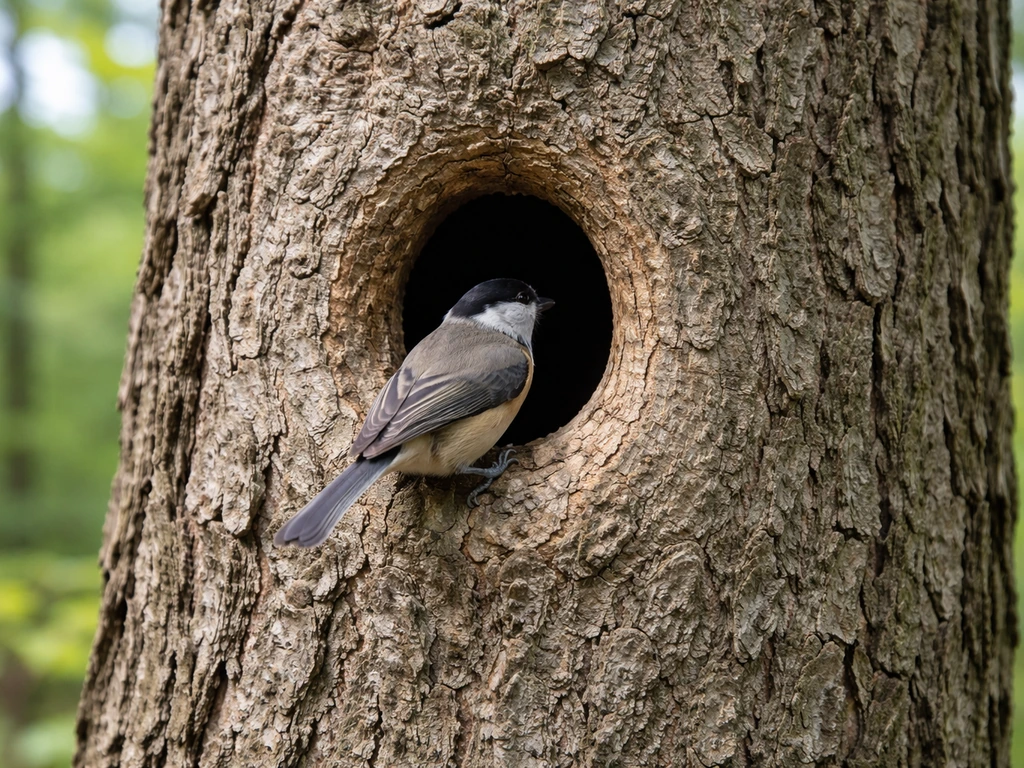
A trunk-cavity nest is inside the main stem of a tree, accessed through a discrete entrance hole. You'll see the birds disappearing into the trunk and reappearing from it, often carrying food or nesting material straight into the hole. A branch nest, by contrast, sits on top of or in the fork of a limb and is usually visible from outside: an open cup of sticks, grass, or mud. If you're looking at an open structure resting on a branch, that's not a trunk nest. If there's a hole and birds are going in and out, you've got a cavity nester.
One more distinction worth knowing: some birds nest in natural rot cavities (soft, irregular, often larger openings where the wood has decayed), while others excavate their own holes (clean, round or oval entrances with fresh wood chips at the base). A third group, called secondary cavity nesters, move into holes that woodpeckers or decay already created. Knowing which type of cavity you're looking at narrows your list immediately.
Common birds that nest in tree trunks (cavity nesters)
Here's the practical breakdown of who's most likely in your tree, split by whether they dig their own holes or borrow existing ones.
Primary excavators (they dig it themselves)
- Pileated Woodpecker: the largest North American woodpecker; carves large, distinctly rectangular entrance holes; cavity internal diameter around 20 cm, depth up to 75 cm; typically high on dead or dying trees
- Downy Woodpecker: smallest common woodpecker; round entrance hole roughly 3.2 cm (1.25 in) in diameter; nests in dead branches or trunks, often lower than Pileated
- Hairy Woodpecker: similar to Downy but larger; entrance hole about 4–5 cm; prefers larger-diameter dead trees
- Red-bellied Woodpecker: entrance about 5–6 cm; often uses soft or partially decayed wood; common in eastern and southeastern US
- Northern Flicker: excavates in softer wood; entrance roughly 6–8 cm; sometimes nests in utility poles or fence posts as well as trunks
- Black-capped and Carolina Chickadee: excavate in very soft, punky wood; entrance about 2.7–3.2 cm; nests low, often under 2 m
Secondary cavity nesters (move into existing holes)
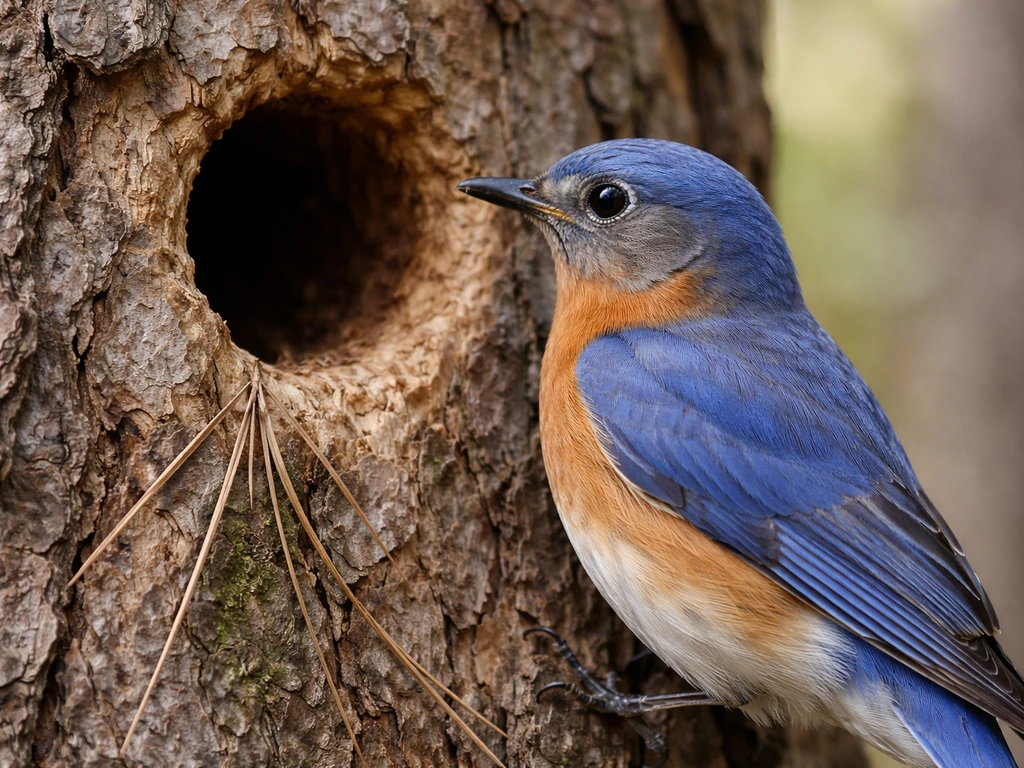
- Eastern Bluebird: uses old woodpecker holes or natural cavities; entrance about 3.8 cm; nests 1–6 m high; brings dry grass and pine needles into the hole
- Tree Swallow: prefers open areas near water; takes over old holes; entrance about 3.8–5 cm; may fight other species for the cavity
- White-breasted and Red-breasted Nuthatch: uses existing holes or natural cavities; entrance about 3–4 cm; you'll often see them plastering mud or resin around the hole entrance
- Great Crested Flycatcher: uses larger cavities; entrance 5–7 cm; famously lines the nest with shed snake skins
- Eastern Screech-Owl and Western Screech-Owl: use larger abandoned woodpecker cavities; entrance 7–9 cm; nocturnal entry makes daytime observation tricky
- Barred Owl and Great Horned Owl: use very large natural decay cavities or broken-top snags; no nest material brought in; typically high on large trees
- Wood Duck: needs a large cavity opening (about 10 cm or more); often near or over water; female lines with down feathers
- American Kestrel: smallest falcon; uses old flicker or similar holes; entrance about 7–9 cm; active in open habitats near woodland edge
- European Starling: aggressive secondary nester; will compete with and evict native species; entrance about 4–5 cm; nest a messy pile of grass and feathers
Observation checklist: entrance, cavity size, placement, materials, and behavior
Before you get into species ID, spend five to ten minutes at a comfortable distance (binoculars help a lot here) and record these five things. You don't need to get close to the hole.
- Entrance hole shape and diameter: Round holes suggest woodpecker excavation or secondary nesters. Rectangular or oblong holes point strongly to Pileated Woodpecker. Irregular, ragged openings suggest natural decay. Estimate or measure diameter: under 3.5 cm, 3.5–6 cm, 6–10 cm, or over 10 cm. A coin or your hand in a photo helps calibrate the size later.
- Height off the ground: Measure or estimate in meters. Chickadees often go low (under 2 m). Bluebirds and flickers range 1–6 m. Pileated Woodpeckers and owls typically go high, often 5–15 m or more on large snags.
- Tree condition: Is the tree dead, dying, or living? Dead or soft wood (snags) attract primary excavators. Living trees with decay pockets attract secondary nesters and natural-cavity species.
- Nest material being carried in: Dry grass and pine needles suggest bluebird or swallow. Feathers suggest Wood Duck, Tree Swallow, or Starling. Bark strips suggest nuthatches. Snake skin? Almost certainly Great Crested Flycatcher. Wood chips at the base of the trunk mean active excavation by a woodpecker.
- Bird behavior and timing: Woodpeckers are noisy and persistent when excavating. Secondary nesters make quieter, repeated short trips. Owls are usually invisible during the day; listen for calls at dusk. Multiple cavities on the same tree, especially more than 1 m apart vertically, suggest Pileated Woodpecker activity over multiple seasons.
Narrowing down to the likely species
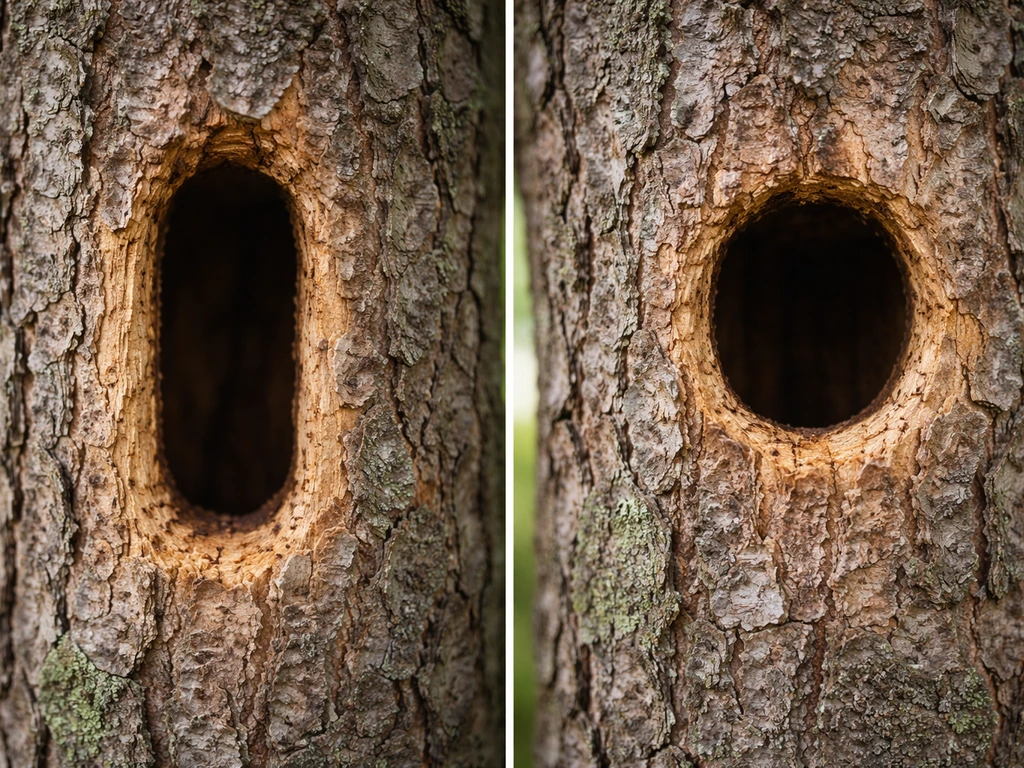
Use this decision framework in order. Each question narrows the list. Stop when you hit a confident match or a short list.
- Is the entrance hole rectangular or oblong? Yes: almost certainly Pileated Woodpecker. No: continue.
- Is the entrance hole under 3.5 cm wide? Yes: likely Downy Woodpecker or chickadee. If the wood is very soft and punky and the bird is small and energetic, lean chickadee. If the trunk is firmer, lean Downy.
- Is the entrance 3.5–5 cm wide? This is the most common range. If the bird is blue with a rusty breast, Eastern Bluebird. If it's iridescent and aggressive toward other birds, European Starling. If it's small, gray, and you see mud or resin smeared around the entrance, nuthatch. If it's near water and the bird has an iridescent green back, Tree Swallow.
- Is the entrance 5–8 cm wide and you're hearing loud calls? If the bird is large and tan-brown with a rufous tail, Great Crested Flycatcher. If it's the size of a robin with a red cap and cream belly, Northern Flicker. If it's tiny and falcon-shaped, American Kestrel.
- Is the entrance over 8 cm wide, high in a large tree? If near water and the bird is boldly patterned in white and iridescent green, Wood Duck. If you hear hooting at night, screech-owl or Barred Owl. If nothing goes in or out during the day and the cavity looks like a broken or rotted top, possibly a Great Horned Owl.
- Still unsure? Check for wood chips at the base (active excavation, so a primary woodpecker is drilling), look for multiple holes on the same trunk (Pileated), or listen for the bird's call and use a free app like Merlin to match it.
Common look-alikes and how to tell them apart
| Confusion pair | Key difference |
|---|---|
| Downy vs. Hairy Woodpecker hole | Hairy hole is noticeably larger (4–5 cm vs. 3.2 cm) and the bird itself is much bigger |
| Chickadee vs. Downy hole | Chickadee wood is punky and soft; Downy drills into firmer wood; chickadee entrance is rounder and often lower |
| Bluebird vs. Starling | Starlings are larger, louder, and will evict bluebirds; their nest is messier and they bring more feathers; bluebirds are shy and quieter at the hole |
| Natural rot cavity vs. excavated hole | Rot cavity has irregular, ragged edges and no wood chips; excavated hole has clean edges and fresh chips on the ground |
| Screech-owl vs. no occupant | Screech-owls often roost at the entrance in morning sun; look for a small, ear-tufted head peering out at dawn |
| Pileated vs. large rot cavity | Pileated holes have a clean, rectangular cut; rot cavities are irregular; multiple oblong holes on one snag is a Pileated signature |
What to do today: safe, non-invasive steps and evidence to collect
The goal right now is to gather solid evidence without disturbing the nest. Here's what to do immediately.
- Set up at a distance of at least 10–15 meters with binoculars. Watch for 10–15 minutes during active times (mid-morning is usually good; dawn and dusk for owls). Don't stand directly in front of the hole.
- Take photos from a distance with a telephoto lens or zoom. Photograph the full tree, the entrance hole with something for scale if possible, and any birds you see entering or exiting. Avoid flash. If you must use flash to capture a detail, one shot only, and make sure no predators are nearby.
- Note the entrance hole diameter as accurately as you can from your photos. A tennis ball is 6.7 cm, a golf ball is 4.3 cm, a quarter is 2.4 cm. Compare the hole to an object at the same distance.
- Note the height. Count branch stubs, compare to your own height, or use a free measurement app on your phone.
- Check the ground at the base of the tree for wood chips, droppings, or ejected nest material. Fresh wood chips confirm active excavation. White streaking on bark below the hole suggests regular use.
- Keep your visit to under one minute if you do need to approach for a measurement. Step away immediately if the adult bird appears distressed or stops returning to the cavity.
- Log everything: date, time, weather, tree species if known, hole dimensions, materials observed, bird behavior. A simple phone note works fine. This information is useful if you later contact a wildlife agency or want to report a sighting to a citizen science platform like eBird or NestWatch.
If you can't see the entrance directly (it's very high or on the far side of the trunk), focus entirely on behavior: watch where birds land before disappearing, note the direction they fly in from, and listen for sounds coming from inside the trunk, especially the soft peeping of chicks. A trail camera positioned near the base and angled up can be a non-invasive way to capture arrivals and departures without you being present at all.
Legal and ethical rules for active nests
This is the part most people skip, and it's the part that can get you into real trouble. In the United States, the blank" rel="noopener noreferrer">Migratory Bird Treaty Act (MBTA) makes it illegal to destroy a nest that contains eggs or chicks, or where young birds are still dependent on the nest. blank" rel="noopener noreferrer">The USFWS defines an active nest as one containing viable eggs and/or chicks, from the time the first egg is laid until fledged young are no longer dependent on it. That means you cannot remove, block, or interfere with the cavity while it's in active use, full stop.
In Canada, the 2022 Migratory Birds Regulations (effective July 30, 2022) prohibit damaging, destroying, disturbing, or removing a migratory bird nest that contains a live bird or a viable egg. Both frameworks make clear that disturbance of an occupied, active nest is a federal offense, not just a guideline.
What you can legally do varies by situation, but these rules apply universally to active nests:
- Do not block or seal the entrance hole while birds are inside or eggs/chicks are present
- Do not cut down, trim, or significantly disturb the tree during the nesting period
- Do not remove nesting material from inside the cavity
- Do not use noise, lights, or physical contact to drive birds away from an active nest
If the nesting tree is in a dangerous location (leaning toward your house, diseased and likely to fall), contact a certified arborist and a local wildlife rehabilitator or your state/provincial wildlife agency before doing anything. They can advise on whether a permit or exception applies in your specific case. Do not assume safety concerns automatically override nest protection law. They often don't.
European Starlings and House Sparrows are not protected under the MBTA in the US, which means their nests can legally be removed even when active. Check your state and local rules, but this is the federal baseline. In Canada, Starlings are also not on the migratory bird protection list, so similar rules generally apply. If you're not 100 percent sure of the species, treat the nest as protected.
When to contact an expert
- The tree poses an imminent structural hazard and you need to act before the nesting period ends
- You find a chick or fledgling on the ground near the cavity (contact a licensed wildlife rehabilitator, not animal control)
- You suspect the species is a protected raptor (owl, kestrel, flicker) and you're unsure of your legal obligations
- You're a property manager or contractor with a project timeline that conflicts with an active nest
- You've observed the nest for several days and cannot identify the species despite your best efforts
Seasonal timing and what to do after nesting ends
Most cavity nesters in North America are active from March through August, with peak egg-laying in April and May. If you're reading this in late May 2026, there's a good chance eggs are already present or chicks are being fed. That means the best thing you can do right now is observe, document, and wait. The average incubation period for most small cavity nesters is 12–18 days, and young fledge in another 2–4 weeks after hatching. Most nests are vacated by early to mid-August.
| Species group | Typical nesting window | Fledging timeline |
|---|---|---|
| Woodpeckers (Downy, Hairy, Flicker) | April to June | Chicks fledge ~24–28 days after hatching |
| Pileated Woodpecker | April to June | Chicks fledge ~26–28 days after hatching |
| Chickadees and Nuthatches | April to June | Chicks fledge ~16–19 days after hatching |
| Eastern Bluebird | March to July (2–3 broods) | Chicks fledge ~17–21 days after hatching |
| Great Crested Flycatcher | May to July | Chicks fledge ~13–15 days after hatching |
| Screech-Owl and small owls | March to May | Young leave cavity ~28–32 days after hatching |
| Wood Duck | March to May | Ducklings jump from cavity within 24 hours of hatching |
| Tree Swallow | April to June | Chicks fledge ~18–22 days after hatching |
Once you're confident the nest is inactive (no birds entering or exiting for at least a week, no sounds from inside), you can legally address the situation. This is the right time to consult an arborist about tree health, clean out the old nest material if it's a cavity you manage (like a nest box you've retrofitted or a low accessible hole), or install a predator guard on the trunk if you want to discourage future nesting in a problematic location. If you want to attract the same species back next year, leave the cavity intact. Many species reuse the same site in following seasons, and woodpecker cavities created one year are often occupied by secondary nesters the next.
If you found birds nesting in a spot that creates a recurring problem (like a trunk cavity adjacent to a structure), fall and winter are the time to consult a wildlife professional about long-term solutions. Cavity nesters will return to the same trees year after year if the habitat is right, so planning ahead after this nesting season is far more effective and legal than reacting during it.
Quick-reference: if you see X, it's likely Y
| What you observe | Most likely species |
|---|---|
| Rectangular hole, large chips, bird the size of a crow with red crest | Pileated Woodpecker |
| Round hole ~3.2 cm, small black-and-white bird, dead branch or snag | Downy Woodpecker |
| Round hole ~3 cm, very soft punky wood, tiny bird, low on trunk | Black-capped or Carolina Chickadee |
| Round hole ~3.8 cm, bird bright blue with rusty chest, dry grass carried in | Eastern Bluebird |
| Round hole ~4 cm, gray bird smearing mud or resin around entrance | White-breasted or Red-breasted Nuthatch |
| Large hole 5–7 cm, bird tan-brown with rufous tail, snake skin in nest | Great Crested Flycatcher |
| Hole 6–8 cm, large brown-and-white bird, spotted breast, drumming sound | Northern Flicker |
| Hole 7–9 cm, high on tree, hooting at night, nothing visible by day | Screech-Owl or Barred Owl |
| Hole 10+ cm, near water, bold green-and-white bird, female with crest | Wood Duck |
| Hole 4–5 cm, messy nest, noisy and aggressive bird chasing others away | European Starling |
| Irregular ragged opening, no chips, no bird seen yet | Natural decay cavity (secondary nester possible; keep watching) |
If you're also dealing with birds using unusual or built structures near your property, many of the same identification principles apply whether a bird is nesting in a roof space, inside a garage, or in other non-tree locations. The entrance size, behavior, and materials are always your first three clues, wherever the nest turns out to be. A related question is which bird makes a nest in a cactus plant, since cactus-dwelling species look for protected, dry structure to raise young which bird makes nest in a cactus plant.
FAQ
If I see a single hole in the tree trunk, does that mean it’s a woodpecker?
Woodpeckers are the most common answer when you see a discrete hole in the trunk and birds repeatedly excavate or rapidly reinforce a cavity. If you notice clean, fresh wood chips at the base and a fairly round entrance, that points more toward active excavation than reuse. If the hole looks old, irregular, or enlarged by rot, it is more likely decay or a secondary cavity nester using an existing space.
How can I tell if it’s a true trunk cavity nest versus something else using the trunk?
A branch nest is usually open and visible, or it sits in a fork with an external cup of sticks or plant material. A trunk cavity nest will have birds disappearing through a specific entrance hole and often shows little to no open structure on the outside. If you can find a “hole” but no actual internal cavity access behavior, recheck for openings made by insects, tree damage, or chimneys from animal activity.
Can entrance-hole diameter alone tell me which bird is nesting in the tree trunk?
Entrance size is useful, but only when paired with behavior. Woodpecker holes are often fairly consistent in shape and come with excavation sign (new chips) when being made or refurbished. Some cavity nesters will not excavate, so you may see no fresh chips and only see birds carrying food directly into the hole. If you can measure the opening, do it only from a distance, and compare to your general “small cavity” versus “larger cavity” categories rather than treating it as a precise ID tool.
What if there’s no fresh wood chips at the base, but birds are still going in and out?
Yes, some birds use holes made in earlier years. When you see birds still active but there are no fresh chips at the base, that often suggests reuse by a cavity nester or a secondary cavity nester rather than fresh excavation this season. Also look for a steady routine of visits, because true re-excavators usually show more irregular timing early on.
When is it safe to remove material, add a guard, or repair the tree?
The “best time to act” depends on whether the nest is active. If you detect any chick peeping or ongoing arrivals and departures, treat it as active and do not block the cavity, even if the tree is in a risky location. If there has been no sign of activity for at least a week and you cannot hear any sounds from inside, that is when professionals commonly schedule any repairs, clean-out, or exclusion steps.
What should I do if I cannot clearly see the entrance hole in the trunk?
If the entrance hole is high or around the far side, you can still ID reliably by watching where birds land before disappearing, which direction they fly in from, and whether their carry-in is food versus building material. A trail camera aimed at the base and angled upward can help capture consistent “visit patterns” without you being near the entrance. Avoid repeated direct approaches to the hole, because that increases disturbance.
What if I’m not sure which bird it is, can I still remove the nest if I’m worried about safety?
Yes, treat species uncertainty as “protected” in practice. The article notes that some non-native species are not covered like most native cavity nesters, but the safe approach is to assume protection if you are not sure. If the birds are clearly active and you need tree work or removal for safety, contact a local wildlife agency or permitted professional first, because the correct fix may be different from simply timing it.
The tree feels unsafe. Does danger let me ignore nesting protection?
If the cavity is in a dangerous spot, you usually cannot “solve” it by removing the nest during incubation or chick dependency. Instead, coordinate with an arborist plus a wildlife professional to determine the least disruptive timing and method. In many cases, the legal pathway is about how and when the work is done, not about skipping the protection rules altogether.
How can I confirm whether the species is European Starling or House Sparrow before taking action?
European Starlings and House Sparrows are commonly treated differently from native cavity nesters in the US. However, the practical safeguard is still to confirm what you’re actually seeing, because misidentification happens and local rules can be stricter. If you are unsure whether the bird is one of those two or a protected native, handle it as protected and avoid touching the cavity.
Do cavity nesters reuse the same tree hole, and should I leave it alone?
Some species reuse the same cavity or the same general location, especially when the site is a good fit for their nesting cycle. That means if you manage the problem location, you should plan for exclusion or predator deterrence after the season, not mid-season. Leaving a cavity intact can be appropriate when it is not causing a safety or property issue, because reuse is common.
Next Articles
There Is a Bird Nest in My Garage: What to Do Today
Step by step actions for a bird nest in your garage: identify life stage, avoid harm, handle legal rules, and safely cle
What Bird Is Nesting in My Roof? Identify and Act Safely
Identify roof nesters, assess if active, stay safe, and use humane deterrents and prevention after fledging.
Should I Let a Bird Build a Nest? What to Do Today
Decide if to let a bird nest, how to check activity, avoid disturbance, and handle conflicts safely and legally.