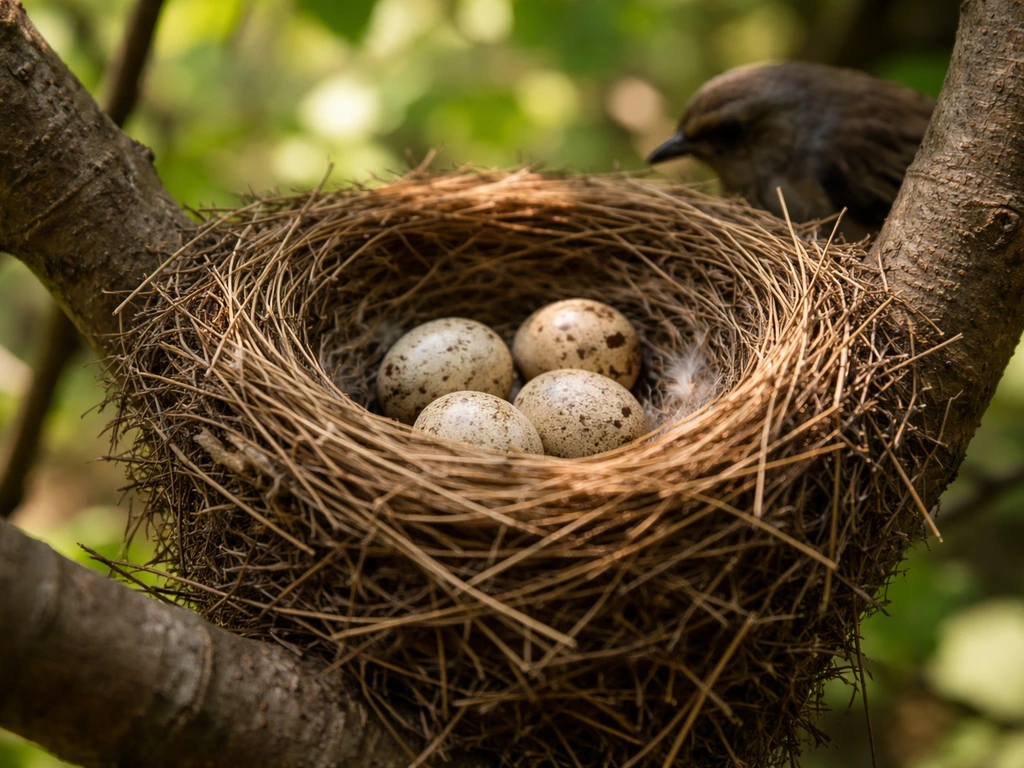
A sociable weaver nest looks like a massive haystack wedged into a tree. We're talking about a rounded, thatched mound that can reach over 5 meters (16 feet) wide and 1.5 meters (5 feet) tall, built from coarse grass straws with a rough outer layer of thorn twigs. The whole thing sits in the canopy like a permanent fixture because it is one: active colonies maintain and add to the structure year-round. If you're standing underneath one, you'll see dozens of small tunnel openings poking out of the flat or gently curved underside, each one the private entrance to a single nesting chamber. That underside full of tunnels is the single most diagnostic thing to look for.
What Does a Sociable Weaver Bird Nest Look Like?

Maya Bennett
11 May 2026
What it looks like from a distance: shape, size, and first impression

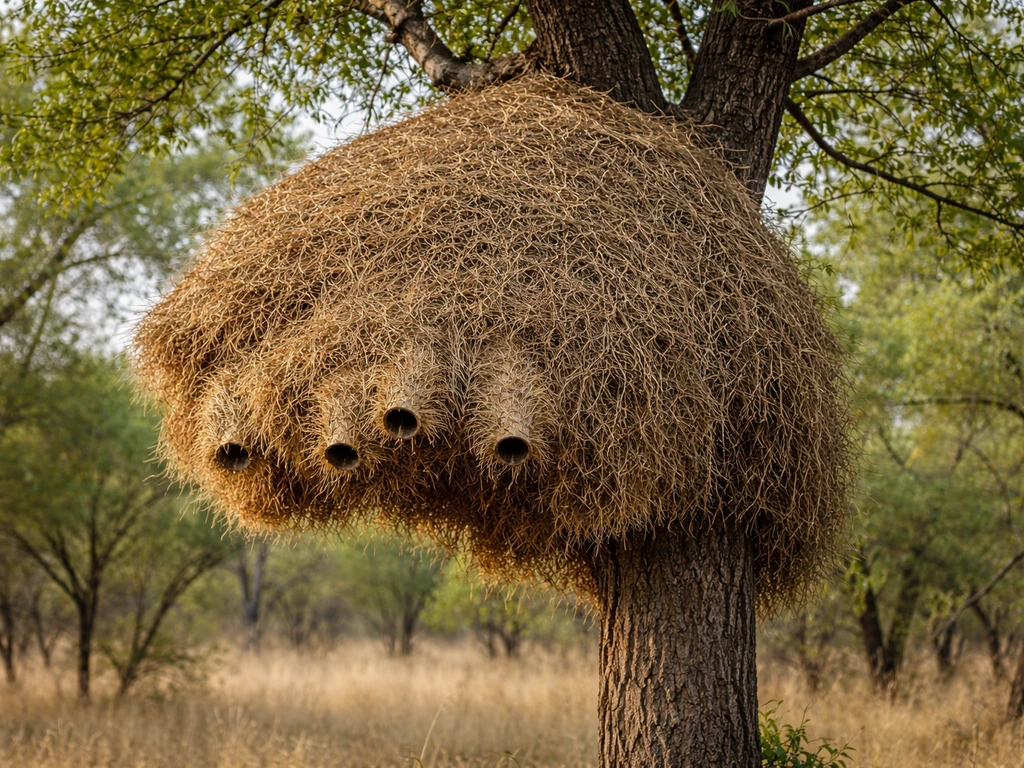
From 50 meters away, your first thought is going to be 'how did that pile of hay end up in a tree?' That's not a bad way to think about it. The overall form is a thick, dome-shaped or oblong mound with no sharp edges, built on top of large branches or in the fork of a tree. If you're still wondering what a bird nest looks like in general, focus on overall shape, size, and where the entrances are located what does a bird nest look like. The exterior surface looks rough and shaggy, like a tightly packed thatch roof, because that's essentially what it is: the birds construct a continuous superstructure of coarse grass straws and thorn twigs over the entire colony to shed rain and regulate temperature.
Size is one of the most useful ID cues you have. A mature colony nest can be roughly 7.5 meters (25 feet) wide, though nests of 5 meters are more typical. Height usually falls around 1 to 1.5 meters. The whole mass can weigh enough to eventually bring down the branch or tree supporting it, which gives you a sense of the scale. For reference, the birds building it are only about 13 to 14 cm long and weigh around 27 grams each. A tiny bird, an enormous nest. That contrast alone is remarkable.
Common host trees in southern Africa's Kalahari region include camelthorn acacia (Acacia erioloba), shepherd's tree (Boscia albitrunca), and quiver tree (Aloidendron dichotomum), as well as telephone poles and water towers where suitable trees aren't available. Spotting the nest in one of these trees, or on a utility structure in an arid, open landscape, puts you well on your way to a confident ID.
Up close: entrance tunnels, texture, and interior details
Once you move closer and look at the underside of the nest, you're looking at the real heart of the identification. If you're comparing to other birds, knowing what a chickadee nest looks like will help you sort out differences in shape and materials identification. The underside surface is studded with entrance tunnels, each one a circular or oval opening leading upward into an individual nesting chamber. If you're trying to identify a finch nest instead, look for a smaller, cup-shaped nest often lined with fine plant fibers and placed in shrubs or branches entrance tunnels. Each tunnel is roughly 7 cm (about 3 inches) wide and can be up to 25 cm (10 inches) deep, depending on how far the corresponding chamber sits from the outer edge of the colony. Chambers closer to the edge have shorter tunnels; chambers deeper in the mass have longer ones.
The entrance tunnels are not just holes in the bottom of the nest. Look closely and you'll notice that sharp grass straws or sticks often protrude around the tunnel entrance at an inward angle. This is a deliberate structural feature: the birds arrange these spiky straws to deter snakes and other predators from sliding in. Running your eye across the underside of an active colony, you'll see a patchwork of these tunnel openings, each one surrounded by its own collar of tightly packed material.
The exterior surface of the roof area is coarser and more disheveled-looking than the tunnel side, made of the larger grass straws and thorn twigs that form the communal thatch. If the colony is active, this material tends to look recently worked and relatively tight. The interior of each chamber is lined with softer material, plant fibers, cotton, or fine grasses, but you won't see that from outside without disturbing the nest, which you shouldn't do.
Colony layout: what a full sociable weaver colony looks like in context

A single nest mass can contain up to around 300 individual chambers, each belonging to one breeding pair. Colony populations range from as few as two birds all the way to over 500 birds, so you'll see nests of vastly different sizes depending on how long the colony has been established and how favorable the site is. A large, mature colony will fill multiple thick branches of a single tree, or it may extend across several adjacent trees, with separate nest masses connected or clustered together.
When you step back and look at a multi-mass colony, the pattern becomes obvious: you're seeing a distributed apartment complex, not a single nest. Different sections of the thatched mass correspond to different neighborhoods of chambers, all sharing the same outer roof structure. The birds maintain this communally, with members continuously adding material and reinforcing the thatch, so active colonies have a worked, lived-in look to them. Studies summarized in PMC report that sociable weaver tunnel length and chamber depth vary with thermoregulation, with centrally located chambers having longer/internal entrance tunnels and better buffering from outside temperature fluctuations Nest architecture / defenses in the sociable weaver.
One thing worth knowing for observation planning: sociable weavers typically forage within about 1.5 km (0.9 miles) of the colony, so if you're watching from a distance and notice small, sparrow-sized birds flying in and out of a large thatched structure, you're almost certainly looking at an active colony. The activity at the underside tunnels is especially telling: birds landing at tunnel entrances, disappearing inside, and reappearing moments later.
It's also worth knowing that sociable weaver colonies are ecological hotspots. Pygmy falcons (Polihierax semitorquatus) nest in unoccupied chambers, and various other species use the structure for roosting and nesting. Sociable weaver colonies provide resources that many different species can use, with large communal nests accommodating multiple taxa across different ecological contexts and remaining influential year-round various other species use the structure for roosting and nesting. If you see a non-weaver bird emerging from one of the tunnels, that's actually a sign of a healthy, established colony, not a sign that you've misidentified the nest.
How to tell it apart from other weaver nests and lookalikes
Weaver birds as a group build some of the most impressive nests in the bird world, so it helps to know exactly what makes a sociable weaver nest different from its relatives and from other structures you might confuse it with.
| Nest type | Shape and size | Entrance location | Colonial scale |
|---|---|---|---|
| Sociable weaver (Philetairus socius) | Massive thatched mound, up to 7.5 m wide | Multiple tunnels on the underside, up to 25 cm deep | Dozens to 300+ chambers in one mass |
| Village weaver (Ploceus cucullatus) | Single pendant ball, ovoid/kidney-shaped, ~15 cm wide | Single entrance at bottom with antechamber | Colonial but each nest is an individual structure hanging from a branch |
| Grey-capped social weaver (Pseudonigrita arnaudi) | Small roofed nest, grass straws | Two downward-facing entrances | Colonial in thorny acacia trees, but small individual nests, not a shared mass |
| Black-capped social weaver (Pseudonigrita cabanisi) | Roofed nest with bottom entrances | Two entrances, one sealed after eggs laid | Colonial in acacia, similar scale to grey-capped, not a shared mass |
| Baltimore oriole / hanging-basket weavers (various) | Suspended woven pouch or basket | Single open cup or slit opening at top or side | Mostly solitary or loosely colonial, not a shared mass |
The key visual test is this: if the nest is a single hanging ball or pouch, it's not a sociable weaver nest. Sociable weaver nests are always a shared thatched mass with multiple tunnel openings on the underside. Baltimore oriole nests look very different from this style, so comparing the two can help you avoid mix-ups. No other African weaver builds at this scale or uses this communal thatched-roof architecture. The village weaver, which is one of the most commonly encountered weaver nests, is a beautiful woven globe dangling from a branch tip, with one entrance at the bottom. Stunning in its own right, but completely different in form and scale.
At very long distances, in bad light or poor binocular conditions, a large sociable weaver colony could briefly be confused with a large clump of mistletoe, a cluster of epiphytic plants, or even a termite mound built high in a fork. The quick check is the underside: a mistletoe clump has no tunnel openings, no thorn-twig exterior, and no bird traffic in and out of discrete holes. Get your binoculars on the underside and you'll resolve it immediately.
Watching an active colony without disturbing it
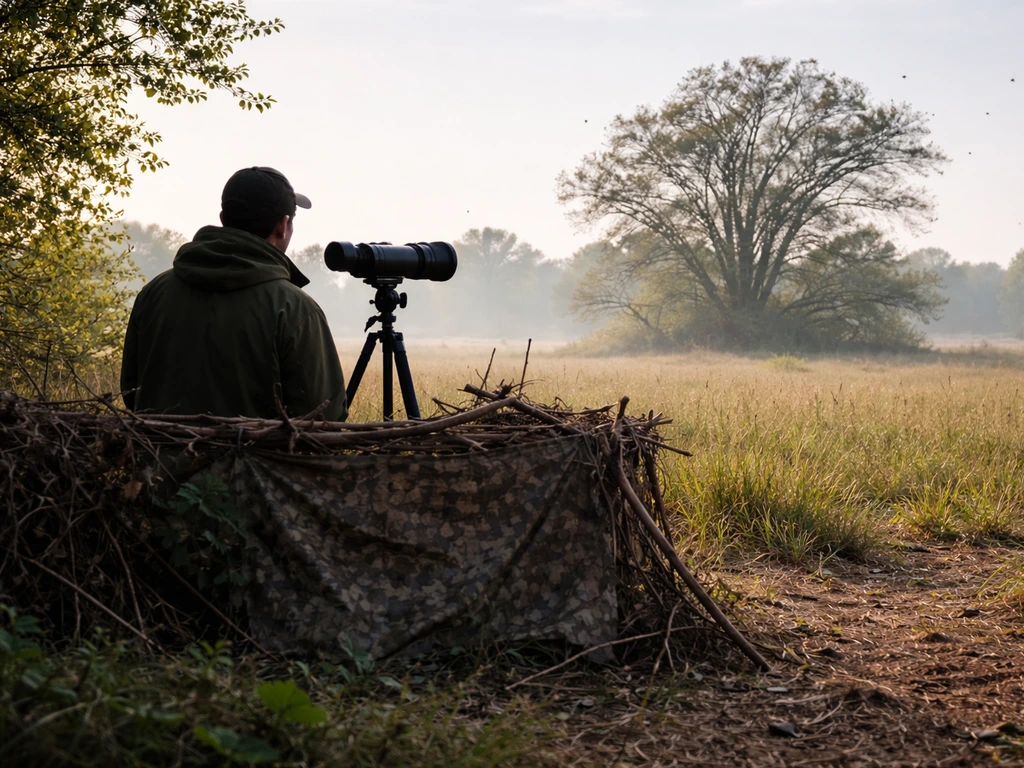
Active colonies are incredible to observe, but the ethical standard here is simple: distance and patience. Researchers who study sociable weavers work from hides (blinds) and allow significant settling time before colonies return to normal behavior. You don't need a research-grade hide, but you should keep at least 20 to 30 meters between yourself and the nest base, use binoculars or a spotting scope, and avoid sudden movements or loud noise. The birds are sensitive to disturbance at entrance tunnels in particular, especially during breeding.
- Stay at least 20 to 30 meters from the base of the nest tree and observe with binoculars.
- Avoid walking directly beneath the colony, both to minimize disturbance and for your own safety (nesting material, bird droppings, and associated insects fall from the underside).
- Keep noise low and movements slow. Sociable weavers respond to sudden intrusions by flushing from entrance tunnels en masse.
- Limit your observation session to 30 to 45 minutes at a time to avoid habituating the colony to a stressful presence.
- Take photos rather than sketches if you need documentation; a camera is quieter and keeps your eyes up.
- Note tunnel activity at different times of day: morning and late afternoon are typically most active for foraging arrivals and departures.
- Remember the colony may also house pygmy falcons, other roosting birds, and reptiles. Assume multiple active animals are present at all times.
One practical safety note: sociable weaver nests in their native southern African range can harbor mites, lice, and other parasites associated with the nest material. If you're in contact with fallen nest material, treat it the way you'd treat any wild bird nesting material: don't handle it barehanded, and wash up afterward.
If there's a sociable weaver nest on your property
First, some context: if you're finding a confirmed sociable weaver colony on your property, you're almost certainly in southern Africa, most likely in the Kalahari region of South Africa, Namibia, or Botswana. This species doesn't occur elsewhere. That matters for legal and practical reasons: sociable weavers are protected under South African national legislation and equivalent protections in neighboring countries. You cannot legally remove or destroy an active nest without the appropriate permits.
The most common concern from property owners is structural: a large, mature colony nest can weigh several hundred kilograms, and nests on trees close to buildings, on utility poles, or on supported structures can pose a real weight and stability risk. Here's what to do and, just as importantly, what not to do.
- Confirm the nest is active before doing anything. Watch it from a safe distance for a day or two. Active bird traffic in and out of the underside tunnels confirms occupancy. An inactive nest that has been abandoned is a different situation.
- Do not remove, relocate, or interfere with an active nest yourself. This is both a legal issue and a practical one: disturbing a large, heavy communal nest without professional help is physically dangerous, and the weight of a mature colony can be significant.
- Contact your local wildlife authority or a licensed bird rehabilitation or conservation organization. In South Africa, this means CapeNature, Ezemvelo KZN Wildlife, or your provincial conservation authority depending on your location. They can advise on permits and, where relocation is genuinely necessary, coordinate it properly.
- For nests on utility poles or active infrastructure, contact the relevant utility company directly. In southern Africa, Eskom has dealt with sociable weaver nests on power infrastructure before and has established protocols.
- If you want specialist guidance on the colony itself, the Sociable Weaver Project is an international research team based in the Kalahari region and is a credible contact for behavioral and structural questions about active colonies.
- If the nest is on your property but not posing an immediate structural risk, the genuinely recommended approach from a conservation standpoint is to leave it. These colonies are long-term ecological structures that support not just the weavers but a whole community of species.
A quick note on what not to do: don't pull out entrance tunnel material, don't block tunnels, don't spray the nest with anything, and don't try to discourage the birds by removing food or water sources nearby. None of these approaches work reliably, and they can cause real harm to the colony. The nest's impressive engineering is specifically designed to resist casual interference.
If you're photographing or documenting the nest for identification purposes, which is a great idea, shoot the underside showing the tunnel openings, the overall profile of the mound from a distance, the host tree structure, and any visible bird activity. Those four angles will give you (and any expert you consult) everything needed for a solid ID. Sociable weaver nests are unmistakable once you know what you're looking at, and this species builds nothing like any other bird in its range or anywhere else in the world.
FAQ
How can I tell if a sociable weaver nest is active versus old or abandoned?
Yes. Active colonies keep adding thatch and maintaining tunnels, so the exterior often looks tight and freshly worked, and you may see birds moving in and out of the openings even if you cannot identify individual birds.
What changes to expect on the underside tunnels if the colony is older or less active?
A finished sociable weaver colony still looks like a rounded thatched mass, but the underside tunnels can be less busy, and the spiky collar around entrances may look less “neatly present” than on an actively maintained nest.
What should I do if I cannot clearly see the tunnel openings when trying to identify the nest?
Tunnels can be partially obscured by shadows, thick thatch overhangs, or vegetation. If you cannot clearly count openings from one angle, try another position to view the underside in a brighter, more frontal line of sight.
If a different species emerges from a tunnel, does that mean the nest is not a sociable weaver nest?
No. Other weavers and passerines may use parts of the structure, but the diagnostic clue is the communal thatched mass with numerous entrance tunnels on the underside. One outsider bird leaving a tunnel is not enough to assume it is not a sociable weaver nest.
Why do some tunnel openings on the underside look deeper or longer than others?
Usually yes, particularly for birds breeding deeper in the mass. Chambers closer to the edge tend to have shorter tunnels, deeper chambers tend to have longer ones, so you may see a mix of tunnel depths across the underside.
What is the fastest visual check to separate a sociable weaver nest from mistletoe or termite-like mounds at long distance?
Mistletoe clumps and epiphyte bunches can look bulky, but they lack discrete bird-access holes and lack the thorn-twig “shaggy armor” exterior. Also, you will not see consistent bird traffic that lands, disappears into holes, and returns quickly.
Can I confirm a nest from far away without a clear view of the underside?
You can often find it by looking for “patterned movement.” If birds approach from nearby and repeatedly use specific entrances, that behavior strongly matches a sociable weaver colony, even when lighting conditions make the nest texture hard to see.
What are the most common mix-ups, and what detail would definitively rule them out?
If you see a large thatched mound, but entrances are not on a shared underside or the structure is a single pouch or hanging nest, it is very unlikely to be a sociable weaver nest. The communal underside tunnel layout is the decision point.
Is it ever okay to touch the nest or move fallen material near the entrances to get a better look?
If there is ongoing traffic, avoid knocking material loose or reaching into the nest area. Even “small” disturbances near entrances can interrupt breeding. Use a spotting scope or zoom, and keep a buffer distance.
What should a property owner do if a sociable weaver nest is close to a building or utility line?
Don’t try to remove, block, or spray anything on the nest. Instead, if the concern is weight or access, manage risk by preventing people or animals from approaching the base, and contact local wildlife or permitted professionals for advice.
Does drought or rainy weather change the appearance enough that the nest could be misidentified?
During very dry periods, the exterior thatch can look more brittle and less uniformly “tight,” but the underside tunnels and communal pattern remain the reliable ID features. Rain and recent maintenance also affect how shaggy the roof looks.
What precautions should I take if nest material falls onto the ground?
Because parasites can be associated with nest material, treat any handling of fallen thatch or debris as potential biohazard. Wear gloves if you must collect anything for safety reasons, avoid touching your face, and wash afterward.
Next Article
What Does a Bird Nest Look Like? A Visual Checklist
Visual checklist to identify active bird nests by type, placement, materials, and activity, plus ethical next steps.