
The bird nests that look like hanging baskets are almost always pendant or pouch nests, and the two you're most likely to encounter are the Baltimore Oriole nest and the Eurasian Penduline Tit nest. The Baltimore Oriole's nest is the classic: a tightly woven, sock-like pouch about 3–4 inches deep with a small opening 2–3 inches wide at the top, hanging from the tip of a slender deciduous branch like a little woven purse. If you want the easiest way to confirm it, learn what a Baltimore Oriole nest looks like from the outside and from below what does a baltimore oriole bird nest look like. If you're in North America, that's your prime suspect. The Penduline Tit takes it further with a fully domed pouch and a side entrance tube, almost like a felted flask hanging from a willow or alder over water. Both look unmistakably like something deliberately woven, because they are.
Which Bird Nest Looks Like a Hanging Basket: How to Tell It

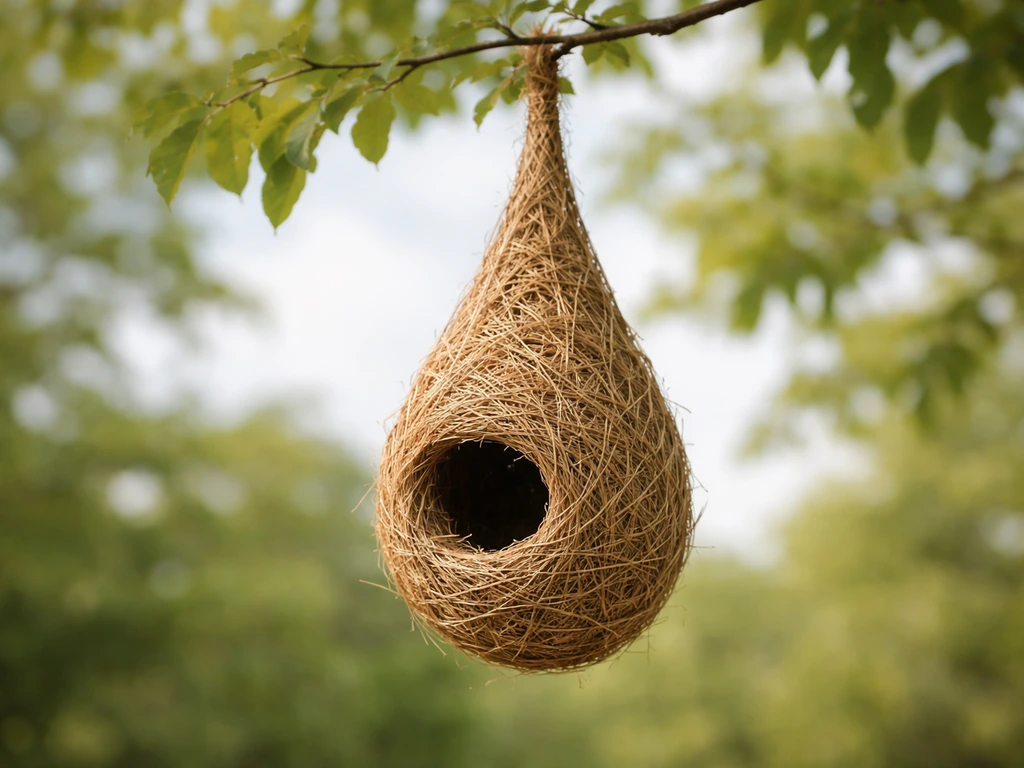
Spotting the hanging-basket look: key visual clues
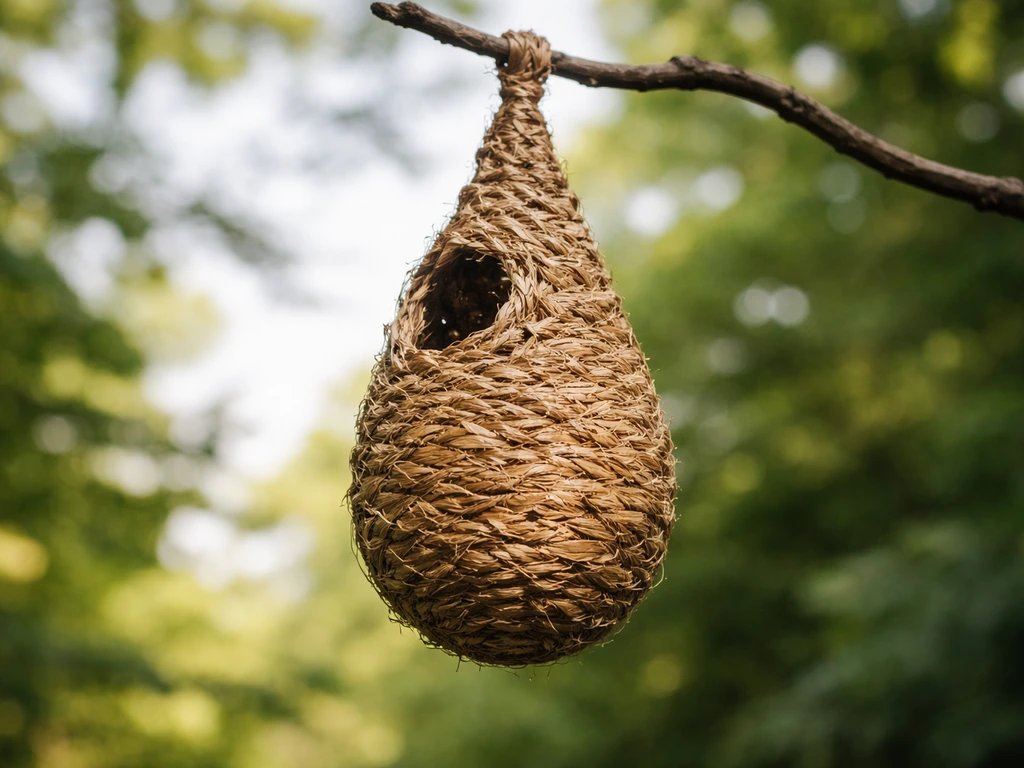
The defining feature is the combination of suspension and woven structure. A true hanging-basket nest hangs freely from a branch tip or twig, swaying slightly in the breeze rather than sitting in a fork or against a trunk. The walls are interlaced, not stacked or packed, so you can often see the individual fibers crossing each other in a tight mesh. The bottom is closed and rounded (like the base of a basket), while the opening is at the top or side, not the bottom.
When you're doing a quick field check, run through these six markers and jot them down or photograph each one:
- Attachment method: is it looped around a branch tip, or built into a fork/ledge? Pendant nests loop or weave onto thin terminal branches.
- Height: Baltimore Orioles typically place nests high up, often 20–45 feet, in cottonwoods, sycamores, elms, and similar tall deciduous trees.
- Shape: closed pouch (oriole) vs. domed flask with entrance tube (penduline tit) vs. open cup (robin, finch — not a hanging basket).
- Materials: plant fibers, bark strips, grapevine, grass, spider silk, wool, hair, and sometimes human-supplied string or yarn woven together.
- Entrance: a small circular opening 2–3 inches wide at the top rim for orioles; a side entrance tube for penduline tits.
- Activity signs: fresh material at the rim, an adult bird visiting repeatedly, or audible chick sounds.
One thing that surprises people: Baltimore Oriole nests are built almost entirely by the female. Chickadee bird nests look completely different than hanging-basket oriole nests, so it helps to know what features to expect Baltimore Oriole nests are built almost entirely by the female.. Finches build very different nests than hanging-basket weavers, so looking for a sturdy cup shape helps you identify the right bird Baltimore Oriole nests are built almost entirely by the female.. You might see a male nearby offering material or singing, but watch for the female doing the actual weaving work. That behavior itself is a confident ID clue if you catch it happening.
Fast confusion check: similar things that aren't bird nests
Before you get excited, rule out the common imposters. Several hanging structures look remarkably nest-like from a distance.
| What you're seeing | Key difference from a bird nest | Quick test |
|---|---|---|
| Paper wasp nest | Gray papery hexagonal combs, no woven fiber, often under an eave or overhang rather than hanging from a branch tip | Tap nearby surface gently — wasps will emerge quickly |
| Hornet nest | Large, enclosed papery envelope with layered combs inside; football-shaped; significantly heavier looking than a woven pouch | Much larger (softball to football size), completely smooth gray exterior |
| Spider egg sac | Silken, not woven from plant fibers; cottony, papery, or fuzzy texture; usually much smaller and lighter colored; attached to foliage or bark | No entrance hole; texture is silky not fibrous; no bird activity |
| Dead leaves/debris bundle | Random accumulation caught in a branch fork; no consistent weave pattern; falls apart easily | Pull gently on one fiber — a real nest holds together firmly |
| Plant pod or seed structure | Rigid, not flexible; part of the plant itself; no entrance | Grows from the plant rather than being attached to a branch tip |
Robin and swallow nests are another common confusion point worth noting. A robin's nest is a tidy mud-reinforced cup sitting in a fork or on a ledge, 5–25 feet up, not hanging freely. Barn swallow nests are mud cups stuck to a vertical surface. Neither swings in the breeze or has a closed bottom. If you can see the inside of the cup from below, it's almost certainly not a hanging-basket type nest.
Most likely nest types that form hanging baskets (and how to recognize each)
Baltimore Oriole
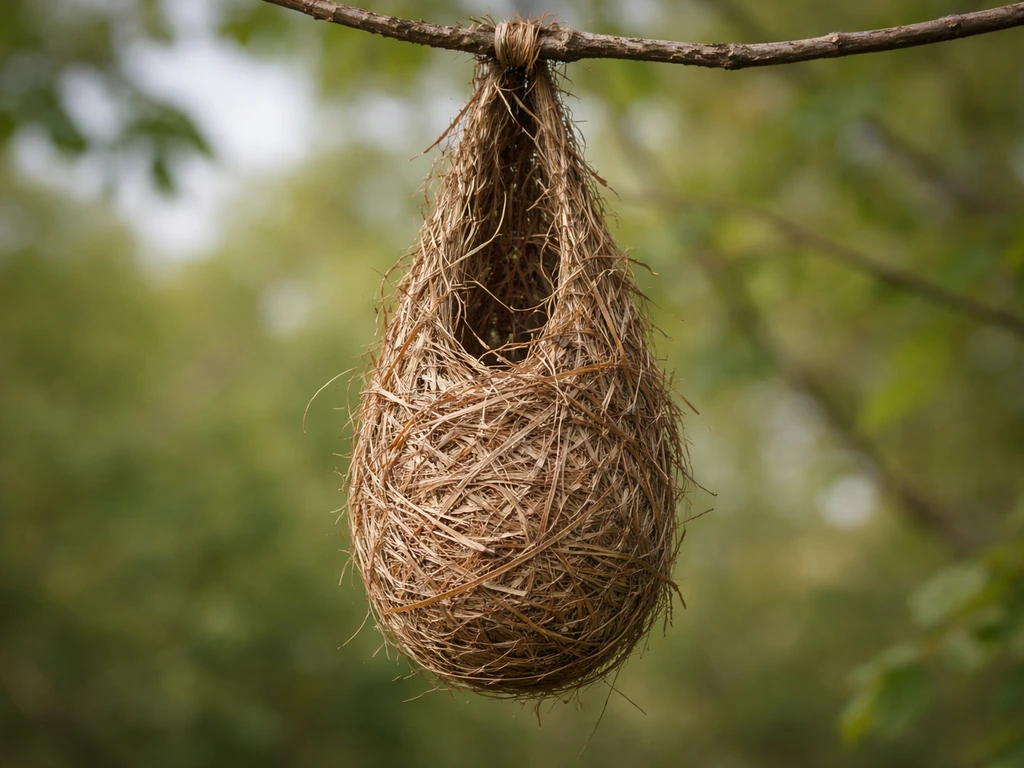
This is the hanging-basket nest most North American readers will encounter. The structure is a blank" rel="noopener noreferrer">deep, pendulous pouch woven from plant fibers, strips of bark, grapevine, grass, and whatever string, yarn, or Spanish moss the female can find. The rim is firmly attached to a thin branch (not resting on it), so the nest hangs below the attachment point. Finished dimensions are roughly 3–4 inches deep with a 2–3 inch opening at the top and a bulging lower chamber about 3–4 inches across. The interior is lined with fine grass, plant down, and animal hair. From below, it genuinely looks like a small woven shopping bag hanging from a tree. Nest height is typically high in tall deciduous trees, which gives the eggs and chicks protection from most ground predators.
Eurasian Penduline Tit
Outside North America, especially in Europe and Asia, the Penduline Tit builds what many naturalists consider the most impressive hanging nest of any small bird. It's a fully enclosed, domed pouch made from grass stems, plant fibers, reed or bulrush fluff, fur, spider silk, and saliva, woven onto the drooping twigs of willows, birches, alders, or poplars, very often over or near water. Museum Most describes the penduline tit’s nest as a pouch-like structure made from grass stems secured to twigs, woven with plant fibers and mixed with animal materials such as fur or spider silk plus saliva, with a side tubular entrance. The entrance is a short downward-facing tube on one side near the top, functioning like a lobby that makes it hard for predators to reach inside. Incubation takes about 14 days and chicks fledge around 18 days after hatching. If you're seeing a bird nest over a wetland or riverbank that looks like a felted flask with a side spout, this is your answer.
Other weaverbird-family nests
If you're outside the range of orioles and penduline tits (sub-Saharan Africa, South Asia), members of the weaver family (Ploceidae) build some of the most elaborate hanging grass nests in the world. Most are kidney-shaped or flask-shaped pouches woven from strips of grass or palm leaf, suspended from palm fronds or reeds. The Sociable Weaver creates a completely different communal structure, but individual weaver nests share the basket-like pendant appearance with orioles and penduline tits. The sociable weaver is especially known for building communal nesting structures that can look very different from single-bird hanging pouches.
Where they're found: placement, height, and attachment patterns by habitat
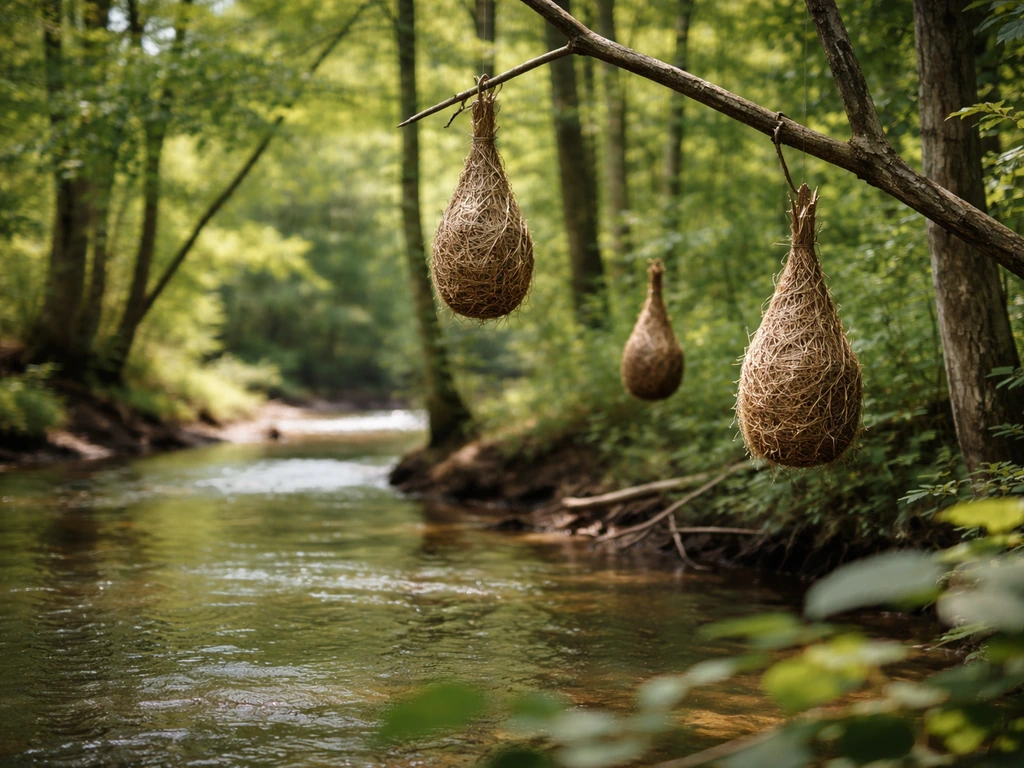
Knowing where to look saves a lot of squinting. Baltimore Orioles favor tall, open-canopy deciduous trees in parks, suburban yards, forest edges, and riparian corridors. They specifically seek out long, slender drooping branch tips that make the nest difficult for predators to reach from above. Cottonwoods, sycamores, elms, and weeping willows are favorites. Height is typically well above head level, often 20–45 feet, and the nest hangs from the outermost few inches of a branch so it sways in the wind rather than being sheltered by the canopy.
Penduline Tits in Europe and Asia are strongly associated with wetland margins: willows and alders along riverbanks, lake edges, and marshes. Their nests hang from thin, flexible twigs that droop over the water, which adds another layer of predator protection. In parts of Africa, pendulous nests from sunbird and weaver species turn up in gardens, parks, and scrubby woodland, often lower down than oriole nests.
The unifying habitat rule: if you're seeing a hanging-basket nest, look for a nearby water source or open woodland edge. These birds choose exposure on purpose. A nest tucked into dense interior canopy with no swing to it is more likely a different species entirely.
Active vs. abandoned: what your nest likely means right now
This is the most practically important question, because it determines what you're allowed to do and what you should do next. Here's how to read the signs without disturbing anything:
- Active and being built: fresh, pale plant fibers at the rim; female bird visiting repeatedly with material in her beak; no settled shape to the bottom yet.
- Active with eggs: the female is sitting deep in the pouch for extended periods (10–30+ minutes at a time); incubation for orioles is 11–14 days.
- Active with chicks: both parents visiting frequently with food every few minutes; you may hear faint begging calls from inside; fledging happens around 11–14 days after hatching for orioles.
- Recently fledged/empty: nest is fully formed and intact but no adult visits; you might see fledglings nearby in shrubs learning to fly.
- Abandoned mid-construction: nest has the correct shape but the bottom is unfinished or there are no fibers added over several days; this can happen if the female was disturbed or the pair moved territories.
- Old and weathered: the nest is gray-brown, frayed at the rim, fibers unraveling, and visibly sagging; this is a nest from a previous season.
If you're checking in May (which is prime oriole nesting season in much of North America), a fresh-looking intact nest almost certainly has activity. Watch from at least 10–15 feet away for 10 minutes without moving. If no adult appears in that window and the nest looks weathered, it's likely last year's structure. In that case, it's safe to observe closely, but still don't remove it without confirming it's genuinely inactive.
What to do (and not do): ethical observation, legal basics, and when to call help
In the United States, the Migratory Bird Treaty Act (16 U.S. Code § 703) makes it illegal to take, possess, or destroy the nest of a migratory bird without a federal permit. Baltimore Orioles are fully protected under this law. That means if there are eggs or chicks in that hanging nest, you cannot remove it, relocate it, or interfere with it, regardless of where it's located on your property. The penalty isn't a technicality: unpermitted take of a migratory bird's active nest is a prosecutable federal offense. Similar protections apply in Canada under the Migratory Birds Convention Act and across Europe under the EU Birds Directive.
Here's the practical do-and-don't list:
- DO observe from a distance using binoculars. Ten to fifteen feet is a reasonable minimum; further is better during incubation.
- DO photograph the nest from that distance for documentation — a photo with a timestamp is useful if you ever need to report disturbance by others.
- DO keep pets and children away from the area under the nest during the active period.
- DON'T touch, shake, or handle the nest whether active or not. Even an empty nest may have parasites or mites.
- DON'T prune the branch supporting an active nest. Wait until after fledging and at least one week beyond to ensure all chicks have left.
- DON'T attempt to relocate an active nest yourself. This is illegal and usually fatal to the eggs or chicks.
- If you find a nest that has fallen (storm damage, etc.) with live eggs or chicks inside: contact a licensed wildlife rehabilitator in your area immediately. The USFWS maintains state-by-state rehabilitator directories.
If the nest is clearly empty and old, and you need to remove it for safety or maintenance reasons (trimming a tree, for example), you can do so legally once you've confirmed it's inactive. Still, consider leaving it in place if at all possible. Old nests can provide nesting material for future birds and don't cause harm to the tree.
Protecting birds from cats and predators, and keeping people safe near the nest
The high placement of oriole nests is intentional predator defense. The thin, flexible branch tips that support the pouch sway under the weight of any climbing predator, making it nearly impossible for a raccoon or squirrel to reach the nest from above. Your job is to not undermine that design.
The biggest threat near residential areas is outdoor cats. A cat cannot climb to a 30-foot oriole nest, but once chicks start fledging and flutter to lower branches or the ground, cats can and do catch them. During the fledgling period (roughly days 11–14 after hatching), keep cats indoors or supervised in the yard. This is the window when most fledgling losses happen.
For people safety: if the nest is over a walkway or play area, the primary concern is disturbance to the birds, not physical danger to people. Unlike wasp nests, bird nests don't pose a sting or bite risk. If adults dive-bomb or alarm-call when you pass below, simply reroute foot traffic 10–15 feet to the side until fledging is complete. Mark the path with a simple rope or garden flag so guests and kids know to walk around.
- Keep outdoor cats inside or on a leash during the fledgling window.
- Don't place bird feeders or bird baths directly under or adjacent to an active nest — activity draws attention from jays, crows, and squirrels.
- If crows or jays are regularly visiting near the nest, you can use temporary visual deterrents (reflective tape on nearby branches) without touching the nest tree itself.
- Avoid using pesticides in the immediate area during the nesting season. Orioles feed on insects extensively and pesticide exposure affects both adults and chicks.
Seasonal expectations and whether those nests get reused
Baltimore Orioles arrive in the eastern U.S. in late April to early May. Nest building typically begins within one to two weeks of arrival, which means May through early June is when you're most likely to find a fresh active nest. Eggs are incubated for 11–14 days, and chicks fledge another 11–14 days after hatching. That puts the active nesting window roughly from mid-May to mid-July for most of the range, with the whole cycle from nest completion to fledging taking about four to five weeks.
On reuse: Baltimore Orioles generally build a new nest for each breeding season rather than returning to the same structure. Old nests may be visited and raided for material, but the female prefers fresh construction. So if you find an intact but weathered hanging pouch in late fall or winter, it's almost certainly last year's nest and won't be used again as-is. You can leave it in place as a natural feature of the tree; it will gradually break down over winter.
Penduline Tits follow a similar pattern: new nests each season, often built by the male as part of courtship display, with the female inspecting and choosing. Multiple nest starts in one area are not unusual, partial or abandoned nests can look like 'incomplete' baskets and often cause confusion about whether a nest is active or was simply abandoned before completion.
By late August, most hanging-basket nests in temperate North America and Europe will be empty and past their active season. If you're checking now in mid-May and the nest looks fresh, you are right in the middle of the most critical window: treat it as active, observe from a distance, and let the birds finish what they started.
FAQ
What if the “hanging basket” nest has a hole or looks torn, could it still be active?
Yes. A torn rim or side opening can happen from weather, birds rearranging lining, or a predator test, so don’t assume inactivity. The safer check is behavior, if an adult is visiting regularly (carrying food or nesting material) treat it as active even if the structure looks damaged.
Can I tell which bird built it if I can’t see the inside from below?
Often you can. Baltimore Oriole nests have a closed, rounded bottom and a top opening, while the Penduline Tit has a more enclosed, domed pouch with a short downward-facing side tube near the top. If the nest is fully enclosed like a “felted flask” with only a side spout visible, lean toward Penduline Tit.
How far away should I watch, and how long should I observe before deciding the nest is empty?
Use 10 to 15 feet (more if you can) and observe for about 10 minutes without moving or hovering. If you see no adult activity in that window and the nest looks waterlogged or heavily weathered, it’s more likely inactive or last season, but confirm before any action.
Do hanging-basket nests look different at the start of building versus when they are complete?
Yes. Early on, you may see partial woven sections, frayed fibers, or a pouch that is not yet fully rounded. Partial nests are common, especially where multiple starts occur, so don’t rely on “unfinished” appearance alone, use adult visitation as the deciding factor.
If there are feathers, hair, or lint in the nest, does that confirm it’s a Baltimore Oriole?
It supports a nest type match, but it’s not a definitive ID by itself. Oriole nests commonly include fine plant material plus animal hair and down, but other hanging weavers can also use mixed fibers. Pair the material clue with the shape indicators, closed rounded bottom, and top opening plus the strong free-swinging attachment.
What should I do if the nest is in my yard and birds start alarm-calling when I walk by?
Adjust your route and reduce lingering below it. If adults alarm-call or dive, step aside and give them space, mark a side path (rope, flag, or temporary signage) so kids and guests don’t cut under the nest until fledging is over.
Is it ever okay to relocate a hanging-basket nest for safety reasons?
No, relocating or removing an active nest is not something to attempt. In the U.S., unpermitted take or destruction of active migratory bird nests can be a federal offense. If there’s a real safety or maintenance need, contact local wildlife authorities or a licensed professional and document activity before any decisions.
Will Baltimore Orioles reuse the exact same hanging pouch next year?
Usually no, they typically build a new nest each breeding season. An intact but weathered pouch in late fall or winter is generally last year’s structure and is unlikely to be used as-is, though leaving it in place is often fine as the material will naturally degrade.
Do indoor or outdoor cats pose a risk even if the nest is far above the ground?
Yes. Cats may not reach a tall oriole pouch, but they can catch fledglings once they leave the nest and hop or flutter to lower branches or the ground. During the fledgling period, keep cats indoors or closely supervised.
If the nest is over water, is it automatically a Penduline Tit?
Not automatically, but it strongly points that direction in Europe and Asia. The Penduline Tit’s nests are commonly over wetland margins and built with a domed, enclosed pouch plus a side entrance tube. Still, check the shape, if it is a more open, top-opening hanging pouch it may be a different hanging-weaver species.
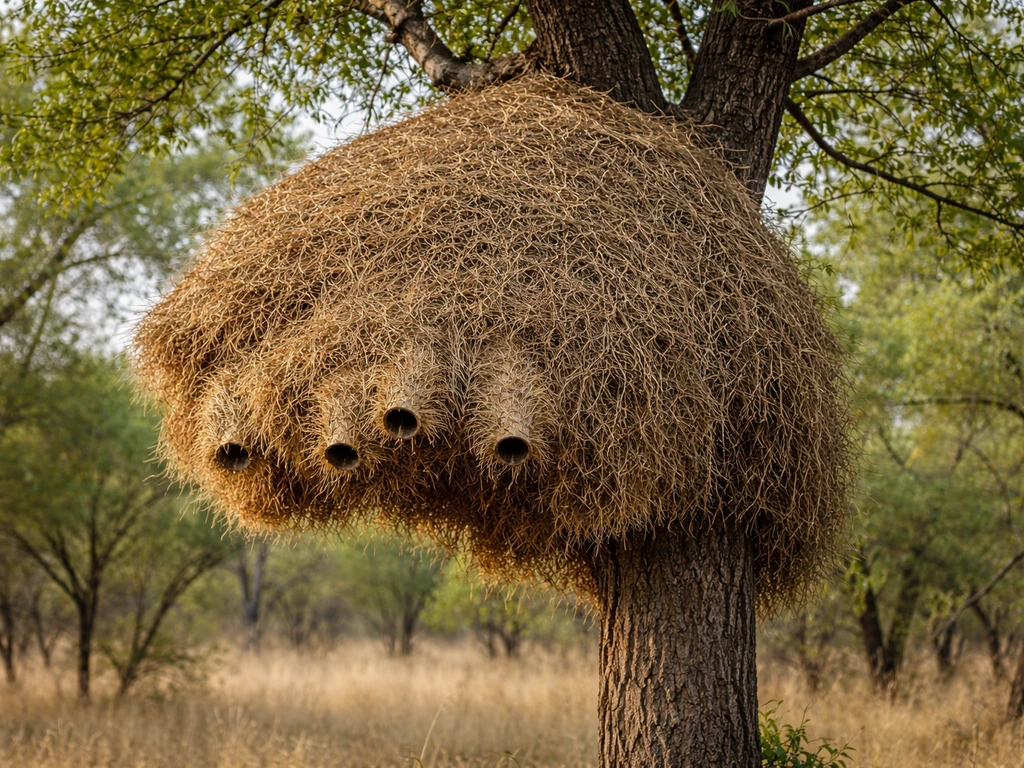
Practical guide to identifying sociable weaver nests by shape, size, entrances, texture, and lookalikes, plus safe next
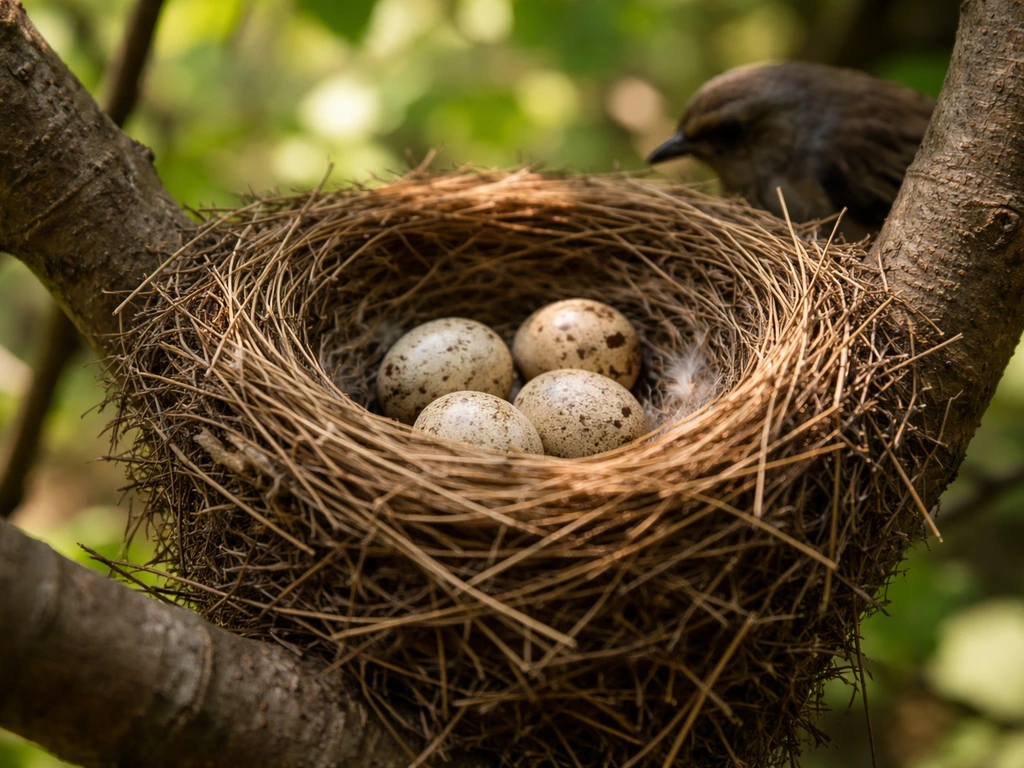
Visual checklist to identify active bird nests by type, placement, materials, and activity, plus ethical next steps.
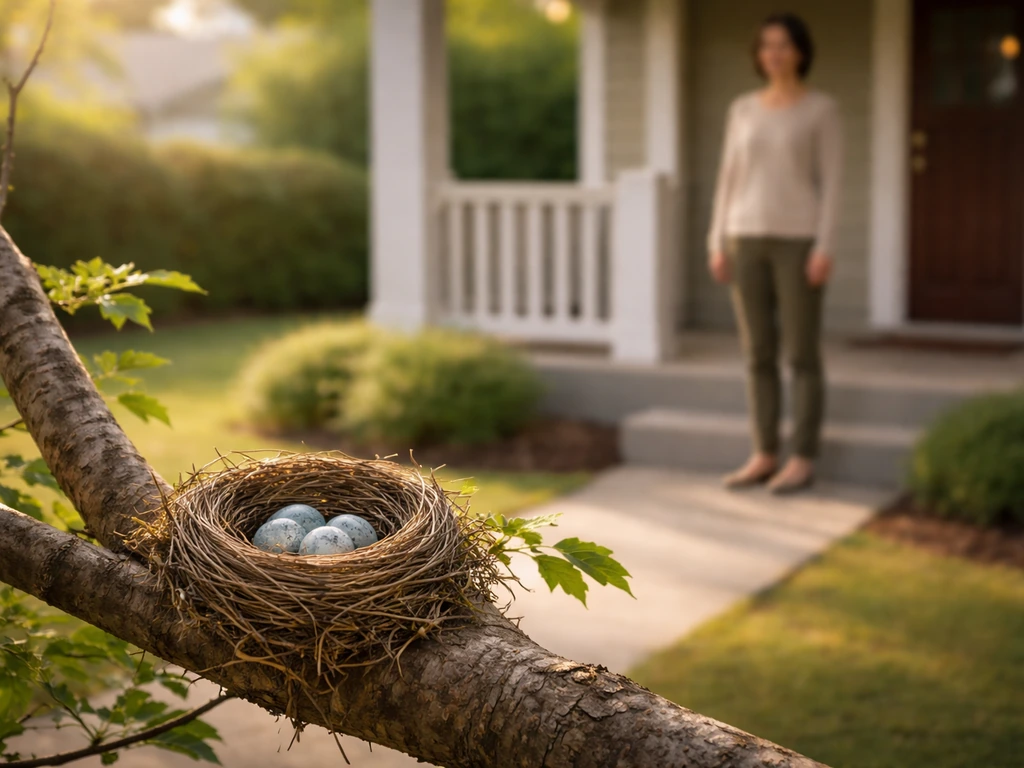
Decide if to let a bird nest, how to check activity, avoid disturbance, and handle conflicts safely and legally.