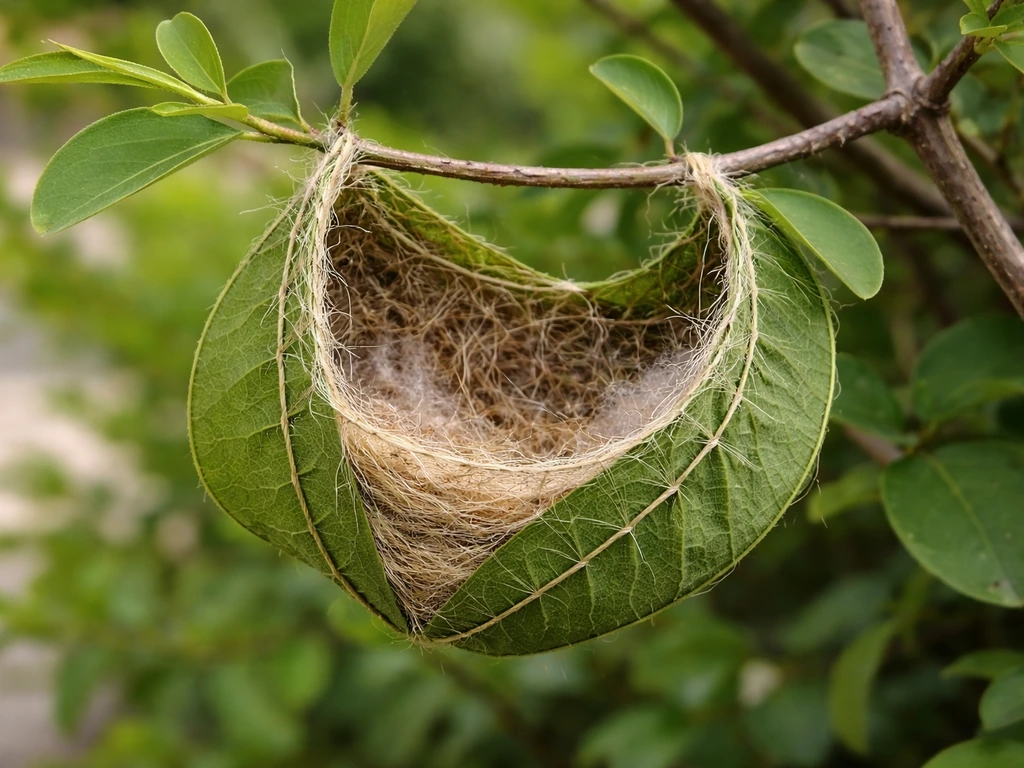
A tailorbird builds its nest by literally sewing leaves together using its beak as a needle. It pierces holes along the edges of one or two large leaves, then threads plant fibers or spider silk through those holes to bind the leaf edges into a cone or pouch shape. That leafy pouch becomes the outer wall of the nest, and the bird fills the inside with soft plant down, cotton fibers, and fine grass.
How Does a Tailorbird Make Its Nest Class 3 Steps to Spot

Maya Bennett
11 May 2026
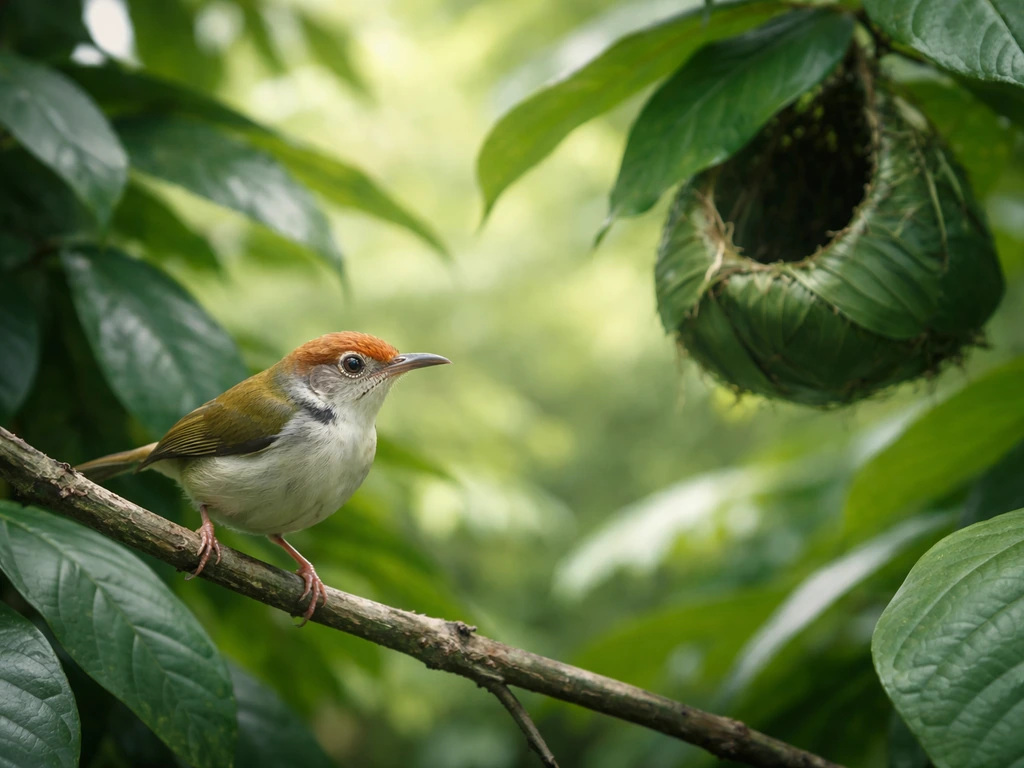
The finished nest is small, usually around 3 to 4 inches deep, and hangs suspended inside the folded leaf structure so it stays hidden and protected. If you have found a small, neatly stitched leaf parcel in a garden shrub with what looks like tiny puncture holes along its seams, that is almost certainly a tailorbird nest.
What kind of bird is a tailorbird, and what types of nests do they make
Tailorbirds belong to the genus Orthotomus, a group of Old World warblers found across South and Southeast Asia. The most commonly seen species is the common tailorbird (Orthotomus sutorius), which frequents gardens, parks, and scrubby vegetation from India across to southern China and Java. It is a small bird, roughly 11 to 14 centimeters long, with a rusty-orange crown, greenish upperparts, and a long cocked tail. The male grows an especially elongated tail during breeding season. You will often hear them before you see them: a loud, repetitive "cheep-cheep-cheep" from dense shrubs.
The tailorbird's nest belongs to a category called a "purse nest" or "stitched leaf nest." Unlike open cup nests (which sit in a fork of branches) or cavity nests (which go inside a tree hole), the tailorbird's nest is enclosed and camouflaged inside folded greenery. This makes it dramatically different from nests built by weaverbirds, which weave grass into hanging pouches. Weaver birds, by contrast, make their nests by weaving grass into hanging pouches rather than stitching leaves. Weaverbirds make their nests by weaving grasses into enclosed, hanging pouches rather than stitching leaves weaver birds make their nests. The tailorbird's signature technique is stitching, not weaving. The leaf structure is the scaffold, not decoration.
Where tailorbirds nest and what the nest looks like in the field
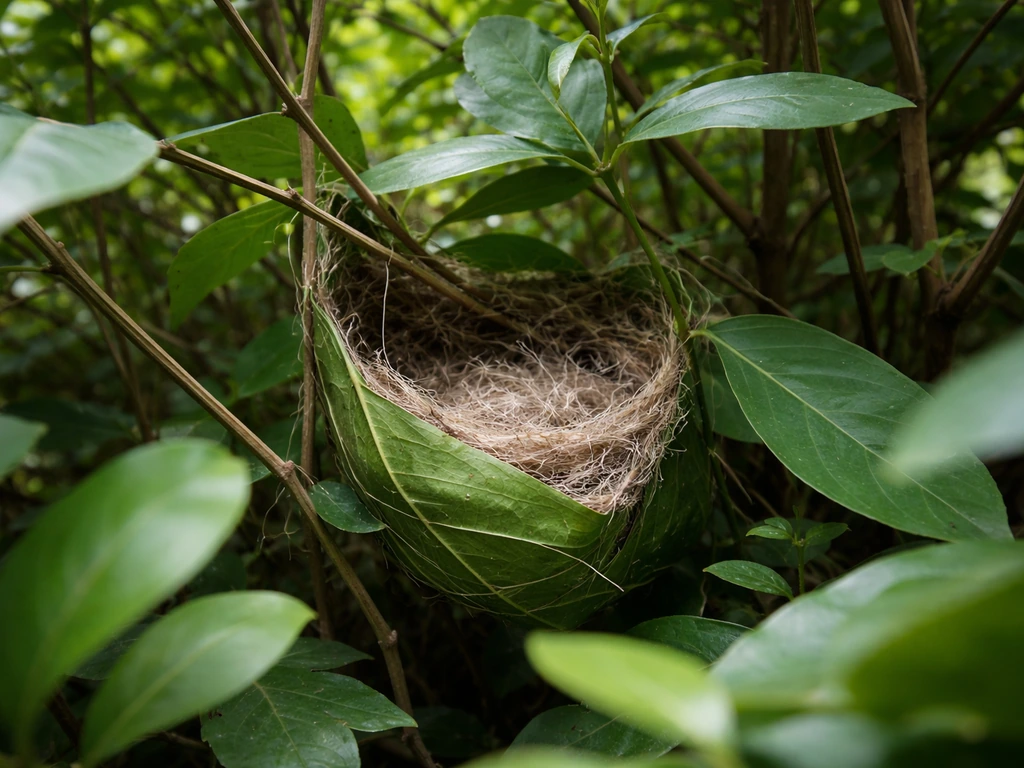
Tailorbirds almost always nest low, typically between 0.5 and 2 meters off the ground in dense garden shrubs, hedges, banana plants, hibiscus, or any broad-leaved plant with large, flexible leaves. They rarely nest in tall trees. The low placement can make them feel vulnerable, but the leaf camouflage is their real protection. When a nest is active, the outer leaves usually remain green and attached to the plant, so the whole structure looks like an ordinary clump of foliage at first glance.
Up close, look for two or three large leaves that appear to be folded inward or pulled together, with the edges touching or overlapping. Run your eyes along the leaf edges and you will see a row of small, evenly spaced holes, roughly 2 to 4 millimeters apart, stitched together with fine fibers. The whole external structure is typically 6 to 10 centimeters wide. If you spot a bird repeatedly disappearing into a cluster of leaves near ground level, that is your clearest behavioral clue that a nest is active.
Step by step: how a tailorbird actually sews the nest
The process is genuinely remarkable, and once you understand each step, you will recognize the signs of nest construction in real time. Here is how it works from start to finish. The key idea is that tailorbirds themselves build the bird nest, stitching leaves together into a purse-like structure Here is how it works from start to finish..
- Leaf selection: The bird scouts for large, flexible leaves that are still attached to a living plant. Flexibility matters because the leaf needs to curl inward without cracking. Banana leaves, hibiscus, and broad tropical garden shrubs are favorites. The bird typically uses one large leaf folded over itself, or two neighboring leaves pulled together at their edges.
- Piercing the holes: Using its sharp, pointed beak like a needle, the bird punctures a series of holes along the leaf edge. It works methodically, spacing the holes evenly about 2 to 4 millimeters apart. Both edges of the leaf (or the facing edges of two leaves) are punctured in matching positions so the thread can pass through both sides.
- Threading the fiber: The bird collects binding material, most often plant fibers like cotton strands, lint from dried seed heads, or fine grass stems. It then threads this material through the aligned holes on both leaf edges, effectively lacing the leaf closed like a shoe. The beak passes the fiber through, then the bird circles around the outside to pull the thread taut from the other side.
- Knotting the ends: Critically, the bird ties or tangles the fiber ends into small knots or balls at each hole so the thread cannot pull back through. This is the step that most observers find astonishing. The bird holds the fiber with its beak and feet and manipulates it until it forms a knot. Without this step, the whole structure would unravel.
- Binding with spider silk or insect silk: In addition to plant fibers, tailorbirds actively seek spider silk strands and silky material from insect cocoons such as caterpillar silk. These are woven or wound around the outer structure to reinforce the binding, add elasticity, and help the nest flex without breaking as the leaves shift. Spider silk in particular is extraordinarily strong for its weight and stretches rather than snaps.
- Interior lining: Once the leaf purse is formed and secured, the bird fills the inside cup with soft materials: fine grass, plant down, cotton fibers, and sometimes feathers or fur. This inner cup is typically 3 to 4 centimeters in diameter, just large enough for a clutch of two to three eggs.
- Final shaping: The bird spends time sitting inside the cup and pressing outward with its body to shape the interior to the right curvature. You may see the whole leaf structure quivering or bouncing slightly as the bird works inside. Construction from first hole to finished nest typically takes four to seven days.
What materials and structural details make the nest strong
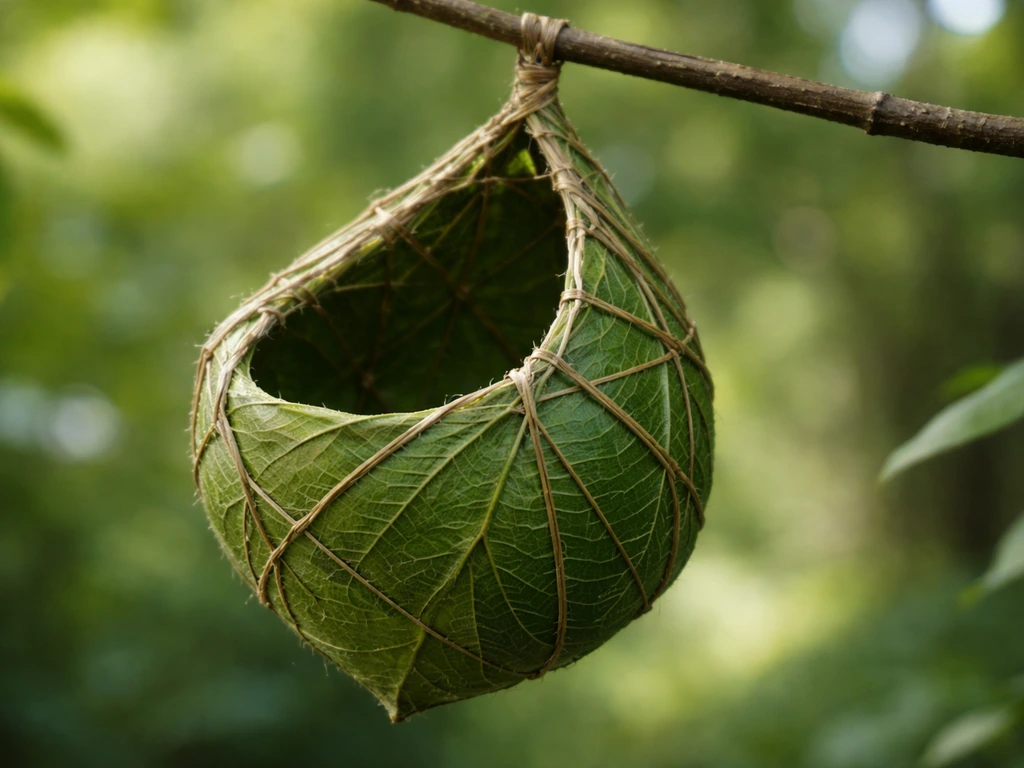
The nest's strength comes from the combination of materials rather than any single element. The leaf itself provides rigid walls and weatherproofing. The fiber threads provide structural tension that holds the walls together. The spider silk provides elasticity and acts almost like a natural glue when it dries and contracts slightly. Together, these materials create a structure that can hold eggs and growing chicks through wind, light rain, and the constant movement of a living plant.
| Material | Where it comes from | Role in the nest |
|---|---|---|
| Living leaves (1 to 3) | Attached garden shrub or plant | Outer wall, camouflage, weatherproofing |
| Plant fibers (cotton, lint, dried seed fibers) | Seed heads, cotton plants, loose garden lint | Primary thread for stitching leaf edges together |
| Spider silk | Collected from active webs or abandoned silk strands | Reinforcement, elasticity, natural adhesive quality |
| Caterpillar or insect cocoon silk | Found on leaves and bark | Additional binding, soft outer layer |
| Fine grass and plant down | Dry grass stems, seed heads | Inner cup lining for insulation and cushioning |
| Feathers or fur (sometimes) | Found in the environment | Extra insulation in the inner cup |
One thing that trips up intermediate observers: not every stitched leaf nest holds perfectly on the first attempt. If you watch a tailorbird building and notice the leaf edges gaping or the fiber threads visibly loose, the bird has not finished yet, or the leaf was too rigid and cracked during folding. In those cases, the bird will often abandon that leaf and start fresh on a neighboring one. A failed first attempt is normal, not a sign the bird is in trouble.
When tailorbirds build: timing, seasons, and habitat needs
In tropical and subtropical regions where the common tailorbird lives, breeding can happen across much of the year, but nesting activity peaks at the onset of the rainy or monsoon season, roughly March through July across much of South Asia, and a second smaller peak in late autumn in some regions. The timing makes ecological sense: fresh vegetation provides flexible leaves for stitching, insect populations boom after rain (feeding both the adults and the chicks), and dense monsoon foliage gives extra cover.
In garden settings, tailorbirds show a strong preference for dense, low-growing shrubs with large, smooth-edged leaves. They avoid heavily trimmed formal hedges and prefer slightly overgrown, layered planting. If you want to attract them, leave one section of your garden a little wilder: dense shrubs at the 0.5 to 2 meter height range, ideally with broad-leaved species like hibiscus, banana, or Heliconia nearby. A garden with access to open-air spider webs (common near fences, windows, and eaves) also provides the silk the birds need.
Temperature and humidity affect leaf flexibility. During dry spells, leaves become brittle and harder to fold without cracking, which is why most stitching activity happens when leaves are fresh and hydrated. If you live in a drier climate and want to monitor tailorbird activity, focus your observation windows on the two to three days following rainfall, when plants have pushed new, pliable growth.
How to find and monitor a tailorbird nest without causing harm

The most reliable way to locate an active nest is to watch the adults, not search the foliage directly. Stand quietly at least 3 to 5 meters from dense low shrubs in the early morning (between 6 and 10 am, when nest-building and feeding activity peaks) and track where the birds repeatedly disappear. Once you see a consistent entry point in the vegetation, you have likely found the nest zone. Resist the urge to part the leaves immediately.
Once you have a general location, approach slowly to within about 1 to 2 meters and use your eyes rather than your hands. Look for the stitched leaf structure described above: folded or pulled-together leaves with a row of fine holes along the seam, and a slight bulge at the base of the leaf pocket where the inner cup sits. Take a photo with a zoom lens or phone camera rather than touching anything. Note the date, shrub species, height from ground, and whether you saw one or both adults nearby.
For ongoing monitoring, check every two to three days from the same observation distance. A typical tailorbird nest cycle runs roughly 12 to 14 days for incubation after the eggs are laid, then another 12 to 15 days before the chicks fledge. A peer-reviewed study in a tropical forest reports a Common Tailorbird [incubation period of about 12 days](https://avianres. biomedcentral.
com/articles/10. 1186/s40657-019-0185-2) and a nestling feeding period of about 12 days, for a total breeding period of roughly 35 days minimum. If you notice the adults have stopped visiting the nest entirely and the leaves have begun to dry and brown (detached leaves will wilt within days), the nest is likely complete for the season. Do not disturb it even then: some species reuse or refurbish old nest structures.
- Observe from at least 3 to 5 meters using binoculars or a zoom lens
- Visit in the early morning when adults are most active
- Log observations: date, location, plant species, nest height, adult behavior
- Photograph the stitching and leaf structure for later identification
- Check every two to three days without approaching closer than your first observation point
- Note whether the leaves are still green and attached (active nest) or drying and browning (likely fledged or abandoned)
What to do if the nest is right next to your house
Tailorbirds often nest in potted plants on balconies, in window-box shrubs, or in garden beds immediately next to buildings. If you find one there, the best action is usually to do nothing except reduce disturbance near that spot for the duration of the nesting cycle (roughly four to six weeks total from nest completion to fledging). Avoid trimming or watering the host plant aggressively during that time. If you have cats, keep them indoors or away from the area. Predator disturbance is the single most common cause of nest failure at this height.
Legal boundaries and what you must not do
In most countries across South and Southeast Asia, tailorbirds and their nests are protected under national wildlife protection laws. In India, for example, the Wildlife Protection Act covers wild birds broadly, making it illegal to destroy an active nest, take eggs, or capture or harm the birds. Similar protections exist across Sri Lanka, Bangladesh, and most of the region. In practice, this means: do not remove the nest, do not relocate it (even to a "safer" spot), do not touch the eggs or chicks, and do not cut the host plant while the nest is active.
The temptation to move a nest "to protect it" is understandable, but relocation almost always causes nest abandonment. Adult tailorbirds are highly sensitive to changes in nest position and orientation. A nest moved even 30 centimeters from its original location is often not returned to. If you believe a nest is in genuine danger (for example, a tree service is scheduled), contact a local wildlife rescue or ornithological society rather than moving it yourself. They can advise on legal options and, in some cases, arrange for supervised temporary protection.
Photography is generally fine as long as it does not involve flash photography at close range during incubation (which can cause adults to flush and abandon eggs), excessive time near the nest (keep visits to under two minutes), or sharing precise nest GPS locations publicly online (which unfortunately attracts egg collectors in some regions). Responsible nest monitoring is an asset to conservation; the key is keeping your footprint minimal and your records private or shared only with trusted naturalist groups.
If you are comparing the tailorbird's approach with other nest-building species, it is worth noting that weaver birds also produce intricate, enclosed nests but use a fundamentally different grass-weaving technique rather than leaf stitching. The tailorbird's method is unique among commonly observed garden birds, and recognizing the stitched-leaf structure is one of the clearest and most satisfying field identification moments you can have in a backyard wildlife watch.
FAQ
Is it normal if a tailorbird’s stitched leaf nest looks messy or unfinished at first?
Yes. If a leaf pocket is fresh and not fully stitched, you may see uneven spacing or looser fibers along the seam. That usually indicates construction is ongoing, or the bird abandoned a partially made pouch and started on a nearby leaf cluster rather than finishing the same structure.
What’s the safest way to check if a stitched leaf nest is active without disturbing it?
Avoid searching by pulling leaves aside. Even light handling can change leaf tension and camouflage, and it can expose eggs or chicks to heat and predators. Use binoculars or a zoom camera from a distance, then confirm activity by repeated adult entries rather than by direct inspection.
Why might I see puncture holes on leaves but no obvious nest pouch?
Tailorbirds typically prefer larger, flexible leaves and will often choose plants that keep leaf edges from splitting when pierced. If you notice many tiny puncture holes but no pouch ever forms, the birds may be testing leaves, failing due to brittle or too-rigid foliage, or switching materials after a disturbance.
How can I confidently distinguish a tailorbird stitched leaf nest from other enclosed nests in shrubs?
It can be hard to tell at a glance, because both tailorbirds and some other birds make enclosed plant structures. The giveaway for tailorbirds is a stitched seam, a row of small evenly spaced holes (often 2 to 4 millimeters apart), and a purse-like leaf pocket hanging within folded greenery at low height.
Do tailorbirds build nests year-round, or do dry periods stop their stitching?
During the driest weather, leaf fibers can be too brittle to stitch without cracking, so nest-building often pauses or slows. If you are monitoring, plan more observation around the 2 to 3 days after rainfall when fresh growth is pliable.
If a nest is in a busy garden area, what practical steps can I take to reduce disturbance?
If a nest is close to foot traffic, you can reduce disturbance by keeping movement low around the host plant, avoiding frequent yard work near the shrub, and placing any viewing spot farther back than you think you need. The goal is to keep adults comfortable enough to continue incubating and feeding.
Is it okay to post my nest photos online, and what details should I avoid sharing?
If you have already photographed the nest, don’t share the exact location publicly. Even when the intent is educational, precise nest coordinates can attract people who want to collect eggs or disturb birds. Keep GPS data to your own records or share only with trusted local groups.
How long should I expect the nesting period to last from eggs to fledging?
A typical nest cycle is about 12 to 14 days for incubation, then about 12 to 15 days before fledging. A simple rule of thumb is that if adults stop visiting entirely and the leaves start browning and detaching, the chicks are likely no longer dependent on that exact inner pocket.
What should I do if the nest is threatened by landscaping or a scheduled yard job?
Relocation is especially risky because adults may refuse to return after even small shifts. If the nest is threatened by mowing, pruning, or construction, the better option is to pause work where possible and contact a local wildlife rescue or ornithological group for guidance on lawful, supervised protection.
If a nest disappears, what are the most common reasons and how can I prevent it next time?
Common causes include predators, but also adult disturbance and the host plant being cut or aggressively trimmed. If a nest fails, check whether the shrub was disturbed, whether animals had access, or whether the nest was exposed by leaf loss, then focus next attempts on leaving dense cover intact during the cycle.
Next Article
Common Tailor Bird Nest: Identify, Safely Leave, or Protect
Identify common tailorbird woven-leaf nests, tell active vs old, and choose safe options to protect or resolve conflicts