The most common birds that build cup-shaped nests in North America are American robins, northern cardinals, northern mockingbirds, house finches, song sparrows, yellow warblers, and black-capped chickadees. If you just found a neat, bowl-shaped nest in your backyard shrub or on a tree branch, odds are one of those species built it. Which one exactly depends on where the nest sits, what it's made of, and the time of year you found it. This guide walks you through all of that.
Which Bird Makes a Cup Shaped Nest? How to Identify

Maya Bennett
27 Apr 2026
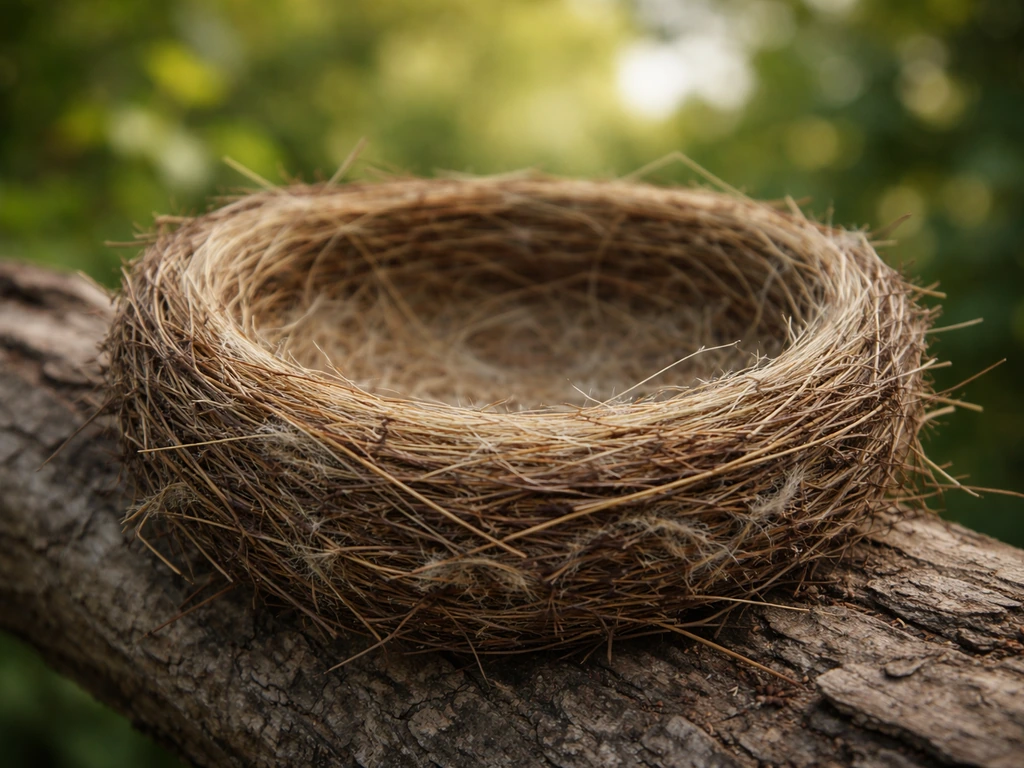
What makes a nest a cup nest
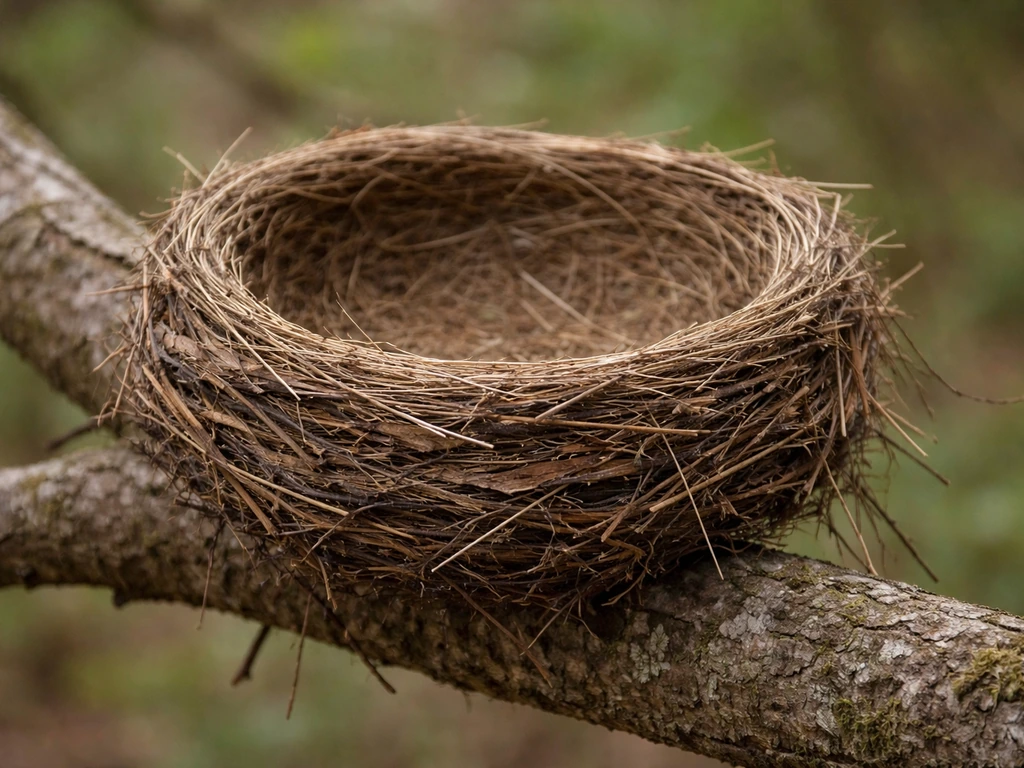
A cup nest is exactly what it sounds like: a round, open-topped bowl that sits upright on a branch, ledge, or in a shrub fork. It has distinct layers. The outer shell is typically coarser material like twigs, bark strips, or dried grass. The inner cup is softer, lined with fine grasses, plant fibers, hair, feathers, or mud.
That multi-layer structure is the key feature. It's not a loose pile of sticks (that's a platform nest), it's not enclosed with a roof (that's a dome or cavity nest), and it doesn't hang or swing below a branch fork (that's a pendant nest, like an oriole's). If you can look straight down into a bowl-shaped structure and see a smooth, rounded interior, you've got a cup nest.
NestWatch's identification framework puts cup nests in their own category alongside enclosed domes, platforms, hanging pouches, and messy stick bundles. Knowing you have a cup immediately narrows the field significantly. From there, size, placement height, and materials do the rest of the work.
Which birds build cup nests, and where
Cup nests are the most common nest type among North American songbirds. Here are the species you're most likely dealing with, organized by where and how high up you found the nest.
Low shrubs and dense bushes (under 5 feet)
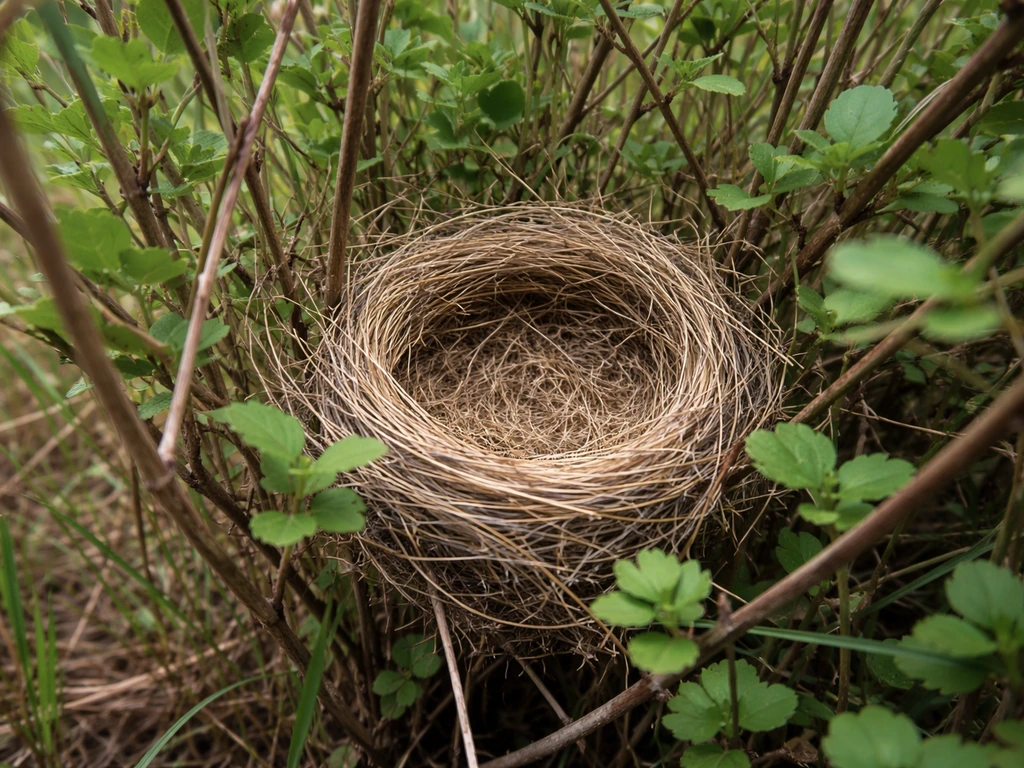
- Song sparrow: A small, grassy cup tucked into low vegetation or even on the ground under a shrub. Often lined with fine grasses and hair. Very common in backyards, meadow edges, and weedy lots.
- Northern cardinal: An open cup of twigs, grasses, bark strips, leaves, and pine needles, typically placed 3–10 feet up in dense shrubs or small trees. The female builds it over about 3–9 days.
- Yellow warbler: A compact, tightly woven cup of plant fibers and spider silk, usually in willows, alders, or shrubby edges near water. Often 2–6 feet off the ground.
- Common yellowthroat: A loosely built grass cup low in cattails, reeds, or dense weedy growth. Found in wetland margins and overgrown yards.
Trees and higher branches (5–30 feet)
- American robin: One of the most recognizable cup nests. A sturdy mud-reinforced cup, 3–6 inches across, lined inside with fine dry grasses. Usually placed on a horizontal branch or building ledge, hidden just below leaf cover.
- Northern mockingbird: An open-twig cup built 3–10 feet up (sometimes higher) in shrubs or small trees. Lined with grasses, rootlets, and occasionally human-made materials like string or plastic.
- House finch: A small, neat cup of twigs, grasses, string, and feathers. Highly adaptable—found in dense shrubs, hanging planters, ledges, and even in other bird structures.
- American goldfinch: A tightly woven cup of plant down and spider silk, placed in the fork of a shrub or tree, typically 4–14 feet up. One of the neater, more compact cup nests you'll find.
- Cedar waxwing: A bulky, loosely built cup of grasses, plant fibers, and string placed in a tree fork, usually higher up in deciduous or mixed trees.
Ledges, eaves, and unusual spots
- House finch: Regularly nests on building ledges, in hanging baskets, and under eaves. One of the most adaptable cup nesters in suburban areas.
- Eastern phoebe: Builds a moss-covered cup on sheltered ledges, under bridges, or on building overhangs. Often returns to the same spot year after year.
- Barn swallow: Builds a mud cup (sometimes with a grass base) on rafters, beams, and ledges—often inside or just outside structures. Note: this one is a common lookalike covered below.
Reading the materials: what the nest is made of tells you a lot
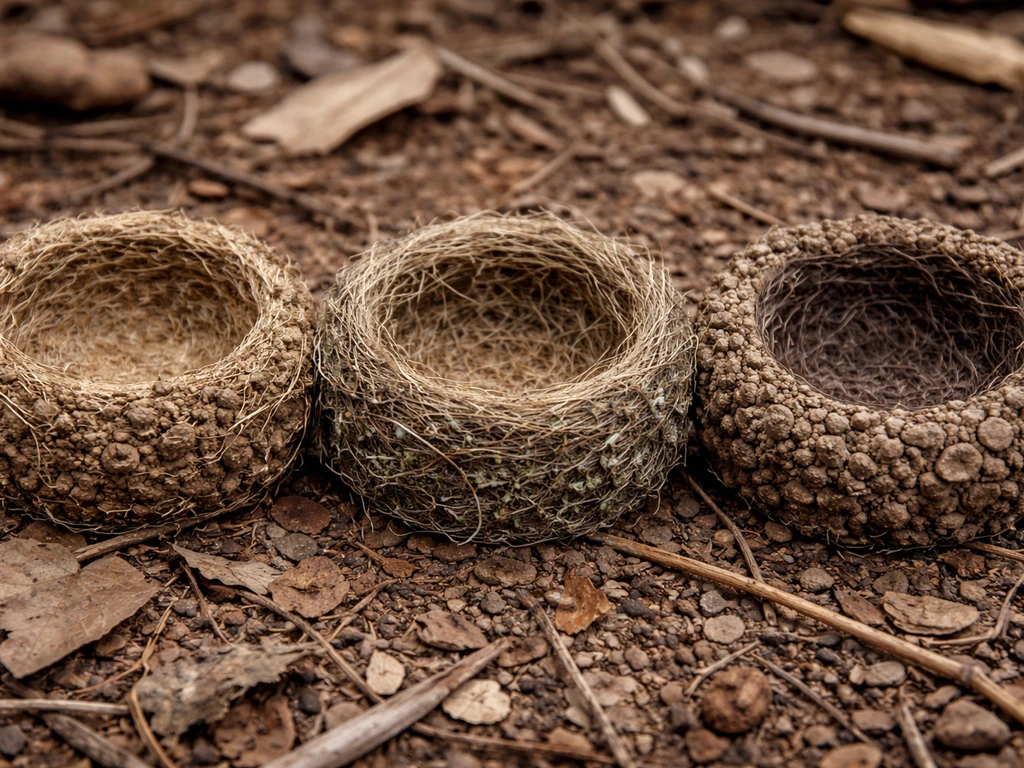
You don't need to touch the nest to gather good clues. Look closely from a few inches away and note what you can see in the outer wall and the inner cup. Different builders have very different material preferences.
| Material signature | Most likely builder |
|---|---|
| Mud cup with fine grass lining, solid and sturdy | American robin |
| Coarse twigs outer shell, rootlets/grass inner lining | Northern mockingbird or cardinal |
| Tightly woven plant fibers bound with spider silk | Yellow warbler, goldfinch, or gnatcatcher |
| Mostly dry grass, loosely woven, with hair or feather lining | Song sparrow or house sparrow |
| Moss outer layer, soft plant fiber or feather lining | Eastern phoebe or ruby-crowned kinglet |
| Fine plant down (fluffy white), bound with spider silk | American goldfinch |
| Mixed twigs, bark, and leaves with pine needle lining | Northern cardinal |
| Mud base on a ledge or beam, sometimes with grass mixed in | Barn swallow (cup on structure, not in vegetation) |
Spider silk is a particularly useful clue. Birds like hummingbirds, kinglets, gnatcatchers, and vireos use it to bind and stretch their nests, giving the cup a compact, almost rubbery feel. If a small nest seems unusually firm and smooth for its size, spider silk is probably involved. Vireos specifically often suspend their cup between a forked branch so it hangs slightly below the fork level, which starts to blur the line between a cup nest and a pendant nest.
When and where to look: timing and location cues
Most cup nesters in North America are active between late March and early August. American robins are among the earliest, with nesting typically running April through July and up to three broods per season. If you're reading this in late April 2026, right now is prime time for active robin, mockingbird, cardinal, and song sparrow nests. American goldfinches nest later than most, peaking in July when thistle is producing the plant down they prefer for lining.
Black-capped chickadees use cavities rather than open cups, but their timing is a useful seasonal reference: they're searching for cavity sites by mid-March in the northeastern US, building by mid-April, and laying eggs by early May. If you find an open cup nest now and chickadees are in your yard, the cup almost certainly belongs to another species.
Height and microhabitat are just as important as timing. A cup at 2 feet in a blackberry thicket points toward a different bird than one at 8 feet in an ornamental shrub, which is different again from one on a window ledge. When you find a nest, note the height above ground (estimate in feet), the plant species or structure it's in, and the direction it faces. These details narrow your ID considerably.
How to confirm the bird without disturbing the nest
The safest and most effective method is patient, distant observation. Back away at least 30 feet, give the area 15–20 minutes of quiet, and watch. An adult bird will usually return to the nest to incubate or feed, and even brief glimpses of size, color, and behavior can clinch the ID. Bring binoculars if you have them.
- Stand or sit at least 30 feet away and stay still. Movement near the nest delays the adult's return and stresses the bird.
- Note the adult's size relative to the nest, bill shape, and any obvious color marks (red crest, yellow wingbars, white eye ring).
- Watch how the adult approaches: robins hop along the ground before flying up; mockingbirds often perch and scold loudly nearby.
- Take photos from your observation distance using a zoom lens or phone zoom. Even a blurry shot of an adult near the nest is useful for later ID.
- If you want a closer look at the nest contents, use a small handheld mirror on a stick to peek in from the side without looming over it. This reduces your silhouette threat to any sitting adult.
- Consider a trail camera aimed at the nest from outside the vegetation line. Install it when no adult is present, use infrared (no white flash) to avoid disturbing birds at night, and keep the camera at least 3–4 feet from the nest.
NestWatch is direct about one rule: never let your monitoring cause a bird to knock eggs or young out of the nest. If an adult flushes off the nest and lands on the rim looking panicked, you're too close. Step back immediately and give the bird several minutes to resettle before trying again.
Found a cup nest on your property: what to do now
The legal situation
Nearly all songbirds in North America are protected under the Migratory Bird Treaty Act (MBTA). This means it is illegal to take, move, destroy, or possess an active nest, eggs, or nestlings without a federal permit. An active nest is one with eggs or live young in it. If you find an active cup nest on your property, you are legally required to leave it in place until the birds have fledged and the nest is abandoned. Typical nesting cycles run 4–6 weeks from egg-laying to fledging, so this is usually a short wait. Disturbing or destroying an active nest, even on your own property, can result in federal penalties.
What you can and should do
- Leave the nest completely alone if it contains eggs or young. Mark the area with a gentle reminder (a flag or tape on a nearby post) so family members or landscapers don't accidentally disturb it.
- Delay any pruning, trimming, or construction work in that immediate area until you confirm the nest is empty and abandoned.
- If the nest is in a location that causes safety concerns (blocking a door, near HVAC equipment), contact a licensed wildlife rehabilitator or your state wildlife agency before taking any action. Do not move it yourself.
- If you find a nestling on the ground, look for the nest above and gently place the bird back if you can reach it. Parent birds will not reject young because you touched them.
- If the nest appears old, dry, and clearly abandoned (no eggs, no feathers, no activity after several days of observation), it is almost certainly from a previous season and can be removed legally.
Protecting the nest from predators
If the nest is in a vulnerable spot, there are a few conservation-friendly steps you can take. Keep cats indoors during nesting season. Avoid leaving feeders directly adjacent to the nest, since feeder activity draws jays, crows, and squirrels that may raid nearby nests. If the nest is on a post or ledge, a simple baffle below the structure can deter climbing predators like raccoons and squirrels. Don't trim the surrounding cover vegetation while the nest is active, since foliage concealment is often a bird's first line of defense.
Sorting out misidentifications and common lookalikes
Cup nests are the most common nest type, so misidentification is easy. Here are the most frequent mix-ups.
Barn swallow vs. robin
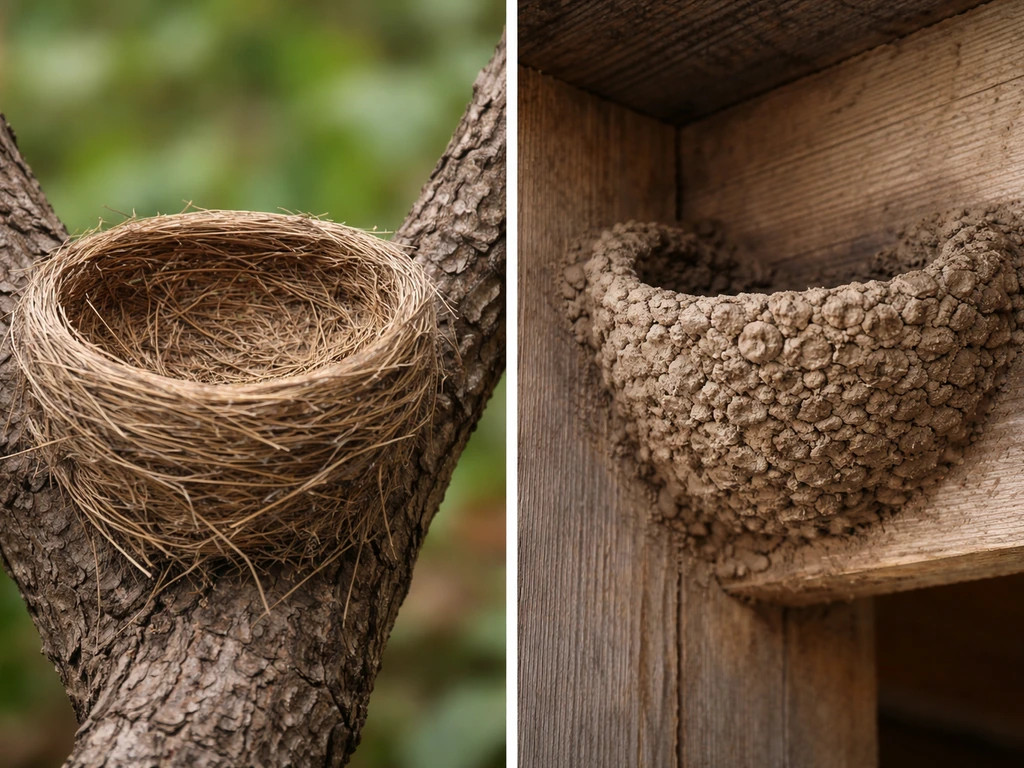
Both use mud heavily, so their nests look superficially similar. The difference: a robin's cup is a free-standing bowl on a branch or ledge, with mud incorporated into the body of the nest and lined with fine grass. A barn swallow's nest is plastered directly against a vertical surface (a rafter, beam, or wall), built almost entirely of mud pellets mixed with grass, and has no inner grass lining as clean as a robin's. Location is the giveaway: if the mud cup is stuck flat against a surface rather than sitting in a branch fork, it's almost certainly a swallow.
House wren vs. cup nesters
Wrens are cavity nesters, not cup nesters. They build inside boxes, tree holes, and enclosed spaces and fill the cavity with a messy pile of sticks topped with a soft cup of hair, feathers, and plant fibers. If you're finding that messy stick structure inside a box or hollow, that's a wren, not a cup-nest builder. The confusion happens when the interior cup is visible and people assume the stick filling is just the outer cup wall.
American robin vs. northern mockingbird
Both build open-cup nests in shrubs and trees at similar heights. Many of the same shrub and bush cup nesters are featured in this guide to cup nests, including species like the northern cardinal. If you’re also trying to identify a bottle-shaped nest, a different set of birds and structures will apply cup nesters. The robin's nest is noticeably sturdier and heavier, with that solid mud layer in its walls.
A mockingbird's nest is bulkier and looser in the outer structure, built primarily of dead twigs without the mud reinforcement, and the lining materials often include a wider variety of fibrous material including occasional human-made debris like string or foil. If there's no mud in the cup wall, lean toward mockingbird. If there's a hard mud layer, it's almost certainly a robin.
Vireo pendant nests vs. cup nests
Vireos suspend their nests between the arms of a forked branch so the cup hangs below the fork level. From certain angles, this looks like a cup nest sitting in a fork. The difference is attachment: a true cup nest rests on top of a branch or in a crotch, supported from below. A vireo nest is woven onto the fork arms and hangs freely. Tilt your head and look at the attachment point. If the nest hangs below the fork rather than sitting in it, you're looking at a pendant-style nest, not a cup.
Other nest types that get confused with cup nests
Some nests require a quick reality check on shape. A dome nest with a side entrance hole (common in marsh wrens and some sparrows) can look like a cup from the top if the entrance is obscured by vegetation. A cone-shaped nest or a round enclosed nest points to completely different builders. Knowing the shape helps, but you can also compare it to what birds build small round nests to narrow down the species cone-shaped nest.
If the nest has a distinct side entrance or is completely enclosed, it belongs to a different nest-type category. Distinguishing cup nests from these other forms is the first step in any identification, and once you're confident you're looking at a true open cup, the species list narrows quickly.
FAQ
If I see a cup-shaped nest, does that guarantee it is one of the common North American songbirds listed?
Not always. Some species can overlap in nest shape, and a nest can also be abandoned mid-build. If the lining looks unfinished, or the nest is unusually small or large for the location and height, treat it as a probable cup nest but use timing, material, and exact placement before concluding the species.
How can I tell whether a nest is truly an open cup versus a hidden-entry dome when the entrance is obscured by leaves?
Check the rim and sides from a few different angles without getting closer. A dome or enclosed nest typically shows a junction line where the roof meets the wall, and you may see a side texture change around an entrance. If there is no roof layer and the interior looks smoothly open all around from above, it is more likely a true cup.
What if the nest looks like it has mud inside, but it is not plastered flat against a wall, which bird is that?
Mud used in a cup nest usually becomes part of the wall structure, so the outer layer looks thick and firm rather than only a thin smear. If the nest sits upright in a crotch or on a ledge, and the inner bowl is lined with finer material, that pattern fits robin-type builders more than wall-plastering swallows.
Can I identify the bird by the lining material, like hair, feathers, or plant fibers?
Lining can help, but it is not definitive because many cup nesters use similar soft materials. The most useful approach is to combine lining with the outer wall texture (twigdy and firm versus loose and fibrous) and with placement height and habitat, like dense thickets versus open shrubs.
What should I do if I discover a cup nest that appears active, but I parked nearby or moved a lot of things during discovery?
Pause and back off immediately. Watch from a distance to confirm whether adults return to resume normal incubation or feeding. If birds remain absent for an extended period, stop monitoring and minimize further disturbance until behavior normalizes.
Is it safe to remove the nest after the chicks hatch or after the nest seems empty?
Wait until the nest is fully abandoned and the young have fledged. A nest can look empty even when fledglings are nearby on branches or hidden in vegetation. If you are unsure, watch quietly for adult feeding visits before you consider removal or cleanup.
How far away should I stand for observation, and what behavior tells me I am too close?
A practical rule is to stay at least about 30 feet away and keep sessions brief, then reassess. If the adult repeatedly flushes, lands on the nest rim looking alarmed, or you notice frequent rechecks of the immediate area, you are likely too close and should step back and give several minutes for resettling.
Do feeder locations matter if there is a cup nest nearby?
Yes. Even if the nest itself is not under the feeder, feeding activity can concentrate predators like jays, crows, and squirrels. If the nest is within the typical predator travel area, consider temporarily moving or reducing feeders during the nesting window rather than leaving them directly adjacent.
What if the nest is on a low branch that cats can reach, but I do not want to stop letting my cat outdoors permanently?
During nesting season, the safest option is to keep cats indoors or restrict outdoor access entirely when a nearby nest is active. If you cannot do that consistently, at least avoid the time windows when cats hunt most actively, like early morning and late afternoon, and remove the cat’s access to the specific shrub or ledge area.
If a cup nest is on an ornamental plant, does that point to a specific bird?
It can indicate habitat preference, but it usually is not enough for a reliable species call. Many cup nesters readily use ornamentals when the microhabitat matches their needs (dense cover, suitable branch structure, and concealment). Use plant species, nest height, and facing direction together to narrow the list.
Can bad weather collapse a cup nest, and how do I know whether it is a failure versus normal abandonment?
Yes, wind and heavy rain can damage cup nests, especially those with lighter outer materials. If you see eggs or dead nestlings after a storm, the nest likely failed. If the nest is intact but adults stop visiting and no one returns after a typical nesting window, it may be abandoned or the birds may have switched sites.