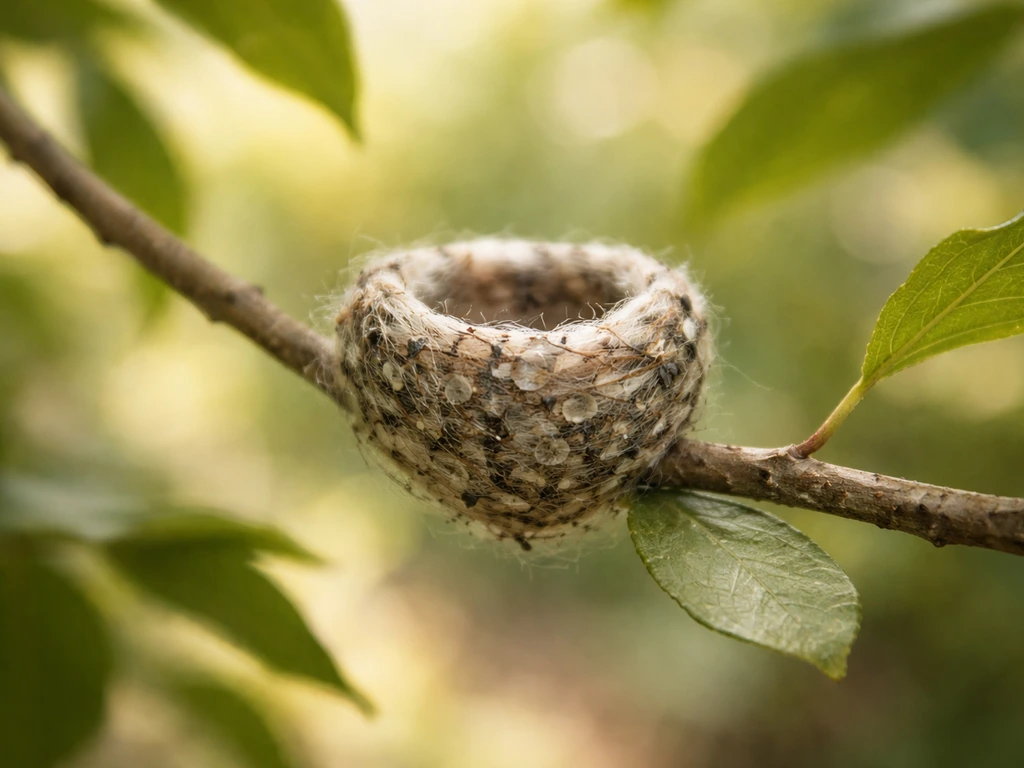
The bee hummingbird (Mellisuga helenae) of Cuba builds what is widely considered the smallest bird nest in the world: a thimble-sized cup roughly 2.5 cm (about 1 inch) in diameter, woven from spider silk, plant fibers, and soft down. If you're in the Caribbean, that's your answer. If you want the overall winner, the bee hummingbird is often cited as the top choice for the smallest nest. That question is commonly answered as the bee hummingbird from Cuba smallest bird nest in the world. Outside that range, the vervain hummingbird (Mellisuga minima) of Jamaica and Hispaniola comes in a very close second, with a nest about half the size of a walnut shell. In North America, the calliope hummingbird builds the smallest nest you're likely to encounter in the wild, and in Europe and Asia, ruby-crowned and goldcrest kinglets hold that title among common breeding birds. The section below gives you a fast shortlist, then everything you need to find, identify, and observe these nests responsibly.
Which Bird Builds the Smallest Nest How to Identify It

Quick answer shortlist: the smallest nests by region
| Species | Region | Nest size (approx.) | Key feature |
|---|---|---|---|
| Bee hummingbird (Mellisuga helenae) | Cuba | ~2.5 cm diameter, thimble-sized | Deepest but narrowest hummingbird nest; Guinness-recognized |
| Vervain hummingbird (Mellisuga minima) | Jamaica, Hispaniola | ~half a walnut shell | Lichen-covered cup; anchored with spider web |
| Calliope hummingbird (Selasphorus calliope) | Western North America | ~3.8 cm (1.5 in) diameter | Disguised as a pine cone; stacked on old nests |
| Ruby-throated hummingbird (Archilochus colubris) | Eastern North America | ~3–4 cm diameter | Classic spider silk and lichen cup on a thin branch |
| Goldcrest / Goldcrest kinglet (Regulus regulus) | Europe, UK, Asia | ~6–7 cm outer diameter | Spherical moss-and-lichen cup hung from conifer tip |
| Ruby-crowned kinglet (Corthylio calendula) | North America (boreal/montane) | ~6 cm outer diameter | Pendant cup near top of spruce or fir |
These are the species to look for first. If you're comparing across categories, nests built by larger birds but in tiny cavities (like certain parrotlets or pygmy owls) can look physically small at the entrance hole, but the chamber itself is usually bigger than anything a hummingbird builds. This article focuses on open cup and pendant nests, which are where the real miniaturization happens.
How to identify a 'smallest nest' in the real world
Tiny nests are easy to miss and surprisingly easy to misidentify. A clump of lichen on a branch, a knot of moss pressed into a fork, a small ball of cobweb snagged on a twig: any of these could be the real thing, or just debris. Here's how to tell the difference in the field.
The five things to check before you call it a nest
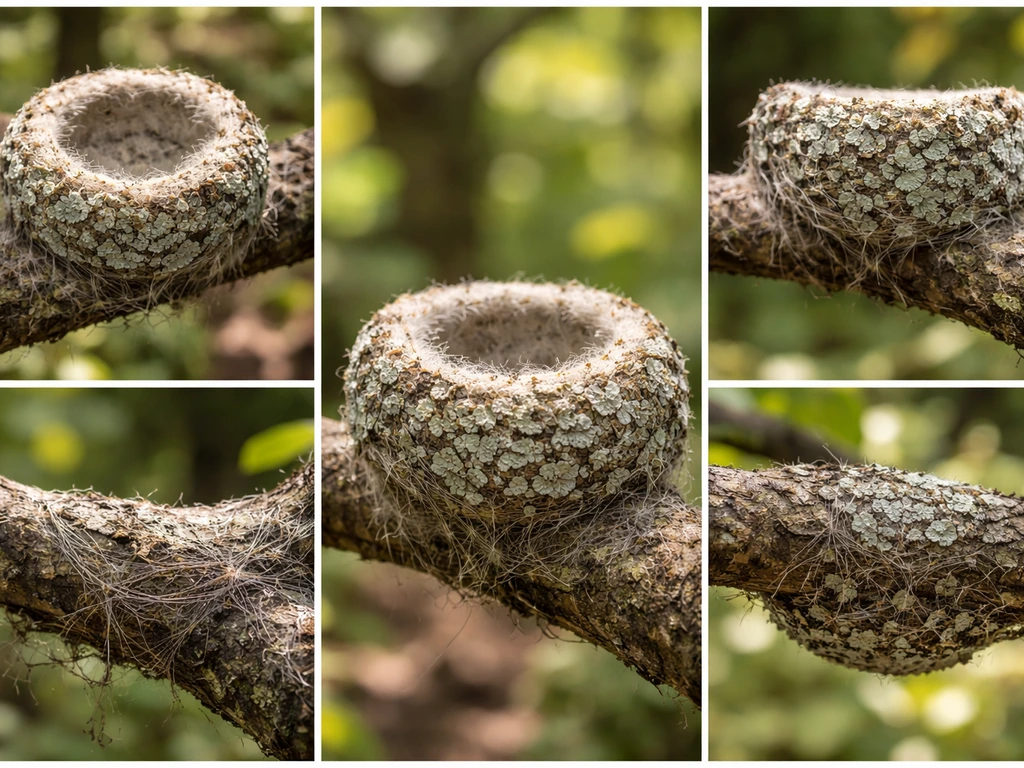
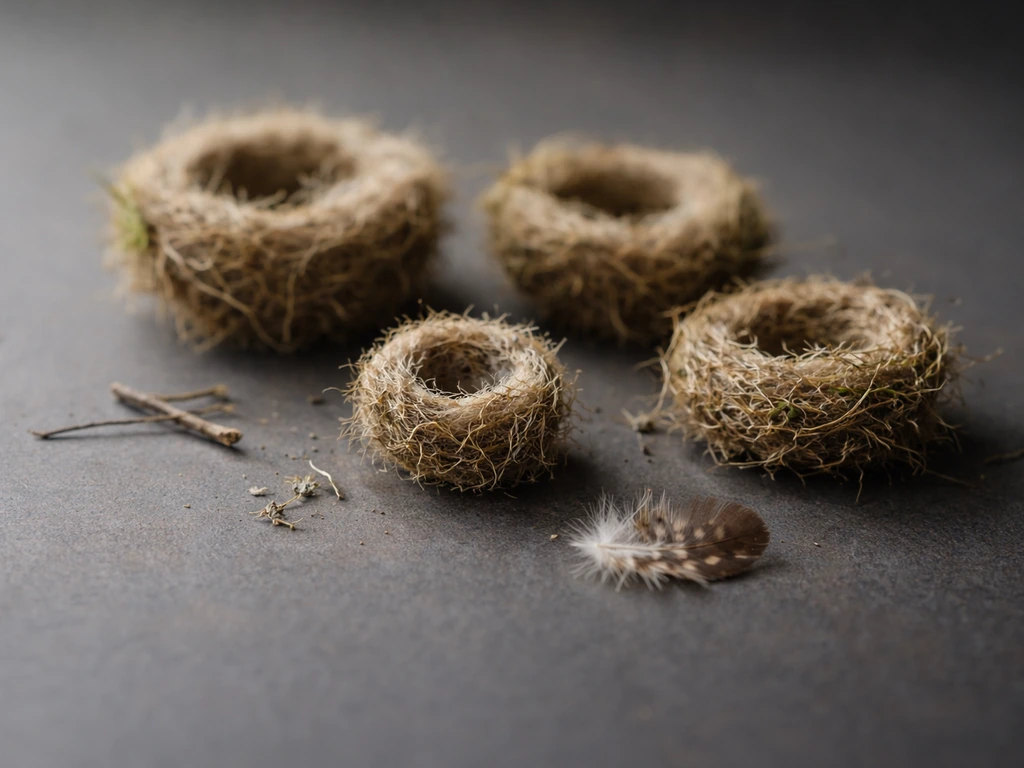
- Cup shape: Look for a distinct interior depression, even if shallow. Hummingbird nests have a neat, symmetrical bowl inside. Random clumps of lichen don't.
- Attachment method: Hummingbird nests are almost always bound to a branch with spider silk, which gives them a slightly shiny or elastic look at the base. Kinglet nests are suspended from twigs near branch tips using the same material.
- Materials on the outside: Lichen flakes and moss on the exterior are a strong signal. The bird deliberately presses these on to camouflage the structure. It won't look random; it will look applied.
- Diameter: Carry a small ruler or use your thumb (roughly 2 cm) as a gauge. If the interior is smaller than your thumb's width, you're almost certainly looking at a hummingbird or kinglet nest. Anything under 4 cm is unusually small for a passerine.
- Adult bird behavior: Sit quietly for 5 to 10 minutes. If a tiny bird makes repeated, direct flights to the same spot on a branch and then departs on a straight line, it's almost certainly visiting a nest. Hummingbird females are the sole incubators, so watch for females specifically.
One practical tip: photograph the object from multiple angles before you move closer. Zoom lenses or binoculars let you confirm the cup shape without stepping under the branch, which matters both for your ID accuracy and for not disturbing the bird.
Species profiles: likely candidates by region and habitat
Bee hummingbird (Cuba)
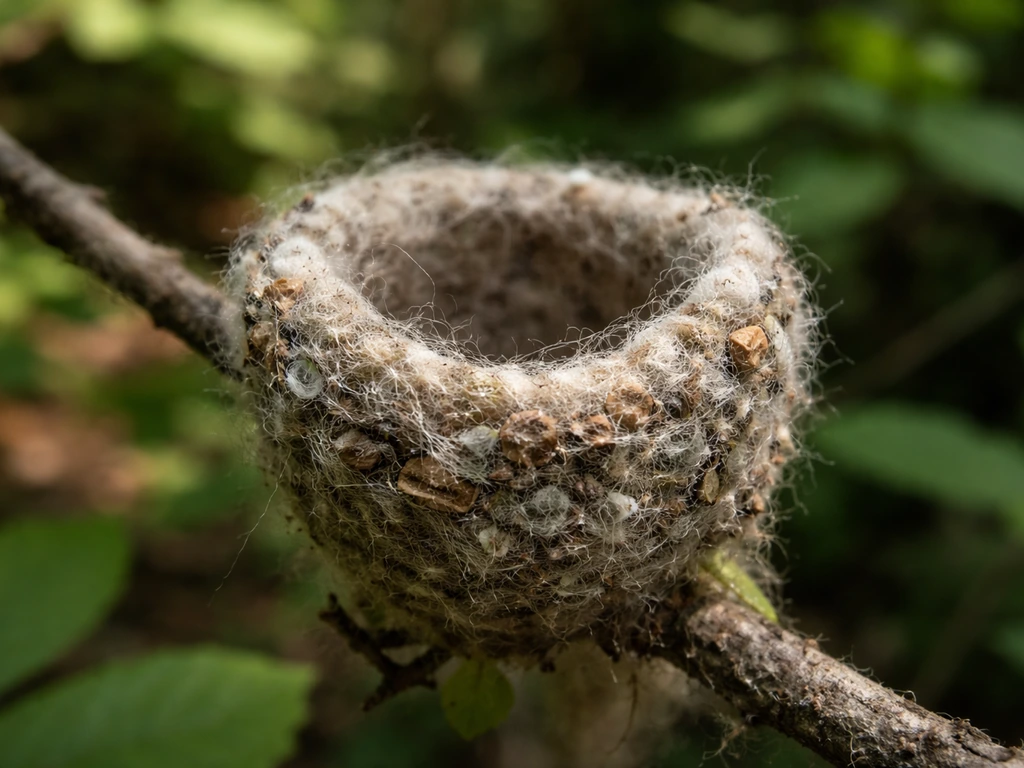
The bee hummingbird is the world's smallest bird, so it makes sense that it builds the world's smallest nest. The female constructs a deep, narrow cup about 2.5 cm across using plant fibers and spider silk. It's deeper relative to its diameter than most hummingbird nests, almost like a thimble in shape. You'll find them in forest edges, gardens, and woodland clearings across Cuba, typically placed on a slender branch at low to mid height. Because this species is near-threatened and its range is restricted, your chances of seeing one are best in protected areas like the Zapata Peninsula.
Vervain hummingbird (Jamaica and Hispaniola)
The vervain hummingbird holds the Guinness record for the smallest hummingbird nest overall: roughly half the size of a walnut shell. The female builds the cup from soft plant down and animal hair, then covers the outside with lichen and moss and binds everything to the branch with spider web. The exterior camouflage is so good that the nest almost disappears into the bark. Look for it on thin horizontal branches in gardens, coffee plantations, and secondary forest, generally below 3 meters.
Calliope hummingbird (Western North America)
This is the smallest bird breeding in North America, and its nest reflects that. The female builds a compact cup from plant down, moss, and bark fibers held together with spider webs, then camouflages the outside with lichen flakes. The nest is typically placed on a conifer branch over or near a stream, often stacked directly on top of a pine cone or an old nest from a previous season, which makes the cup look wider than it is and provides insulation. Interior diameter is around 3.8 cm (1.5 inches). Look in mountain meadows and streamside conifers from British Columbia south through California and east to Colorado, generally at elevations between 1,000 and 3,500 meters.
Goldcrest and kinglets (Europe, Asia, and North America)
Kinglets are the smallest songbirds in their respective regions and build some of the smallest passerine nests. The nest is nearly spherical, made of moss and lichen bound with spider silk, and it's suspended from the drooping tip of a conifer branch rather than sitting in a fork. The outer diameter runs about 6 to 7 cm, making it noticeably larger than a hummingbird nest but still remarkably small for a bird with a clutch that can reach 10 eggs. In Europe, the goldcrest (Regulus regulus) is the species to look for. In North America, the ruby-crowned kinglet uses boreal spruce and fir forests. Both are active, hover-gleaning birds that give themselves away with constant movement through foliage.
Nest materials and building behavior: why some nests end up so tiny
It's not just about body size, though that's the foundation. Research shows that nest-cup diameter scales to roughly the cube root of female body mass across passerine species, a relationship that holds consistently regardless of taxonomy. In other words, the physics of fitting the bird's body into the cup drives the minimum size. But hummingbirds and kinglets go even further toward the minimum because of how they build.
Spider silk is the key material. It's extraordinarily strong relative to its weight, flexible, and slightly elastic, which means the builder can use far less of it (and less of everything else) to make a structurally sound cup. As chicks grow, the silk stretches to accommodate them rather than the nest falling apart. This is why hummingbird nests can look almost empty of material: the silk is doing the structural work invisibly. Larger birds that rely on twigs and mud need more mass to achieve the same stability.
Camouflage materials (lichen, moss, bark) are pressed onto the outside after the cup is formed, not woven in. This keeps the structural material minimal and adds insulation and disguise in a single step. The result is a nest that's functionally complete at a size that would be structurally impossible if built with conventional materials. It's worth knowing this when you're trying to spot one: the exterior looks like part of the branch, not like a nest, which is exactly the point.
When and where to look: seasonality, timing, and microhabitats
Timing by species
| Species | Nesting season | Best search window |
|---|---|---|
| Bee hummingbird | March to June (Cuba) | April to May |
| Vervain hummingbird | February to June (Caribbean) | March to May |
| Calliope hummingbird | May to July (Western NA) | Late May to mid-June |
| Ruby-throated hummingbird | May to August (Eastern NA) | May to June |
| Goldcrest / kinglet | April to July (Europe/UK) | Late April to May |
| Ruby-crowned kinglet | May to July (boreal NA) | June (breeding grounds) |
Where to focus your search
- Streamside conifers and aspens at mid-elevation: prime calliope hummingbird habitat in the western US and Canada.
- Garden edges and flowering trees: ruby-throated hummingbirds favor spots near nectar sources like trumpet vine or salvia, with a sheltered branch nearby for the nest.
- The drooping outer tips of mature spruce, fir, or cedar branches: this is where kinglets place their pendant cups, typically 5 to 20 meters off the ground.
- Coffee and garden plantings at low elevation in the Caribbean: both the bee hummingbird and vervain hummingbird use these areas regularly.
- South-facing branches in partial shade: hummingbird nests are often placed where they get morning sun for warmth but afternoon shade to avoid overheating eggs.
The practical search method that works best: stand near a likely habitat on a calm morning and watch for repeated, purposeful return flights by a tiny female bird to the same branch location. She'll arrive fast, pause briefly, then leave in a straight line to feed. Once you've fixed the location with binoculars, look for the cup from a distance of at least 5 to 10 meters before stepping closer.
Ethical, legal, and safety guidance around nests
Tiny nests are disproportionately vulnerable. Because they're built to a structural minimum, even small physical disturbances (a branch bending under your hand, vibration from nearby activity, the nest being touched) can dislodge eggs or cause the female to abandon the nest. The legal framework in most countries reflects this vulnerability.
What the law says
In the United States, the Migratory Bird Treaty Act (MBTA) makes it illegal to collect, possess, or transfer migratory bird nests. A key nuance from USFWS guidance: the MBTA does not prohibit destroying an empty, inactive nest on its own (where no possession occurs), but any active nest with eggs or chicks is fully protected, and disturbing one can carry serious penalties. If you're in the UK, the Wildlife and Countryside Act 1981 protects all wild bird nests in use or being built, and moving one without authorization can be a criminal offense. The EU Birds Directive similarly prohibits deliberate, significant disturbance of wild birds during breeding and rearing. Always check your local regulations before doing anything other than observing.
Safety for you and the bird
- Never touch an active nest, its eggs, or its chicks. The folk belief that handling causes abandonment is not universally true, but the physical risk of dislodging spider-silk-anchored eggs is very real.
- Don't use flash photography close to the nest. The sudden light can startle the incubating female and cause her to flush from the nest suddenly, which risks damaging eggs.
- Keep visits short. Two to three minutes of quiet observation, then move away. Prolonged presence near the nest keeps the parent away from incubation duties, which matters especially in hot or cold weather.
- Don't attempt DIY relocation. Even a few centimeters of movement can cause the parents to lose the nest site and abandon the clutch. In most jurisdictions, moving an active nest without a permit is illegal.
- If a nest is in a genuinely dangerous location (directly over a high-traffic door, for example), contact a licensed wildlife rehabilitator or your local wildlife authority before touching anything.
What to do if you find an active nest (and what not to do)
Immediate steps when you find a tiny nest
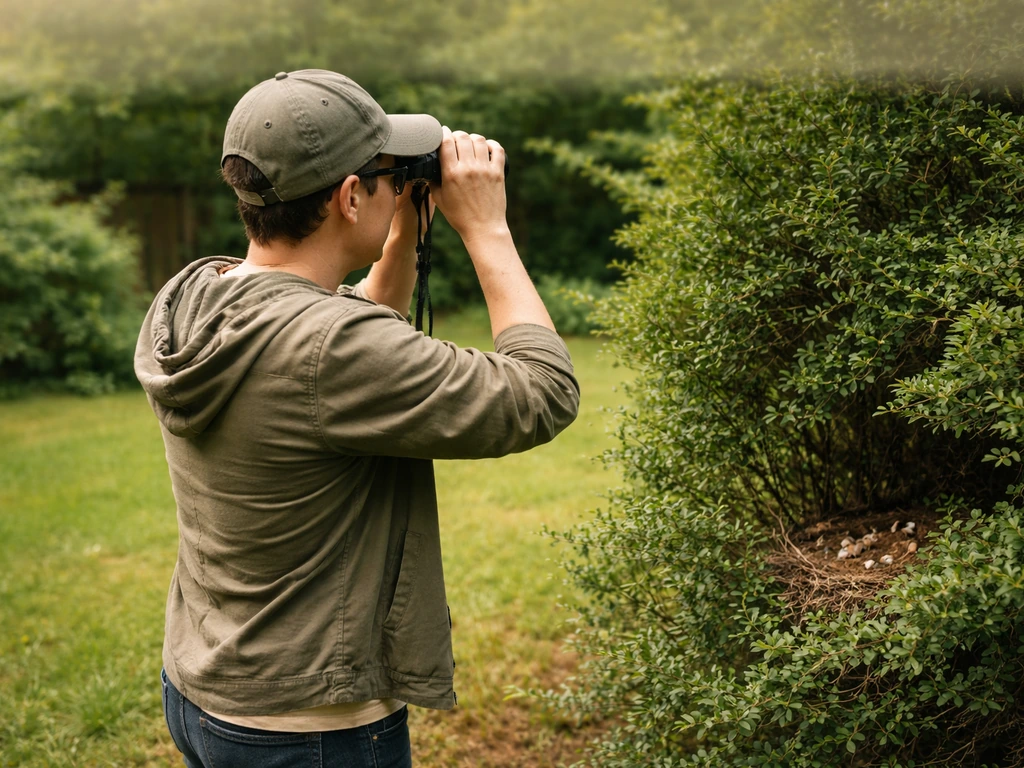
- Stop where you are and observe from a distance. Use binoculars or a zoom lens. Don't step under the nest or reach toward it.
- Photograph the nest from multiple angles without moving branches. Get the full context (tree species, branch height, attachment point) as well as close-up detail of materials.
- Note the date, time, GPS location or a clear written description, weather conditions, and any adult bird behavior you see. A simple field note in your phone's notes app works fine.
- Estimate size by reference: a standard coin (a US quarter is about 2.4 cm; a UK 10p is about 2.4 cm) held near the nest for scale in a photo is useful without requiring you to touch anything.
- Mark the location on a map app so you can return to observe at a respectful distance and track nesting progress over time.
- If you believe you've found a nest that could be a new or unusual record for your area, contact your local birding society or wildlife agency. They can send a licensed observer to document it properly.
What not to do (the short version)
- Don't handle eggs, chicks, or nest material under any circumstances.
- Don't prune, trim, or modify the tree or shrub while the nest is active.
- Don't post the exact GPS location publicly on social media during the active season. This attracts crowds that can collectively cause enough disturbance to cause abandonment.
- Don't assume an empty-looking nest is abandoned after one visit. Hummingbirds and kinglets leave for feeding runs that can last 20 to 30 minutes.
- Don't add food near the nest to attract the parents for better photos. It draws predators and can alter normal behavior.
If you're comparing the smallest nests to the biggest structures in the bird world, the scale difference is extraordinary: a bee hummingbird's 2.5 cm cup against the multi-ton platform nests that some eagles reuse for decades. Hanging nests, woven nests, and even the most architecturally impressive structures built by weaver birds all require a different identification approach, and each comes with its own set of ethical considerations during the breeding season. Whatever type of nest you encounter, the same principle applies: observe first, document carefully, and let the birds do their work undisturbed.
FAQ
Which bird builds the smallest nest overall, not just the smallest nest in a certain region?
For a global “smallest overall” answer, the vervain hummingbird (Mellisuga minima) is often cited for the smallest hummingbird nest size, even though the bee hummingbird is frequently named as the smallest overall for the smallest bird and for its famously tiny thimble-like cup in Cuba.
Why can I see a tiny “thing” on a branch that looks like a nest, but it’s not?
Common lookalikes include lichen clumps, moss pressed into a fork, and cobweb balls after insects have moved through. The fastest check is behavior, not looks, because real nests will have repeated purposeful returns by the same adult to the exact spot.
How close is too close when I’m trying to confirm the nest is really there?
Use binoculars and keep distance until you can confirm the shape. If you must approach, avoid stepping under the branch and do not touch anything, since the smallest nests can be dislodged by minor vibration or branch movement.
Do hummingbird and kinglet nests sit in the open the same way?
No. Hummingbird nests are open cup or pendant cups, often on slender branches. Kinglet nests are nearly spherical and are typically suspended from drooping conifer tips rather than sitting in a fork, which changes what you look for.
What should I photograph to help with identification later?
Capture multiple angles that show the overall cup or pendant shape, the attachment point on the branch tip or fork, and the surrounding substrate for camouflage context (lichen, moss, or bark texture). If possible, include a wider frame to estimate scale against nearby twigs.
How can I tell a hummingbird nest from a similarly sized insect or spider structure?
Insect and spider structures usually lack consistent “purposeful placement” and do not show adult bird return flights to the same exact attachment spot. Also, the hummingbird nest will typically have a cup or thimble-like interior geometry rather than a random tangle.
Are there edge cases where a cavity-nesting bird’s nest might look small from the entrance?
Yes. Some cavity nesters can have a small entrance opening, but the breeding chamber is often larger than what a hummingbird cup provides. If the structure is in a cavity, you need to rely on species-specific nesting behavior cues rather than only entrance size.
If the nest is very camouflaged, how do I locate it without disturbing the birds?
Start with habitat and timing, then watch for repeat flight paths by a tiny female to a consistent branch location. Fix the point with binoculars first, then look for the cup from several meters away before any closer movement.
Is it ever legal to move or remove a tiny nest if it seems empty?
Rules vary by country, but in many places the key distinction is whether it is active or was recently used. In the US under MBTA, active nests with eggs or chicks are protected, and disturbing them can lead to serious penalties, while an empty inactive nest may be treated differently. Check local regulations before acting.
Which Bird Can Weave a Nest? Identification Guide
Identify which bird weaves nests, spot leaf use, distinguish true woven nests, and confirm species by location and timin