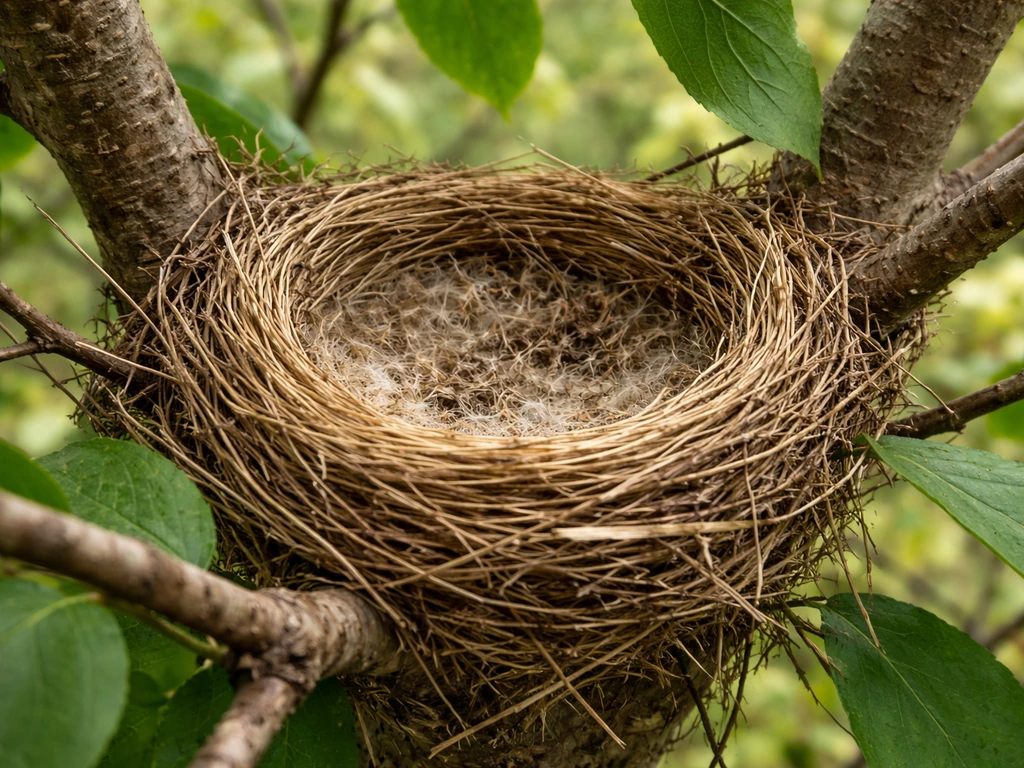
blank" rel="noopener noreferrer">Weaverbirds (family Ploceidae) are the world's most accomplished nest weavers, but several other species also build genuinely woven or stitched nests. The standout weavers include the Baya weaver, Village weaver, Black-headed weaver, Spectacled weaver, and Sociable weaver, all of which interlace grass stems, leaf strips, and plant fibers into tight, basket-like structures with roofed chambers and often a downward-facing entrance tube. Beyond the weavers, the Common tailorbird takes a completely different but equally impressive approach: it sews leaf edges together with spider silk or plant fiber to create a stitched leaf cradle, then lines it with a soft cup nest inside. If you have spotted a nest that looks woven, knotted, or stitched rather than just stacked with sticks, one of these species is almost certainly responsible.
Which Bird Can Weave a Nest? Identification Guide

The main birds that weave their nests
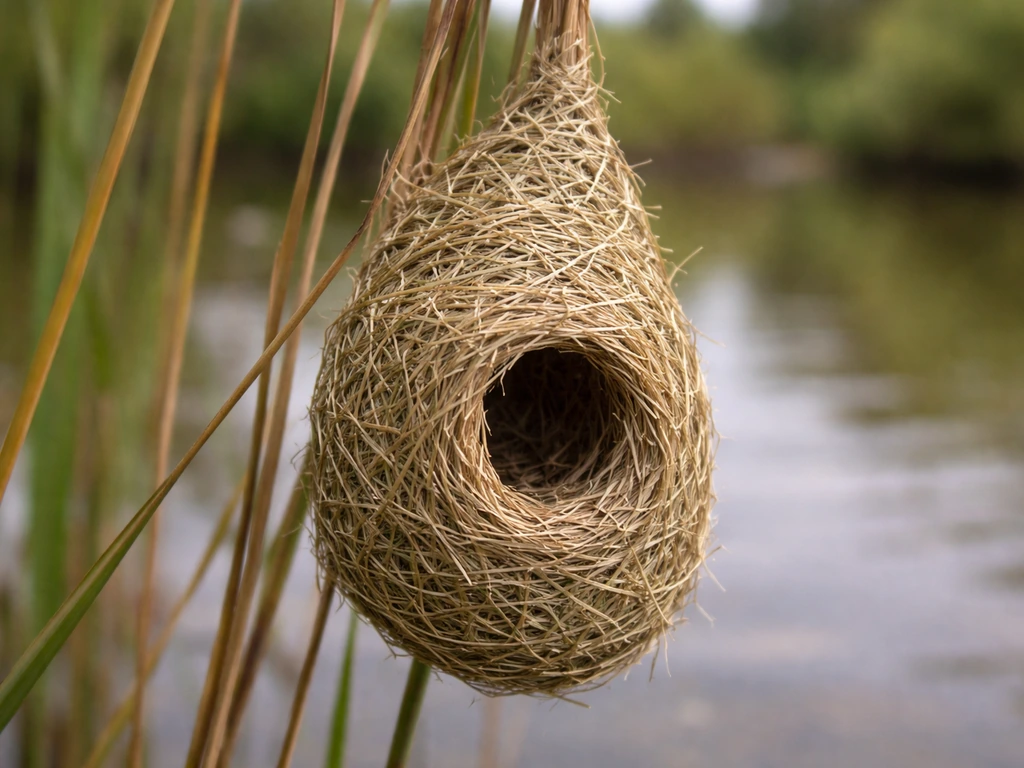
Weaverbirds earn their name honestly. Males spend days weaving hundreds of individual grass blades, reed strips, and palm fronds into a single nest, interlacing each strand so the structure holds without mud or glue. The result is a dense, roofed sphere or retort shape that hangs from a branch tip, often over water. Below are the species you are most likely to encounter or read about.
| Species | Range | Nest shape | Key material cue | Entrance style |
|---|---|---|---|---|
| Baya weaver (Ploceus philippinus) | South and Southeast Asia | Retort-shaped hanging sphere | Long strips of paddy leaves woven in | Downward-facing tube spout |
| Village weaver (Ploceus cucullatus) | Sub-Saharan Africa | Large coarsely woven sphere | Leaf strips torn from palms and grasses | Downward-facing opening |
| Black-headed weaver (Ploceus melanocephalus) | Central/West Africa | Intricately woven sphere | Hundreds of grass, reed, and palm blades | Side or downward entrance |
| Spectacled weaver (Ploceus ocularis) | Eastern/Southern Africa | Ornate woven nest with long tunnel | Fine plant fibers, very neat weave | Long woven tunnel entrance |
| Sociable weaver (Philetairus socius) | Southern Africa (Kalahari) | Massive communal thatched complex | Grass and straw in layered chambers | Individual tunnel chambers underneath |
| Common tailorbird (Orthotomus sutorius) | South and Southeast Asia | Leaf cradle cup | One or more leaves stitched at the edges with spider silk or plant fiber | Open top cup inside the leaf pouch |
The Sociable weaver's nest is worth a separate mention because it is genuinely enormous: a single structure can span several meters across and house dozens of breeding pairs, each with its own tunnel-accessed chamber underneath the thatched roof. If you are curious about the biggest nests overall, the Sociable weaver also figures into that conversation. The Sociable weaver is often linked with the question of what bird builds the biggest nest biggest nests overall. On the smaller end of the spectrum, the Common tailorbird builds one of the most delicate nests in the bird world, and it is easy to miss because it hides inside folded living leaves.
Woven nests vs. other nest styles: how to tell the difference fast
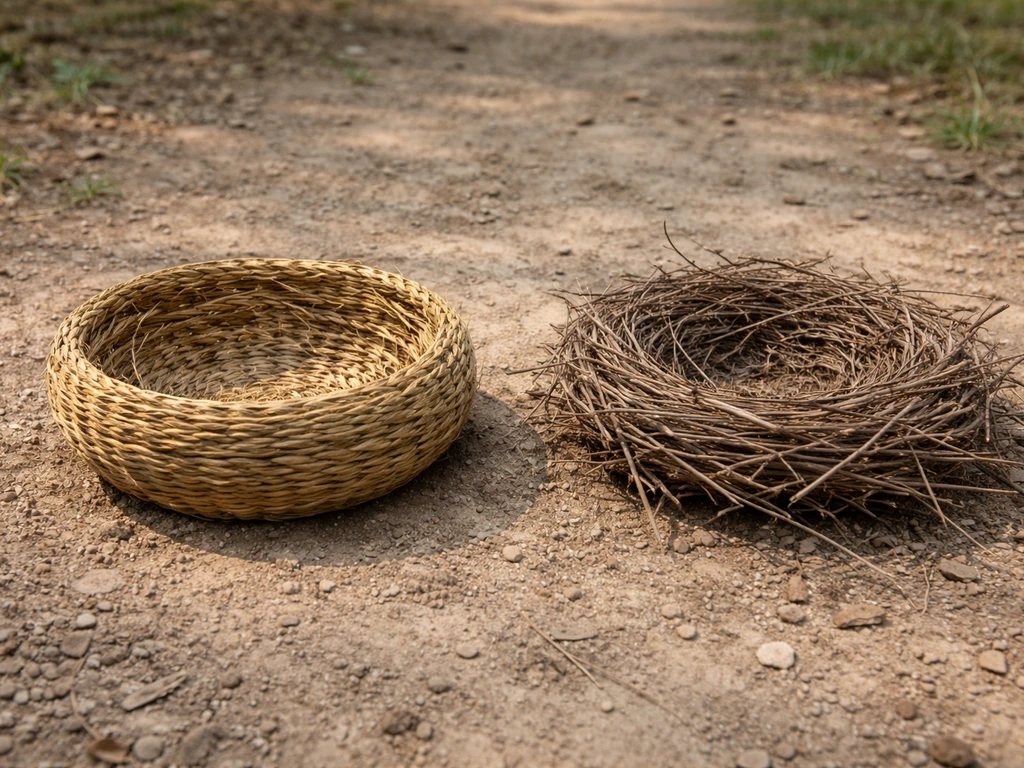
Most birds build nests by stacking or pressing materials together into a cup or dome. Truly woven nests look and feel different. The fibers are interlaced, not just piled, so the structure is flexible but holds its shape under tension. Here is how to read what you are seeing without getting close enough to disturb anything.
Signs you are looking at a woven nest
- Interlaced fibers: individual strands cross over and under each other like basket weave. Stacked nests have layered materials that do not interlock.
- Enclosed or roofed chamber: woven nests are usually fully enclosed with a distinct entrance, unlike open-cup nests that are open at the top.
- Entrance tube or downward-facing hole: many weaver species build a spout-like tube pointing down, which you can see from below without touching anything.
- Hanging from a branch tip: most weaverbird nests are suspended from the end of a thin branch or palm frond, often over water, making them hard for predators to reach.
- Visible knots or loops near the attachment point: male weavers tie specific knots at the anchor point, visible with binoculars.
- Stitched leaf edges (tailorbird specific): look for one or more large leaves curled into a cone or tube shape, with a visible line of tiny perforations or thread-like binding along the edge seam.
What simple nests look like by comparison
A robin's mud-reinforced cup, a crow's twig platform, or a sparrow's loose grass bundle all lack the interlocked fiber structure. You can tell these apart because materials slide out or shift when the nest moves, and there is no enclosed chamber or entrance tube. Domed nests like those of wrens come closest but are built by stuffing and pressing rather than weaving individual strands through each other. If you want to compare nest-building extremes, hanging nests and the biggest platform nests represent opposite ends of avian architecture. If you want the classic hanging nest question, this is the bird group most often associated with a hanging woven nest hanging nests.
What leaves and materials tell you about the nest builder
Leaf use is one of the most useful field clues for narrowing down which weaving bird you are looking at, because different species use leaves in fundamentally different ways.
Long leaf strips woven into the structure
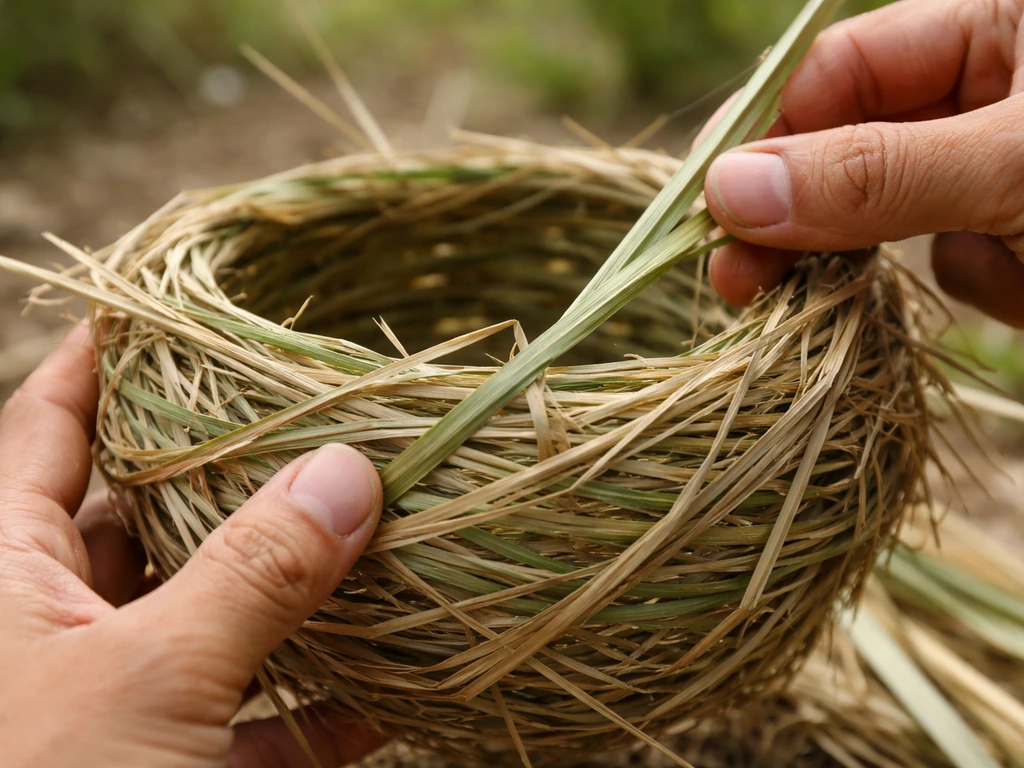
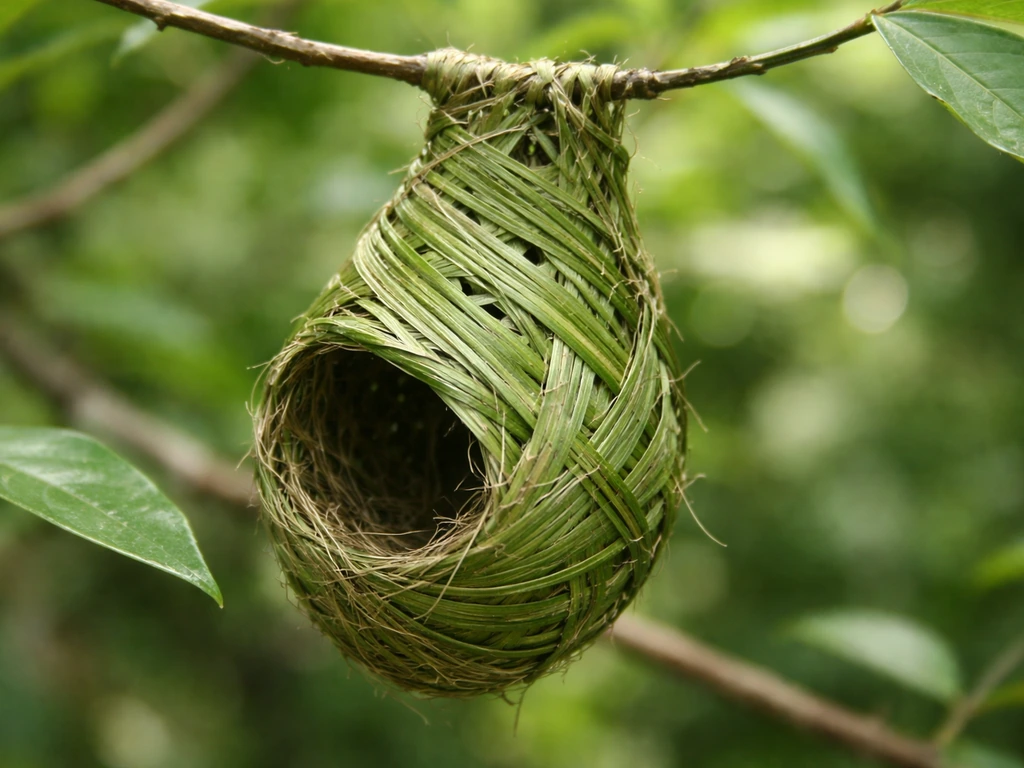
Baya weavers and Village weavers both tear long, thin strips from broad leaves, especially paddy leaves, palms, and grasses. These strips are then woven in lengthwise, so you can often see the stripey texture of the nest wall if you look through binoculars. The strips are not just laid in; they are threaded over and under existing strands. If you spot a hanging nest with a clearly striped or ribbed outer surface and a downward entrance tube, a Baya or Village weaver is almost certainly responsible.
Fine plant fibers and a polished finish
The Spectacled weaver and blank" rel="noopener noreferrer">Black-headed weaver use finer fibers than the Baya or Village weaver, giving their nests a smoother, almost varnished look. The Black-headed weaver can incorporate hundreds of individual grass blades, reed sections, or palm strips, producing a dense spherical nest that is noticeably heavier and more tightly woven than it looks. The Spectacled weaver adds a long entrance tunnel, sometimes 10 to 15 centimeters or more, woven from the same fine fibers, making it one of the most visually striking nests you can find.
Stitched leaves (the tailorbird signature)
The Common tailorbird is the bird most people mean when they ask which bird weaves its nest with leaves, and technically it sews rather than weaves. If you are asking which bird makes the best nest, the tailorbird is the best answer to that question because its stitched-leaf design is so distinct which bird most people mean.
The female selects one or two large, supple leaves, still attached to the plant, then uses her sharp bill to pierce a line of tiny holes along the edges. Wikipedia notes that the common tailorbird has a stitched-leaf nest made by piercing and sewing leaf edges with plant fibre or spider silk, forming a cradle for the actual nest.
She threads plant fiber or spider silk through each hole and ties it off, drawing the leaf edges together into a cone or pouch shape. Up close (or in a good photograph), you can see the individual stitch holes and the thread-like binding running between them.
This stitched-seam detail is visible without touching the nest and is essentially diagnostic: no other common garden bird produces this structure. If you are wondering which bird makes the most beautiful nest, the tailorbird's stitched leaf design is one of the most striking alternatives to classic woven nests.
Confirming the species from location, season, and behavior
Even the best nest photo is more useful when combined with where you found it, what time of year it is, and what behavior you observed nearby. Here is how to pull all of that together.
Location and habitat
- Hanging over water or from palm trees in rice-growing areas of South or Southeast Asia: very likely Baya weaver.
- Hanging from acacias or fig trees in sub-Saharan Africa, often in noisy colonies: Village weaver or Black-headed weaver.
- Single nest with a long entrance tube, in thickets or forest edges in East or Southern Africa: Spectacled weaver.
- Massive thatched structure in a camelthorn or quiver tree in the Kalahari or Namibia: Sociable weaver, no other species builds like this.
- A cone of folded living leaves in a garden shrub or low vegetation in South or Southeast Asia: Common tailorbird.
Season and timing
Weaverbirds in Africa typically begin nest construction at the start of the rainy season, which is when fresh grass is long, green, and pliable enough to weave without snapping. Baya weavers in South Asia usually start building between June and August, tied to the monsoon. The tailorbird breeds through much of the year in warm climates but is most active from spring through early summer. If you find a freshly built woven nest, check whether breeding season for the local candidate species matches your current month. A nest that looks brand new in the middle of the dry season might be an old structure or a non-native species.
Observed behavior
Watching the bird at the nest, even briefly through binoculars, confirms more than any single nest feature. Male weaverbirds are active and conspicuous builders: the male weaves alone, hangs upside down from the entrance to display, and may build several incomplete nests before a female accepts one. The female inspects the interior and lines it if she approves. Tailorbirds are smaller, skulky birds that dart in and out of low foliage.
Catching a glimpse of a small, olive-green bird with a cocked tail entering the stitched leaf structure is a solid confirmation. Document what you see with photos and notes: the Cornell Lab NestWatch program recommends recording the nest location carefully and photographing it so you can return to the same spot without disturbing it.
A quick field checklist for confirming a woven nest builder
- Note the country and habitat type (rice field, acacia woodland, garden shrub, riverine forest).
- Check the nest's position: hanging from a branch tip, attached to a vertical reed, or sewn into a living leaf.
- Look for an entrance type: open cup (not a weaver), side hole (possible), downward tube (strong weaver indicator), stitched leaf seam (tailorbird).
- Assess the weave texture through binoculars: are the fibers interlaced or just stacked? Are leaf strips visible?
- Note the current month and compare it to the known breeding season for local candidate species.
- Watch from a distance for 10 to 15 minutes: does the attending bird match a weaver or tailorbird by size, color, and behavior?
What you can do today: observe and document without disturbing
Finding a woven nest is exciting, but the most important thing you can do is keep your distance. Active nests with eggs or chicks are legally protected in the United States under the Migratory Bird Treaty Act, and disturbance anywhere in the world reduces the chances of successful breeding. Here is how to be a responsible observer from day one.
Use binoculars and a camera, not your hands
Stay at least 5 to 10 meters back from any active nest and use binoculars or a telephoto lens to get the detail you need. NestWatch's monitoring protocol recommends using binoculars and, for higher nests, a mirror on a pole rather than climbing or reaching in. You can identify every structural feature of a woven nest (entrance tube, leaf strips, stitch holes, attachment knots) from a respectful distance with the right optics. Never part branches or move leaves to get a better view: even small disturbances can alert predators to the nest's location.
Document with photos and a few quick notes
- Photograph the nest from multiple angles without moving closer than feels comfortable.
- Photograph the surrounding habitat and the branch or plant the nest is attached to.
- Note the GPS location or a clear landmark so you can find it again without searching.
- Record the date, time, approximate nest height, and any bird behavior you observe.
- Note what materials you can see: grass strips, leaf fibers, spider silk thread, entrance tube direction.
How often to check back
NestWatch recommends visiting active nests no more than once or twice per week. Visiting too frequently creates a disturbance trail that predators can follow, and it adds stress to breeding birds. You do not need to record every visit: the NestWatch program itself clarifies that checking in 50 times is unnecessary. Once or twice a week, spending a few minutes watching from a distance, is enough to track a nest through incubation and nestling stages without causing harm.
Legal and safety guidance for homeowners and nest encounters
Whether you have found a woven nest in your backyard or a bird has started building in an inconvenient spot, the legal position in the United States is clear: do not touch or remove an active nest. Under the Migratory Bird Treaty Act (MBTA), destroying an active nest containing eggs or chicks, or taking migratory birds, eggs, or nests without authorization, is a federal offense. The U. S.
Fish and Wildlife Service's 2025 guidance (MBPM-2) reaffirms that nest destruction resulting in unpermitted take of migratory birds is prosecutable. Most of the weaverbirds discussed in this article are not native to the United States, but tailorbirds and many other cavity and cup nesters that could be confused with weavers are protected. When in doubt, treat any active nest as protected.
What to do if you find an injured bird near a nest
If you find an injured or orphaned nestling near a woven nest, the USFWS guidance is simple: leave it alone in most cases, and contact a licensed wildlife rehabilitator if it is clearly injured. Under 50 CFR Section 21.76, a member of the public may take temporary possession of a sick, injured, or orphaned migratory bird only for the immediate purpose of transporting it to a permitted rehabilitator or licensed veterinarian, not to keep it. Do not attempt to feed nestlings, and do not place them back in a nest you cannot safely reach without disturbing the structure.
Protecting nests from predators without causing harm
If a woven nest on your property is being targeted by a cat, squirrel, or snake, there are a few non-disruptive steps you can take. Fit a smooth metal baffle on the branch or post below the nest attachment point. Keep cats indoors during peak nesting season, especially early mornings when adult birds are most active. Avoid pruning or mowing near the nest site until you are certain the nest is no longer active (empty after fledging, not just temporarily unattended). If you are unsure whether a nest is active, watch from a distance for 20 to 30 minutes: adults will usually return during that window.
When to call an expert
Call a licensed wildlife rehabilitator if you find a nestling on the ground that is clearly injured, featherless, or not responding to nearby adult birds. Contact your local building or pest control authority, not a wildlife removal company, if a weaver species that is considered invasive in your region (such as Village weavers established in parts of Florida or Hawaii) has built a nest that poses a genuine structural or safety problem. In that case, legal removal may be possible under specific state or federal permits, but get expert advice before acting. For any nest that is simply inconvenient but inactive (no eggs, no chicks, clearly abandoned), you are free to remove it safely once the breeding season has ended.
FAQ
How can I tell the Common tailorbird’s stitched leaf nest from a real woven nest at a distance?
Look for a stitch line made of tiny, repeating holes along the leaf margin. Tailorbird nests often show a visible seam or puckered binding where the leaf edges are pulled together, and they sit inside a soft leaf cradle. True weaver nests show interlaced strands forming a woven wall, usually with a distinct entrance tube rather than a stitched seam.
What if the woven nest looks fresh, but I do not see any birds yet, how do I know if it is active?
Weaverbird nests can look “brand new” but remain unused for a while, because males may build several incomplete structures before a female chooses one. Check whether there is active traffic (adults repeatedly entering the entrance) and whether the nest has a currently intact opening rather than being abandoned or torn.
Can woven nests be abandoned or unfinished before they end up active, and does that change what I should do?
You may see partial or unfinished weaver nests, especially in the early stages. Weaver males sometimes leave incomplete domes or roofless frames, then add structure after female interest, so absence of eggs at first does not mean it is inactive.
How do I distinguish a recently built woven nest from an older structure that is being reused or partly repaired?
In many weavers, the entrance tube and roofed chamber are built as the nest develops, but older nests can keep parts intact even after birds stop using them. If you are trying to identify the bird, prioritize features like the entrance tube orientation and fiber type over the overall “age” of the material.
What are common misidentifications when people assume a nest is woven but it might just be tightly stacked?
Yes. Birds in the same region can produce nests that are “woven-looking” due to dense stacking, but the diagnostic factor is interlacing, not just packing. If fibers shift when you gently view with binoculars or if you cannot see an enclosed chamber and entrance tube, treat it as non-weaver or at least uncertain.
Can leaf choice and leaf appearance help me tell which weaver species made the nest?
Often you can narrow it down by leaf processing. Broad-leaf strips that create a striped outer wall point toward Baya or Village weavers, while very smooth, tightly knit spheres with longer entrance tunnels suggest Spectacled or Black-headed weavers. Tailorbird nests specifically rely on one or two whole living leaves stitched into a pouch-like cradle.
How reliable is breeding season timing for identification if I am not sure which species are local or non-native?
Time of year is a strong filter, but location matters more than your general climate. A nest found during a season that does not match local rainy or monsoon patterns for the likely species is more likely to be older, misdated, or from an unexpected species, including non-native birds.
What is the safest way to confirm the nest builder if I want a higher-confidence ID for photos?
Use binoculars or a telephoto lens to confirm, then capture only non-intrusive evidence like entrance shape, tube length, and visible stitch holes if present. Avoid attempts to “get closer for a better photo,” because nest defense behavior can increase disturbance and predator attention.
If I am trying to verify whether a nest is active, how often is too often to check it?
Even passive visits can add risk, especially if you create repeated trails near the nest. Instead of multiple quick checks, choose one careful observation session, then reduce revisit frequency to once or twice per week while staying well back.
When can I remove a woven nest that is on my property, and what counts as “inactive” in practice?
If the nest is active, do not remove it yourself, even if it is inconvenient. For non-active nests, you should still confirm it is truly inactive, meaning no eggs or chicks and no adult returns over a reasonable watch window, before removal.
What should I do if I find a nestling on the ground, how do I decide whether it is truly orphaned?
If a nestling is on the ground and clearly injured, featherless, or not responding to nearby adults, contact a licensed wildlife rehabilitator and do not try to feed it. If you only suspect it is orphaned, watch from a distance first because adults may be nearby but temporarily out of view.
What can I do if a cat, squirrel, or snake is targeting the woven nest, without disturbing the nest?
For cat or snake risk, use barriers and timing rather than disturbing the nest. A baffle on the attachment post or branch can prevent climbing predators, and keeping cats indoors during peak nesting months reduces direct predation. Avoid trimming branches or mowing near the site until you have confirmed fledging or clear inactivity.
If the weaver species is invasive and the nest is causing a structural problem, who should I contact and what comes first?
If a weaver species is invasive in your area and the nest creates a safety or structural hazard, removal may be possible but is not guaranteed and often requires permits. The practical step is to call local building or pest authorities (or a wildlife professional) for permit-aware guidance rather than attempting removal immediately.
How can I quickly and safely determine whether adults are actively using the nest before I decide what to do?
A typical “field move” is a short watch period, 20 to 30 minutes, from a fixed distance. If adults return consistently and are entering the entrance, it is almost certainly active, and you should treat it as protected regardless of what it looks like.
Which Bird Makes the Best Nest Learn to Identify and Help
Match nest type to the bird, learn what makes a high quality nest, and safely help local nest builders.