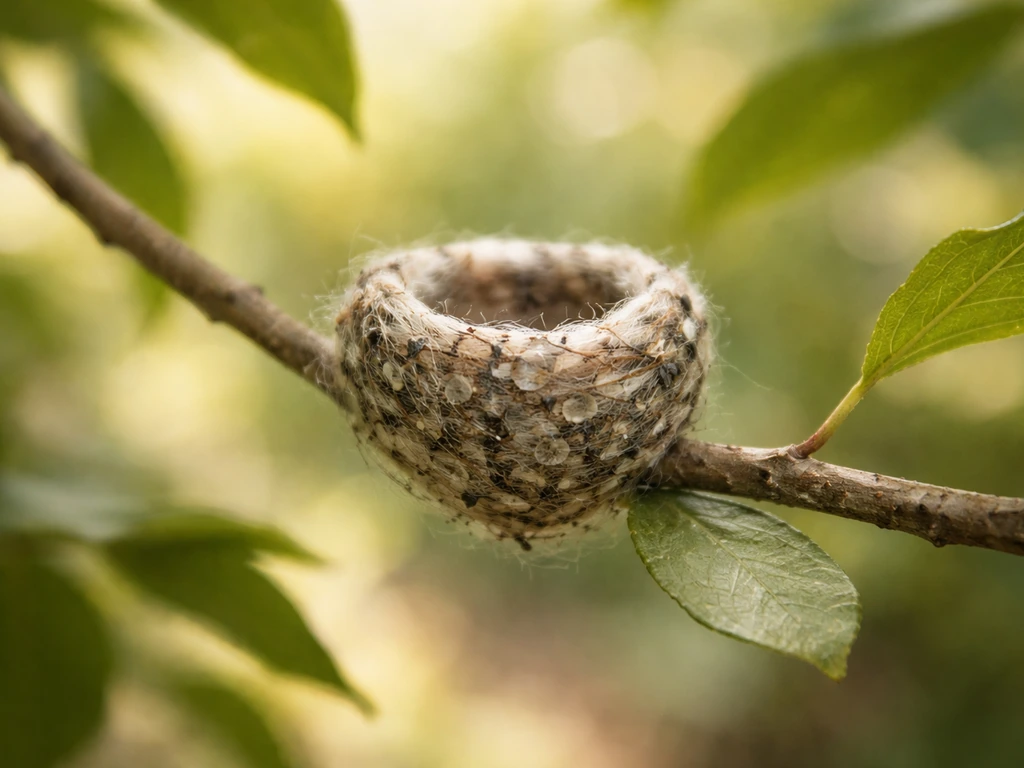
The birds most commonly responsible for a messy nest near your home are house sparrows, European starlings, barn or cliff swallows, and American robins.
What Bird Makes a Messy Nest? Identify and Handle It Safely

Maya Bennett
5 May 2026
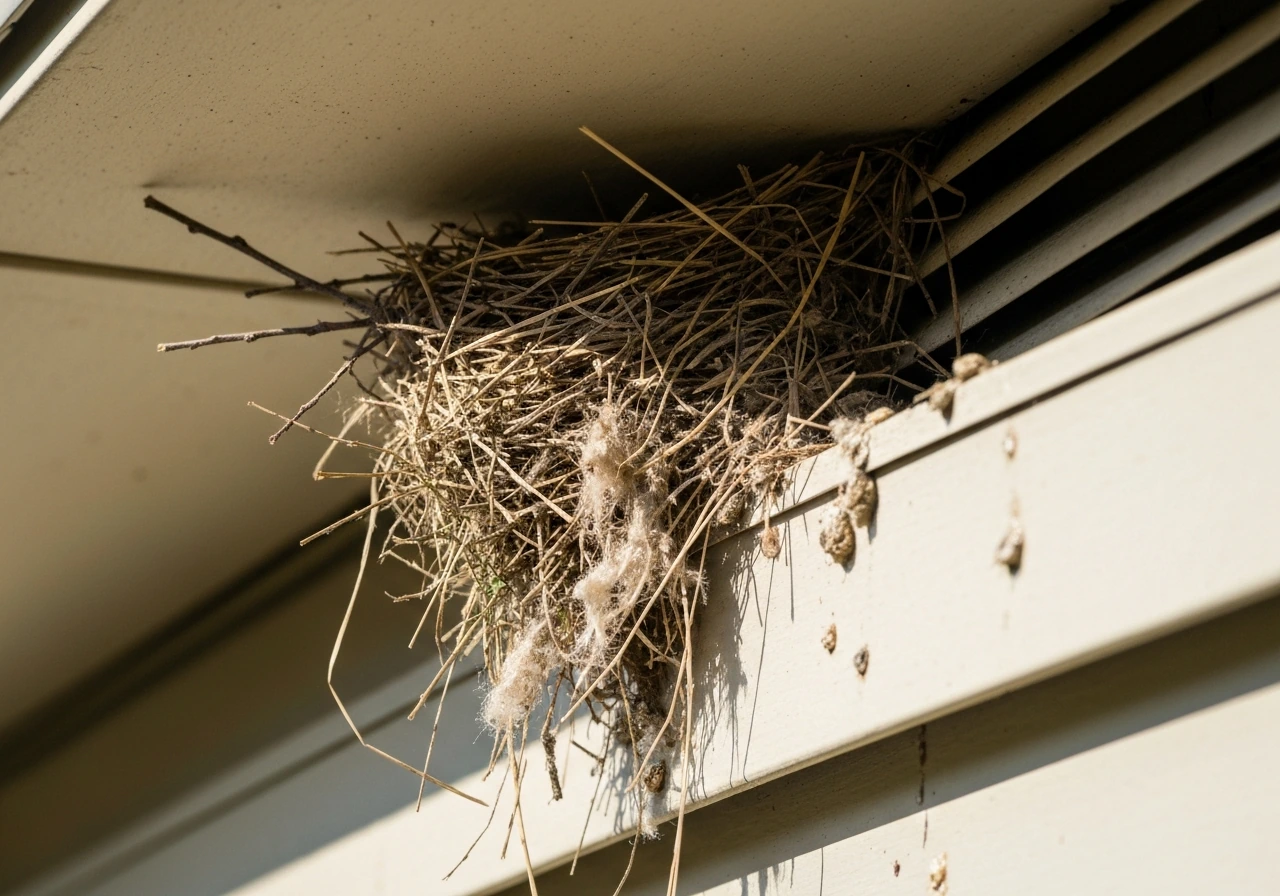
Each one makes a different kind of mess: sparrows stuff vents and eaves with coarse dried grass and feathers; starlings pack cavities with debris that spills out around the opening; swallows plaster mud cups onto walls and soffits and leave streaks of droppings underneath; robins build open twig-and-mud cups in shrubs or on ledges that shed material and get stained. Knowing which bird you have tells you exactly what you can (and legally must) do next.
If you are also trying to figure out which bird builds the smallest nest, the nest size and shape clues can help you narrow down the species. Different birds build different nest styles, so the best way to know which bird makes the best nest is to match the nest traits to the likely species.
What a 'messy nest' usually is (and what it isn't)
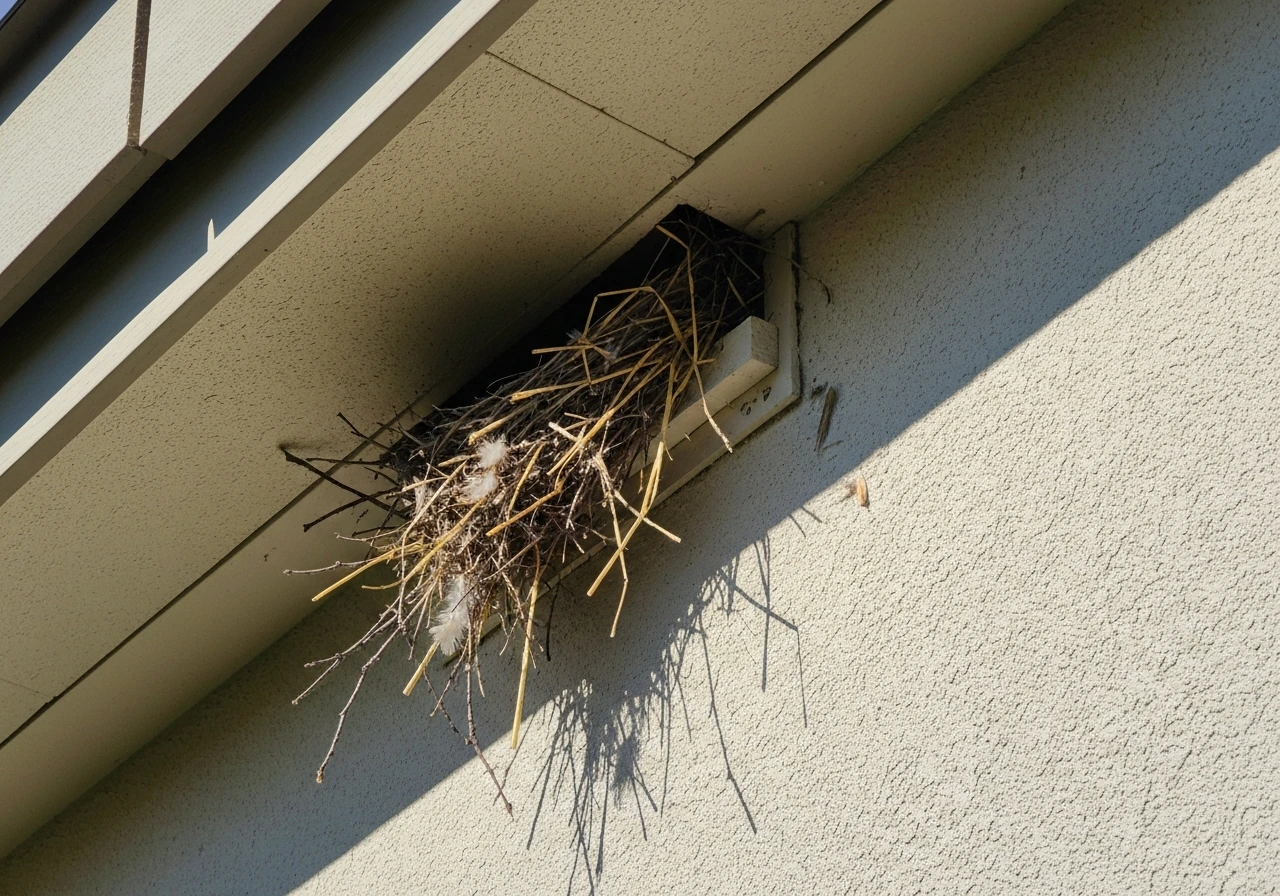
When people search for this, they usually mean one of a few specific situations: a pile of straw, twigs, or feathers falling out of a vent or eave; mud smears on a wall with droppings streaking below them; a loose, bulky heap of sticks in a shrub or on a ledge; nesting material dropping onto a car, deck, or air conditioning unit; or a cavity entrance with debris packed in and spilling out. These are all real nests, actively built or recently used.
What it usually isn't: a neat, compact woven cup in a tree is not what most people call messy (that is more likely a robin or finch, and it stays tidy). A hanging pouch-style nest woven from fibers is actually quite engineered and clean-looking. If you are wondering what bird makes a hanging nest, that pouch-style shape is a key clue to look for A hanging pouch-style nest.
A roosting bird that shelters in the same spot repeatedly but hasn't laid eggs isn't technically nesting. And piles of debris near a chimney or vent sometimes turn out to be wasp nests or accumulated windblown material with no bird involved at all. It is worth taking five minutes to confirm you are looking at a real nest before doing anything.
Quick nest-and-bird clues to identify the maker
Before you get too close, stand back and watch for ten minutes. Note the time of day, whether you see a bird entering or leaving, and how often. Then look at four things: location, shape, materials, and season. Together these almost always narrow it down to one or two species.
| Clue | What to look for | Why it matters |
|---|---|---|
| Location | Vent/cavity, eave/soffit, open ledge, shrub/tree, ground, hanging basket | Different species use very different nest sites |
| Shape | Scrape (bare ground depression), platform (loose mound), open cup, cavity-packed, mud cup | Shape is often species-specific |
| Materials | Coarse dried grass/string/paper, mud, sticks, fine feathers/moss, bark, plastic | Materials narrow it further within shape group |
| Activity timing | Dawn/dusk (most songbirds), dawn (robins), dusk/night (swallows leaving), all-day (sparrows/starlings) | Helps confirm if nest is currently active |
Take a photo from a safe distance with your phone zoomed in. If you are specifically trying to find which bird makes the most beautiful nest, look for birds known for elaborate, tidy nest construction rather than messy cavity debris safe distance. Note the width and height of the nest if you can estimate it (a robin cup is roughly 6 inches across; a sparrow-stuffed vent is usually a loose mass 8-12 inches deep). Note whether there is mud or saliva binding the structure, or whether it is just loose material piled in. These details matter a lot.
Likely birds that build messy nests (by location and nest style)
House sparrows: the vent and eave stuffers
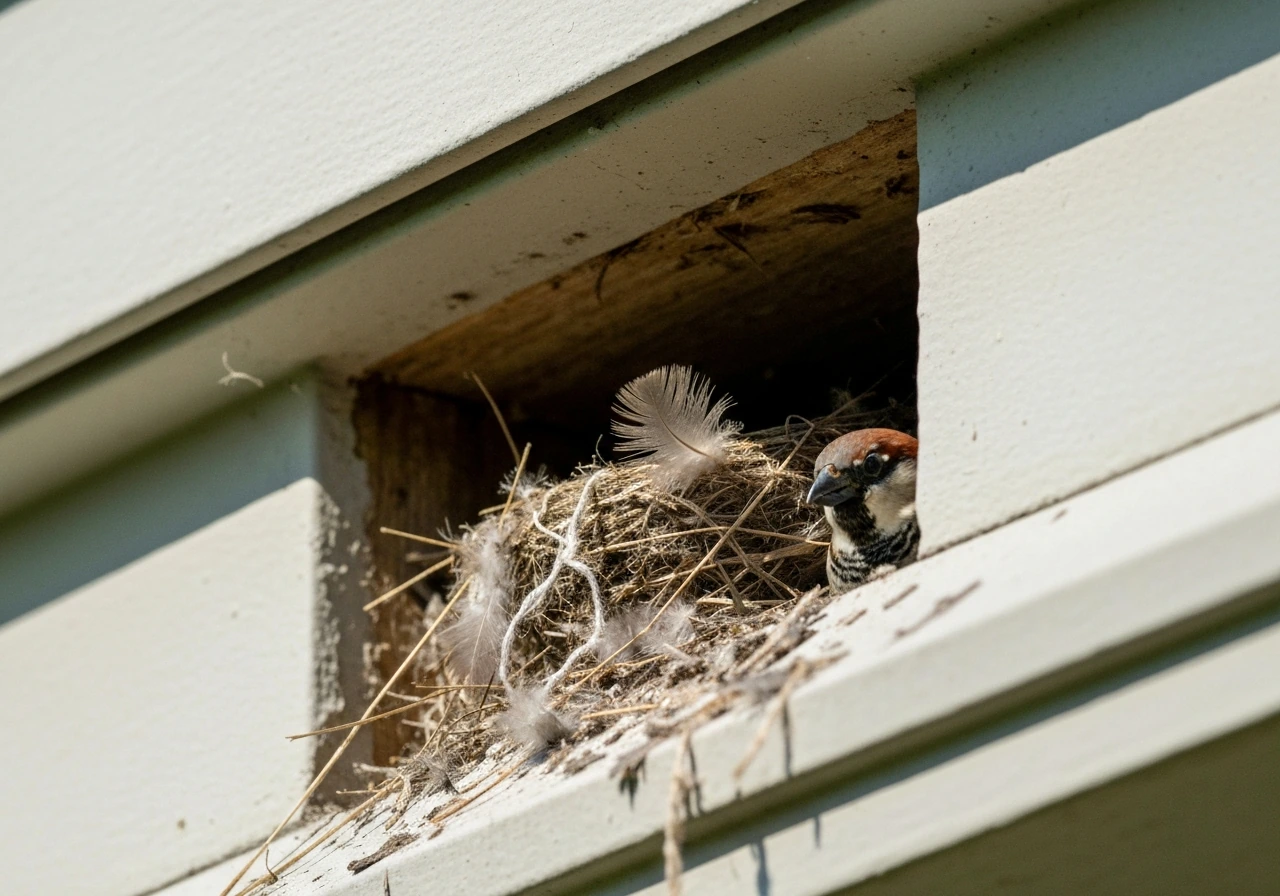
House sparrows are the single most common source of 'messy' nesting complaints near buildings. They pack any available hole with coarse dried vegetation, feathers, string, and scraps of paper until the cavity is nearly full. The mess falls out of dryer vents, bathroom exhaust vents, and gaps in fascia boards. They reuse the same nest site for multiple broods each season, so the material compounds year after year. If you see a loose, jumbled wad of straw and feathers falling out of a vent opening between April and August, house sparrows are the almost certain answer.
European starlings: cavity nesters that leave debris everywhere
Starlings nest in any cavity they can find: natural hollows, old woodpecker holes, gaps in building soffits, and birdhouses. They build a cup toward the back of the cavity lined with feathers, fine bark, leaves, and grass, and material spills out around the entrance. The mess looks similar to house sparrow mess but is often larger and deeper, and starlings are bigger birds, so the entrance hole is wider (at least 1.5 inches across). They are also loud and aggressive at the nest site.
Barn and cliff swallows: the mud-daubers
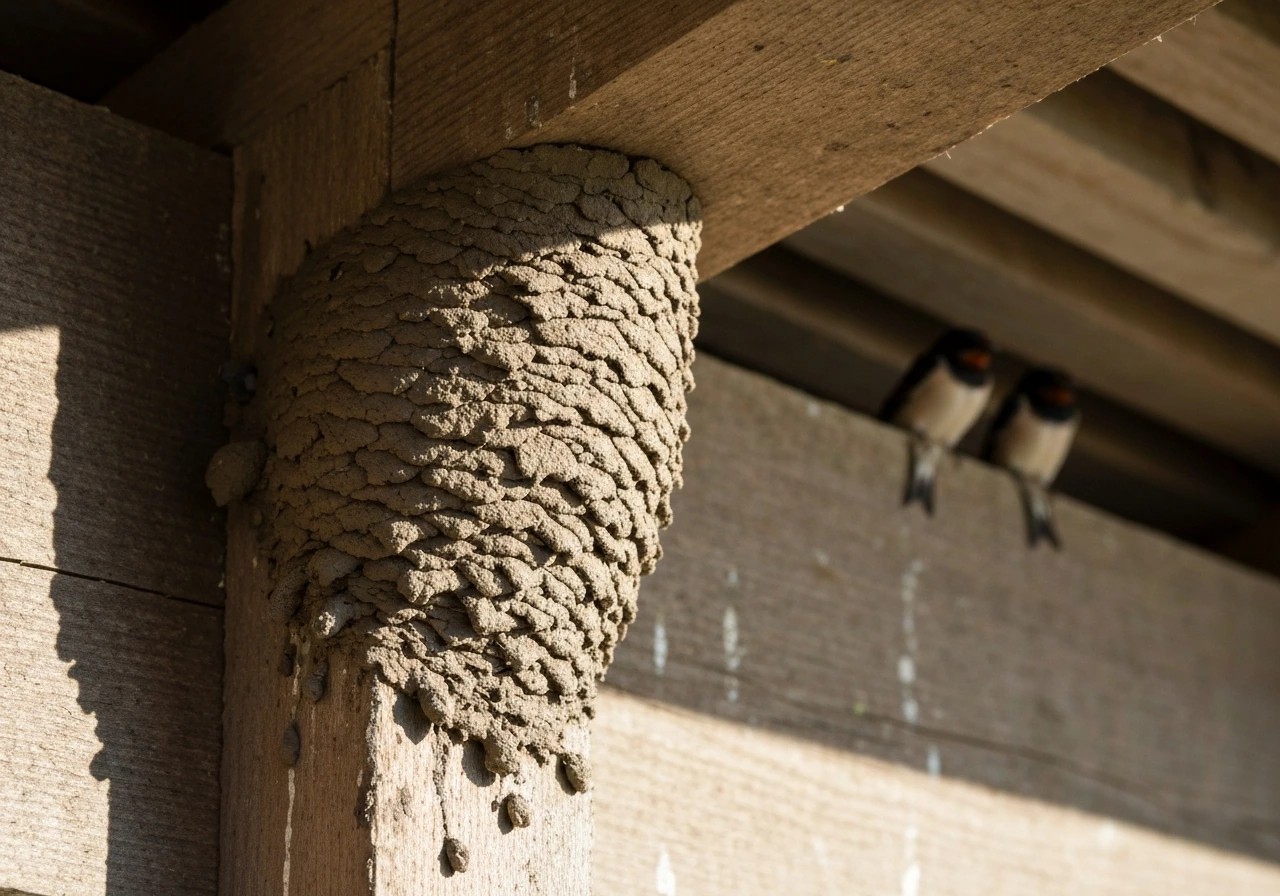
Barn swallows build open cup nests of mud pellets and dried grass plastered to vertical surfaces like barn walls, bridge beams, and home soffits. Cliff swallows build enclosed gourd-shaped mud nests, often in colonies of dozens, under eaves or on concrete structures. Both produce large amounts of droppings below the nest and shed dried mud during construction. The USFWS specifically notes that cliff and barn swallows can produce large amounts of feces and other debris. The mess is immediately below the nest: brown/white droppings streaking down the wall and dried mud fragments on the ground.
American robins: open cup builders on ledges and in shrubs
Robins build open cup nests of twigs, grass, and mud, typically on horizontal branches, window ledges, porch lights, and gutters. The nest itself looks tidy up close but sheds material during construction, and the droppings of nestlings land right outside the cup (or on your ledge/windowsill). The mess is usually droppings stains and a few loose twigs rather than a full explosion of material. Robins often return to the same site for a second brood, so the mess resumes after a short gap.
House wrens: the cavity junk-fillers
House wrens pile twigs into cavities, sometimes filling the entire space before choosing a site to actually nest in. They will stuff a birdhouse, a hanging basket, or a natural crevice with a chaotic mass of sticks, then line a small cup inside with grass and feathers. The result looks like someone shoved a bundle of sticks into a hole. If you find a nest box packed solid with twigs but only a small soft depression toward the back, a wren did that.
Mourning doves and grackles: the minimal-effort platform builders
Mourning doves build some of the flimsiest platform nests of any bird: a loose scattering of a few dozen sticks on a branch, ledge, window box, or gutter that looks like it would fall apart in a breeze (it often does). The bird that builds the biggest nests is typically the bald eagle, which can make extremely large nests in tall trees or on cliffs bald eagle builds the biggest nests. The mess here is the nest itself plus droppings. Great-tailed grackles and common grackles build larger, bulkier platform-style cup nests in trees or on ledges, with coarse grass, strips of bark, and sometimes mud or paper worked in. Both species are conspicuous and loud while nesting.
Woodpeckers: cavity excavators that create a different kind of mess
Woodpeckers don't build a traditional messy nest, but their cavity excavation leaves a pile of wood chips below the entry hole, and the drumming and drilling can go on for weeks. If you see a fresh hole in wood siding or a tree trunk with clean chips on the ground, that is a woodpecker actively digging. The inside of the cavity is bare or has a thin layer of wood chips. This is worth identifying correctly before deciding on any action.
Common misidentifications: roosting, debris piles, and other nests
Not every mess near your eaves or yard is a bird nest. Here are the most common confusions worth checking before you act:
- Roosting, not nesting: A bird that shelters in the same spot every evening (especially pigeons or starlings on a ledge) leaves droppings but no nest structure. Look for actual nesting material: twigs, grass, feathers, mud. If there's only a droppings accumulation and no woven or stacked structure, it's a roost, not a nest.
- Paper wasp or yellowjacket nests: These look like gray papery honeycombs or smooth gray balls tucked into eave corners or vents. No feathers, no twigs, no soft lining. Wasps also produce a distinctive papery material you can feel.
- Mason bee tubes: Circular mud plugs in wood holes or tube openings look nothing like bird nest material up close, but homeowners sometimes confuse them with starling or sparrow debris.
- Windblown debris accumulation: Gutters and corners collect leaves, seed pods, and plastic without any bird involvement. If there is no evidence of a bird (feathers, droppings, activity), check whether it is just debris.
- Cavity scrapes on the ground: Killdeer and some shorebirds make scrape nests that look like just a bare spot or a shallow depression. These are actual nests but are easy to accidentally destroy because they look like nothing. If you find eggs on bare gravel, soil, or in a garden bed, photograph them and step back.
- Predator-attractant mess: Sometimes a pile of scattered feathers near your yard is not a nest at all but the remains of a bird killed by a hawk, cat, or fox. Look for blood, bone, or feather shafts that are broken or pulled out, not woven in.
When you are unsure, take close-up photos from a distance using your phone's zoom, note the size of the entrance opening, and record when and how often you see a bird at the site. A 1-inch entrance hole is almost always a small songbird (sparrow, wren, bluebird). A 1.5-to-2-inch hole fits a starling. A 3-inch-plus hole is a flicker or large woodpecker. These measurements, combined with material type, are usually enough to confirm what you're dealing with.
When you can clean vs when you must leave it alone
This is the part people get wrong most often. In the United States, most birds and their active nests are protected under the blank" rel="noopener noreferrer">Migratory Bird Treaty Act (MBTA). Destroying an active nest (one with eggs, chicks, or birds still dependent on it) is a blank" rel="noopener noreferrer">federal violation that can carry misdemeanor fines up to $15,000 and up to six months in jail. The rule is clear: if there are eggs or young birds in it, leave it alone until the young have fledged and left.
The USFWS does note that destroying a nest that is completely empty and not actively in use does not violate the MBTA by itself, but the practical risk is that you may be wrong about whether it is occupied. A cavity nest is especially tricky because you cannot always see inside. If there is any doubt, consult a wildlife authority before removing anything.
House sparrows and European starlings are non-native, invasive species not protected by the MBTA in the same way, which gives you somewhat more flexibility legally. But before you act on that, confirm your ID: a native tree swallow or bluebird using a nest box could easily be mistaken for a sparrow or starling. When in doubt, don't remove.
In Canada, regulations updated as of July 30, 2022 protect nests when they contain a live bird or viable egg, which is slightly different from older year-round protection. The practical advice is the same: if there is a bird or egg in it, do not touch it. State and provincial laws often add additional protections on top of federal law, so check local rules too.
Mass Audubon's rule of thumb is one of the most practical: wait until fall or winter to remove nests, after all broods are fledged and the nest is cold. That is the safest, most legal window.
| Situation | What you can do | What you cannot do |
|---|---|---|
| Empty nest, birds gone, season over (fall/winter) | Remove and dispose of nest; clean and disinfect the area | Nothing prohibited, but check local rules |
| Active nest with eggs or chicks | Watch from a distance; protect site from predators if possible | Touch, move, or destroy nest (federal violation) |
| Swallow nest being built (no eggs yet) | Wash away fresh mud daily before eggs are laid; install barriers beforehand | Remove once eggs are present |
| House sparrow/starling cavity (non-native species) | More legal flexibility to remove; confirm ID before acting | Still risky if you misidentify a native bird |
| Woodpecker cavity in your siding (active) | Contact local wildlife agency for options; document damage | Destroy or block active hole during nesting season |
| Unknown nest, unclear activity | Photograph, observe, consult wildlife agency | Assume it is empty and remove it |
Deterrence and prevention that doesn't harm birds
The most effective approach to messy nesting near your home is prevention before birds arrive, not eviction after they settle in. Most birds return to the same site year after year, so if you close off a site in late winter (February to early March in most of North America) before nesting season, you break the cycle cleanly and legally.
Sealing and blocking access (before birds arrive)
For vents and small gaps, use silicone caulk for openings under about half an inch, and galvanized steel mesh or hardware cloth for larger openings. Make sure dryer vents, bathroom exhaust vents, and attic vents have intact screens or vent covers with no gaps wider than half an inch. Check these in February before sparrows and starlings start scouting. When blocking cavities after a nesting season ends, Mass Audubon recommends hardware cloth or metal as the most durable option, with bird netting (mesh no larger than half an inch) as an alternative, noting that larger mesh can trap small birds.
Swallow-specific deterrents
For swallows targeting your eaves or soffits, the USFWS recommends installing physical barriers before birds arrive: Coroplast sheeting (corrugated plastic), PTFE/Teflon sheeting, plexiglass, Bird Slide products, or plastic sheeting angled at 45 degrees or more to make landing impossible. Silicon-based paint on the surface also reduces adhesion. The USFWS is explicit that repellants are not effective for swallows and there are no registered toxicants for them, so physical barriers are the only tool that works.
For active swallow season (before eggs are laid)
If swallows have arrived and are building but have not yet laid eggs, you can wash away fresh mud nests daily with a hose. This is legal only while there are no eggs. Once you see eggs, you must stop and wait for fledging. This is a daily commitment for two to three weeks until the birds give up and move on or the season progresses past egg-laying.
For open surfaces like ledges and signs
- Install bird slope products or angled metal sheeting on flat ledges so birds cannot stand and build
- Use stainless steel bird spikes on narrow ledges (effective for larger birds like pigeons and starlings, less so for small birds)
- Place physical barriers like netting in front of eave spaces where swallows or sparrows repeatedly attempt nesting
- Remove nearby food sources (open trash, pet food left outside, fruit-bearing shrubs close to the building) that attract birds to the area
After-the-fact cleanup and preventing the same problem next season
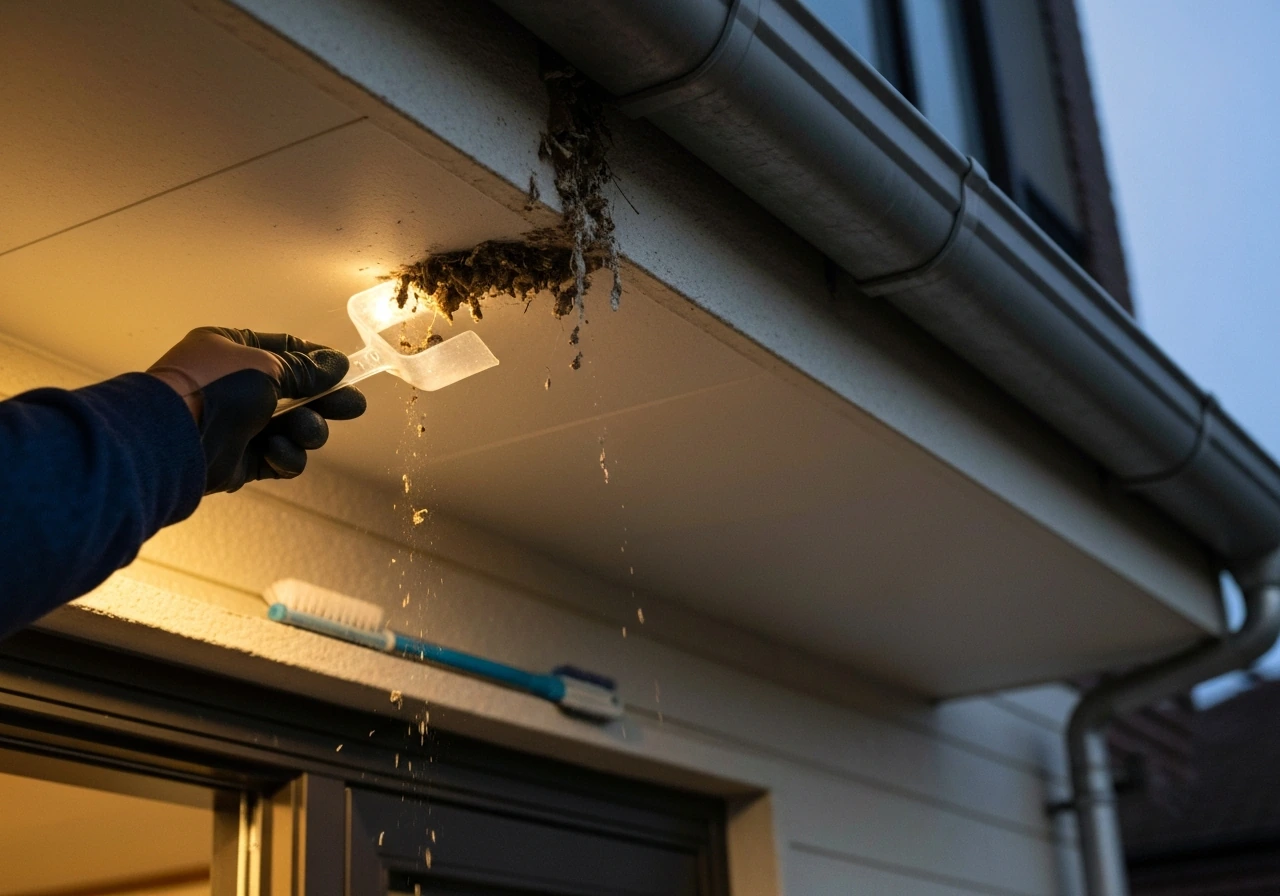
Once the nest is inactive and the season is over (fall or winter is safest), you can remove and clean the area. This is not a job to do in shorts and a t-shirt. Bird droppings, old nest material, and feathers can carry Histoplasma capsulatum fungal spores, respiratory pathogens, and mites. The cleanup rules from CDC and Washington State University's EHS are consistent: use wet cleaning methods only (never dry-sweep or use a leaf blower), wear a NIOSH-approved N95 respirator or better (HEPA filtration is ideal for large accumulations), non-latex gloves, eye protection, and disposable coveralls. Shoe coverings are also recommended for larger accumulations.
The reason wet methods matter is simple: dry disturbance aerosolizes fungal spores and fine dust from droppings, which is how histoplasmosis infections occur. Dampen the material with a light mist of water or disinfectant before bagging it, then seal it in heavy plastic bags for disposal. Do not compost nest material.
- Wait until fall or winter after all broods have fledged
- Put on N95 or better respirator, gloves, eye protection, and disposable coveralls before starting
- Lightly mist the nest material and surrounding droppings with water or a dilute disinfectant
- Remove nest material by hand or with a damp cloth, placing it directly into a sealed plastic bag
- Wipe down the surface with a disinfectant appropriate for the material (wood, metal, concrete)
- Dispose of bags in outdoor trash; do not handle them again
- Install exclusion hardware (mesh, vent covers, barriers) on the same day before any bird returns
- Inspect the site in February of the following year and repair or reinforce before nesting season
The single best long-term prevention is closing the access point the same day you clean. Birds return to the same sites year after year, sometimes literally on the same calendar week. If the site is sealed when they arrive next spring, they move on within days. If it is open, you will be back here next May.
Your quick decision checklist
Use this to figure out where you stand right now and what step to take today.
- Is there a bird, egg, or chick in the nest right now? If yes: leave it completely alone. Do not touch, move, or disturb it. Come back in fall.
- Is nesting material falling from a vent or eave but you cannot see inside? Photograph the opening and the material. Note the hole size. Watch for 10 minutes. If a bird enters and exits, it is active. Do not remove it during nesting season (roughly March through August in most of North America).
- Is the nest clearly a mud cup on a wall or soffit with no eggs visible? If you can confirm no eggs, you may wash it away daily while discouraging continued construction. Install physical barriers immediately.
- Is the nest empty and the season over (fall/winter)? Clean it safely using wet methods and PPE, then seal the site the same day.
- Are you unsure whether the nest is active or what species built it? Photograph it, note activity times, and contact your local wildlife agency or a licensed wildlife rehabilitator before doing anything.
- Is the bird a non-native invasive (confirmed house sparrow or European starling)? You have more legal flexibility, but confirm your ID carefully before acting, and still use the same safe cleanup methods.
- Is this a safety hazard (nest blocking a gas or dryer vent, posing fire risk)? Document the hazard and contact your local wildlife agency or USFWS to ask about a permit for emergency removal. Do not remove it unilaterally without guidance.
A note on working with birds, not against them
Most of the birds that make messy nests near your home are doing exactly what they are supposed to do: raising young in the safest spot they can find. The mess is a management problem, and it is almost always solvable with timing and the right physical barriers rather than by harming birds. The MBTA exists because North American bird populations declined catastrophically in the late 1800s and early 1900s precisely because people removed, collected, and destroyed nests without consequence.
That framework protects everyone, including the birds that control insects around your property, pollinate plants, and fill your yard with sound every spring. Being thoughtful about how you respond to a messy nest is not just legally required. It is also the right call.
If you want to go further, consider putting up appropriate nest boxes for cavity nesters you want to encourage (bluebirds, chickadees, tree swallows) with proper entrance hole sizes that exclude starlings and sparrows. Directing birds to sanctioned nesting spots reduces the pressure they put on your eaves and vents. It is a small investment that pays off in years of no-conflict cohabitation.
FAQ
How can I tell if a “mess” is an active nest versus older leftovers?
Look for fresh, warm droppings that are damp or shiny, current material being added (new mud pellets or new straw strands), and repeated bird visits over multiple days. If you see no bird activity and the debris is dry and dusty, it is more likely inactive, but cavity nests are hard to confirm, so err on the side of not removing anything when unsure.
Is it ever legal to clean up droppings under a nest, even if the nest might be occupied?
Do not assume it is safe if the nest could still be active. For occupied nests, the safest approach is to wait until fledging is complete, because disturbance during cleaning can harm dependent young. If you only have debris from recent use but cannot confirm occupancy, contact a local wildlife agency for guidance before cleaning.
What if I rent my home or live in an apartment, can I still block the nest?
You usually need landlord or HOA approval before making physical changes like caulking vents, adding mesh, or installing barriers on exterior structures. The practical move is to document the problem, identify likely species from the entrance size and mess pattern, then request an approved prevention method with a clear timeline (seal in late winter, before scouting starts).
Can I use bird spikes, sticky gels, or repellant sprays to stop messy nesting?
Repellants and toxicants are not an effective solution for swallows, and sticky gels or adhesives can create entanglement hazards for birds and other wildlife. For reliable results, use exclusion barriers (mesh, screens, angled sheeting systems) and block access points before the season starts, since timing matters more than treatment.
I sealed a vent or gap, then noticed birds nesting there anyway. What did I likely do wrong?
Most failures happen when the opening was not fully blocked, there were gaps wider than about half an inch, or the bird found an alternate nearby cavity. Recheck the entire run of the vent system, fascia gaps, and any adjacent crevices, because starlings and sparrows will quickly switch to the next available cavity.
How do I choose the right barrier material for a small opening versus a larger one?
For small gaps under about half an inch, silicone caulk can work to stop entry. For larger openings, use galvanized steel mesh or hardware cloth so birds cannot chew through it. When sealing after a season, prioritize durable metal, because flimsy netting or weak fencing can fail and reopen access.
If I want to remove a nest in fall or winter, how do I make sure it is actually inactive?
Wait for multiple days with no bird visits, no fresh nesting material being added, and no adult birds returning to feed young. A cautious method is to observe at different times of day, and if it is a cavity you cannot see inside, assume it could still be in use and consult a wildlife professional.
What is the safest way to handle cleanup if there might be nesting materials and droppings?
Use wet cleaning only, never dry-sweep or blow with a leaf blower, and wear protective gear such as a NIOSH-approved N95 respirator (or better with HEPA), non-latex gloves, eye protection, and disposable coveralls. Dampen before bagging, seal waste in heavy plastic bags, and avoid composting old nest material.
Can sparrows or starlings become a problem again after I clean and patch one area?
Yes. These cavity nesters reuse nearby sites and may reoccupy if access points remain or if the patch is incomplete. After cleanup, seal the entry point the same day, then recheck in spring scouting season for new entrance attempts and reinforce any surrounding gaps.
Should I put up a nest box to reduce messy nesting on my building?
It can help, but only if the box is sized correctly for the target species. Place cavity boxes with entrance hole sizes that exclude sparrows and starlings, and mount them in appropriate locations. Poorly designed boxes can attract the very species you are trying to avoid.
What health or liability risks should I be aware of beyond legality?
The main health risk is exposure to dust and fungal spores from droppings during dry disturbance, which can lead to respiratory illness. Also, physical repairs done hastily near vents or eaves can lead to falls or damage to siding, so use safe ladder practices and consider a professional for hard-to-reach exclusions.
Next Article
Which Bird Builds the Smallest Nest How to Identify It
Find which bird makes the smallest nest by region and nest type, verify on-site, and handle active nests ethically.