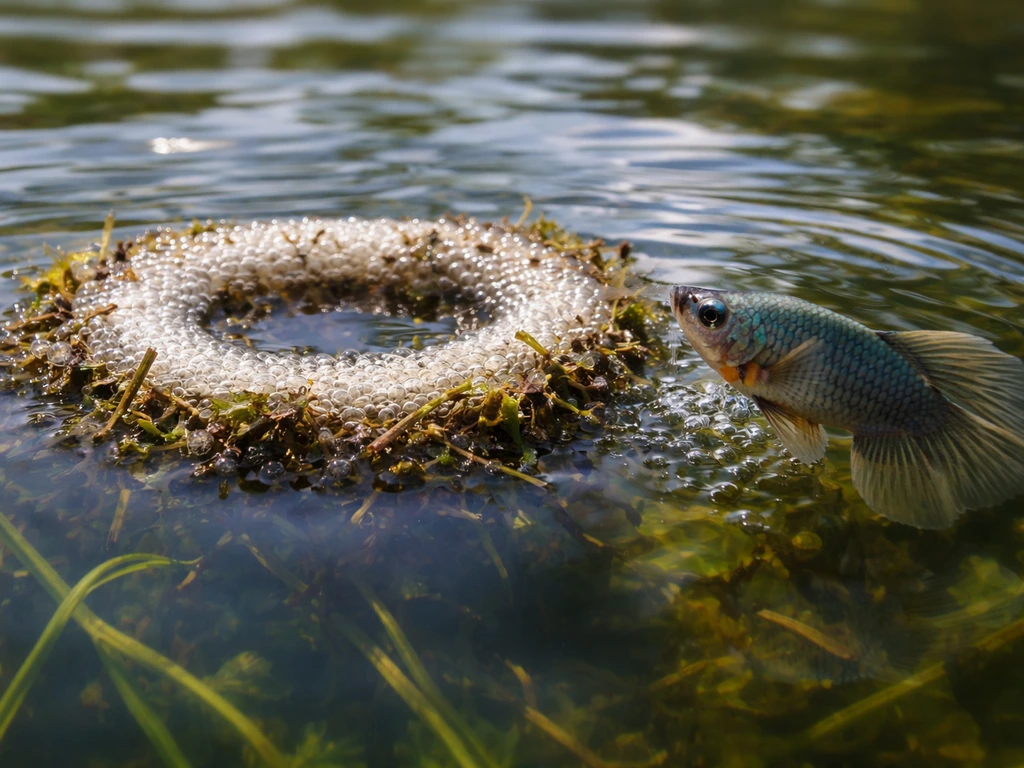
Most birds in North America build nests between late February and late July, with the peak activity running from March through June depending on where you live. If you're watching a bird repeatedly carry grass, twigs, or mud to the same spot, that's nest building, and it usually means eggs are just days to a couple of weeks away.
When Does a Bird Make a Nest? Timing and Signs to Know

Maya Bennett
6 May 2026
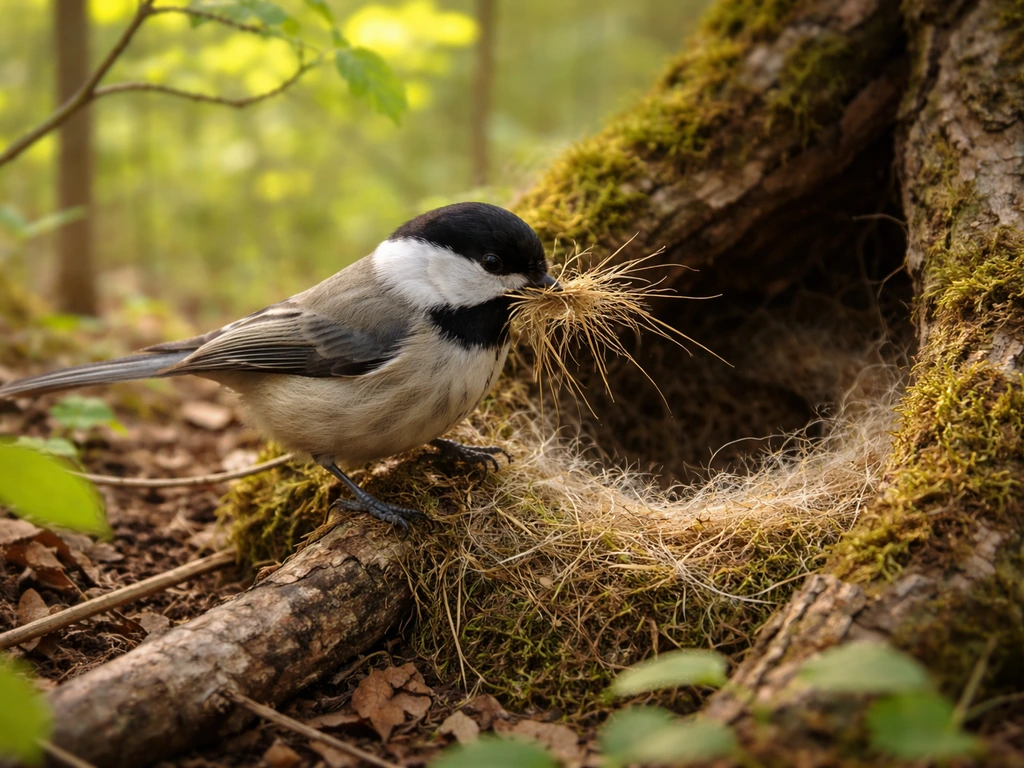
A bird building a nest is an example of active nesting behavior that leads toward egg-laying it usually means eggs are just days to a couple of weeks away. The exact timing shifts a lot by species and by your local climate, but if it's spring and a bird keeps returning to a shrub, eave, or tree cavity with material in its beak, you're almost certainly watching a nest go up right now.
Different birds make nests in different ways, so the best approach depends on the species you are watching.
When nesting season actually happens (and how it shifts by region)

There's no single start date for nesting season because temperature and day length drive the timing, and both vary with latitude and elevation. A useful rule of thumb: the further north or higher in elevation you are, the later things start. In the southern U.S. and coastal California, some species are already building nests in February. In New England, the Great Lakes, and the Pacific Northwest, most songbirds don't get going until April. In Canada and higher-elevation mountain regions, the bulk of nesting compresses into May and June.
Research tracking North American landbirds over 27 years has confirmed that breeding phenology shifts in direct response to temperature, and that birds at higher latitudes start later because their local conditions warm later. What that means practically: your neighbor two states south may already have fledglings while you're still watching a bird scout locations. Local weather matters too. A cold snap in April can delay nest initiation by a week or more even for birds that arrived on schedule.
| Region | Typical nest-building start | Peak nesting window | Late nesters active until |
|---|---|---|---|
| Southern U.S. / coastal CA | Late February | March–May | July–August |
| Mid-Atlantic / Midwest | Mid-March | April–June | July |
| New England / Great Lakes | Early April | May–June | Late July |
| Pacific Northwest | Late March | April–June | July |
| Canada / high elevation West | Early May | May–July | August |
These windows overlap because many species attempt second or even third clutches in a single season. A robin in Ohio might lay her first clutch in April and start a second nest in June. So even if you think nesting season is winding down in your yard, that activity in late summer may well be a second attempt, not a straggler.
Is that bird actually building a nest, or doing something else?
This is probably the most common source of confusion for homeowners and backyard birdwatchers. Not every bird near your porch, eave, or hedgerow is building a nest. When a bird builds a nest on your porch, keep an eye on whether it’s depositing material versus just roosting or foraging. Not all bird species build nests the way robins or swallows do, but many do use nest structures for egg care do all bird species build nests. Here's how to tell the difference. In many species, the mom or dad bird’s repeated trips with nesting material are a key clue that nest building has started Here's how to tell the difference..
Signs of active nest building
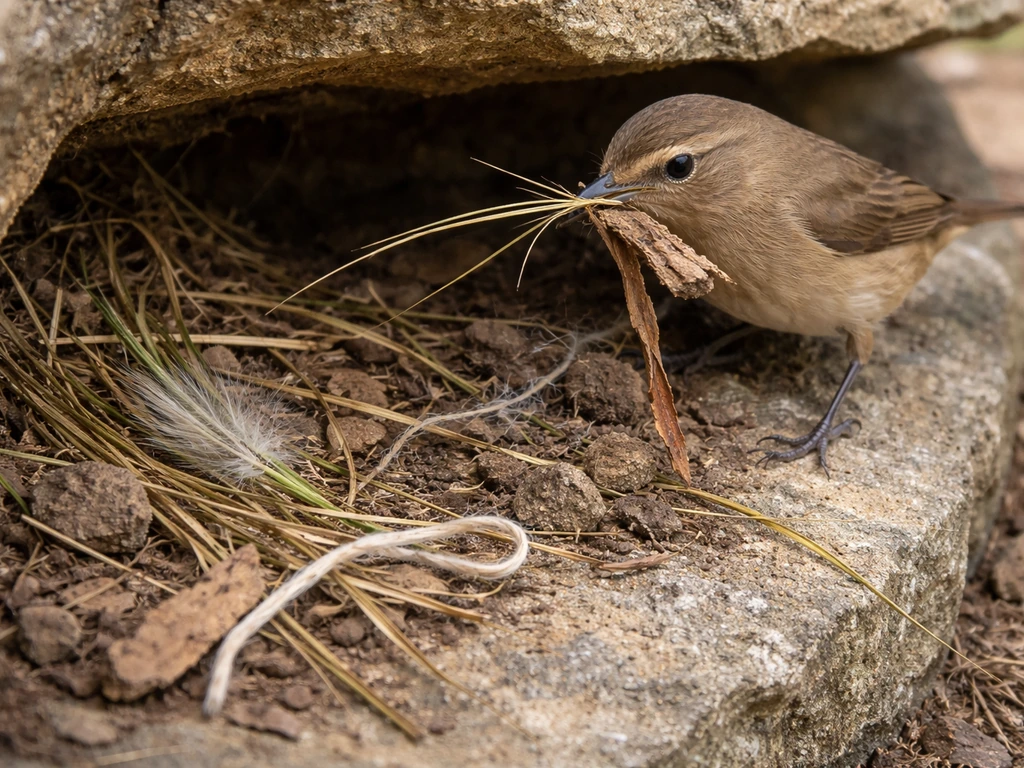
- Repeated trips to the same spot carrying material (grass stems, bark strips, mud, feathers, string, spider silk)
- The bird arrives with something in its beak and leaves without it
- Visible construction progress at the site: a cup forming, a cavity being lined, or a platform getting denser
- The bird pauses at the site and makes poking, weaving, or tamping motions with its beak
- A female spending extended time at the site pressing her body into the cup (she's shaping it to her breast)
Behaviors that look similar but aren't nest building
- Roosting: a bird sits quietly at the same spot each evening or morning but carries nothing and makes no construction movements
- Territorial display: a male sings loudly from a prominent perch, chases other birds, or fans his tail, but isn't carrying material
- Foraging near a potential site: a bird picks at bark, leaves, or soil for insects and moves on; it's not returning consistently to the same construction point
- Prospecting: a bird investigates a nest box or cavity by perching at the entrance and looking in, but doesn't bring material yet; this is pre-building scouting
The clearest single test is material movement. Watch for five to ten minutes from a comfortable distance. If the bird is making return trips to the same spot and visibly depositing something, it's building. If it's sitting still or flying around without a consistent destination, it's roosting, foraging, or displaying. Mallards are a good example of the timing cue: wildlife guidance from Virginia notes that nest-building behavior should be watched for daily starting in late February through late May, exactly because the behavior is so consistent once it begins.
Early nesters, late nesters, and everyone in between
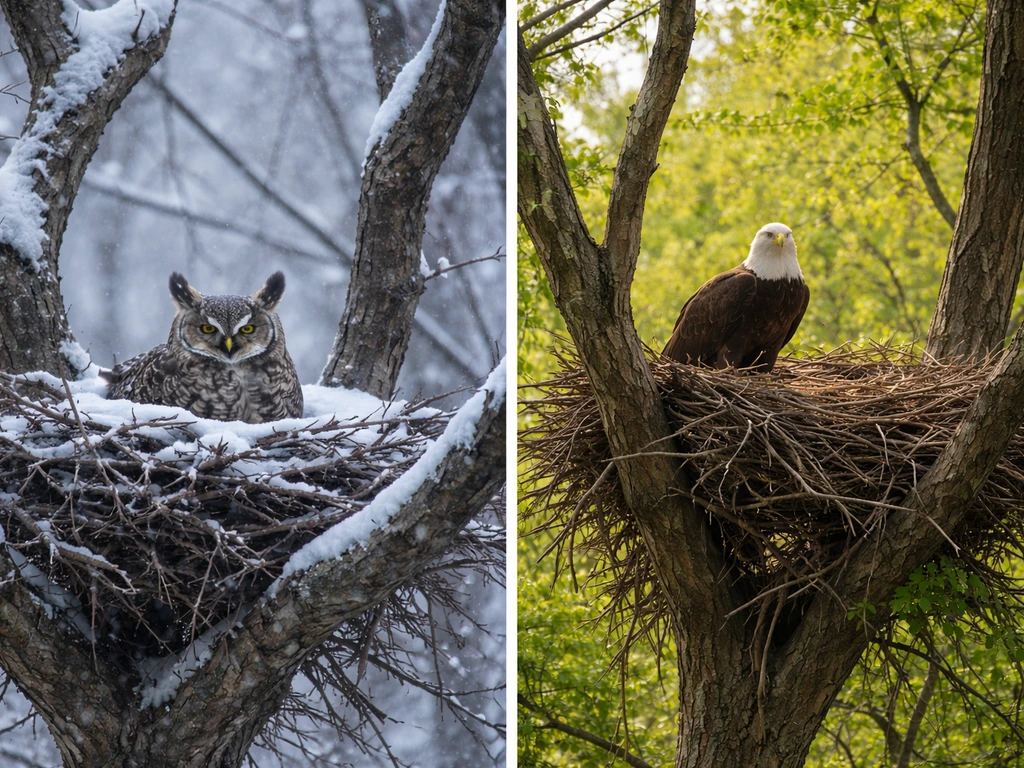
Species timing varies more than most people expect. Great Horned Owls start incubating eggs in January in much of the U.S., sometimes sitting on snow-covered nests. Bald Eagles are also early, with nest building or refurbishment starting in late fall or winter. On the other end, American Goldfinches time their nesting to coincide with thistle seed availability, which means they often don't lay until late June or July, some of the latest of any common songbird.
| Species | Nest building starts | First eggs typical | Notes |
|---|---|---|---|
| Great Horned Owl | December–January | January–February | Uses existing structures; no new nest built |
| Bald Eagle | October–February | November–March | Returns to and refurbishes same nest annually |
| American Robin | Late March–April | Within days of nest completion | Female builds; lays one egg every 3–4 days |
| Black-capped Chickadee | April–May | May | Excavates or uses cavities; 6–8 egg clutch |
| Barn Swallow | April–June | After 1–2 weeks of building | Mud construction; 7–14 days to build |
| Mallard | Late February–May | During or just after nest construction | Ground nest; watch for daily building behavior |
| American Goldfinch | Late June–July | July–August | One of the latest nesters; tied to thistle bloom |
Robins are one of the best-studied backyard species for timing. Females start building shortly after arriving or after winter temperatures break, finish the nest in a few days, and then lay their first egg within days of completion. They add one egg every three to four days until the clutch is complete (usually four eggs), then incubation runs about 12 to 14 days. Chickadees follow a similar pattern but with larger clutches of six to eight eggs. Knowing your species lets you estimate exactly where in the cycle the nest is.
How long does nest building actually take once it starts?
For most songbirds, nest construction takes three to seven days from first material placement to a finished cup. Swallows building mud nests take longer: barn swallows and cliff swallows typically spend seven to fourteen days on construction, and their pace depends heavily on mud availability and weather. A dry spell can pause construction entirely until rain softens the soil again. Larger raptors and cavity-nesting species like woodpeckers can spend weeks excavating or refurbishing.
Here's the full timeline for a barn swallow as a useful reference: seven to fourteen days for nest construction, three to six days for egg laying, twelve to sixteen days of incubation, twenty to twenty-five days for nestlings to develop, then another two to three days before the young leave the nest. That's roughly six to nine weeks from the first mud pellet to an empty nest. For a robin, start to empty nest runs closer to five to six weeks. This matters if you're trying to figure out how long to wait before doing any work near an active nest.
What to do when you find an active nest

First, the legal reality: under the Migratory Bird Treaty Act (MBTA), it is illegal to destroy a nest that contains eggs or live chicks.
The FWS Resident Canada Goose Registration materials also describe that depredation order authorization applies to registered landowners and local governments to destroy resident Canada goose nests and eggs within the seasonal window of March 1 through June 30 to resolve or prevent specified harms depredation order authorizes landowners/local governments who register to destroy resident Canada goose nests and eggs within the seasonal window of March 1 through June 30.
This covers the vast majority of wild bird species in the U. S. Permits for removal are rarely granted and only in cases involving human health or safety hazards, or when birds are in immediate danger. This isn't a gray area, so don't remove or relocate an active nest just because it's inconvenient.
There is one important nuance from USFWS guidance: a nest that is actively being built but does not yet contain any eggs is technically considered 'inactive' under MBTA interpretation. That means if you catch a bird in the very early stages of construction at a location that genuinely creates a safety problem (inside a dryer vent, on active machinery, or directly blocking a fire escape), you have a narrow window to gently remove the early-stage nest before eggs are laid. Once there are eggs, the legal protection kicks in fully.
Even when you're legally in the clear, act with caution and respect. Disturbance during nest building can cause a bird to abandon the site and start over, wasting her energy during a critical period. Keep your distance, avoid making direct eye contact with the bird (birds read this as predator behavior), and don't linger. Your movement toward the nest also draws attention and may signal the location to crows, jays, and other nest predators. If a nest has been built somewhere genuinely problematic, consider whether you can work around it for the next five to nine weeks rather than disturbing it.
- Observe from at least 10 to 15 feet away; use binoculars rather than approaching
- Don't touch the nest, eggs, or surrounding vegetation once eggs are present
- Avoid repeated visits that create a trail to the nest or habituate the bird to your presence in a stressful way
- If you need to do yard work nearby, do it in one session rather than spreading it over days, so disruption is brief
- Never add or remove material from a nest, and don't place food or water directly next to it
Why nesting might be delayed or abandoned, and what not to do
If you watched a bird building energetically and then it stopped, don't panic immediately. Several common things can pause or end nest building that have nothing to do with you. Cold snaps and late frosts are the most frequent cause of a brief pause in early spring. The bird is conserving energy and waiting for conditions to stabilize. Building typically resumes within a few days when temperatures rise.
Nest abandonment (where building stops permanently and the bird doesn't return) happens for different reasons. Predator disturbance is the leading cause: if a snake, cat, crow, or raccoon discovers the nest site during construction, the bird may write off the location entirely. Human disturbance has the same effect. Pairs also sometimes prospect multiple sites simultaneously and simply choose a different one. If a nest with eggs is abandoned, that's more serious and usually means something actively scared the parents away, either a predator or repeated human intrusion.
What not to do when building stops or a nest is abandoned: don't move the nest to a 'better' spot hoping the bird will follow. Wild birds use location memory and site-specific cues, and a relocated nest is almost always ignored or treated as a foreign object. Don't add nesting material to the existing structure. Don't place a decoy egg or anything else in or near the nest. The best action is to back off completely, give the bird several days of undisturbed quiet, and watch from a distance to see if activity resumes.
How to identify the bird and figure out where the nest is in the cycle
Identifying the species is the single most useful thing you can do once you notice nest-building activity, because it tells you the expected timeline, preferred nest placement, and typical clutch size. You don't need to be an expert birder. A decent photo taken from a respectful distance with a smartphone or a brief description of size, color, and beak shape is enough to look up the species in a field guide or an app like Merlin Bird ID.
- Photograph the bird from a distance without approaching the nest. Focus on overall size, beak shape, prominent color markings, and any distinctive behavior.
- Note the nest location and structure: is it in a tree fork, on a ledge, in a cavity, on the ground, under an eave? What materials are visible (mud, grass, moss, feathers, string)?
- Record the date you first noticed nest-building activity. Most species take three to fourteen days to finish a nest, then lay eggs over the following few days.
- Once you've identified the species, look up its average incubation period (typically 11 to 16 days for songbirds) and nestling period (typically 10 to 25 days) to estimate how long the nest will be active.
- Take a quick photo of the nest site every few days from the same distance and angle. Changes in the structure tell you whether building is ongoing, eggs have been laid, or young have hatched (look for adult feeding trips increasing sharply once chicks hatch).
- If you're unsure about the species, post your photo to iNaturalist or the Cornell Lab's eBird for a community ID. Both are free and usually get responses within hours.
Estimating the nest stage without touching anything is genuinely possible if you're systematic. If you see the adult doing intensive lining work (pressing soft feathers or fine grass into the cup), egg-laying is usually within 24 to 72 hours. If you see the adult sitting quietly and barely moving for long stretches, that's incubation, and you can count forward from your first observation of that behavior to estimate when hatching is likely. Once you hear faint peeping from the nest or see adults arriving with insects in their beaks (rather than construction material), the chicks have hatched.
The nest itself also tells you things. A cup nest made from dried grass and lined with soft material is almost certainly a songbird. A nest built from mud pellets under an eave is a swallow. A collection of sticks in a tree fork could be a robin or a dove. Knowing what bird nests are made of and how the structure is put together helps you narrow the species even when you haven't seen the bird clearly. Once you have the species, you have the timeline, and you can plan any yard work, maintenance, or monitoring around it in a way that's both practical and legal.
FAQ
If I see a bird hanging around my yard, does that mean it is building a nest right away?
Not necessarily. Many birds use the same ledges and shrubs for courtship, display, or roosting. The quickest confirmation is repeated return trips to the exact same spot with visible nest material being deposited, not just flying past or lingering nearby.
Can a bird start nesting and then stop before eggs are laid?
Yes, especially early in the season. Some species begin nest building without any eggs present, and the behavior can pause for weather or site evaluation. If you are dealing with a hazard location, wait to see whether eggs appear, and avoid any actions that could disturb the birds once egg-laying starts.
How do I tell nest building from foraging if I only have a few minutes to watch?
Use a short observation window and look for two patterns: consistent destination plus deposition. Watch from the same spot for 5 to 10 minutes. If the bird makes multiple trips carrying material to the same location and you can tell items are being placed, that is a strong sign. If it is just carrying items and then drops them elsewhere, forages, or sits without a clear destination, it is less likely to be nest-building.
Do birds always make brand-new nests each year?
Some nests are “reused” or “refurbished.” Raptors and many cavity nesters may repair older structures or expand existing burrows, so you can see activity outside the typical late winter to summer window for specific species. In practice, check whether the bird is bringing new material and altering the structure, versus only perching or displaying.
Why am I still seeing nest-building in late summer or early fall?
Yes. Second and third clutches are common for many species, so nesting behavior can continue even after your first peak seemed to pass. Late-season activity can be from a new clutch, not a late straggler. Species identification helps you estimate which wave you are seeing.
If construction stops, how can I estimate whether eggs are already likely?
If the bird is adding material but then suddenly turns to silent sitting for long stretches, that usually indicates construction is complete and incubation has started. Egg-laying often follows quickly once the nest is finished, so avoid yard work nearby even if you have not confirmed eggs yet.
What can cause nest timing to be different in my exact neighborhood compared with others nearby?
There are a few big factors that can make timing look “wrong,” even if you are in the right region: a late cold snap, unusual rain patterns (especially for mud nesters), and differences in microclimate (sheltered yards warm earlier than exposed areas). So your backyard can lag or lead nearby neighborhoods by days to weeks.
How soon should I avoid mowing, trimming, or using loud equipment near a nest?
If you are trying to plan yard maintenance, treat any active nest-building as immediately time-sensitive. Many construction-to-hatching transitions happen in days for small songbirds, and cavity or raptor activity can take longer. The safest rule is to postpone work that could cause repeated disturbance until you confirm the nest stage has advanced.
When is it legal to remove an actively building nest if eggs are not visible yet?
The MBTA protection is tied to eggs or live chicks, and there is a narrow early-stage interpretation where a nest is actively being built but has no eggs yet. Even then, only remove if it creates a genuine safety hazard in an area like hazardous equipment or a confined space, and do it gently. If you can wait and reroute work instead, that is usually the better choice.
What should I do if a nest is in a risky spot like a vent, gutter, or doorway?
Do not relocate it. Birds typically do not accept a nest moved to a new location, because they rely on site-specific cues. If you must address an unsafe situation, the practical options are to prevent access, temporarily block entry to the hazard area, and let birds finish elsewhere on their own schedule.
Why does the bird sometimes bring materials frequently, but other times seems to build slowly?
Construction material handling does not always follow the same schedule for every species. Some birds spend long periods gathering or transporting items, then suddenly build more quickly. For accuracy, base your stage estimate on behavior (intensive lining versus long quiet sitting) rather than only how often you see the bird.
How can I tell when the chicks have hatched?
Yes. A major sign you are looking at a newer nest is sudden peeping from inside and increased insect deliveries, which usually starts right after hatching. You can also see chicks begging at the entrance. At that point, the risk of disturbance is higher because parents often cannot easily abandon without consequences.
Is it okay to add nesting material or put up a decoy to ‘encourage’ birds to use a nest?
Avoid “helping” by adding extra nesting material or placing decoys, because it can increase disturbance, attract predators, or confuse the birds’ site selection. If you want to be helpful, maintain quiet, reduce traffic near the site, and let the parents control the nest contents.
If the bird stops bringing material, how do I know whether the nest is abandoned or just paused?
Back off immediately if the adults stop returning for a day or two, then re-check after several days of quiet. The nest may be abandoned due to predation or repeated disturbance, but birds can also pause briefly after weather changes. The key is to avoid additional disturbance while you wait.
Next Article
Which Fish Builds a Nest Like a Bird? Key Signs
Discover which fish makes birdlike nests, how bubble or substrate nests form, where to spot them, and how to confirm saf