If you're staring at a nest tucked into a cactus and wondering who built it, the most likely culprit is the Cactus Wren, especially if the nest looks like a football lying on its side with a narrow tube-like entrance at one end. But depending on where you live and what kind of cactus it's in, you could also be looking at a Curve-billed Thrasher, a Gila Woodpecker, a Gilded Flicker, or even a tiny Elf Owl using someone else's old hole. The species narrows down fast once you factor in the nest shape, cactus type, entrance style, and your region. Here's how to work through it confidently.
Which Bird Makes a Nest in a Cactus Plant? Identify Fast

Maya Bennett
24 May 2026
What you're probably seeing: a quick nest ID
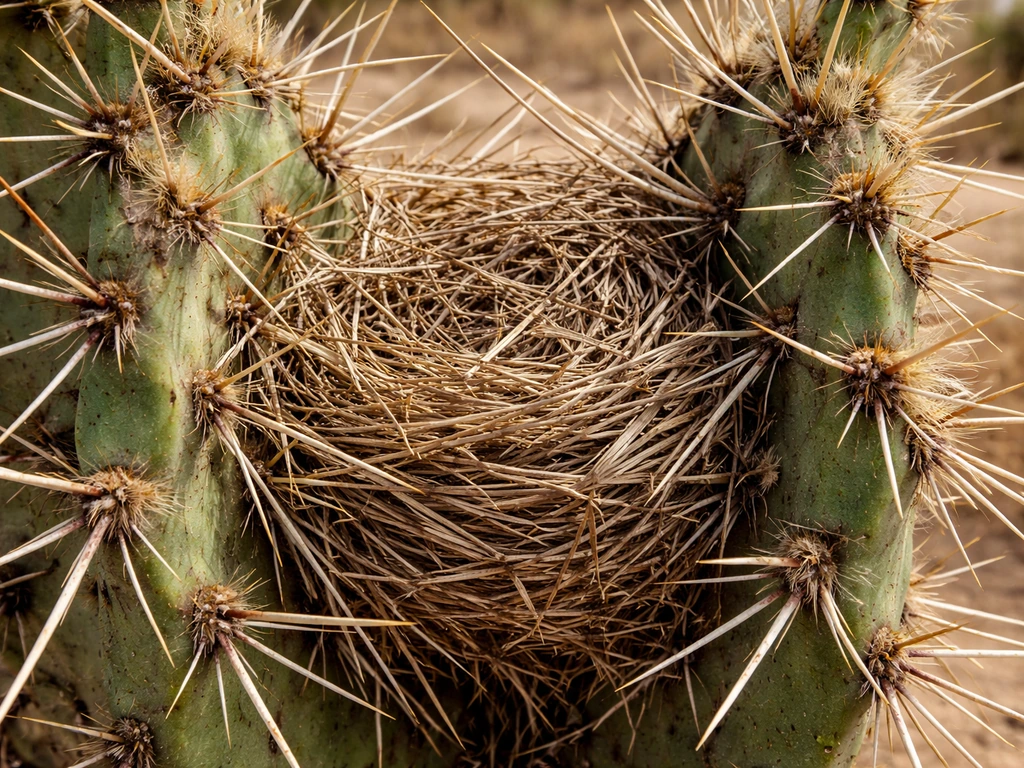
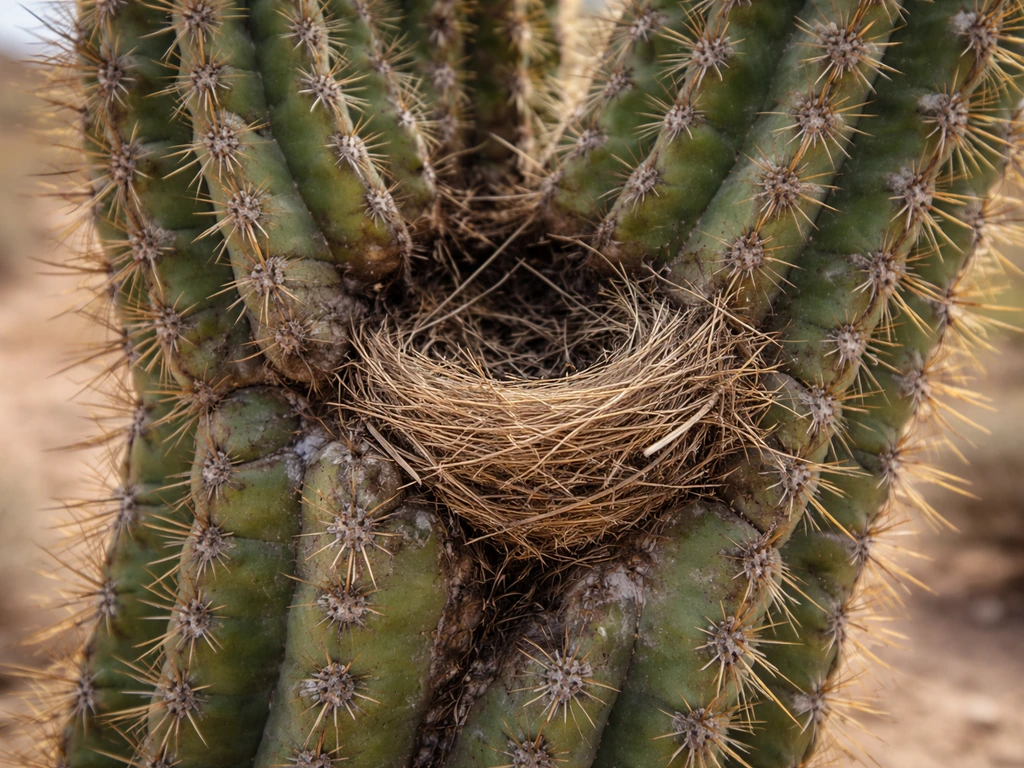
Most people find a cactus nest one of two ways: they walk past a cholla or saguaro and spot an unusual bulk of plant material wedged into the spines, or they notice birds flying in and out of a hole in a large cactus trunk. Those are actually two completely different nest types, and that distinction alone cuts your suspect list in half.
The first type is an open or enclosed woven nest, a bulky mass of grass, weeds, and twigs built among the spines. The second is a cavity nest, a hole excavated directly into the cactus flesh, most commonly in a saguaro trunk or arm. If yours is a woven nest in a cholla, prickly pear, or similar spiny shrub-like cactus, you're almost certainly dealing with a Cactus Wren or Curve-billed Thrasher. If you're looking at a round hole bored into a thick saguaro column, the builder was a woodpecker, and the current tenant may be a completely different species.
Most likely cactus nesters by region
Cactus nesting birds are heavily tied to the American Southwest and northern Mexico. Here's a quick regional shortlist so you can immediately rule in or out based on where you are.
| Species | Region | Cactus Used | Nest Type |
|---|---|---|---|
| Cactus Wren | Sonoran, Mojave, Chihuahuan deserts; SW Texas to coastal CA | Cholla, prickly pear, saguaro | Enclosed woven nest with tube entrance |
| Curve-billed Thrasher | Sonoran Desert, SW Texas, suburbs of AZ/NM | Cholla (strongly preferred) | Open cup nest, often under upper arms |
| Gila Woodpecker | Sonoran Desert (AZ, SE CA, NW Mexico) | Saguaro trunk/arms | Excavated cavity ('boot') |
| Gilded Flicker | Sonoran Desert (AZ, NW Mexico) | Saguaro (near top) | Excavated cavity, larger than Gila's |
| Elf Owl | Sonoran and Chihuahuan deserts, SW TX | Saguaro (abandoned cavities) | Uses existing cavity, doesn't excavate |
If you're outside the Southwest entirely, say, in Florida or the Carolinas, and you're looking at a nest in an ornamental cactus in a garden, the odds are very high it's a bird that nests in dense thorny shrubs generally, not a cactus specialist. In those cases, a Northern Mockingbird or Brown Thrasher is worth considering. But for the purposes of this guide, the focus is on true cactus-nesting specialists in their native range.
How to confirm: nest shape, placement, materials, and entrance
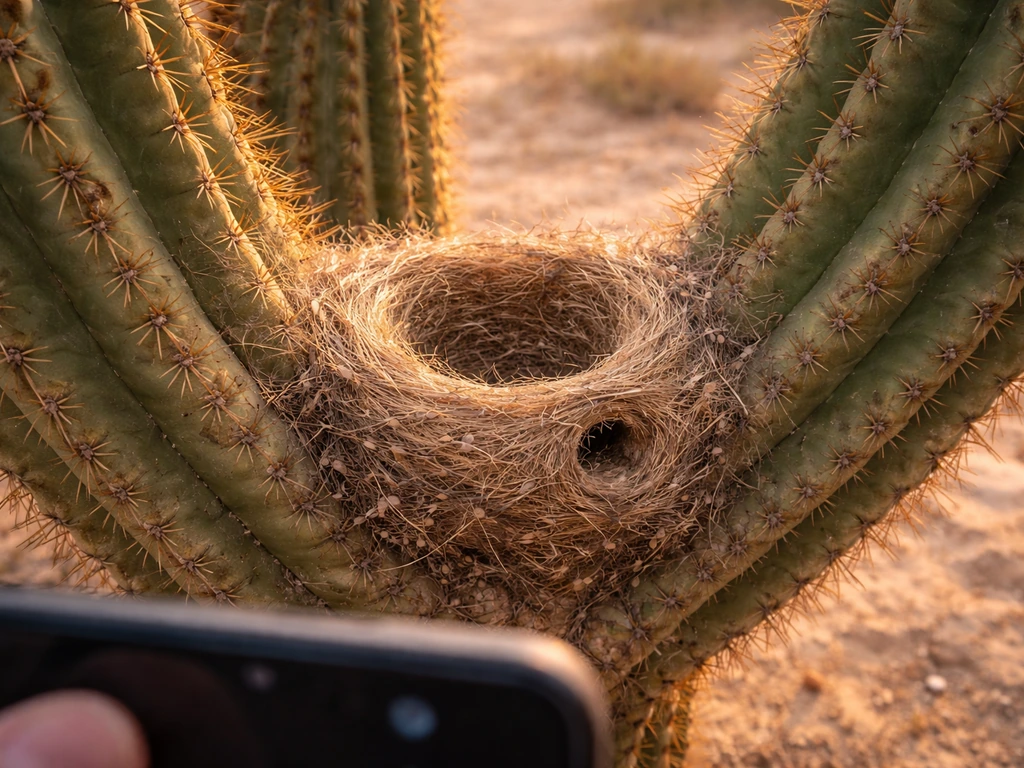
Get as close as you safely can without disturbing the nest, and note these four things. A phone photo works perfectly, zoom in later rather than getting right up on it.
Cactus Wren
The Cactus Wren nest is unmistakable once you know what to look for. It's a large, football-shaped mass of grasses, weeds, and twigs lying on its side in the cactus, usually less than 10 feet off the ground (though occasionally up to around 30 feet). The entrance is at one end, a narrow tube about 1.5 inches (3.8 cm) wide that opens into a wider inner chamber roughly 3 inches (7.5 cm) across. The interior is lined with feathers, animal hair, and plant down, giving it a soft, cozy interior that's very different from the rough exterior. There's often a small perch or ledge near the entrance because the tube is tight enough that the birds essentially have to walk in rather than fly directly through. Both male and female build the nest together, and the male often builds extra 'roost nests' nearby that look similar but are less carefully finished inside.
Curve-billed Thrasher
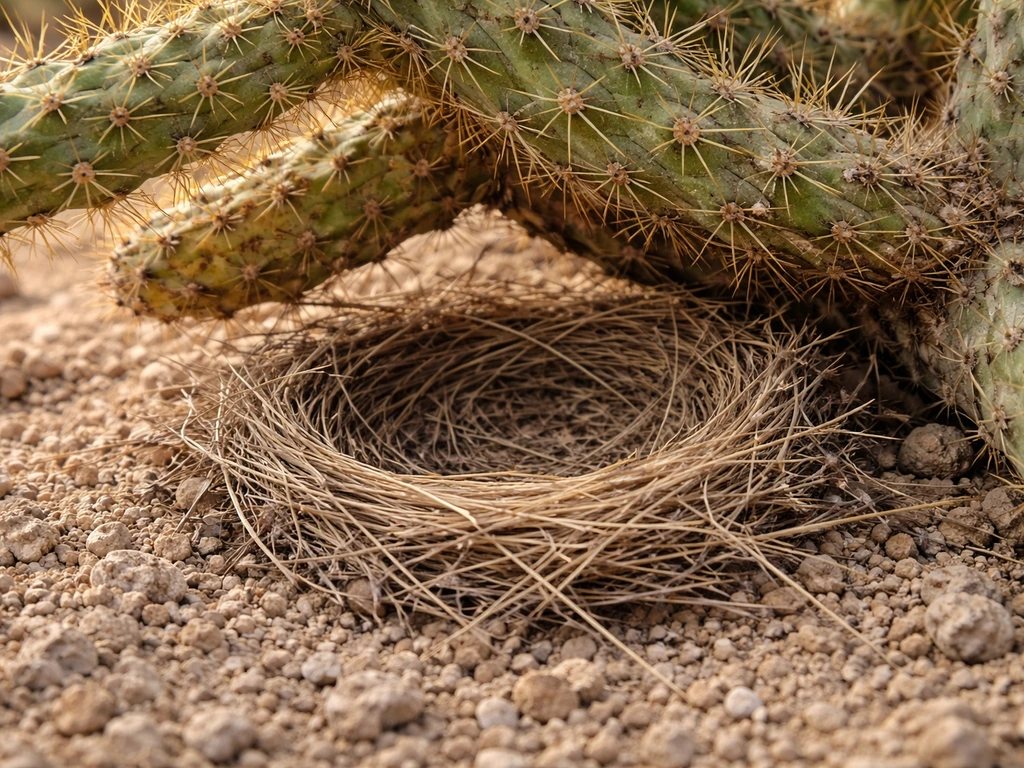
The Curve-billed Thrasher builds a more traditional open cup nest, usually tucked under the upper protective arms of a cholla. It's smaller and shallower than a Cactus Wren nest, with no tube entrance, just an open cup of twigs and plant material. If you can see eggs or nestlings directly from above or from an angle, it's not a Cactus Wren. This species is very comfortable in suburban Southwest neighborhoods, so don't be surprised to find one in a potted or landscaped cholla on a patio.
Gila Woodpecker and Gilded Flicker
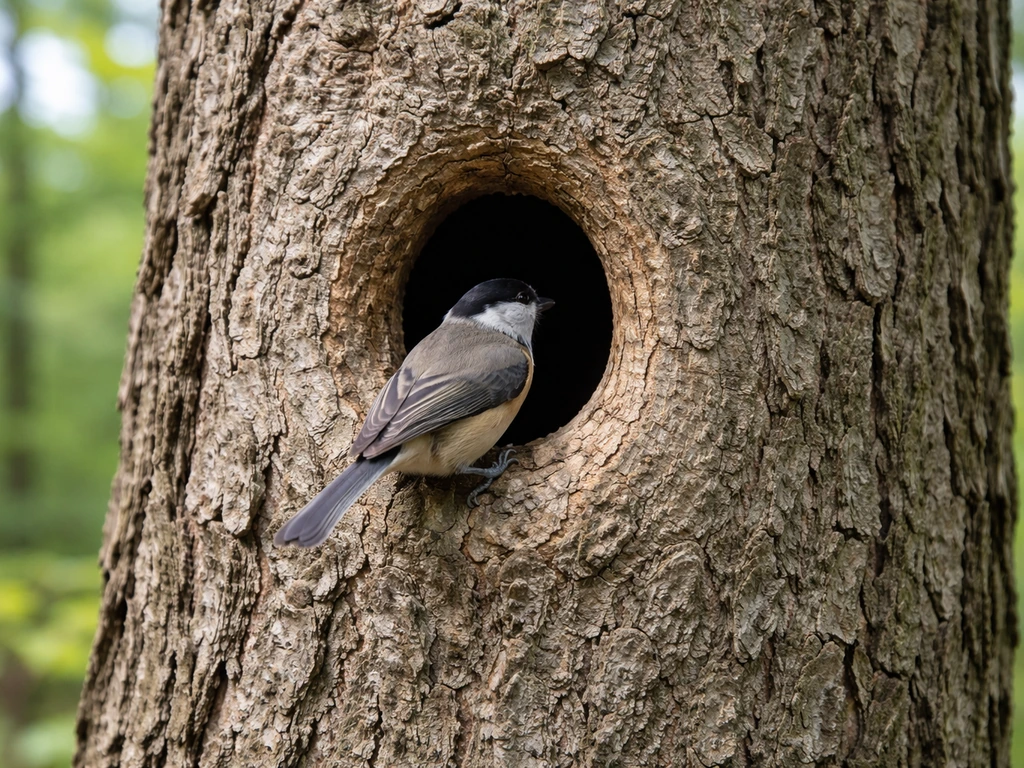
Both of these species excavate holes directly into saguaro trunks. If you spot a nest in a tree trunk, it could be made by cavity-nesting birds that excavate or use natural holes. The saguaro hardens the wound into a tough, gourd-like structure called a 'boot', and these boots persist for years after the bird moves on, eventually becoming real estate for Elf Owls, kestrels, and other cavity nesters. Gila Woodpecker holes are typically round and relatively smooth-edged, placed anywhere along the trunk or arms. Gilded Flicker holes tend to be positioned higher up, closer to the crown of the saguaro. If the hole edges look fresh and chipped, woodpecker activity is ongoing. If they look smooth and weathered, you may be watching a blank" rel="noopener noreferrer">secondary tenant like an Elf Owl.
Seasonal timing and behavior clues to narrow the species
Timing is one of the most useful ID tools you have, and it costs nothing.
- Cactus Wrens nest primarily from February through June in most of their range, and they often attempt two or even three broods per season. Incubation runs 16–17 days and nestlings fledge after another 17–23 days. If you're watching in late summer, you may be seeing a second or third brood.
- Curve-billed Thrashers also nest in late winter through early summer, with a peak in March–May across Arizona and New Mexico.
- Gila Woodpeckers excavate or revisit cavities from March onward, with peak nesting from April to June.
- Elf Owls are migratory and arrive in the Sonoran Desert around late March or April, nesting through June. They're strictly nocturnal — if you hear a rapid, high-pitched yipping from a saguaro hole at dusk, that's your answer.
Behavior narrows things further. Cactus Wrens are bold and loud, you'll hear them before you see them, and if a snake or cat gets near the nest, they'll mob and scold aggressively. That defensive behavior is a strong Cactus Wren tell. If you see a bird repeatedly flying into a cholla with grass or feathers in its bill, it's actively building or lining the nest. Adults making frequent short trips in and out with no nesting material means they're feeding nestlings, the nest is active.
If it's active: what to do (and not do) right now
First, the legal piece: in the United States, almost all native wild birds and their nests are protected under the Migratory Bird Treaty Act (Title 16, U.S. Code). That protection includes the nest itself, the eggs, and the nestlings. Disturbing, moving, or destroying an active nest without a federal permit is illegal, and 'disturbing' can mean more than just touching it. Repeatedly approaching close enough to flush the parents off the nest counts as disturbance too.
The practical rule: give the nest at least 10–15 feet of clearance for small species like wrens, and try to observe from a distance using binoculars or your phone camera's zoom. National Park Service wildlife guidance recommends a minimum 50-yard buffer for wildlife approaches as a general principle, you don't need to go that far in a backyard context, but the spirit is right. Keep pets indoors or leashed away from the nest area. Cats in particular are a documented predator threat to Cactus Wrens.
If the nest is in a location that creates a genuine safety problem, blocking a door, in a heavily trafficked spot, or in a cactus that needs emergency maintenance, contact your local U.S. Fish and Wildlife Service office or a licensed wildlife rehabilitator before doing anything. Don't attempt to move an active nest yourself.
On the predator protection side: if you notice snakes regularly in the area, or outdoor cats visiting, creating a low physical barrier (a simple ring of wire fencing a few feet around the base of the cactus, for example) can help without disturbing the birds. You're not protecting the cactus, you're protecting the nest site's ground access.
Common misidentifications and troubleshooting
A few things commonly get misread as bird nests in cacti, and a few bird nests get misread as something else.
- Paper wasp or hornet nest: If the 'nest' is a papery gray globe or open comb structure with hexagonal cells and no feathers or soft lining, it's insects, not birds. Bird nests in cacti are always made of plant fibers, grasses, or feathers — never paper.
- Debris caught in spines: After a windstorm, a wad of tumbleweed or dead plant material can get lodged in a cholla and look like a nest from a distance. Check for a defined shape, an entrance, and any soft lining material. Random debris won't have any of those.
- Abandoned Cactus Wren roost nests: Male Cactus Wrens build extra nests that are never used for eggs — they serve as roosting spots or decoys. These look very similar to the real nest but have a less carefully finished interior lining. If you can't see feathers or soft material inside and there's no activity after several days of watching, it may be a roost nest.
- Nests in non-cactus spiny shrubs: If the plant has spines but no cactus pads, joints, or a columnar trunk, it may not be a cactus at all. Catclaw acacia, ocotillo, and desert shrubs can all host similar birds. The nest-building behavior and species overlap, but the plant ID matters if you're reporting your sighting.
- Mistaking a Gilded Flicker hole for a Gila Woodpecker hole: Both excavate saguaros, but Gilded Flicker holes tend to sit higher on the cactus near the top, while Gila Woodpecker holes appear at various heights. Flicker holes are also slightly larger.
Your next-step checklist: tonight vs. this weekend
Do tonight
- Take 2–3 clear photos from a safe distance — one showing the whole cactus for context, one showing the nest placement, and one zoomed in on the entrance if visible.
- Note the cactus type (cholla, saguaro, prickly pear, or other), the nest height in feet, and the nest shape (football/enclosed vs. open cup vs. hole in the trunk).
- Keep pets inside or away from the area tonight — predator activity near active nests increases at dusk and overnight.
- Listen at dusk: if you hear rapid high-pitched calls from a saguaro hole, suspect Elf Owl. If you hear loud, raspy chattering from the area of a cholla nest, that's almost certainly a Cactus Wren.
- Do not shine a flashlight directly into the nest or entrance — it stresses incubating birds.
Do this weekend
- Set up a quiet observation spot 15–20 feet away for 20–30 minutes in the early morning. Watch for adult birds entering and exiting and note the species if you can.
- Cross-reference your photos against the species table above and a field guide app like Merlin (Cornell Lab) using your location filter.
- If you're in Arizona, New Mexico, Texas, or California, check your county's eBird data to see which cactus-nesting species have been reported nearby in the current season.
- If the nest is active, mark your calendar: for a Cactus Wren, expect nestlings to fledge roughly 5–6 weeks after you first noticed adults incubating. Plan any garden work or cactus maintenance around that window.
- If there's a safety, legal, or pet-conflict concern, contact your nearest USFWS field office or a licensed wildlife rehabilitator before taking any action near the nest.
- If the nest appears inactive (no adults, no sounds, cool to the touch on a warm day), wait at least a week before concluding it's abandoned — Cactus Wrens and thrashers can temporarily leave nests during incubation.
Cactus nests are genuinely fascinating, the spines aren't just structural support for the nest, they're active predator deterrence, and these birds have evolved to use that protection deliberately. All About Birds notes that Curve-billed Thrashers blank" rel="noopener noreferrer">rest in the shade of cactus and cholla in the Sonoran Desert, which matches the field cue of looking for them around those cactus plants. If you end up with a confirmed Cactus Wren nest in your yard, you're hosting one of the most architecturally impressive builders in North American birdlife. The same conservation-first approach applies whether you're dealing with a nest in a cactus, a nest tucked into a garage rafter, or a cavity worked into a tree trunk, the legal protections are the same, and the reward for patient, non-invasive observation is almost always worth it.
FAQ
If I see a nest hole in a saguaro, does that mean the bird currently using it excavated it?
Yes, but only in specific setups. If the nest is a cavity bored into a saguaro trunk, the “maker” may be the bird that excavated the hole earlier (often a woodpecker), and a different species (like an owl) can later use the existing cavity.
How can I tell whether the builder was a woodpecker versus a cactus specialist?
No. A fresh, smooth-edged round hole with recent chipping strongly suggests an active woodpecker cavity, not a Cactus Wren or thrasher. By contrast, the tube-like entrance and football-shaped woven mass are consistent with Cactus Wren construction.
What if the nest is woven but doesn’t have a narrow tube entrance?
If it looks like an open cup with no tube, it usually points away from Cactus Wren. Curve-billed Thrasher nests are typically smaller and more traditional, often tucked under cholla arms, and you may be able to see eggs from above or at an angle without a tube entrance.
What behavior patterns help me confirm whether the nest is being built or feeding young?
Use quiet observation first, then limit checking frequency. If adults are repeatedly flying in with nesting material, that suggests building or lining. If they mostly make short trips with less visible material, it often indicates feeding nestlings rather than active construction.
Can the same cactus nest site be used in different seasons by different birds?
Be careful with timing if you want to identify by season. Cactus Wren nests are often obvious during breeding, but cactus cavity sites can have multi-season reuse through “secondary tenant” occupancy. So a cavity may look occupied even if the original excavator is long gone.
In my region outside the Southwest, is a cactus nest still likely to be a Cactus Wren?
It can, especially if a nest is in an ornamental cactus in a non-native region. In places outside the Southwest, nests found in garden cacti are more often made by generalists that use dense thorny shrubs rather than true cactus specialists.
What’s the biggest mistake people make when identifying a cactus nest?
Don’t rely on how “spiky” the nest is. Spines protect the nest from predators, but predators also vary by location, so you should verify nest type by entrance style (tube versus hole), overall shape (football woven mass versus cup), and whether it is in a cholla-like spiny shrub or a saguaro trunk.
If cats or snakes are a problem, what should I do without disturbing the nest?
If you suspect an active nest is in danger, relocate only the risk, not the nest. For example, create a small exclusion zone with a simple ring of wire fencing around the base (for ground-access predators) and keep pets indoors or leashed, instead of moving the cactus or the nest.
I can’t get close to the nest, how do I still identify the bird accurately?
It’s not always possible to be 100% sure from a distance. The safest practical approach is to document the key ID features (tube width, entrance shape, nest mass versus hole) with zoomed photos, then identify from those details rather than approaching for a closer look.
What if the nest is in a spot that affects my home maintenance or access?
Yes, and it matters for safety. If the nest blocks a door, sits where maintenance will be required, or is in a cactus that must be removed for hazards, contact a local U.S. Fish and Wildlife Service office or a licensed wildlife rehabilitator for guidance before any work begins.
Next Article
Which Bird Makes a Nest in a Tree Trunk? How to Identify
Identify which bird nests in a tree trunk using entrance, cavity size, materials and behavior, plus safe next steps.