
A chickadee nest is a small, soft-lined cup tucked inside a tree cavity, old woodpecker hole, or nest box, never out in the open. Baltimore oriole nests look very different, since they are usually built as an open, hanging basket woven from plant fibers high in trees. From the outside you will not see the nest itself, only the bird disappearing into a hole roughly 1 to 1.
What Does a Chickadee Bird Nest Look Like? Key ID Features

Maya Bennett
23 May 2026
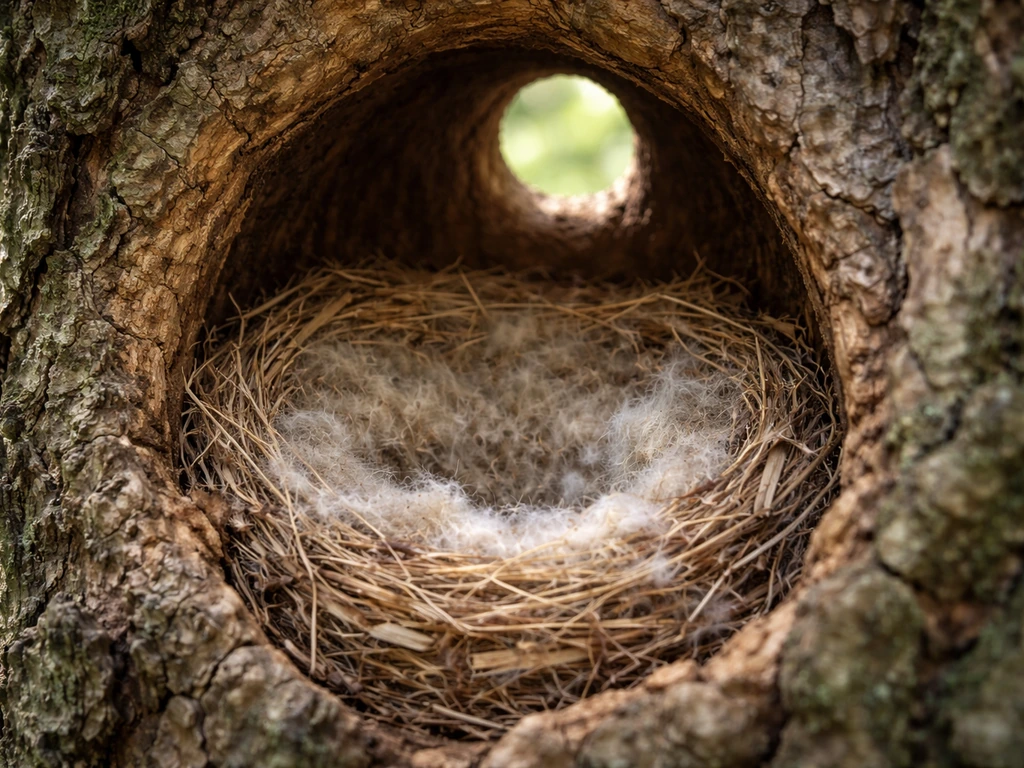
25 inches wide, positioned anywhere from a couple of feet off the ground up to about 20 feet. Inside that cavity sits a tidy cup built on a foundation of coarse moss or bark strips and lined with a thick, plush layer of animal fur, plant down, or feathers. That soft, fuzzy interior is the single most distinctive thing about a chickadee nest once you get a look at it.
Quick visual ID checklist
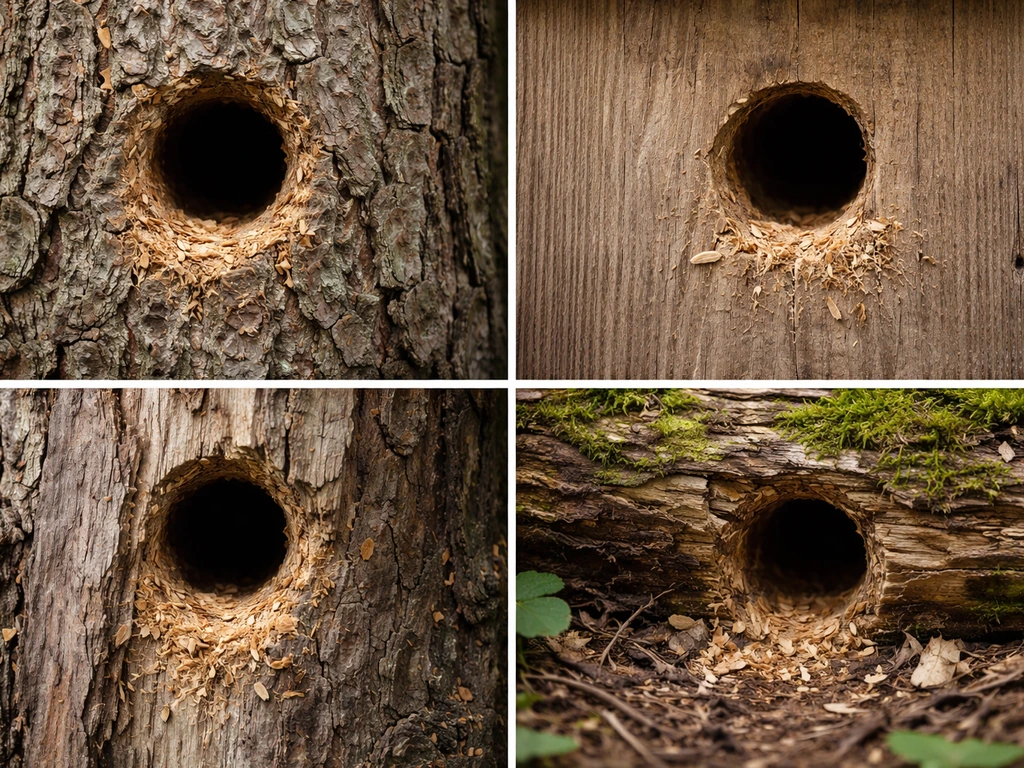
If you need a fast field confirmation, run through these key traits before anything else. All of them should line up for a confident chickadee ID.
- Cavity entrance: small, roughly circular hole in a tree, snag, or nest box (about 1 to 1.25 inches in diameter for black-capped and Carolina chickadees)
- Height: most often 5 to 20 feet above ground, though boreal chickadees sometimes nest just a few feet up
- Nest cup base: chunky, green-gray moss or shredded bark strips that form a dense mat
- Nest cup lining: a thick, visibly soft layer of animal fur (rabbit, deer, or other mammal hair), plant down, or fine feathers
- Color overall: the cup looks two-toned, with a darker, coarser outside layer and a pale, almost woolly inner lining
- Adult behavior: one or both adults seen perching briefly at the cavity entrance, then slipping inside repeatedly
Nest structure and materials up close
Chickadees build a classic open cup inside a protected cavity, so the structure has two distinct layers. The female does most or all of the building. She starts with a foundation of coarse green moss, sometimes mixed with strips of bark, plant fibers, or even lichen depending on the species. This base gives the cup its shape and insulation. Black-capped, Carolina, and boreal chickadees all follow the same basic blueprint here.
The lining is where the nest really stands out. On top of that coarse foundation the female packs in soft animal fur, plant down, and sometimes fine feathers. Birdfact describes the black-capped chickadee nest as a cup female builds from a coarse moss foundation, then lines it with soft materials like rabbit fur, plant down, or feathers for a plush interior [rabbit fur, plant down, and feathers](https://www. birdfact.
com/articles/black-capped-chickadee-nesting). Rabbit fur is a classic choice for black-capped chickadees in suburban and rural settings, and it gives the cup a distinctly plush, almost pillow-like look. If you shine a flashlight into an active box or cavity, that fluffy pale interior is hard to miss.
The lining serves as both insulation and cushioning for the eggs, which makes sense given that black-capped chickadees are laying in mid to late April when nights can still drop well below freezing in much of their range.
The finished cup is relatively compact. It fills part of the cavity floor rather than the whole space, and it sits snugly enough that it will not shift around. The overall texture is coarse on the outside and velvety on the inside, which is a combination you will not easily confuse with, say, a paper wasp nest or a squirrel's leaf cache.
Where chickadees nest and what to look for from the outside
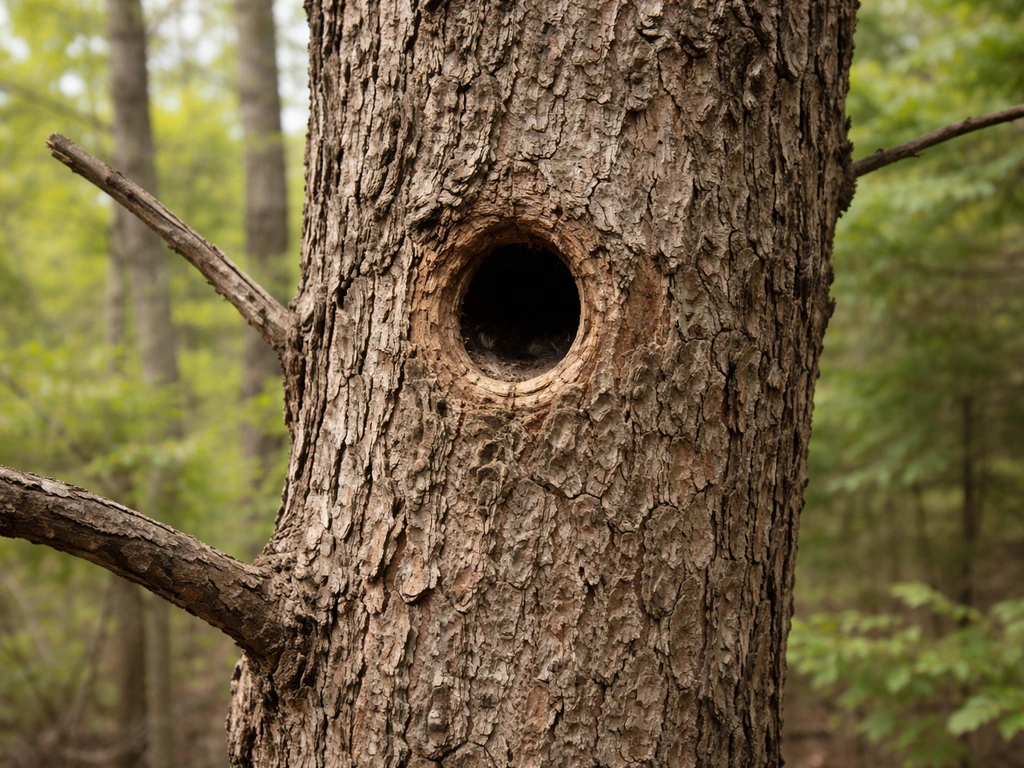
All common North American chickadee species are cavity nesters. They do not build exposed basket nests on branches the way robins or finches do. Finches, unlike chickadees, typically build open nests in trees, so what does a finch bird nest look like depends on the species and the materials they gather open basket nests on branches.
The nest is always hidden inside something: a natural hollow in a rotting tree, a cavity a woodpecker excavated in a previous season, a snag with soft wood that the chickadee has enlarged itself, or a nest box you have put up. This is a critical ID point because it immediately rules out any open cup nest you find sitting on a branch or in a shrub.
Black-capped chickadees typically choose cavities 5 to 20 feet off the ground. Carolina chickadees follow a similar range. Boreal chickadees often nest lower, sometimes only a few feet up in a spruce or fir snag in northern forests. Mountain chickadees tend to nest in conifers and can go higher. The entrance hole is the main visible clue from the outside. Look for a small, smoothed-edged opening in a dead or dying tree, often in a spot where the bark has started to peel away. If chickadees are present, you will see them hovering at that hole, gripping the edge, and ducking inside in a quick, decisive motion.
For nest boxes, the entrance diameter matters for ID context. Black-capped chickadees favor a 1 1/8-inch opening and Carolina chickadees use one closer to 1 1/4 inches, with the entrance positioned about 7 inches above the floor of the box. If your nest box has a larger hole, a different cavity nester may have moved in instead.
How chickadee nests differ from common lookalikes
The biggest source of confusion is other cavity nesters sharing the same trees and boxes. Pygmy nuthatches, white-breasted nuthatches, and house wrens all use similar sites and sometimes similar soft materials. Here is how to sort them out.
| Bird | Cavity entrance size | Nest base material | Lining material | Key difference from chickadee |
|---|---|---|---|---|
| Black-capped / Carolina chickadee | ~1 1/8 to 1 1/4 in | Moss, bark strips | Animal fur, plant down, feathers | Very thick, plush fur lining; moss base is usually lush green |
| Pygmy nuthatch | Similar small hole | Bark shreds, moss, grass, plant down | Fur, wool, snakeskin, cocoons, feathers | Often includes feathers and snakeskin; less pure moss base |
| House wren | Similar small hole | Twigs (heavy twig base filling most of the cavity) | Grass, hair, feathers | Twig base is dense and fills the cavity floor; no moss foundation |
| White-breasted nuthatch | Slightly larger hole | Bark, twigs, grass | Fur, hair, feathers | Larger entrance; base is less mossy |
| Black-capped chickadee self-excavated site | Often rough-edged, very small | Moss | Fur, down | The hole itself may look freshly worked in soft, punky wood |
The house wren is probably the most common confusion case. Wrens pack their cavities with sticks first, creating a bulky twig platform before adding any soft lining. A chickadee nest will never have that twig base. If you open a box and find a pile of sticks underneath any soft material, that is a wren, not a chickadee. The lush green moss foundation is one of the clearest chickadee signatures.
It is also worth comparing chickadee nests to the broader category of bird nests generally. If you are wondering what a typical bird nest looks like across species, the key is to focus on the type of nest and where it is placed bird nests generally. Unlike the hanging, woven pouches made by Baltimore orioles or the elaborate communal structures of sociable weavers, chickadee nests are modest, hidden, and entirely inside a cavity.
If you are wondering which bird nest looks like a hanging basket, that description usually points to species that make woven pouches rather than cavity nests. Sociable weavers build very different nests, forming bulky, communal structures rather than the enclosed cavity cups made by chickadees. Baltimore oriole nests are hanging, woven baskets, usually made of fine grasses and fibers and slung from the fork of a branch.
You will never find one dangling from a branch or constructed out in the open.
Seasonal timing: when to expect activity
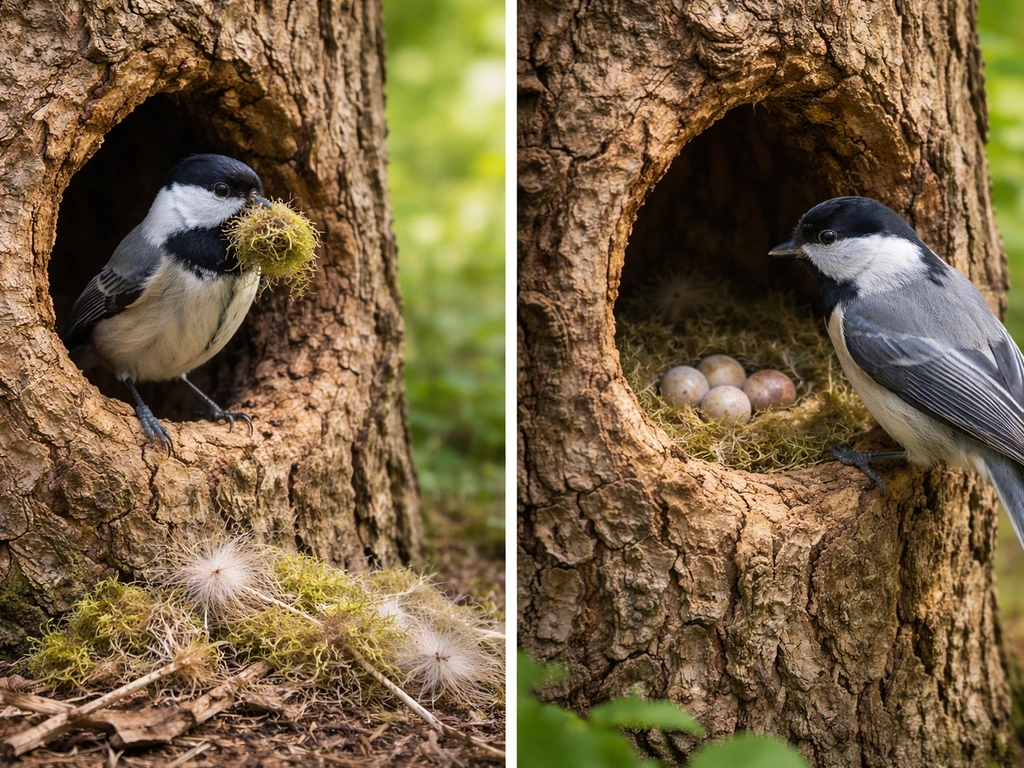
Knowing the seasonal calendar helps you interpret what you are seeing when you spot a chickadee at a cavity. Nest building for black-capped chickadees typically begins in mid-April in most of their North American range, with egg laying starting in the first week of May. Incubation runs 12 to 13 days, so chicks are hatching in mid-May in many areas, and fledglings are leaving the nest by early June. In northern British Columbia and similar higher-latitude zones, egg laying may not start until the second week of May, with the overall breeding season stretching from mid-April to early July.
Carolina chickadees follow a broadly similar but slightly earlier timetable in the southern and mid-Atlantic states. Boreal chickadees lay eggs between May and July with a 13 to 16 day incubation period. Mountain chickadees in the Rockies and Colorado can nest from May through August.
Here is a practical timeline of what activity looks like through the season, using the black-capped chickadee as the benchmark since it is the most widespread species:
| Time of year | What you will likely observe |
|---|---|
| Mid-April | Adults investigating cavity entrances; female beginning to carry moss into the hole; male present nearby or bringing food |
| Late April to early May | Frequent adult visits to carry nesting material; female spending more time inside; courtship feeding at the entrance |
| First to second week of May | Egg laying begins; adults quieter around the site; female on nest most of the time; male brings food regularly |
| Mid to late May | Eggs hatching; both adults making rapid, repeated food delivery trips in and out of the hole multiple times per hour |
| Late May to early June | Nestlings growing; adults carrying fecal sacs out of cavity; visits become very frequent as nestlings demand more food |
| Early June | Fledglings leaving the cavity; family group moving through nearby vegetation; cavity may appear quiet or abandoned |
An apparently quiet or empty nest mid-season does not always mean it has been abandoned. During incubation the female sits still inside and the male comes and goes less obviously. If you are seeing no activity for a full day or two in late April or early May, watch from a distance for at least 30 minutes before drawing conclusions.
Ethical observation: what to do and what to avoid
Finding an active chickadee nest is genuinely exciting, and you can learn a lot by watching carefully. The key is keeping your distance and minimizing any disruption during the most sensitive periods: incubation and the first week after hatching.
- Do: observe from at least 10 to 15 feet away, ideally from inside a building or behind natural cover so the birds do not register your presence as a threat
- Do: use binoculars rather than approaching the cavity to get a closer look
- Do: note the time and frequency of adult visits if you want to track progress, which can tell you roughly what stage the nest is at
- Do: photograph the entrance hole from a distance for your own records
- Do not: tap on or knock the tree or box to provoke a reaction from the bird inside
- Do not: open a nest box to check inside during active incubation without a specific reason, and if you must check, do it quickly and quietly
- Do not: handle eggs, nestlings, or nesting material at any point
- Do not: clear vegetation, trim branches, or do any yard work directly around an active cavity during the nesting period
- Do not: allow pets, especially cats, to roam near an active nest site
Chickadees are relatively tolerant of careful human observation compared to many species, but they will abandon a nest if they experience repeated, close disturbance during laying and early incubation. The risk is highest in the first few days after egg laying begins.
Found one at your home? Practical next steps and legal basics
If you have found what looks like an active chickadee nest in a tree, snag, or nest box on your property, the first and most important thing to know is that it is protected by federal law in the United States under the Migratory Bird Treaty Act. In Canada, equivalent protection applies under the Migratory Birds Regulations ([updated July 30, 2022](https://www. canada. ca/en/environment-climate-change/services/avoiding-harm-migratory-birds/fact-sheet-nest-protection-under-mbr-2022.
html)), which prohibit damaging, destroying, disturbing, or removing a migratory bird nest when it contains a live bird or viable egg. In both countries, removing or relocating an active nest without authorization is illegal, with very limited exceptions for immediate human health or safety emergencies. A nest in your nest box or a dead tree in your yard does not qualify as an emergency.
Here is a simple action plan if you discover an active chickadee nest on your property:
- Confirm activity first: watch from a comfortable distance for 20 to 30 minutes to see if adults are visiting the cavity. An entrance with no activity at all over a full day, combined with no sound from inside, may indicate the nest has been abandoned, in which case different rules apply.
- Mark your calendar: knowing the approximate date you first noticed activity helps you estimate when fledging will occur (roughly 4 to 6 weeks from egg laying). Most nesting situations resolve themselves within that window.
- Postpone any nearby yard work: hold off on trimming the tree, painting the fence nearby, or running loud power equipment close to the nest site until the birds have fledged. A few weeks of patience protects both the birds and your peace of mind.
- Do not block or seal the cavity entrance: this can trap adults or nestlings inside. If the cavity is in a location that concerns you structurally (such as a dead limb over a walkway), document the concern and consult a licensed arborist who is familiar with wildlife considerations, but do not act during the active nesting period.
- Contact your state or provincial wildlife agency if you have a genuine conflict: in rare cases involving hazardous tree removal or other urgent situations, agencies can advise on whether a permit for nest disturbance applies to your situation.
- Once the nest is inactive after fledging, you are generally free to clean out a nest box or address the tree as needed. The MBTA applies to active nests with eggs or live birds; once the family has moved on for the season, the legal situation changes significantly.
One last practical note: chickadees often return to the same cavity or nest box in subsequent years if conditions are good. Cleaning out a nest box in late summer or fall, once the nesting season is clearly over, and making sure the entrance diameter is correct (1 1/8 inches for black-capped, 1 1/4 inches for Carolina) gives them the best shot at using it again next spring. That is about the best thing you can do for them as a homeowner.
FAQ
What does a chickadee nest look like from the outside when it is active?
From outside you usually only notice the bird entering and leaving the cavity, plus a small smoothed opening. The cup itself stays hidden inside the hollow, so there is typically no visible rim or exposed lining, even when you know a nest box is occupied.
How can I tell a chickadee nest from a cavity-mason like a nuthatch without opening the cavity?
Look for the most obvious difference you can observe, the entrance behavior and site choice. Chickadees tend to use the cavity as a quick entry hole and rely on a moss base with a very plush, pale fur lining, while nuthatches often create a cleaner, less obviously “pillowy” interior and may show more frequent activity at the hole over longer stretches.
Is the nest always made of fur inside, or can it look different?
The lining is almost always soft and plush, but the exact ingredients can vary. You may see more plant down and feathers in some areas or years, yet the overall look should still read as velvety and cushion-like compared with rough, fibrous, or twig-heavy nests.
If I find a nest cup in a nest box but it seems too high up, could it still be chickadee?
Yes, but it depends on whether the box matches the species range and setup. Chickadees commonly nest several feet to around 20 feet high in trees, and for boxes, the entrance placement matters, if the hole height and diameter are off, another cavity nester may use the box instead.
What should I do if I accidentally peek inside and disturb the nest box?
Back off immediately and stop repeated checking. If you need identification, use observation from a distance (timed watches) rather than opening the box, because the highest risk of abandonment is during egg laying and the first days after incubation begins.
Can chickadees reuse the same cavity, and what does the nest look like between years?
They may return to the same cavity or nest box in later years, but the new nesting cycle usually results in a fresh cup. An older cup might still be visible as a compact remnant, yet a current chickadee nest should show the coarse moss foundation and a new, plush lining.
Do chickadee nests ever appear on the ground or in open areas?
No, not as a typical chickadee nest structure. If you find an open cup-like thing outside a cavity, it is more likely from a different species or it is debris. Chickadee nests are designed to be enclosed, tucked inside a protected hollow.
If the nest looks empty in mid-season, does that automatically mean it is abandoned?
Not necessarily. During incubation, the female may stay very still inside and activity at the hole can seem minimal. Give it a longer quiet watch window, around 30 minutes or more, and consider timing, if it is late April or early May there can be low visible movement even when eggs are present.
Can I relocate a chickadee nest if it is in a spot where I will mow or prune?
No, not without authorization, and a planned yard project is not considered an emergency. The safest approach is to postpone work around the cavity during the sensitive breeding window and coordinate timing after the nesting season is clearly finished.
What entrance size should I measure, and what if I cannot measure accurately?
For boxes, chickadees commonly use about a 1 1/8-inch opening (black-capped) or about 1 1/4-inch opening (Carolina). If you cannot measure precisely, compare to a known drill bit or ring gauge before making changes, because making the hole larger can invite other cavity users.
Next Articles
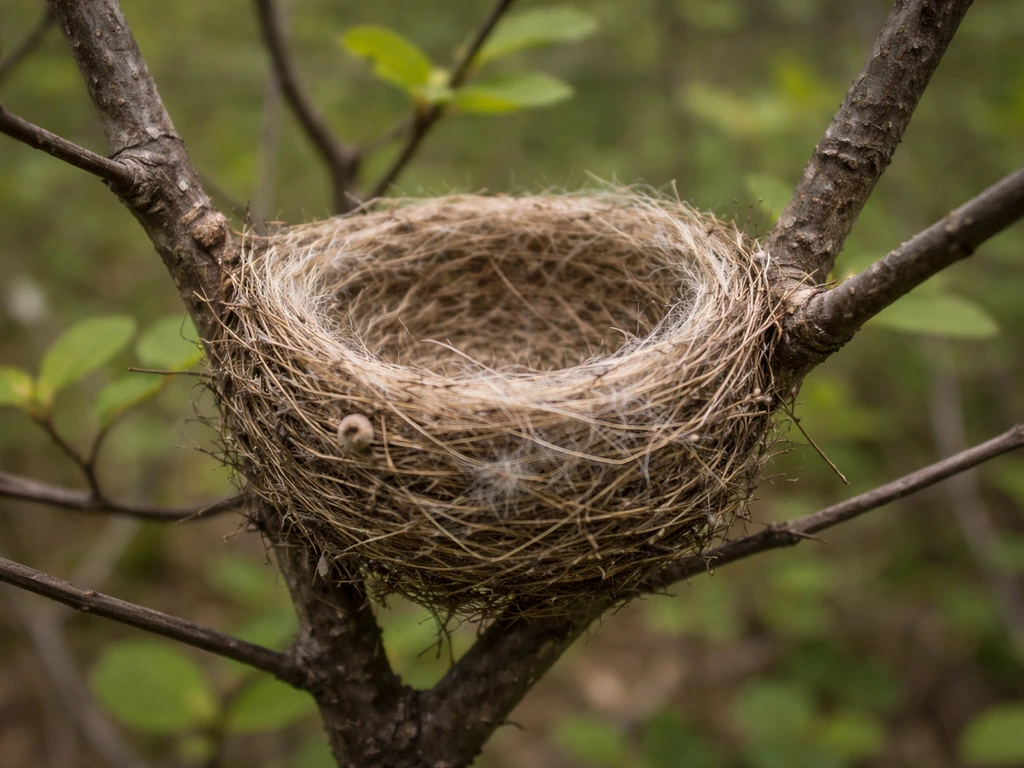
What Does a Finch Bird Nest Look Like? Goldfinch Guide
Learn what finch and goldfinch nests look like, including materials, size, placement, eggs, and safe identification tips
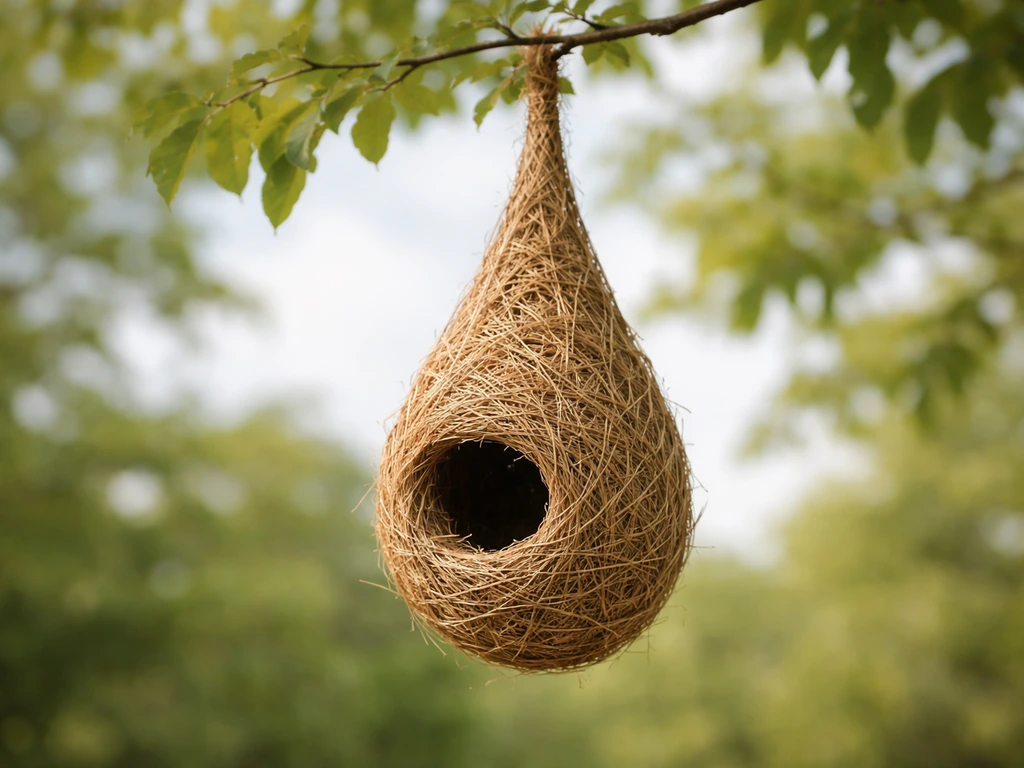
Which Bird Nest Looks Like a Hanging Basket: How to Tell It
Identify hanging-basket style bird nests fast, tell them from lookalikes, and know what to do if active or abandoned
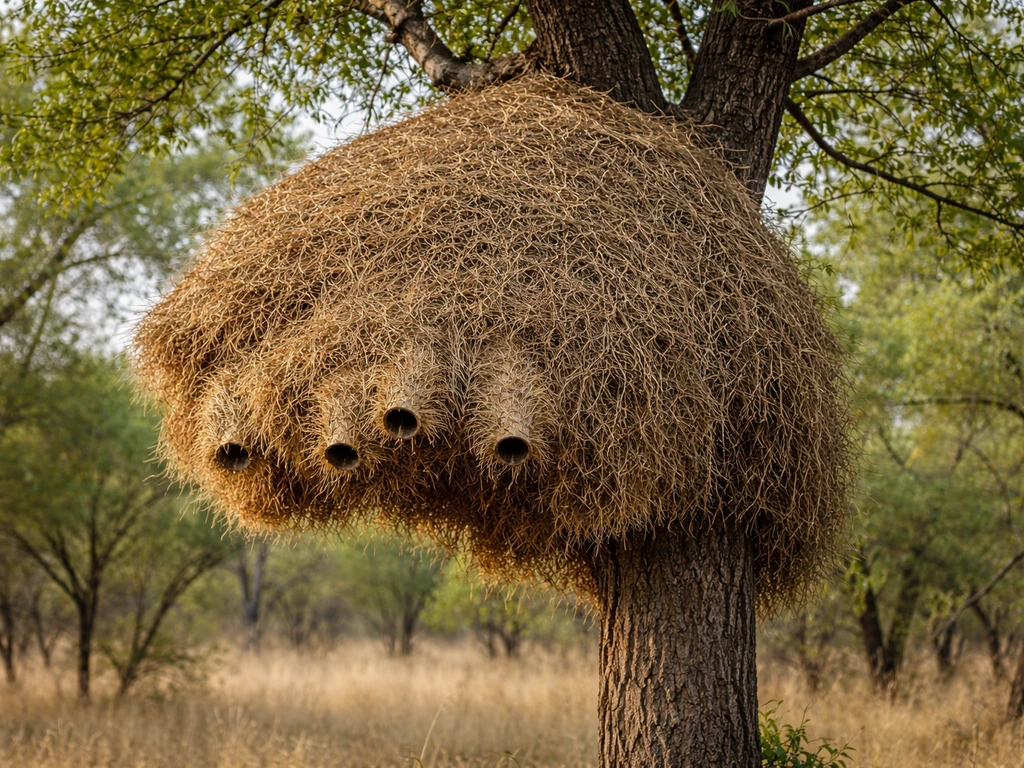
What Does a Sociable Weaver Bird Nest Look Like?
Practical guide to identifying sociable weaver nests by shape, size, entrances, texture, and lookalikes, plus safe next