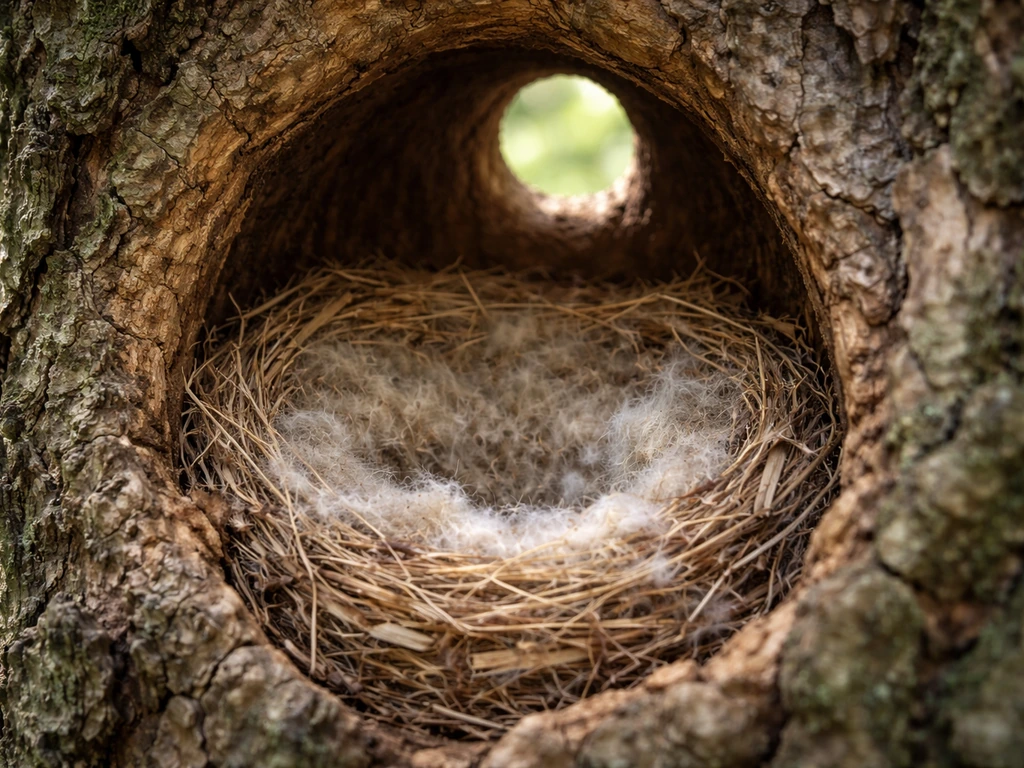
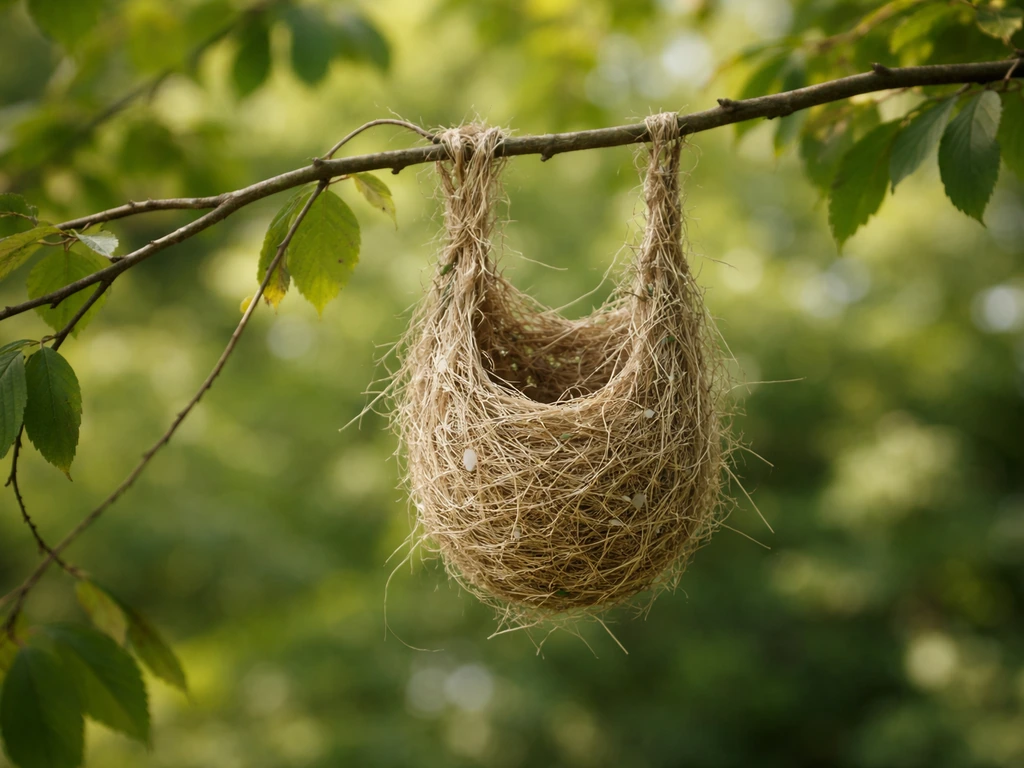
A Baltimore Oriole nest looks like a small gray or greenish-gray sock hanging from the tip of a tree branch. It's a deep, woven pouch, roughly 3 to 4 inches deep with a small opening (about 2 to 3 inches wide) at the top and a rounded, bulging bottom chamber where the eggs sit. If you spot something that looks like a tiny basket or basketball net swinging from a drooping branch high in a deciduous tree, you're almost certainly looking at an oriole nest.
What Does a Baltimore Oriole Nest Look Like? Key Traits

Maya Bennett
27 May 2026
Quick visual ID: overall shape and size
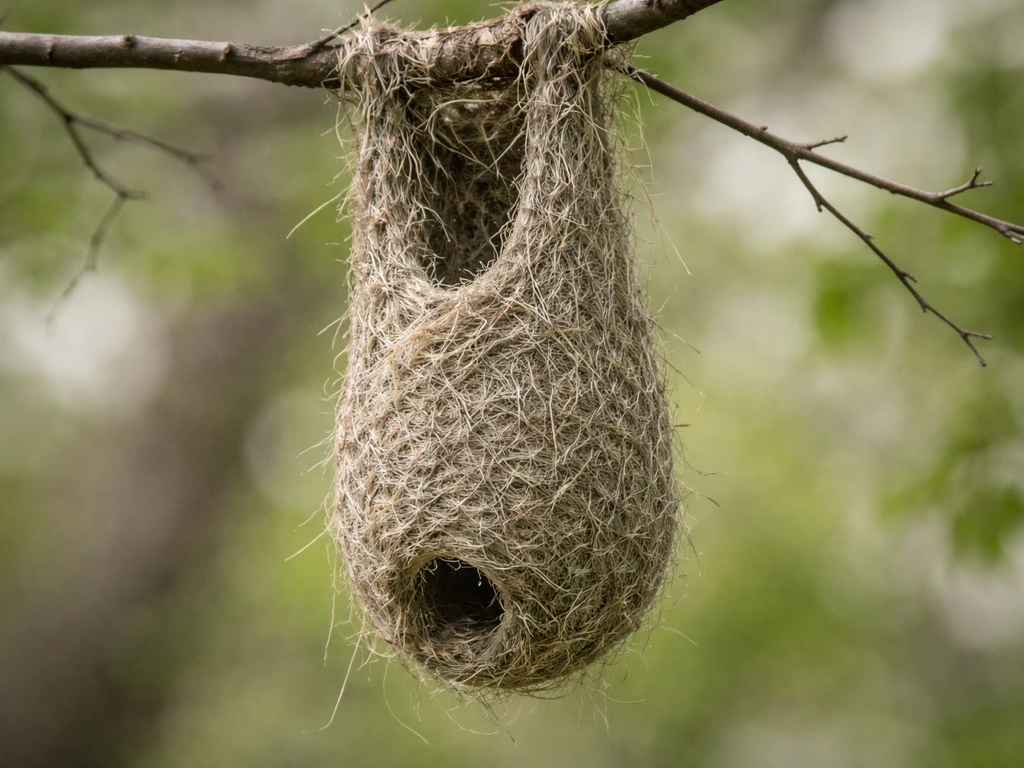
The most distinctive thing about a Baltimore Oriole nest is its shape: it's pendulous, meaning it hangs freely rather than sitting like a cup on a branch. Picture a small woven sock or a miniature coin purse dangling in the breeze. The opening is tight and narrow at the top, only 2 to 3 inches wide, then the pouch widens into a rounded bottom chamber about 3 to 4 inches across. That bottom pocket is where the female incubates her eggs.
The overall color tends to be gray, tan, or muted greenish-gray depending on the materials used locally. From a distance (and these nests are almost always found high up), it can look like a crumpled leaf or a piece of debris caught in the branches. If you’re wondering what a bird nest looks like in general, start by noting the shape, location, and how the nest is attached to the branch. After the leaves drop in fall, these nests become dramatically more visible, swinging empty from bare branches. That's often when most people first realize orioles were nesting in their yard all along.
- Shape: pendulous, sock-like or pouch-like hanging structure
- Depth: approximately 3 to 4 inches
- Opening width at top: approximately 2 to 3 inches
- Bottom chamber diameter: approximately 3 to 4 inches
- Color: gray, tan, or muted greenish-gray
- Texture: tightly woven, flexible, slightly papery or fibrous-looking
Nest location and typical placement patterns
Baltimore Orioles almost always choose tall deciduous trees, and they place their nests near the end of a slender, drooping branch, usually 20 to 30 feet off the ground, though they'll go as low as 6 feet or as high as 60 feet or more. The branch placement is deliberate: a slender, flexible branch tip makes it harder for predators like squirrels and raccoons to approach without the whole branch swaying and alerting the nest.
Common tree species include elm, maple, cottonwood, and large shade trees in parks or suburban yards. Orioles seem comfortable nesting near human activity and will use trees along roadsides, in backyards, and at the edges of open areas. If you have a large, mature shade tree in your yard, especially one with long, drooping outer branches, take a close look at the branch tips in late spring or after the leaves drop in fall.
You're most likely to spot an active nest between May and July in the eastern and central United States. The female begins building shortly after the pair arrives on breeding territory, and construction typically takes about a week, though wind and rain can stretch that to about 15 days. Incubation runs 11 to 14 days after the clutch is complete.
Materials and construction details (what it's made of)
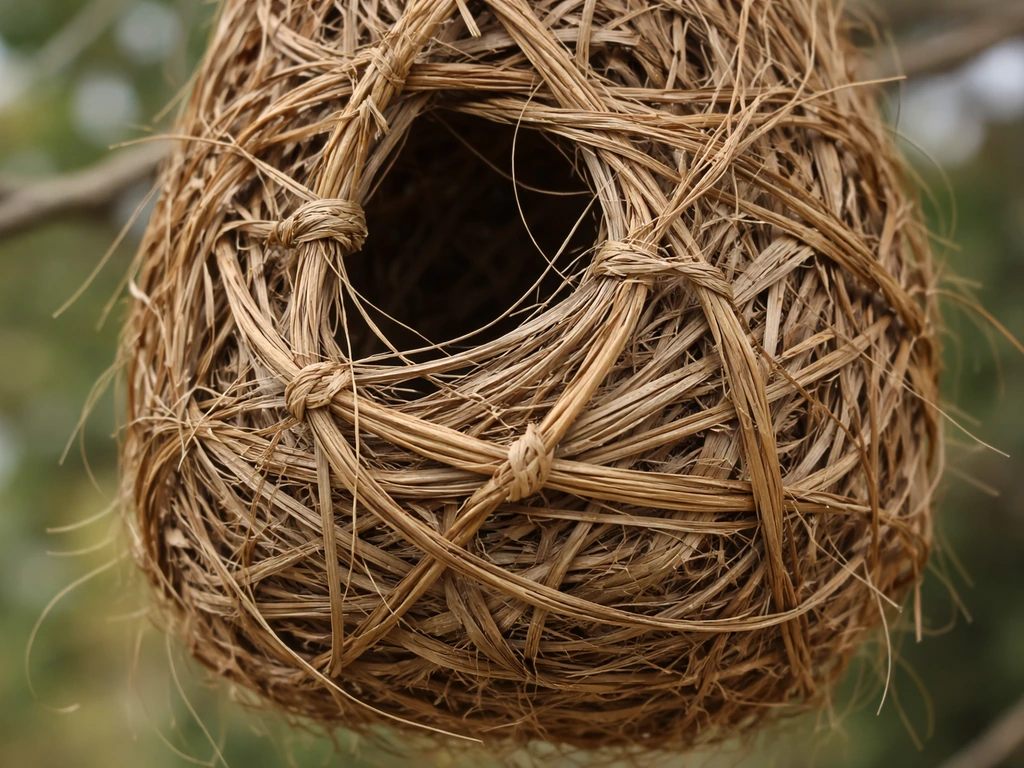
The Baltimore Oriole is a genuinely skilled weaver. The female constructs the nest almost entirely on her own, using long, slender, flexible fibers that she loops, knots, and tucks into place over several days. The primary materials are plant fibers (often milkweed silk, thin strips of bark, or grass strands), animal hair, and occasionally fine synthetic fibers like string or fishing line if they're available nearby. The finished structure is flexible and strong, able to swing in the wind without tearing.
Up close, the weave looks irregular and almost improvised, with fibers running in different directions, but the overall structure is remarkably sturdy. The inside of the pouch is lined with softer material for cushioning. If you've ever seen a nest that looks like it was made from a tangled ball of fine plant threads, not a neat cup of mud and twigs, you're likely looking at an oriole's work. This woven construction is fundamentally different from the mud-reinforced cup nests of robins or the moss-and-spider-silk construction of hummingbirds.
- Primary structural material: long plant fibers (milkweed silk, grass, thin bark strips)
- Secondary material: animal hair (horse hair, deer hair, or similar)
- Occasional additions: thin synthetic string or twine if locally available
- Interior lining: softer plant material or fine fibers for cushioning
- Construction method: woven and knotted, not packed or cemented with mud
Look-alikes: common nests that get confused with orioles
A few other nests can fool you, especially at a distance or when you're not familiar with what you're looking at. The most common sources of confusion are other oriole species and a couple of unrelated weavers.
| Species | Nest Shape | Attachment Style | Key Difference from Baltimore Oriole |
|---|---|---|---|
| Baltimore Oriole | Deep hanging sock/pouch | Suspended from tip of slender drooping branch | Baseline for comparison |
| Orchard Oriole | Tightly woven shallow pouch | Attached to a fork on a horizontal branch | Shallower, attached to a fork not a drooping tip |
| Hooded Oriole | Tightly woven pouch | Attached to underside of a leaf or branch | Attached beneath a surface, often in palms |
| Finch (House/Purple) | Open cup shape | Sits in a crook or ledge, not hanging | Not pendulous; open top cup, not a pouch |
The most practically useful distinction is the hanging, free-swinging pouch shape with the narrow top opening. Orchard Oriole nests are also woven pouches, but they're shallower and attached at a branch fork rather than suspended from a drooping tip. Hooded Oriole nests are stitched to the underside of leaves, which is a very different attachment style. If you're used to looking at open cup nests like those built by robins, house finches, or chickadees, an oriole nest will look dramatically different: much deeper, enclosed at the top, and hanging freely. Chickadees build small, cup-shaped nests, and learning what a chickadee bird nest looks like can help you tell similar nests apart. Finch nests are typically sturdier and more cup-shaped, so comparing the shape can help you tell a finch nest from an oriole nest. For comparison, finch nests sit solidly in place while oriole nests sway.
Confirmation tips: how to be sure it's an oriole nest
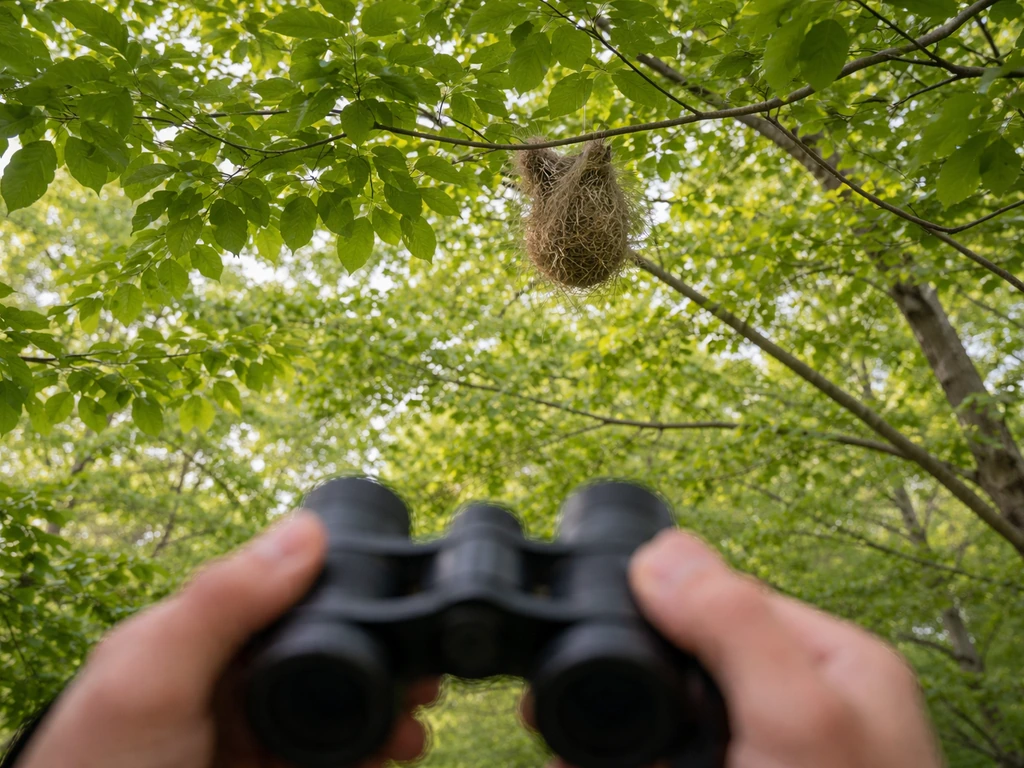
If you've spotted a likely nest, here's how to confirm it. You don't need to get close or touch anything. In fact, staying well back is both safer for the birds and better for your own observation because the adults are more likely to visit freely if they don't feel watched.
- Check the shape from below or from the side: a true Baltimore Oriole nest has a distinctly narrow top opening (2 to 3 inches) and a wider, rounded bottom pouch. It should look like a small hanging sock, not a flat cup or a fully closed sphere.
- Confirm branch placement: the nest should be hanging from a slender, drooping outer branch tip of a tall deciduous tree, usually 20 feet or higher.
- Look for the woven texture: binoculars help here. The walls should look woven or fibrous, not packed with mud, moss clumps, or bark pieces.
- Watch for the birds: Baltimore Orioles are visually striking. The male has a bright orange-and-black pattern; the female is a duller yellow-orange and olive. If you see either visiting the nest location, that's strong confirmation.
- Listen: Baltimore Orioles have a loud, clear, flute-like whistle. If you hear oriole calls near a hanging pouch nest in a tall deciduous tree, you've got your answer.
- Note the season: active nests will be present from roughly May through July. An empty, weathered pouch swinging in fall or winter is likely last year's nest, which still confirms orioles nested there.
If you want a record for later, take a photo from a respectful distance with a zoom lens or phone camera with digital zoom. Note the tree species, approximate height, and date. This kind of observation note is genuinely useful if you want to track whether the same pair returns next season, which Baltimore Orioles sometimes do to the same general area.
Ethical observation and what to do if you find an active nest
Baltimore Orioles are migratory songbirds protected under the Migratory Bird Treaty Act in the United States. That protection extends to their nests and eggs. It is illegal under federal law to disturb, damage, move, or possess a Baltimore Oriole nest (or any migratory bird nest) without a permit, and violations can carry significant fines. This isn't a technicality, it's a meaningful conservation law, and it applies even if the nest is in an inconvenient location on your property.
The practical rule is simple: look, don't touch. If you find an active nest, the best thing you can do is observe from at least 50 to 100 feet away, or from a window indoors. Binoculars or a spotting scope let you watch without getting close enough to stress the adults. Signs that you're too close include the adults staying away from the nest, giving alarm calls, or making repeated short flights in your direction. Audubon’s nest photography guidance similarly emphasizes keeping distance and watching for stress, since increased visitation or approach can create harmful implications for nesting birds keeping distance and watching behavior for signs of stress. If you see any of those behaviors, back off.
Do not touch the nest, handle eggs, or attempt to move the nest even with good intentions. If a nest appears threatened by a tree trimming project or construction activity, pause the work during the active nesting period (roughly May through July) if at all possible. Most active nesting periods are short: with about a week of construction, 11 to 14 days of incubation, and a few more weeks to fledging, the whole cycle from nest start to young birds leaving is often under two months.
If the nest or young birds appear to be in genuine distress (injured adults, a nest that has fallen, or obviously orphaned nestlings), do not attempt to care for them yourself. Leave the area, minimize further disturbance, and contact a licensed wildlife rehabilitator or your state's fish and wildlife agency. They have the permits and expertise to intervene legally and effectively. The USFWS website lists rehabilitators by state, and the NestWatch program at Cornell Lab is another excellent resource for guidance on what to do when nesting situations get complicated.
One last note for the birdwatchers here: if you find an oriole nest and want to do something useful with the observation, report it to NestWatch. Sociable weaver nests, made by social colonies, have their own distinctive look, often forming large communal structures. It takes about five minutes, it contributes to long-term population monitoring data, and it's a genuinely satisfying way to turn a backyard sighting into something meaningful for bird conservation.
FAQ
How can I tell the difference between a Baltimore oriole nest and a hanging Spanish moss or natural bundle of fibers?
Orioles usually make a true pouch with a narrow top opening and a bulging bottom chamber. Moss or leaf tangles tend to look like a loose mat, without a distinct enclosed entrance, and they rarely hang from a single drooping tip like a sock. If you can see fibers braided into an uneven woven texture, that strongly favors an oriole nest.
Do both male and female Baltimore orioles build the nest, and does that affect what I might see?
The female does most of the weaving. If you notice ongoing construction, you may mainly see one bird carrying and weaving fibers, while the male is often nearby and can be more visible with song or display. A nest under construction will look rougher and less evenly woven than a finished pouch.
What does an oriole nest look like before eggs are laid, and when should I expect changes?
Before the clutch is complete, the pouch may look less “finished,” and the opening and lining can look thinner. Once incubation starts, the bottom chamber looks more consistently cushioned, and adult visits become more frequent. Timing typically falls between May and July in much of the eastern and central U.S.
Can Baltimore oriole nests be reused in later years, or are they always brand new?
They are not typically reused as a finished structure. Orioles may return to the same area, and they might re-nest nearby, but they usually build or heavily rebuild the hanging pouch. Photographing the same tree tip in multiple seasons can help you track whether it’s the same pair and the same general location.
If the nest is higher than I can reach with binoculars, how can I document it without disturbing the birds?
Use maximum safe distance and zoom, then focus on fixed reference points like the tree species and branch tip position rather than trying to “approach for a better look.” If possible, take two or three photos over time to capture the overall outline and attachment point, and note the estimated height and date.
What if I think I found an oriole nest but I see an open cup instead of a pouch, what are my likely options?
An open cup shape usually points away from Baltimore orioles, since their nests are enclosed and pendulous. Common alternatives include species that build cup nests directly on branches. If the structure is a shallow woven pouch, it may be another oriole type rather than a Baltimore oriole.
How close is too close, and what specific behaviors should I watch for as a warning?
If adults stop visiting normally, give alarm calls, or repeatedly fly straight at you from short range, you are likely too close. Another sign is persistent hovering or circling behavior that seems focused on you rather than the nest. If you see these, back off immediately to restore normal activity.
What should I do if landscaping or trimming will occur near the nest?
Pause the work during the active nesting window (roughly May through July) if you can, and coordinate with the property owner or contractor to establish a no-work buffer. If you cannot delay, contact local wildlife authorities for advice rather than trying to relocate or cover the nest, since disturbing migratory bird nests is illegal without the proper authorization.
Are there any signs that the nest has failed, and how can I respond without taking action that could harm birds?
You might notice prolonged adult absence, repeated failed attempts to incubate, or a conspicuously damaged or detached nest. If you see a fallen nest or injured birds, do not attempt to handle them. Instead, leave the area and contact a licensed wildlife rehabilitator or your state fish and wildlife agency.
If I find a suspected oriole nest in my backyard during migration (outside typical nesting months), is it still likely to be active?
Baltimore oriole nesting is most likely between May and July in the eastern and central U.S., but timing varies by location and weather. Outside that window, nests may be empty, in-progress, or abandoned. Treat it as potentially active until confirmed, but check adults’ behavior, such as frequent visits and incubation posture, before assuming it’s abandoned.
Next Article
What Does a Chickadee Bird Nest Look Like? Key ID Features
Learn chickadee nest look-alikes and field ID: cup materials, color, lining, cavity sites, and ethical steps to observe