
Three birds stand out as true pebble-nest builders: the rock wren, the killdeer, and (if you're in the Southern Hemisphere) the gentoo penguin. Of these, the rock wren and killdeer are the ones most backyard observers and birdwatchers in North America are likely to actually encounter. Each uses pebbles in a distinct and purposeful way, not as random debris, so once you know what to look for, the ID is usually pretty straightforward.
Which Bird Makes a Nest of Pebbles? Key IDs and Tips

Maya Bennett
29 May 2026

The birds that actually build with pebbles
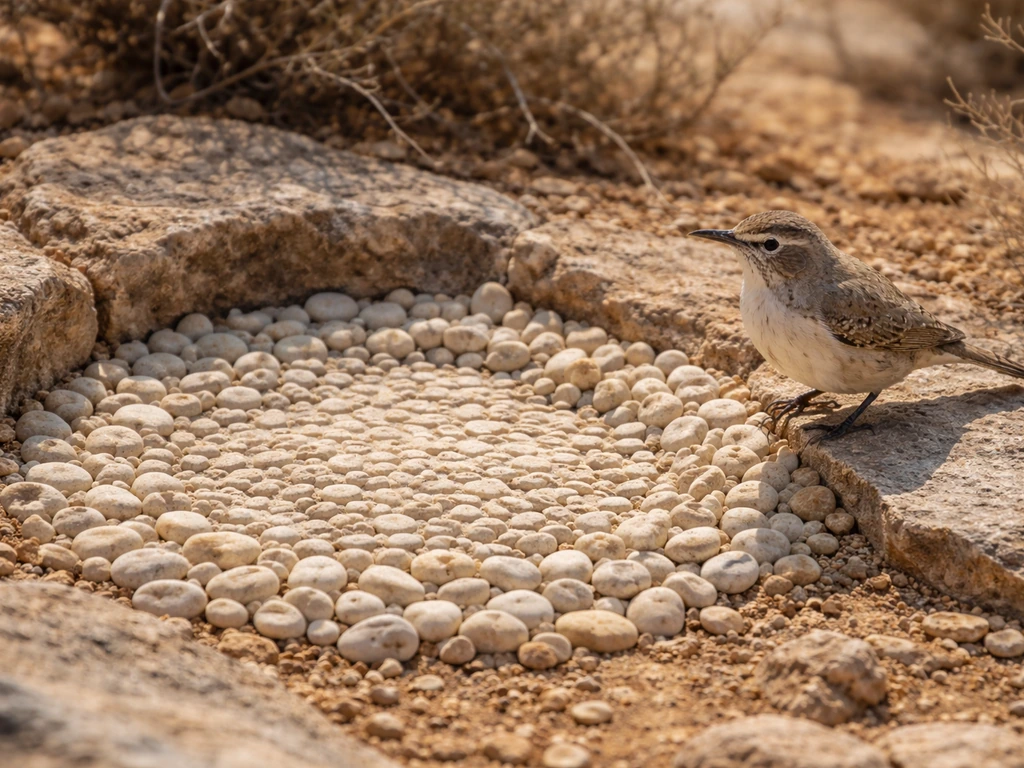
Rock wren
The rock wren (Salpinctes obsoletus) is the most architecturally committed pebble-nest builder you'll find in North America. It constructs a distinctive stone pavement, sometimes called a 'pebble glacis,' directly in front of its nest entrance inside a rock crevice or cavity. This isn't a handful of gravel: studies document an average of around 230 stones per nest, and the total stone mass can equal roughly 20% of the bird's own body weight. The pavement extends up to about 18 cm out from the entrance, forming a structured walkway that slopes into the nest. The function is practical: the stones keep the nest dry, improve drainage, and help regulate temperature for nestlings. This is deliberate, patterned construction, not accidental accumulation.
Killdeer
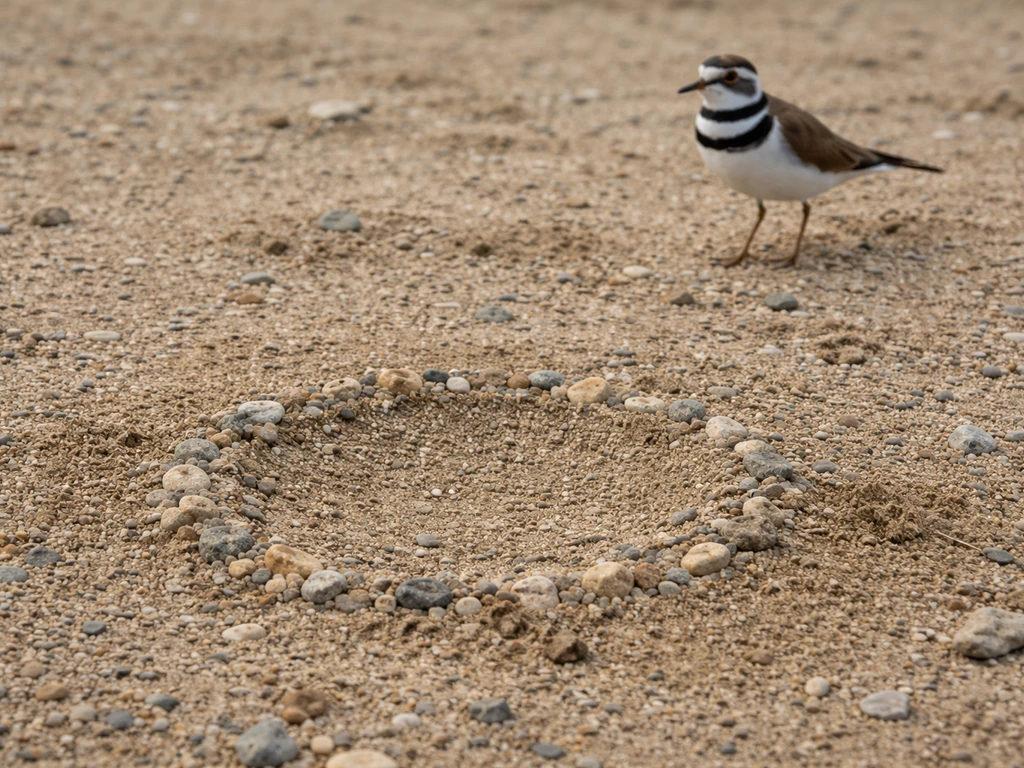
The killdeer (Charadrius vociferus) takes a simpler approach. It scrapes a shallow depression in open ground, gravel, or even a flat rooftop and lines it with small pebbles, bits of shell, grass, and other debris. Killdeer are famously tolerant of human environments, nesting on gravel driveways, parking lot edges, flat gravel rooftops, and stony fields. Their nests are easy to miss because the pebble lining blends perfectly with the surroundings. Some birds line their scrapes with noticeably white pebbles or pieces of white shell, which can actually make the nest slightly more visible if you know what you're looking at.
Gentoo penguin
Gentoo penguins (Pygoscelis papua) build above-ground pebble mounds on rocky Antarctic and sub-Antarctic shorelines. The male selects and arranges a pile of rocks and pebbles as a courtship display and nest structure, and pairs defend their pebble collections actively during breeding season. Unless you're visiting Antarctica or a zoo, you're unlikely to encounter a gentoo nest in the wild, but they're worth knowing about because they represent the most elaborate pebble-nest structure in the bird world: a true stacked mound rather than a lined scrape or pavement.
Where and when to expect pebble nests
Rock wrens breed across the rocky, arid, and semi-arid regions of western North America, from British Columbia south through the western US into Mexico. They prefer terrain with exposed rock faces, boulder fields, cliff edges, talus slopes, and rocky canyon walls. Nesting season runs roughly from April through July, peaking in May and June. If you're in their range and near rocky outcrops, checking crevices at eye level or below for a telltale stone walkway is a reliable strategy.
Killdeer are widespread across North America and much of Central and South America, and because they've adapted so well to human-modified landscapes, you can find their nests almost anywhere with open, flat ground and some gravel. Nesting starts as early as late February in southern states and continues through August further north, with a peak from March to June. Gravel parking lots, flat roofs, playing fields, and stony stream margins are all prime killdeer real estate. The fact that they nest on rooftops is especially relevant for homeowners: if you hear the distinctive 'kill-dee' alarm call near a flat-roofed building, there's a real chance a nest is up there.
How to confirm it's a pebble nest (not just a messy scrape)

The biggest identification challenge is distinguishing deliberate pebble use from nests that simply happen to sit on gravelly ground. Here are the markers that confirm you're looking at genuine pebble-nest construction.
| Feature | Rock Wren | Killdeer | Random debris on ground |
|---|---|---|---|
| Location | Inside rock crevice or cavity | Open ground scrape, gravel roof | Anywhere |
| Stone arrangement | Structured pavement, ~18 cm extension from entrance | Lined inside rim of scrape | Scattered, no pattern |
| Stone count | ~230 stones average | Handful to dozens | Accidental |
| Mixed materials | Mostly stones, soft inner cup of grass/bark | Pebbles, grass, shell bits | Whatever is underfoot |
| Nest depth | Hidden in cavity | Shallow, 1-2 cm depression | No nest shape |
| Eggs present | White with reddish-brown spots | Buff with dark blotches | No eggs |
One practical rule: if the stones are arranged in a line or arc leading to a specific point, or if they form a clear rim around a shallow cup, you're almost certainly looking at intentional placement. Random grit or windblown gravel doesn't organize itself into a structured pavement or a lined bowl. Also check for a soft inner lining: both rock wren and killdeer nests have a grassy or fibrous inner cup beneath or behind the stones. Pure gravel with no soft material and no cup shape is likely just the ground.
For comparison, mud nests (like those of barn swallows or cliff swallows) are formed cups attached to vertical surfaces, while stick nests are elevated structures in trees or shrubs. For comparison, mud nests and other construction styles like which bird stitches leaves to make its nest are different categories, but the same careful observation helps you sort them out. Stick nests are also common, but a classic stick-nest builder is the American robin. If you are trying to rule out a mud nest, one classic clue is that the species makes a cup of mud attached to a vertical surface. Moss-lined nests tend to be deep cups in dense vegetation. One example is the song thrush, which is known for using moss to help form and cushion its nest cup Moss-lined nests. If you're seeing stones at ground level with a cup shape, you're in pebble-nest territory. Nests that use spider silk as a binding material are a separate category entirely and usually belong to much smaller birds. If spider silk is used as a binding material, that points to smaller birds that choose web-like supports, not the big pebble builders described earlier which bird makes its nest even with spiders cobwebs.
Why birds build with pebbles
Pebble use in nest building isn't arbitrary. Each function maps directly onto the ecology of the species using it.
- Drainage and moisture control: The rock wren's stone pavement slopes away from the nest entrance, preventing water from pooling in the cavity. In rocky terrain where rain can funnel into crevices, this is a real survival advantage for eggs and nestlings.
- Thermal regulation: Stones absorb and slowly release heat. The pavement in front of a rock wren nest helps stabilize temperature at the nest entrance, buffering against rapid temperature swings common in rocky, exposed environments.
- Camouflage: Killdeer nests are nearly invisible in gravel because the pebble lining matches the surroundings exactly. The cryptic pattern on killdeer eggs adds another layer of concealment. This is why walking through a gravel parking lot in spring without watching your step is genuinely risky.
- Courtship and mate selection: For gentoo penguins, the quality and size of a pebble collection signals male fitness. Males actively steal pebbles from neighboring nests, and females assess the nest before pairing. The pebble nest is both a functional structure and a display object.
- Structural support: In open scrapes, a pebble rim helps prevent eggs from rolling and provides a slight physical barrier against wind and small disturbances.
Legal and ethical rules around active nests
Before you do anything with a nest you've found, the legal situation is clear and consistent across most jurisdictions. In the US, the Migratory Bird Treaty Act (MBTA) makes it illegal to destroy, move, or disturb an active nest containing eggs or chicks. Both killdeer and rock wrens are covered by the MBTA. In the UK, the Wildlife and Countryside Act 1981 prohibits intentionally taking, damaging, or destroying any wild bird's nest while it is in use or being built, and the RSPB advises that disturbance should be avoided at all costs. Similar protections apply across the EU under the Birds Directive, which specifically addresses deliberate disturbance during breeding and rearing. The short version: if there are eggs or chicks in the nest, you leave it alone, full stop. In GOV.UK guidance on a wildlife licence to disturb, kill or take for health and safety, “disturbance” includes destroying an active nest of any wild bird, so you should not disturb or remove active nests without authorization disturbance includes destroying an active nest. No exceptions without a permit.
Even if a nest is currently empty, it's worth being cautious. Birds often return to the same nesting sites in subsequent years, and a nest that looks abandoned may still be in active use between incubation shifts. If you're unsure, watch from a distance for 30 to 60 minutes before concluding it's inactive.
Observation distance matters. For killdeer especially, close human presence near a nest triggers the famous broken-wing distraction display, which costs the adult bird energy and draws attention to the nest location. Stay at least 10 to 15 meters away when observing, use binoculars, and avoid repeated visits that could stress the adults or habituate predators to the area.
What to do if pebble-nesting activity is on your property
Finding a killdeer nest in your gravel driveway or a rock wren nesting in a stone wall is genuinely exciting, and with a few simple steps you can protect both the nest and your own routine.
- Mark the nest location with a visible but low-profile marker (a small flag or ring of stakes at a safe distance) so you and others don't accidentally step on it or drive over it.
- Redirect foot traffic and vehicle movement away from the nest area until fledging is complete. Killdeer nests take about 24 to 28 days to hatch, with chicks leaving the nest within hours of hatching. The whole process from laying to fledging is usually 40 to 45 days.
- Reduce predator pressure nearby without approaching the nest. Discouraging free-roaming cats from the area is the single most effective thing you can do. Temporary low fencing (40 to 60 cm high wire mesh) placed a meter or more from the nest can deter ground predators without disturbing the adults.
- Do not add or remove pebbles from the nest. It may seem helpful to 'improve' the nest, but handling the nest or nearby material can leave human scent, disturb the structure, and in some jurisdictions may technically constitute disturbance under wildlife law.
- Document what you see. Take photos from a safe distance on day one and then leave it alone. A simple note with the date, location, number of eggs if visible from distance, and any adult behavior you observe is useful if you later need to report the nest to a local wildlife authority.
If the nest is on a flat gravel roof and you need roof access for maintenance, contact your local wildlife authority or a licensed wildlife rehabilitator before doing anything. They can advise on timing and, if absolutely necessary, help you apply for a permit. In most cases, waiting the 40 to 45 days is genuinely the simplest and most legal path.
Common misidentifications and troubleshooting
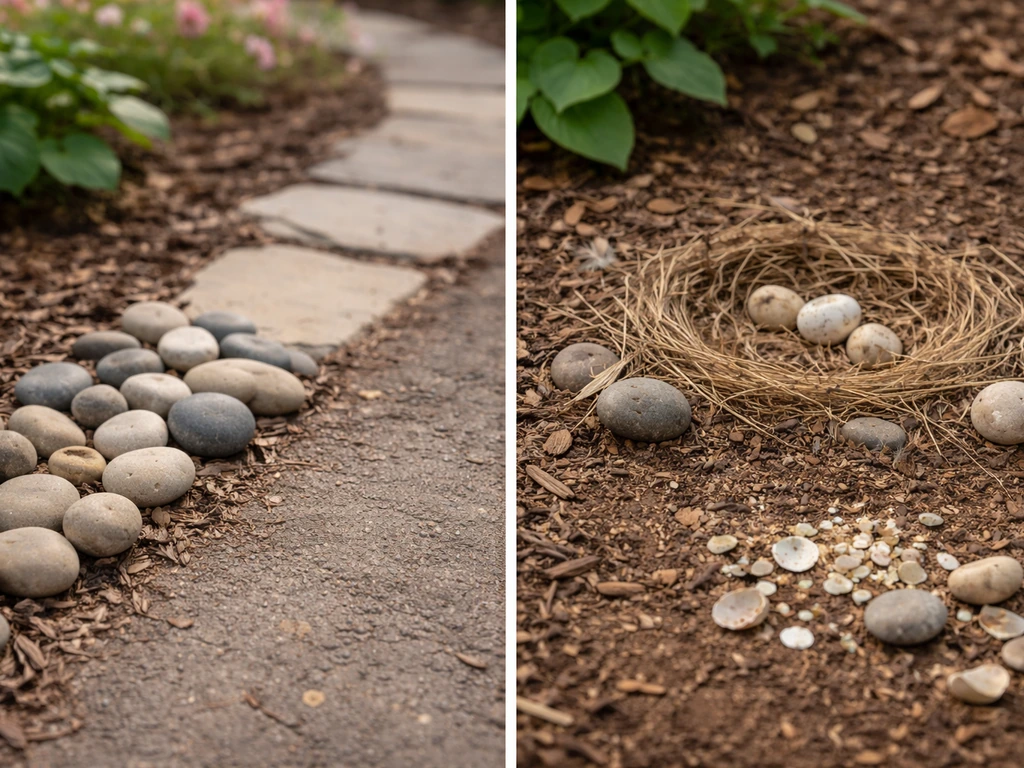
It might not be a bird nest at all
Small piles of pebbles near garden borders or pathways are sometimes placed deliberately by people as edging or decoration and mistaken for nests. The giveaway is that human-placed pebbles tend to be uniform in size, color, or origin (often purchased from a garden center) and lack any cup shape, soft inner lining, or signs of adult bird activity nearby. A genuine nest will have some organic material mixed in and a clear depression or cavity shape.
Predation aftermath looks different from an active nest
If you find scattered pebbles, broken eggshell fragments, and no adult bird in sight, the nest may have been predated. Egg fragments scattered at a distance from the scrape (more than 30 cm) usually indicate a mammalian predator. Shells left neatly in the scrape with the top removed suggest a corvid (crow or jay). Predation doesn't mean you need to do anything; the adults may attempt a re-nest nearby within a week or two, especially killdeer, which commonly re-nest after failure.
Gravel-roof killdeer vs. a ground nest
Killdeer nesting on rooftops is common enough that it has become a distinct management challenge. The nest looks identical to a ground nest, but the chicks face a serious hazard: once they hatch, they will follow the adults and can fall off the roof. If you find an active killdeer nest on a roof, contact a licensed wildlife rehabilitator or your local Audubon chapter as soon as possible. They can advise on safe temporary barriers and, after fledging, help you modify the roof surface to reduce future nesting attraction.
Reused and mixed-material nests
Birds sometimes reuse or modify old nest sites, which means you might find a scrape with both old and new pebbles alongside grass, feathers, or debris from the previous season. Don't let mixed materials throw you off. The key diagnostic is always the cup shape, the presence of eggs or adults, and the patterned placement of stones rather than random scatter. If you're comparing against nests made with other specialist materials like woven leaves, mud walls, or spider-silk bindings, those are distinct construction styles you'd find in entirely different species and habitats. Some birds build using woven leaves, too, but that is a different nest-construction style than pebble-nest builders which bird sews a nest out of leaves.
Your confident ID checklist

If you want to walk away from this article with one practical tool, use this quick checklist the next time you're looking at a suspected pebble nest.
- Is it on the ground or inside a rock crevice? (Yes = consistent with killdeer or rock wren)
- Are the stones arranged in a cup, rim, or structured pavement leading to a cavity? (Yes = deliberate placement)
- Is there a soft inner lining of grass, bark, or feathers beneath the stones? (Yes = active or recently active nest)
- Are eggs or chicks present, or is an adult bird nearby acting distressed? (Yes = active nest, do not approach further)
- Are you in the western US near rocky terrain? (Rock wren is your candidate)
- Are you near open gravel, a flat roof, or a stony field almost anywhere in North America? (Killdeer is your candidate)
- Take photos from a safe distance, note the date, and leave the nest undisturbed
Pebble-nest builders are genuinely fascinating to observe because their construction behavior is so visible and purposeful. A good next step is to figure out which bird made this nest by comparing the nest shape and the type of pebble placement Pebble-nest builders. Rock wrens in particular are worth seeking out just to see that pavement in person. Once you've seen a killdeer scrape lined with carefully selected pebbles against a gravel background, you'll understand exactly why this camouflage strategy has worked so well. The best thing you can do as an observer is keep your distance, protect the site from foot traffic and predators, and let the birds finish what they started.
FAQ
How can I tell a real pebble-nest from garden edging or landscaping gravel?
You can usually confirm by looking for (1) a true cup or cavity and (2) a soft inner lining like grass or fibrous material. Pebble piles for decoration tend to be uniform, lack a depression, and have no surrounding signs of adult activity (calls, repeated approach routes, or distraction displays).
What should I do if I find a pebble nest but I am not sure whether it is active?
If a nest has eggs or chicks, leave it alone even if it looks abandoned. If there are no visible eggs/chicks, watch from a distance for 30 to 60 minutes, because some adults stay off-camera between incubation shifts. Avoid repeatedly checking the same spot, as that increases stress and can attract predators.
How should I observe a killdeer nest without causing the broken-wing distraction display?
For killdeer, prioritize distance and low-impact viewing. Their broken-wing display is a defensive tactic, it can lead you toward the nest, but you should still back away and avoid standing between the bird and the nest. Using binoculars from farther than 10 to 15 meters and staying put during observations helps prevent repeated stress.
Could a gentoo penguin be responsible for a pebble nest I see outside Antarctica?
A gentoo penguin’s pebble mound is typically a stacked pile on exposed coastal ground, not a lined scrape or stone pavement. If you are far from Antarctic and sub-Antarctic coasts or not in a zoo setting, a gentoo nest is extremely unlikely, so focus first on rock wren pavement in crevices or killdeer scrapes in open gravel.
What is the safest plan if a pebble nest is on a roof and I must do maintenance?
If you need to access a property with an active nest, treat it like a timing problem. Wait out the nesting period when possible (often about 40 to 45 days as a general rule mentioned for roof cases), and contact a licensed wildlife rehabilitator or local wildlife authority for permit or temporary exclusion guidance before any maintenance.
If eggs or shell fragments are present, does that mean the nest is finished for good?
Predation clues do not require you to intervene, but they change what you should expect next. Shell or egg fragments scattered away from the cup can indicate predation, and killdeer often re-nest after failure, so the site may be reused within a week or two. Keep watching from a distance rather than trying to relocate or “clean up” the area immediately.
What are the most common nesting materials that get mistaken for pebble nests, and how do I rule them out?
Distinguish pebble nests from other ground-level construction by the presence of a soft inner cup and organized stone placement. Mud nests attach to vertical surfaces as attached cups, stick nests are elevated in trees or shrubs, and moss nests tend to be deeper cups in dense vegetation. Pebble nests are typically ground or cavity entrances with stones arranged into a purposeful rim, pavement, or mound.
Why might a pebble nest look messy or mixed-material, and does that affect identification?
Yes, birds can reuse older sites, so you may see a mix of old pebbles and newer ones plus debris from prior seasons. The decision rule is still the structure: confirm the cup shape, check for eggs, adults, or recent adult behavior, and look for patterned placement rather than scattered grit.
Can I help by moving stones out of the way or cleaning around a suspected pebble nest?
If you can identify a species with confidence, you still should not handle materials or move stones. Even passive actions like frequent foot traffic can reduce nesting success. Instead, protect the area (for example, block footpaths temporarily) and allow the birds to finish nesting.
Next Article
What Bird Made This Nest? Step-by-Step Identification Guide
Identify what bird made your nest using shape, materials, location, season, and entry clues, with safety tips.