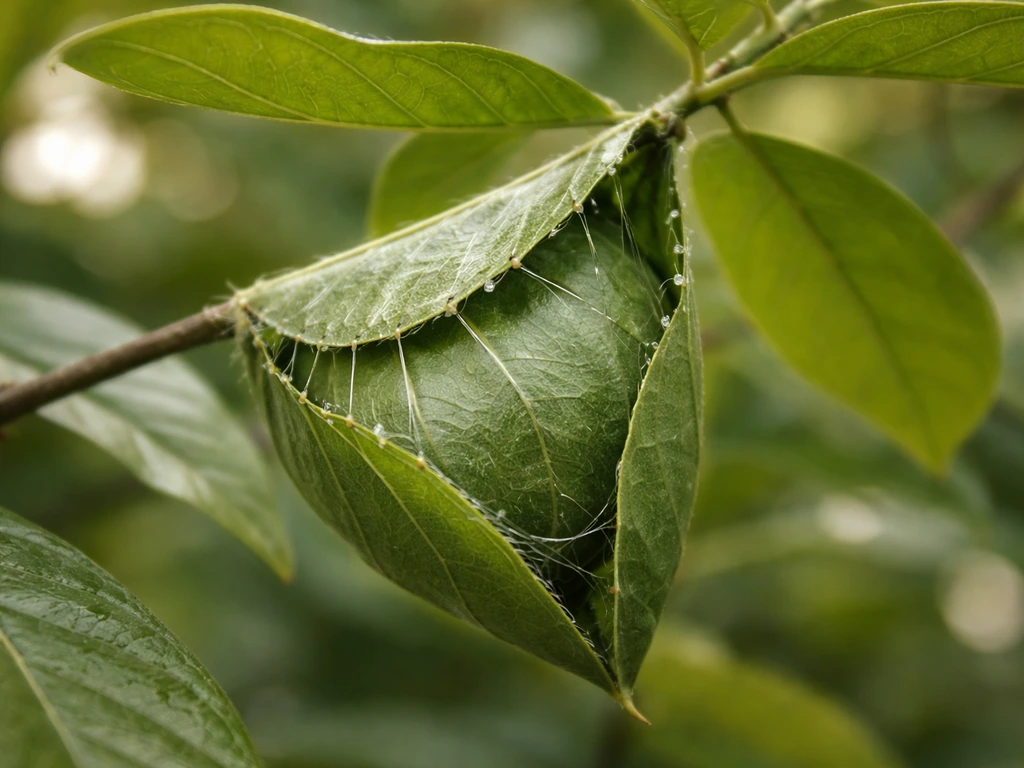
The bird that sews a nest out of leaves is the tailorbird, specifically the common tailorbird (Orthotomus sutorius) and its close relatives in the genus Orthotomus. These small, energetic birds found across tropical and subtropical Asia literally stitch one or two living leaves together using their bill as a needle, threading plant fibres or spider silk through punctured holes to form a snug, hidden cradle for their eggs. If you are wondering what bird made this nest, the signature is that punctured, stitched leaf structure built by a tailorbird.
Which Bird Sews a Nest Out of Leaves? ID Guide

Maya Bennett
30 May 2026
The birds that actually sew leaves
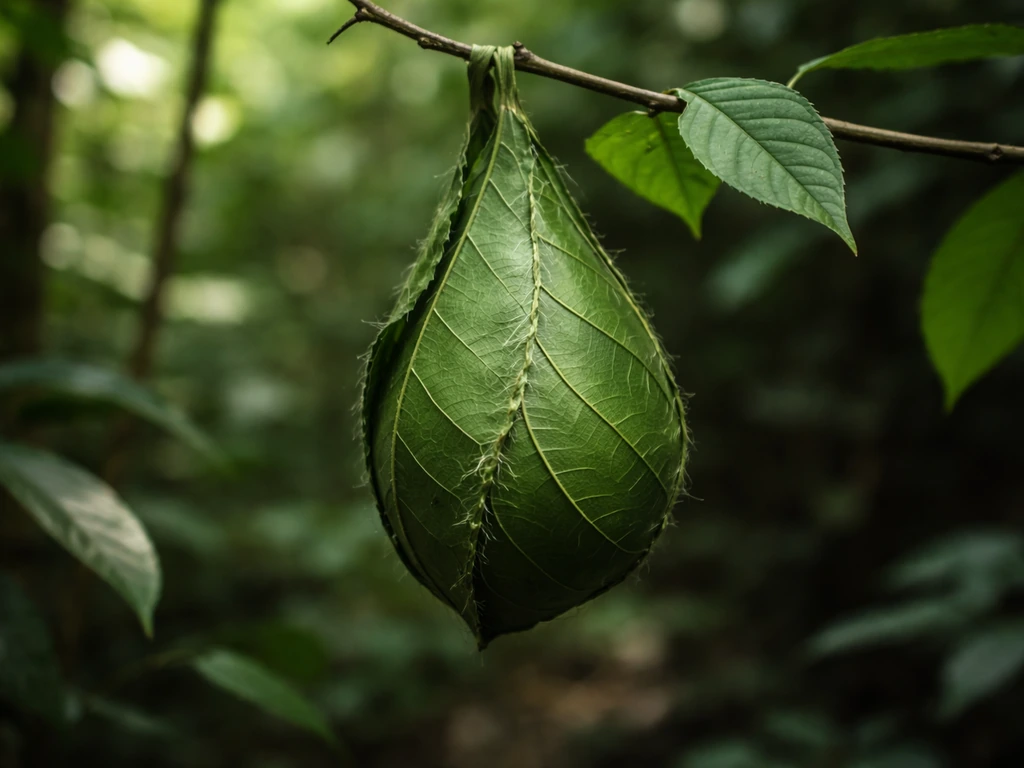
The tailorbird family (genus Orthotomus) is the clearest answer here. There are around a dozen species spread across South Asia, Southeast Asia, and parts of East Asia, and the common tailorbird is the one most people encounter and read about. If you are in India, Sri Lanka, southern China, or much of Southeast Asia, the common tailorbird is the primary suspect when you find a leaf-sewn nest. Related species like the dark-necked tailorbird (Orthotomus atrogularis) use the same basic technique across overlapping parts of the range. Outside Asia, no other bird group performs this specific stitch-and-loop leaf construction in the same systematic way, so if you are looking at a genuinely sewn leaf structure, a tailorbird built it.
It is worth noting that other birds use leaves as nest material too. Stick-building species may tuck leaves into their structures, and some birds press leaves flat into a cup. But those are not sewn. The tailorbird's signature is the actual punctured leaf edge with thread pulled through it and knotted, which gives the nest a distinctly constructed, almost hand-crafted look. If you compare it to nests made from mud, moss, pebbles, spider cobwebs, or sticks, the sewn leaf nest stands out immediately as something more deliberate. If you are instead wondering about a stick-built nest, check which species makes a nest primarily from sticks in your region.
How to confirm it is a tailorbird nest
What to look at first
Before you get close, take a moment to observe the nest's location, shape, and the condition of the leaves. A tailorbird nest has a very recognizable profile once you know what to look for. Here are the diagnostic markers to check in order:
- The outer shell is formed by one or two living or recently-living leaves that have been folded or curled into a cone or pouch shape, not just collected and piled.
- The leaf edges are punctured with small, evenly-spaced holes, and you can see fine thread, fibre, or silk passing through them on the outside, often fluffed into tiny knots.
- The nest is compact, roughly the size of a large egg cup, tucked inside the sewn leaf pouch rather than sitting openly on a branch.
- The interior is lined with soft material: plant down, fine grass, fur, or feathers.
- The whole structure is positioned inside dense foliage, not exposed on an open branch.
Timing and season
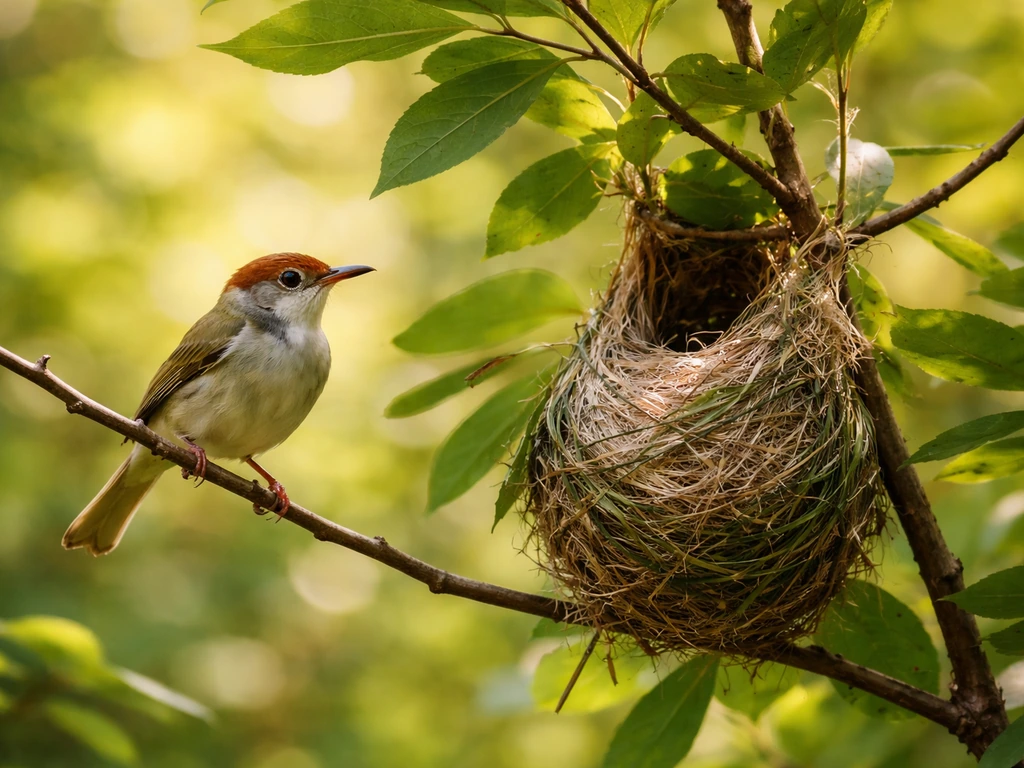
Common tailorbirds breed from April through August across much of their range, so if you find an active nest in that window, it fits perfectly. That said, in warmer tropical areas they can raise multiple broods and nesting activity may extend outside those months. If you find the nest in late spring or early summer and the leaves still look green and relatively fresh, there is a good chance eggs or chicks are present or recently fledged.
The bird itself
If you can spot the adult near the nest, the common tailorbird is a small bird, roughly 10 to 13 cm long, with a rusty-orange cap, greenish-olive upperparts, pale underparts, and a distinctive cocked tail. It is a loud, persistent singer for its size, and if there is a nest nearby you will often hear its sharp, repetitive call before you see the nest. The male sometimes develops elongated central tail feathers during the breeding season.
The materials and the method up close
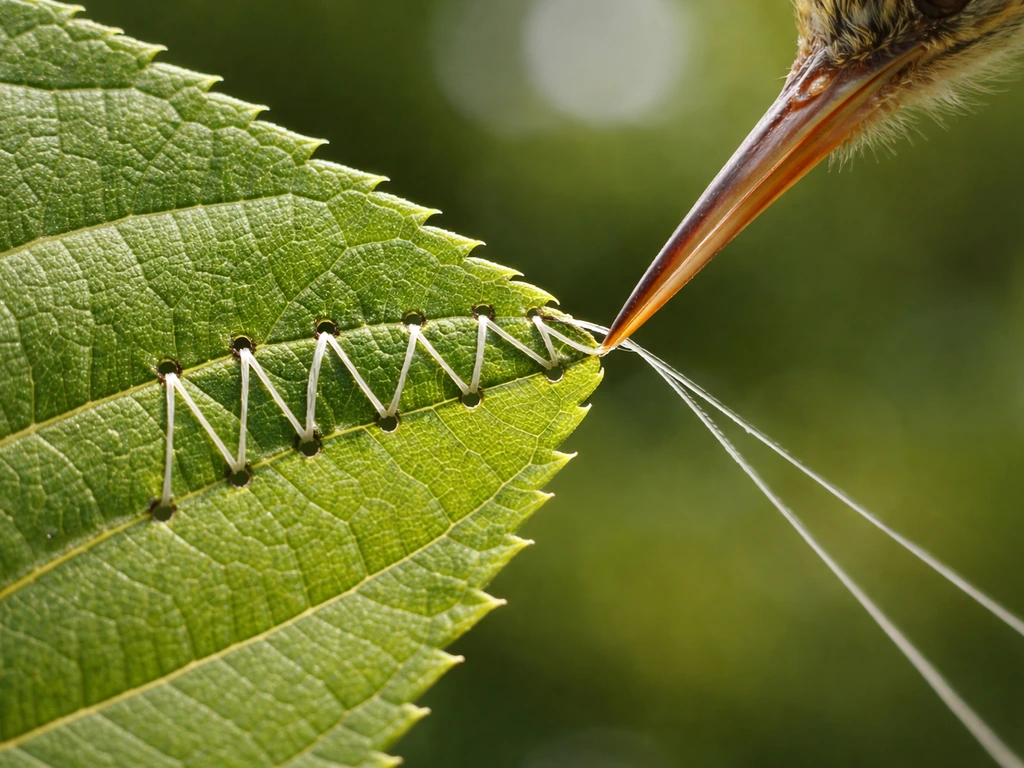
The tailorbird uses its bill like a sewing needle. It pierces a series of holes along the edge of a large leaf, then draws thread through each hole. The thread material varies depending on what is available: spider silk is a favourite because it is strong and flexible, caterpillar cocoon silk is also commonly used, and plant fibres like cotton and lint work well too. Some tailorbirds have also been reported using moss alongside other materials to strengthen their nest lining moss to build a nest. Britannica documents that birds have even been observed using stolen household thread when it is accessible near human settlements. Britannica also notes observations of tailorbirds using blank" rel="noopener noreferrer">stolen household thread when it is accessible near human settlements. The ends of the thread on the outside of the leaf are frayed or fluffed into small knots so they cannot pull back through the holes. This is not casual weaving or tucking; it is a genuine loop-and-knot system.
Once the leaf pouch is formed and secured, the bird fills the inside with soft plant down, fine grasses, feathers, or animal hair to create the actual nest cup. The leaf structure is the architecture; the soft lining is the bed. The finished nest is remarkably sturdy for something built from living plant material and insect silk.
| Component | Material used | Function |
|---|---|---|
| Outer shell | One or two large living leaves (folded/curled) | Concealment and structural support |
| Stitching thread | Spider silk, caterpillar cocoon silk, plant fibre, cotton/lint, sometimes household thread | Holds leaf edges together via loop-and-knot |
| Inner lining | Plant down, fine grass, feathers, fur | Cushioning and insulation for eggs and chicks |
Where tailorbirds nest and what habitat they prefer
Common tailorbirds are highly adaptable and one of the few wild bird species that thrive in both natural forest and urban or suburban gardens. They are found across South Asia and Southeast Asia, from India and Sri Lanka through Bangladesh, Myanmar, Thailand, Vietnam, southern China, and into parts of the Indonesian archipelago. Within that range, they live in gardens, parks, forest edges, scrubland, and plantations.
For nest placement, the bird chooses strategically: a leaf in the middle of thick foliage hides the nest from aerial predators, while positioning it toward the end of a branch makes it harder for climbing predators to reach without disturbing the surrounding vegetation first. You are unlikely to find a tailorbird nest in an obvious, open spot. Look in dense shrubs, climbing plants, large-leafed garden plants like banana or gingers, and the interior of leafy trees at low to medium height, usually between 1 and 3 metres off the ground.
If you are in North America, Europe, or Africa and you think you have found a sewn-leaf nest, it is worth double-checking your identification. The true tailorbird's systematic leaf-stitching behaviour is specific to the Orthotomus genus in Asia. Other leaf-using nest builders elsewhere do not replicate the same puncture-and-thread technique.
How to watch without causing harm
The whole point of the tailorbird's camouflage strategy is that the nest is hidden. Repeated close visits undermine that protection and can cause the adults to abandon the nest, especially during incubation. Here is how to observe responsibly:
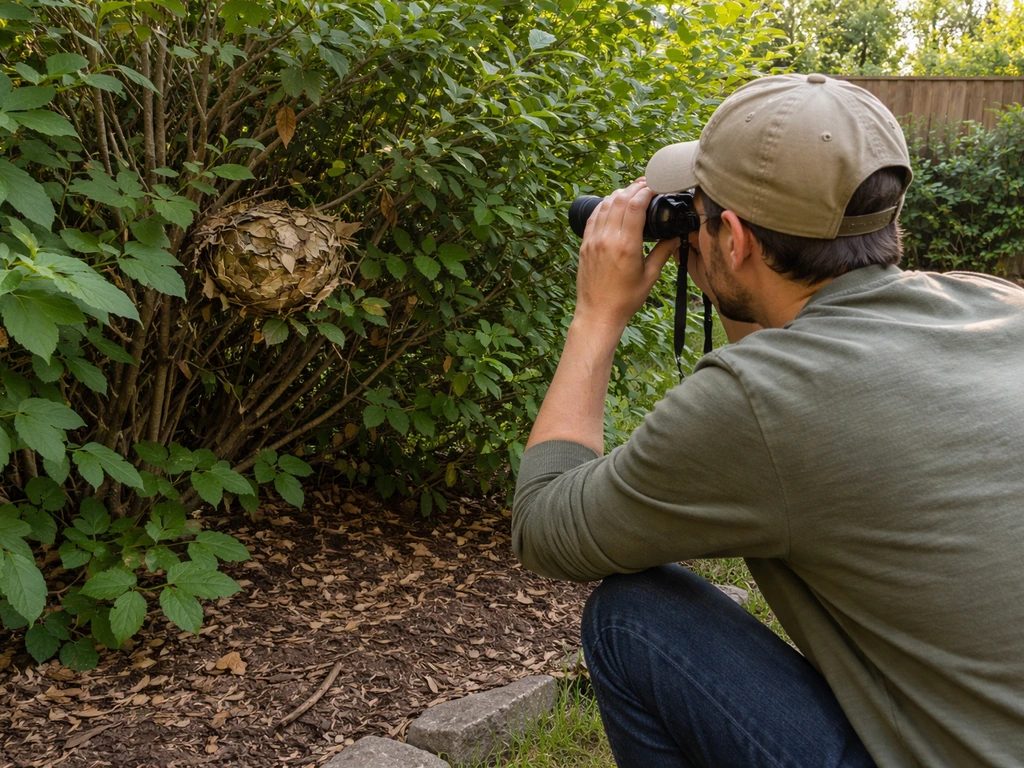
- Keep a minimum distance of at least 3 to 5 metres when observing, and use binoculars rather than moving in for a closer look.
- Limit your visits to once every two to three days at most during active nesting. Each visit is a disturbance, even if you cannot see an obvious reaction from the adult.
- Never touch the leaves, the nest, or the surrounding foliage to 'open up' a view. Bending branches or leaves changes the nest's camouflage and microclimate.
- If you want a photo, use a telephoto lens from your observation distance rather than a phone camera up close. A single well-planned session beats multiple disruptive attempts.
- Watch for distress signals: if the adult is scolding loudly, freezing, or moving away from the nest repeatedly when you are present, you are too close.
- Do not bring other people or pets to the nest site during active breeding. Dogs especially stress nesting birds.
- Keep a simple field note: date, what stage the nest appears to be at (construction, incubation, chicks), and any adult behaviour you observed. This gives you useful data without requiring repeated close approaches.
Found a leaf nest on your property? Here is what to do
Check the legal situation first
In the United States, most wild bird nests are protected under the Migratory Bird Treaty Act (MBTA). Destroying an active nest (one containing eggs or chicks) is illegal without a permit from the U.S. Fish and Wildlife Service, and those permits are typically only issued for genuine health or safety emergencies. In Canada, similar protections apply: guidelines from Environment and Climate Change Canada state that removing or destroying a nest with a live bird or viable egg is prohibited except in very limited circumstances, and work that might disturb nests should be rescheduled or relocated where possible. In the tailorbird's native range across Asia, local wildlife protection laws vary by country, but the ethical principle is the same: leave an active nest alone.
Practical next steps depending on the situation
If the nest is active (eggs or chicks present), the best action is almost always to leave it and wait. Tailorbirds fledge quickly, and the whole nesting cycle from egg-laying to fledging typically takes around three to four weeks. If the nest is in a spot where garden work needs to happen, pause that work in the immediate area and resume once the nest is empty.
If the nest appears abandoned or was never completed, and there are no eggs or chicks, you can carefully remove it after confirming it is truly inactive over several days of observation. A good rule: if there has been no adult activity at the nest for five or more consecutive days during the breeding season, it is likely abandoned.
For predator protection while the nest is active, avoid pruning or thinning the surrounding foliage, since the tailorbird chose that density deliberately. If you have cats that roam the garden, keep them indoors during the nesting period. Do not place food sources that attract corvids or rats near the nest location.
- Confirm whether the nest is active: look for adult visits, eggs, or chicks over two or three days before making any decision.
- If active, mark the area with a low-key flag or garden stake so family members and contractors know to avoid it.
- Pause any pruning, mowing, or structural work within 2 metres of the nest until fledging is complete.
- Keep pets indoors or away from the garden zone near the nest.
- If the nest is in a genuine safety hazard location (e.g., directly in a doorway used daily), contact your local wildlife authority or a licensed wildlife rehabilitator before touching anything.
- Once the nest is confirmed empty and the breeding season has passed, you can remove it. Preserve it if you want: dried tailorbird nests are remarkable objects and good for educational purposes.
Finding a tailorbird nest, or any leaf-sewn nest, is a genuinely rare and interesting thing to witness. A different, commonly asked question is which bird make nest of pebbles, and the answer depends on the region and species. Some people also ask what bird makes a mud nest, and it can help to compare how different materials and techniques affect a nest's appearance. The stitching technique these birds use is one of the more impressive feats of animal construction in the natural world. Giving the nest the space and time it needs costs very little and means you get to watch the full process from construction to fledging, which is well worth the patience.
FAQ
Can I confirm it is a tailorbird nest without disturbing it (what should I look for from a distance)?
Yes. Look for a leaf pouch where the leaf edges have visible punctures and loop-and-knot stitching on the outside. Also check that the nest is cradled in dense foliage (often 1 to 3 meters up), and that the leaves still look functional and fresh rather than just loosely piled.
Do tailorbirds reuse the same leaf-sewn nest in later broods?
They usually do not. After a nesting attempt, they typically build a new leaf pouch rather than repairing the old one, especially because the stitched leaves can dry, fray, or become more obvious to predators. If you see repeated nests at the same spot, it is often because adults are selecting the same area, not the same structure.
How can I tell the difference between “sewn” leaf nests and birds that simply tuck leaves into a cup?
Focus on the mechanism. Tucking or cup-building leaves won’t show a line of repeated holes along the leaf edge with thread pulled through and knotted. Sewn nests look puncture-patterned and more rigid, with an obvious stitch line rather than a general leaf lining.
What nest materials should I expect besides leaves, and does the lining help with identification?
Inside, you may see down, fine grasses, feathers, or animal hair as a soft cup. The lining varies by availability, so lining alone is not diagnostic, but when the lining sits inside a stitched leaf pouch with knotted outside thread, that combination strongly points to a tailorbird.
If I find a sewn leaf nest outside the breeding season, does that mean it is not a tailorbird?
Not necessarily. In warmer tropical areas, multiple broods can shift activity beyond the typical April to August window. If the leaves are green and the nest looks recently handled (and adults are nearby), it can still be active even outside the “usual” months.
What should I do if the nest is in a place where I must prune, mow, or trim (for example, a garden path)?
Pause work in the immediate area and wait until fledging is complete. A practical approach is to postpone pruning within a few meters of the nest and resume after adults stop visiting for several days. If the nest is in a high-impact location (hedge that must be cut back), consider contacting a local wildlife authority for guidance before moving anything.
My leaf nest is on the ground or very low. Could it still be a tailorbird nest?
It is less likely. Tailorbirds most often place nests within thick foliage and typically at low-to-medium height (commonly 1 to 3 meters). Ground-level or very exposed placements can indicate other nest styles or different species, so check carefully for the puncture-and-knot stitch line before assuming it is a tailorbird.
How long should I observe to decide whether a nest is truly abandoned?
If you need to determine inactivity, monitor quietly from a distance over multiple days. A commonly useful rule during the breeding period is that if there has been no adult activity at the nest for five or more consecutive days, it is likely abandoned. Even then, verify with binoculars or a zoom camera rather than approaching repeatedly.
Are tailorbird nests safe to touch if there are no eggs visible?
Avoid touching. Eggs or chicks can be hidden inside the leaf pouch, and handling can trigger abandonment. If you must act for safety reasons, use minimal disturbance, confirm inactivity first, and follow local wildlife protection rules.
If I see a sewn leaf nest in Asia, how do I know it is common tailorbird versus a different Orthotomus species?
Look for location and plumage cues, but rely mainly on the nesting technique. The stitch style is shared across Orthotomus tailorbirds, so the nest construction confirms genus-level identity. Species-level ID (like dark-necked tailorbird) is usually best done by matching adult markings and tail pattern, ideally with a clear view or audio call identification.
Next Article
Which Bird Makes a Nest of Pebbles? Key IDs and Tips
Learn which birds use pebble nests, how to confirm real stone use, and what to do safely when you find one.