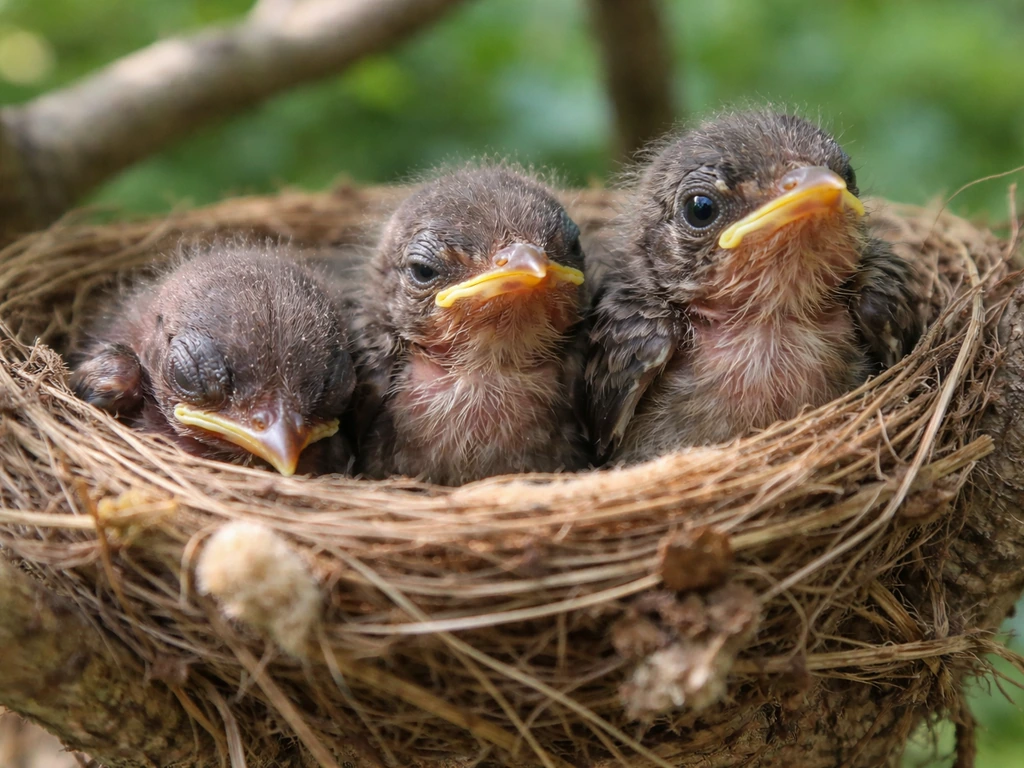
If the bird has closed or partly closed eyes, bare pinkish skin, and little to no feathering, you are almost certainly looking at a true nestling. That bird should be in a nest, and your job is to figure out whether it fell, whether the nest is still active, and whether it needs professional help. If the bird is covered in fluffy or patchy feathers, hopping around, and has fully open eyes, it is most likely a fledgling doing exactly what it is supposed to do: learning to live outside the nest. Knowing which one you are looking at changes everything about what you do next.
How to Identify a Nestling Bird: Field Guide Checklist
Maya Bennett
30 May 2026
Nestling vs fledgling vs other young birds: quick checklist
Before you touch anything or make any decisions, spend 60 seconds running through this checklist. Most of the time you can resolve the situation with observation alone.
| Feature | Nestling | Fledgling | Hatchling |
|---|---|---|---|
| Eyes | Closed or barely open | Fully open and alert | Sealed shut |
| Feathering | Bare to sparse pin feathers | Patchy to mostly feathered | Completely bare |
| Size | Small, may fit in a palm easily | Close to adult size | Tiny, often under 2 cm |
| Mobility | Weak, cannot stand or grip | Hops, walks, may flutter | None |
| Gape | Wide, often brightly colored (yellow/orange) | Present but less exaggerated | Present but very tiny |
| Likely location | In or directly below a nest | On ground, shrubs, low branches | In nest only |
| Parent care | Yes, parents visit nest | Yes, parents still feed it nearby | Yes, nest-bound |
A hatchling is a very newly hatched bird, essentially a nestling at day one or two. For practical purposes, treat hatchlings and nestlings the same way. The critical distinction is always nestling versus fledgling, because fledglings do not need rescue and nestlings usually need to be returned to their nest.
What to look at: body features, feather development, and behavior
Start at the head and work your way down. You do not need to pick the bird up to do this. Use your phone camera to zoom in if the bird is sitting still.
Eyes and head
A nestling's eyes are typically closed or just beginning to crack open. If the eyes are closed or look sunken and partly sealed, this is a strong nestling indicator. A fledgling's eyes are wide open, bright, and tracking you. Any bird with eyes that look droopy, filmy, or sunken regardless of age is showing a distress signal and may be injured or ill.
Feathers and skin
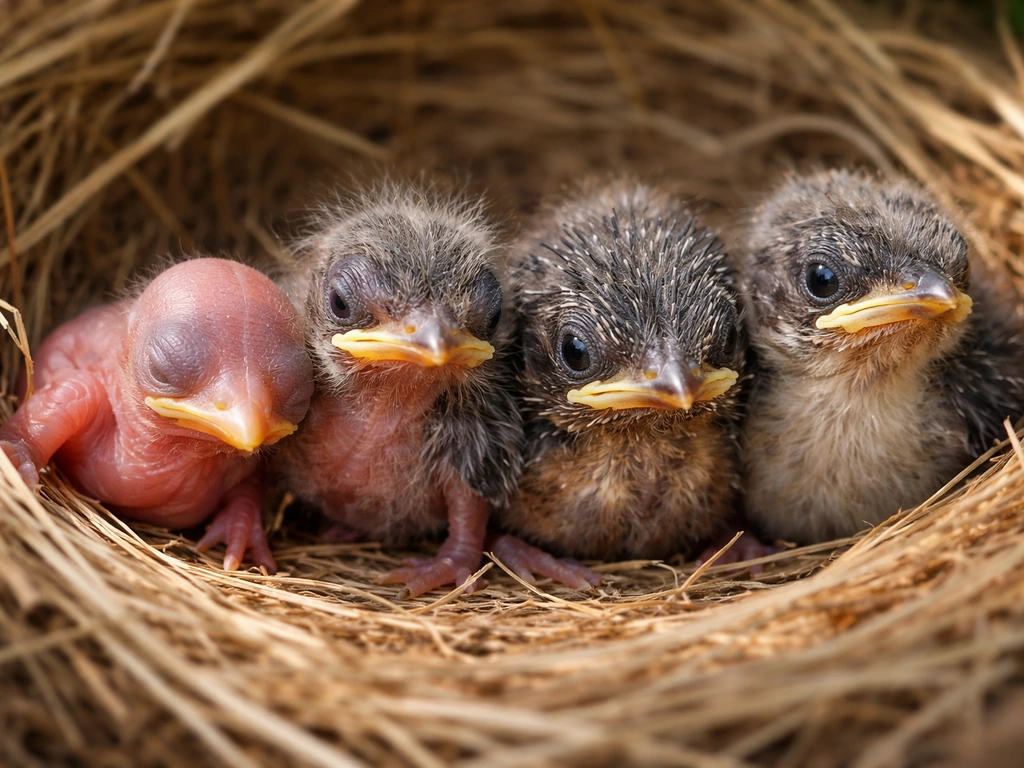
Run through four stages mentally: bare pink skin (hatchling or very young nestling), sparse downy tufts with bare patches (mid-stage nestling), pin feathers (rolled quills still encased in a keratin sheath, common in older nestlings), and full or near-full feathering (fledgling). Bald spots on an otherwise feathered bird are a warning sign. Pin feathers look like small dark spikes or rolled tubes emerging from the skin. They are normal in a nestling that is still nest-bound but concerning if the bird is on the ground far from any nest, because it means the bird left too early or was knocked out.
Gape and mouth color
Young nestlings have a wide, soft-edged gape, often bright yellow or orange at the corners, designed to trigger feeding behavior in parents. If the bird opens its mouth wide when you approach or make a sound, that gape is telling you something: it is young, it is hungry, and it expects to be fed by something larger. This behavior alone is a reliable nestling indicator.
Posture, grip, and mobility
A nestling cannot grip a perch reliably and will wobble or fall if placed on a branch. Its legs may splay outward and it cannot hold an upright posture for long. A fledgling can grip, hop, and at minimum flutter between surfaces even if it cannot sustain full flight. If the bird is sitting flat on the ground without any attempt to right itself, it is either a nestling or a bird in distress. If it is hopping away from you and looking for cover, that is classic fledgling behavior.
Droppings
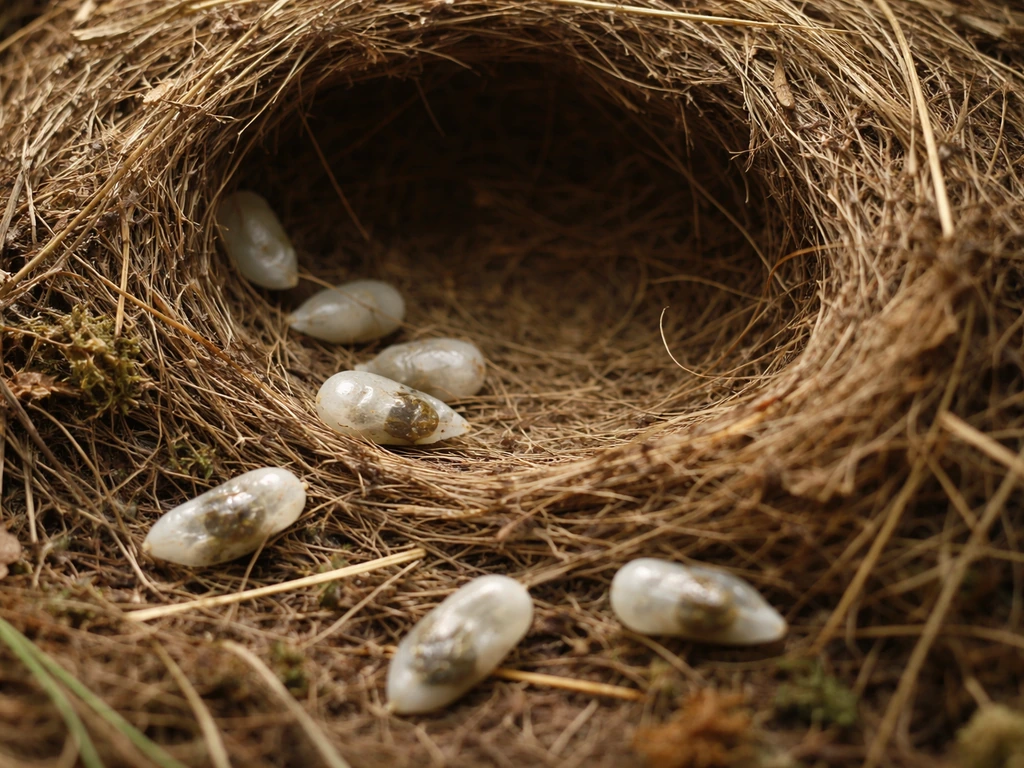
Nestlings produce fecal sacs, a neat white membrane-wrapped dropping that parent birds remove from the nest. If you see these near the bird or in a nest directly below, that nest has been recently active. A healthy nestling will often produce one shortly after being fed.
Nest and habitat clues: what the nest and location tell you
The nest itself is one of the most underused identification tools. Where the nest is located and what it is made of can help you narrow down the species group, which in turn tells you what developmental stage looks normal.
- Cup nests made of grass and mud in shrubs or trees: robins, thrushes, finches. Nestlings are altricial (born helpless) and stay nest-bound for 9 to 16 days.
- Open platform nests on ledges or flat surfaces: mourning doves, pigeons. Nestlings have yellowish down and are relatively calm.
- Cavity nests in tree holes or nest boxes: chickadees, bluebirds, wrens. If you find a featherless bird below a tree with a hole in it, look up.
- Ground nests in grass or leaf litter: killdeer, sparrows, some warblers. These birds often use distraction displays to lead you away from the nest.
- Colonial nests in reeds or marshes: red-winged blackbirds, swallows. Nestlings found on the ground here are usually windblown or predator-disturbed.
If you find a nestling on the ground, look up and within a 3-meter radius for any nest structure. If you are trying to locate where the nest should be, start with overhead scanning and look for clues that a nest has been dislodged how to find a bird nest.
To learn how to display bird nests responsibly, start by figuring out where the nest is and whether it is active before you do anything else If you find a nestling on the ground. Many people miss nests because they are looking at eye level rather than overhead. Also check for debris suggesting a nest was dislodged: twigs, grass strands, or mud fragments on the ground around the bird.
If you are wondering where to find a bird nest, start by looking overhead for nest structures and by scanning likely sheltered spots like tree branches and dense shrubs find a nest. If there was a storm recently, nest displacement is a common cause of nestlings being found on the ground. The nest may be damaged but still intact enough to accept the bird back.
Step-by-step identification workflow
Work through these steps in order before doing anything else. The goal is to make a confident identification with the least possible disturbance to the bird.
- Stop and observe for 2 to 3 minutes before approaching. Watch for parent birds nearby and note any alarm calls or hovering behavior.
- Take a photo from a distance using your phone's zoom. This gives you a reference image and lets you check details without handling the bird.
- Check the eyes: open and bright (fledgling) or closed/barely open (nestling or injured).
- Check feather coverage: bare or sparse pin feathers (nestling), patchy to full feathering (fledgling).
- Check mobility: can it grip, hop, or flutter? If yes, fledgling. If it falls over or cannot right itself, nestling or injured bird.
- Look for injury signs: bleeding, obvious asymmetry in wings or legs, a wing held at an unnatural angle, or blood near the beak.
- Look up for the nest. Scan a 5-meter radius and check overhead branches, eaves, ledges, and cavities.
- Check nest activity: any material in the nest, any droppings, any other young visible? That helps you confirm whether the nest is still active.
- Cross-reference your photo with a regional field guide app or a photo comparison on a birding site to narrow down the species group.
- Based on all of the above, decide: is this bird a healthy fledgling that should be left alone, a nestling that can go back to a nest, or a bird showing injury or abandonment signs that needs professional help?
A photo is genuinely valuable here. If you later need to contact a wildlife rehabilitator, a clear image from multiple angles saves time and helps them prepare for the intake. Snap at least one close shot of the face (eyes, gape), one of the back (feather development), and one showing the feet and legs.
Is it abandoned? How to decide whether to intervene
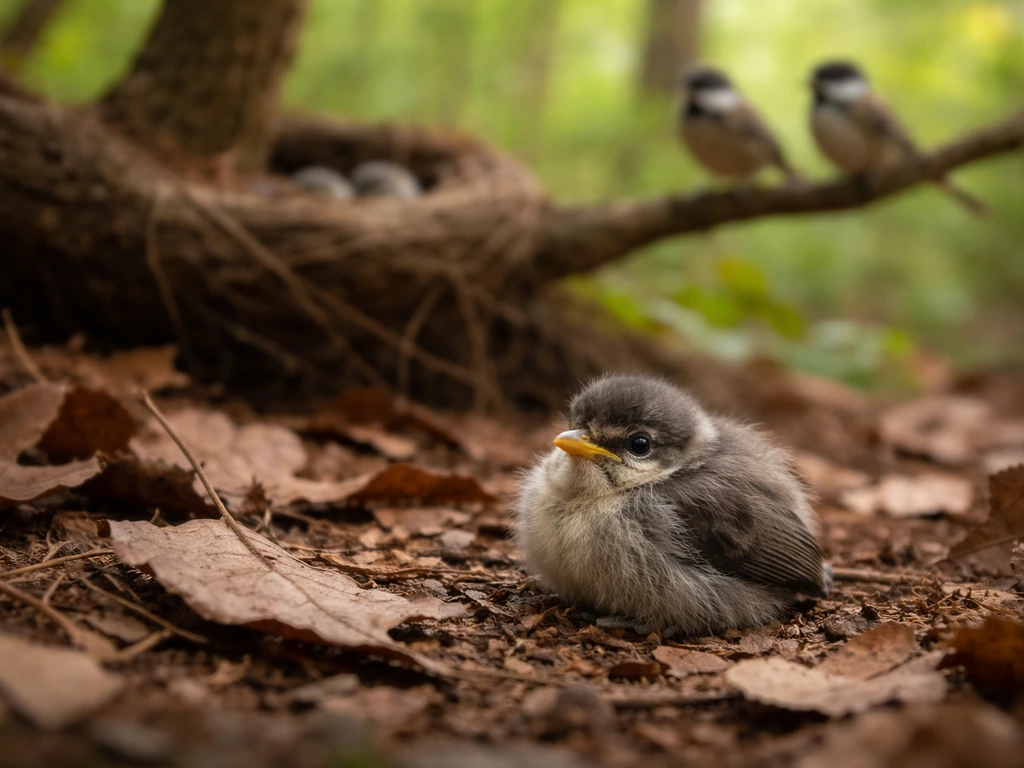
This is the question most people get wrong, and the answer in the majority of cases is: the bird is not abandoned. Parent birds are often quiet and stay away from the nest when humans are nearby. If you suspect a mom bird has abandoned the nest, focus on whether the adults are still nearby and watch quietly before intervening. They may watch from 10 to 20 meters away and return the moment you leave.
The USFWS is clear that a baby bird likely does not need human help unless it is featherless or has its eyes closed. Fledglings that look alone and abandoned are usually just doing the awkward, ground-level phase of fledgling life, with parents close by and feeding them.
Here is a practical decision framework. If the answer to any of the injury questions is yes, move to the intervention column regardless of developmental stage. Best Friends Animal Society notes that a baby bird may be injured if it is bleeding, feels cold, has eyes closed or partly closed, or looks exhausted, dehydrated, droopy, or lifeless injured if it’s bleeding, feels cold, has eyes closed or partly closed, or looks exhausted/dehydrated/droopy/lifeless.
| What you observe | Most likely situation | What to do |
|---|---|---|
| Fully feathered, hopping, eyes open, no injury | Fledgling doing normal ground phase | Leave it alone, move pets/children away, watch from distance |
| Featherless or sparse pin feathers, eyes closed, on the ground near a nest | Nestling that fell or was dislodged | Return to nest if possible; if not, call a rehabilitator |
| Featherless, eyes closed, no nest visible within 5 meters | Nestling fallen from unknown nest | Warm, dark, quiet container; call a rehabilitator today |
| Any age, bleeding, broken or drooping wing, cold to the touch | Injured bird | Warm, dark, quiet container; call a rehabilitator immediately |
| Eyes partly closed, droopy posture, no response to movement | Sick or exhausted bird | Do not feed or give water; call a rehabilitator immediately |
| Parent not seen in 2+ hours after you have stepped back completely | Possibly abandoned | Wait another hour, then call a rehabilitator for guidance |
| Bird found in late fall or winter with no nearby nest | Out-of-season, possibly blown or injured migrant | Call a rehabilitator; seasonal timing makes survival unlikely without help |
A key detail about the "parents not returning" test: it only counts if you have fully stepped back, kept pets and children away, and waited a genuine 1 to 2 hours. Parents will not return while a threat is present. This connects to a broader question many people face: whether a nest itself is abandoned. The assessment for the bird and for the nest involve some of the same logic, but they are slightly different decisions.
What to do (and what not to do) right now
If the bird needs to go back to its nest
The myth that a parent bird will reject a baby that has been touched by humans is exactly that: a myth. Most birds have a limited sense of smell and will not abandon a chick because it carries human scent. If you find a nestling on the ground and can see the nest within a few meters, gently pick up the bird with clean hands (or thin gloves if you prefer) and place it back in the nest. Do it quickly, step back, and watch from a distance for 30 minutes to see whether parents return.
If the nest is destroyed but you can build a substitute
If the original nest was knocked down by a storm or predator but the nestlings look healthy, you can create a substitute nest. Use a small plastic container like a strawberry pint with drainage holes punched in the bottom, line it loosely with dry grass or the original nest material, and secure it to the same tree or as close to the original location as possible. Place the nestlings inside and step back. Parents will usually find their young by sound, and the chicks will call when hungry.
Immediate handling do's and don'ts
- DO keep the bird warm: body temperature for most passerine nestlings is around 40°C (104°F). If you must hold the bird temporarily, cup it gently in your hands.
- DO put it in a small, ventilated, dark container lined with a soft cloth if it needs to wait for a rehabilitator.
- DO keep it quiet: stress is a major killer of young birds.
- DO wash your hands after any contact.
- DON'T give it food or water. The WDFW is explicit about this. You can easily aspirate a nestling or cause nutrient imbalances that injure it further.
- DON'T try to feed it bread, milk, crackers, or worms from your yard. These can cause fatal complications.
- DON'T keep it as a pet or attempt to raise it yourself unless you are a licensed wildlife rehabilitator. It is illegal under the Migratory Bird Treaty Act to possess most wild birds without a permit.
- DON'T place it in a box with a heat lamp directly underneath it. Overheating is as dangerous as cold.
- DON'T let children or pets near it while you figure out next steps.
Ethical next steps: legal considerations, wildlife rehab, and nest protection
The legal side
In the United States, nearly all native wild birds are protected under the Migratory Bird Treaty Act. This means you cannot legally keep, transport, or attempt to raise a wild bird without the proper state or federal permits. The practical implication: if a nestling needs care beyond returning it to its nest, your legal and ethical responsibility is to get it to a licensed wildlife rehabilitator as quickly as possible. This is not a bureaucratic formality. Rehabilitators have the species-specific knowledge, proper diet protocols, and socialization techniques that give young birds the best chance of surviving and being released successfully.
How to find a licensed wildlife rehabilitator
The USFWS recommends contacting a licensed wildlife rehabilitator any time a nestling cannot be returned to its nest or shows signs of injury or illness. To find one near you, search the National Wildlife Rehabilitators Association (NWRA) or Wildlife Rehabilitators Network online directories, or call your state fish and wildlife agency. Many areas also have local Audubon chapters that maintain a list of rehabilitators. When you call, have your photos ready and be prepared to describe: where you found the bird, approximate size and feather stage, whether the eyes are open, and any visible injuries. They will advise on transport and intake.
Protecting the nest without relocating it
If the nest is active and you are worried about predators or weather, there are steps you can take without moving it. Moving a nest with eggs or young inside is generally illegal without a permit and almost always counterproductive. Instead, focus on reducing threats in place. Keep outdoor cats inside during nesting season (roughly March through August in most of North America).
If a specific predator like a crow or snake has been seen near the nest, temporary physical deterrents such as a cone baffle on a nest box pole or a loosely placed thorn branch nearby can help without disturbing the birds. For nests on the ground that are exposed to rain, a small piece of plywood propped at an angle a foot or two away can deflect water without blocking parent access.
Seasonal timing and what it changes
Spring and early summer (April through July in most of North America) are peak nestling season. Finding a nestling on the ground in May or June is common and usually manageable. Finding a featherless nestling in September or October is unusual and warrants faster action, since late-season nesting attempts have lower survival rates and rehabilitators may have fewer resources by then. Winter finds are almost always injuries or sick birds rather than normal nestlings, and those should be escalated to a rehabilitator immediately. Weather events like high winds, heavy rain, or late frosts can knock nests down in any season, so after any major storm it is worth scanning your yard or local green spaces for displaced birds.
The bottom line: most baby birds you find on the ground are fine and do not need you to do anything except give them space. When you do need to act, act quickly, handle minimally, and get the bird to someone qualified. The single most helpful thing you can do for a nestling in trouble is make a phone call to a rehabilitator rather than attempting to raise it yourself.
FAQ
What if the bird looks like a nestling, but there are no visible nests within 3 meters?
First, broaden the search upward and around, not just sideways. Look for nests 3 to 6 meters away in the same tree, along nearby branches, and in dense shrubs, since fallen nestlings can land farther than expected. If you truly cannot locate any nest structure, treat it as “cannot be confidently returned,” and contact a licensed wildlife rehabilitator for guidance, especially if the bird is featherless or its eyes are closed or sunken.
How long should I watch from a distance to decide whether parents are returning?
Give a single, uninterrupted watch after stepping back fully, keeping pets and kids away, and avoiding repeated visits. In practice, 30 minutes is often enough for many species to resume feeding once the threat is gone, but the article’s longer “1 to 2 hours” benchmark applies when you are specifically testing for persistent non-return. If parents do not return within that window, or you see no adult activity despite good weather, escalate to a rehabilitator.
Is it safe to feed a nestling or give it water or bread while I wait for help?
No. Do not feed or water nestlings or fledglings. Many cause aspiration risk (especially with water or liquids) and diet errors can be lethal. If you must wait, keep the bird warm, shaded, and contained without food until a wildlife rehabilitator tells you what to do.
What is the right way to keep a nestling warm and contained if I cannot immediately put it back?
Use a small ventilated container (like a lined box) and provide a soft, dry lining. Keep it at a stable, moderate warmth (not hot), and place it in a quiet, dark spot away from people and pets. Avoid overheating, since nestlings with minimal feathers can dehydrate quickly from heat and stress.
Can I handle the bird to take photos if it might be injured?
Yes, but limit handling time. Take the minimum number of shots needed, support the body securely, and avoid squeezing the chest or moving the legs excessively. If you notice bleeding, twisted posture, breathing trouble, or a wet or foamy mouth, stop photographing and contact a rehabilitator immediately.
What signs mean the bird is distressed or possibly sick rather than “normal nestling life”?
Escalate when you see any clear injury signs (blood, broken limbs), abnormal movement (can’t right itself, severe wobbling), abnormal breathing (open-mouth gasping, persistent gaping without calling for food), or cold, wet, or very dirty plumage. Droopy, filmy, sunken eyes also count as a distress signal, regardless of age.
What should I do if the bird is on a road, sidewalk, or other high-risk area?
Treat it as time-critical because predators and traffic are immediate threats. Move it only if you can do so safely and quickly, and then return it as close as possible to where it came from (if you can identify a nest) or contact a rehabilitator for next steps. If you cannot identify a nest location quickly, containment and phone advice beat repeated searching on the ground.
Is “bald spots” always bad, or can it still be a normal older nestling?
Bald or thin areas can be normal in nestlings that are transitioning to pin feathers, especially if pin feathers are present. What makes it concerning is baldness combined with being far from a nest, inability to maintain posture, or signs of injury and illness. If the bird looks otherwise nest-bound but you have no nearby nest, use caution and involve a rehabilitator.
What if I’m not sure whether it is a fledgling or a nestling?
Use the legs and eye test together. Nestlings generally cannot grip a perch and often wobble or fall if placed on a branch, while fledglings can grip and hop, even if they cannot fly well. Also compare eye appearance: wide, bright eyes that track you suggest fledgling behavior, while closed or partly sealed eyes suggest nestling status.
Does the “parents won’t return if touched” myth change what I should do?
It should not. Most parents do not reject a chick just because of human scent, so returning a nestling to the nest is still the right default when the nest is nearby and you can do it quickly. The key factor is whether the bird has to be returned versus whether it is injured or far from any nest, not whether you briefly handled it.
When creating a substitute nest, what’s the safest setup to avoid making things worse?
Keep it close to the original location (same tree if possible) and loosely lined so the chicks are cushioned but not tightly packed. Use drainage if you’re using a container, and do not add materials that are wet, sticky, or unsafe to ingest. After placement, step back and avoid frequent checking, since repeated disturbance can reduce parental attendance.
Is it legal to move a nestling to a rehabber or even temporarily shelter it myself?
Returning a nestling to its nest when you can is generally the least intervention approach. If the bird cannot be returned or needs treatment, contact a licensed rehabilitator promptly for permission and instructions on transport. In the US, permits are generally required to keep or raise wild birds, so “temporarily keeping it overnight” without rehab guidance can create legal and welfare problems.
What information should I have ready when I call a wildlife rehabilitator?
Besides photos, be ready to describe the exact location (yard, park, tree species if known), whether you can see or locate a nest overhead, the bird’s approximate size, and feather stage (bare pink skin, pin feathers, sparse down, or fuller feathers). Also mention whether the eyes are closed, partly open, or tracking, and whether there are injuries or unusual noises (wheezing, constant mouth-open distress, or severe lethargy).
Next Articles
How to Tell If a Bird Nest Is Active: Quick Checklist
Use a quick checklist to confirm if a bird nest is active, then respond safely with minimal disturbance.
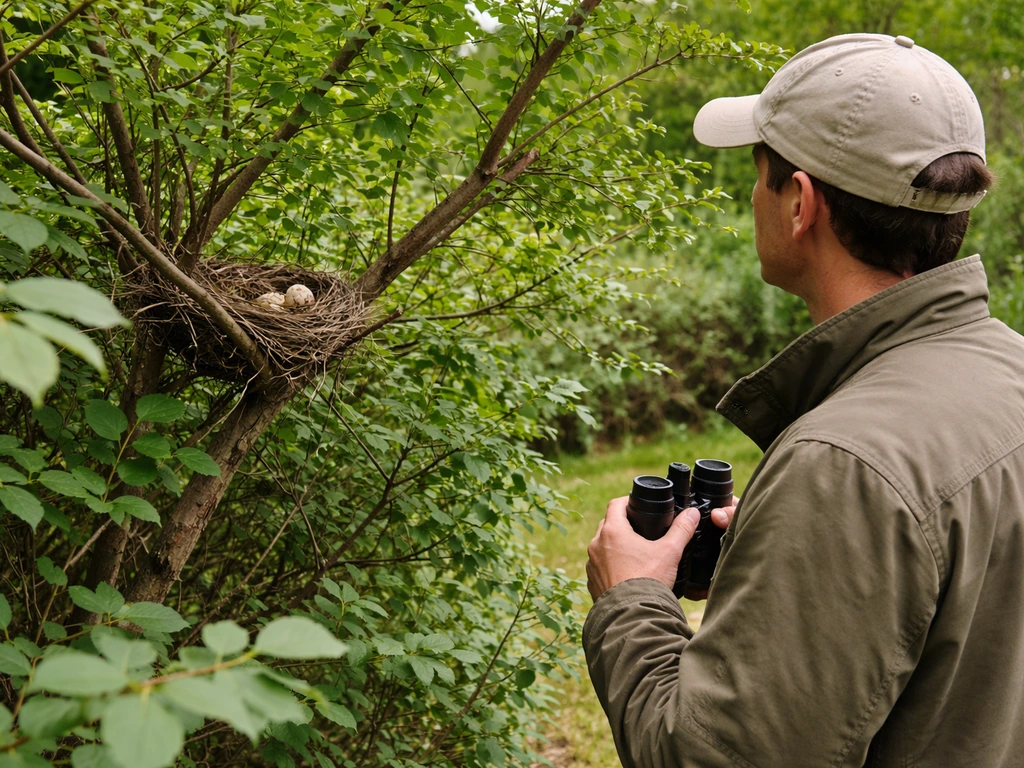
Where to Find a Bird Nest: Ethical, Step-by-Step Guide
Ethical, step-by-step guide to where to find a bird nest by habitat and season, spotting active signs safely.
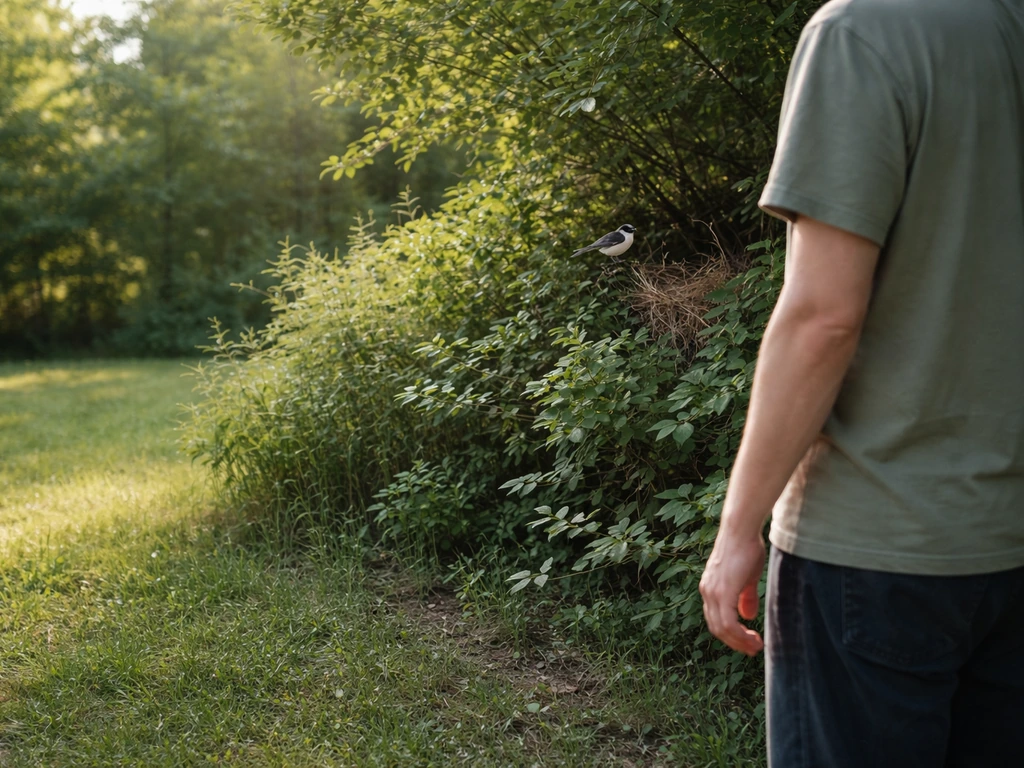
How to Help a Bird Find Its Nest Safely and Legally
Step by step guide on how to help a bird reunite with its nest safely and legally, without disturbing active nests.