A bird building a nest is an example of instinct, specifically a type of innate behavior called a fixed action pattern (FAP). It's a complex, species-specific sequence of actions the bird performs without being taught, triggered by internal cues like hormones and external ones like day length or the right kind of nesting site. That said, the full picture is a little more interesting: experience and even social learning can fine-tune how well a bird builds, which is why the instinct vs. learned behavior question comes up so often in biology classes and backyard birdwatching alike.
A Bird Building a Nest Is an Example of Instinctive Behavior

Maya Bennett
17 May 2026
What the phrase is really asking
When a test question or curious observer asks what nest-building is an example of, they're pointing at a core concept in animal behavior: the difference between behaviors an animal is born knowing how to do versus ones it has to learn. Nest building sits firmly in the instinct category.
Which fish builds a nest like a bird is also an example of instinctive, species-typical behavior shaping how animals reproduce and care for young Nest building sits firmly in the instinct category. . Instinct, as behavioral biologists define it, is an inborn, complex pattern of behavior that is distinct from a simple reflex. A reflex is a single automatic response (think: knee jerk).
An instinct is a whole coordinated sequence, like a robin repeatedly collecting mud, grass, and dead leaves, pressing them into a cup shape, and lining the interior with fine dry grass, all without ever having watched another robin do it.
The more precise term researchers use is fixed action pattern. An FAP is a highly stereotyped, species-characteristic sequence of actions triggered by a specific stimulus. For a nesting bird, the stimulus is usually a combination of hormonal state (elevated estrogen or testosterone as breeding season begins), photoperiod (lengthening spring days), and sometimes the presence of a suitable cavity or tree branch. Once triggered, the FAP runs essentially to completion. That's why you'll watch a bird weave the same style of nest, in the same type of location, using the same category of materials, generation after generation without instruction.
Instinct vs. learned behavior: it's not black and white
Here's where it gets genuinely interesting, and where a lot of people get tripped up. Saying nest building is instinctive doesn't mean experience plays zero role. Peer-reviewed research has shown that birds can refine their building skills through trial and error, and that some species will actually copy material preferences from familiar, successful neighbors, a form of social learning. In one well-documented study, birds adopted a specific color preference for nest lining material after watching a familiar individual use it, even when that color offered no structural advantage.
The practical takeaway: the overall drive to build, the general architecture, and the species-typical placement are all innate and fixed. Not all bird species build nests, and some use different strategies such as nesting in cavities or laying eggs directly in the environment do all bird species build nests. The fine details, such as which exact grasses to select, how tightly to weave, and how to adapt to a slightly unusual site, can improve with experience.
Think of it like walking: humans are wired to walk upright (innate), but we still learn balance and coordination through practice. For your biology class or your backyard, the correct answer is still instinct or innate behavior, with the nuance that learning can sharpen the execution.
How to recognize nest building when you see it
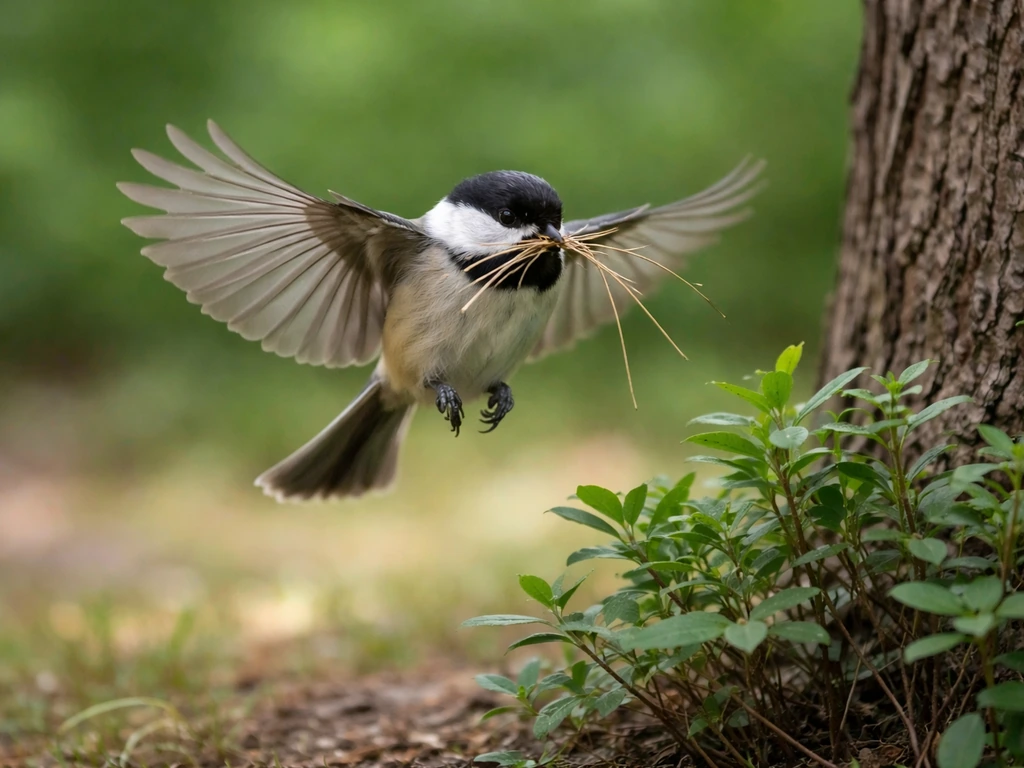
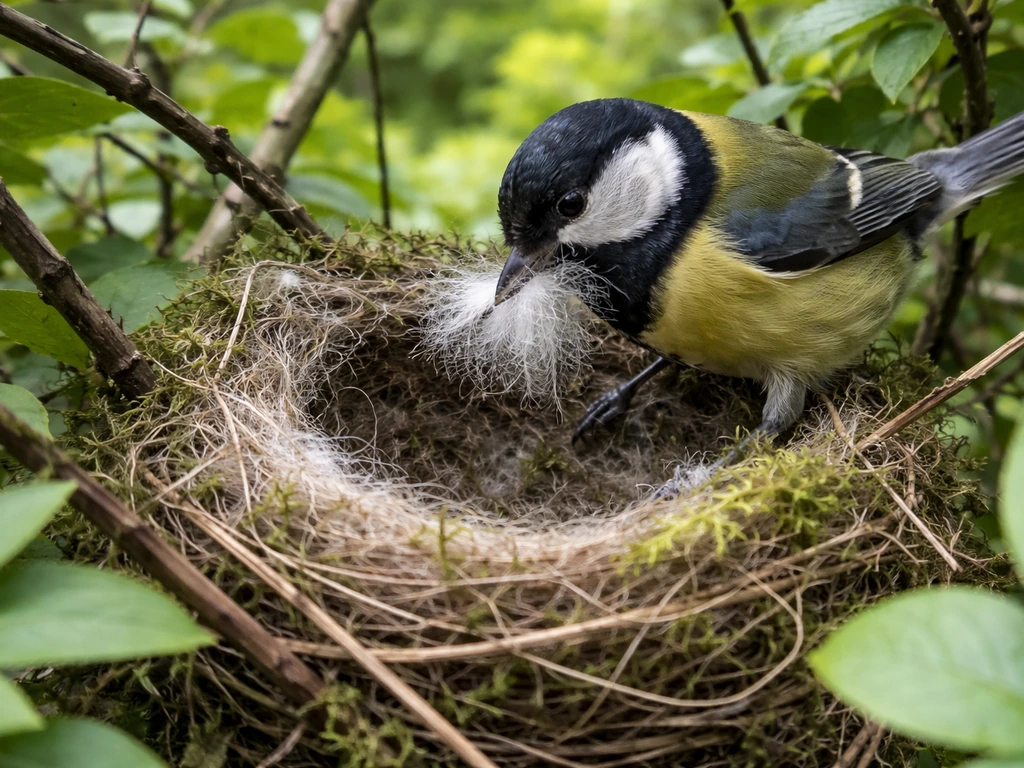
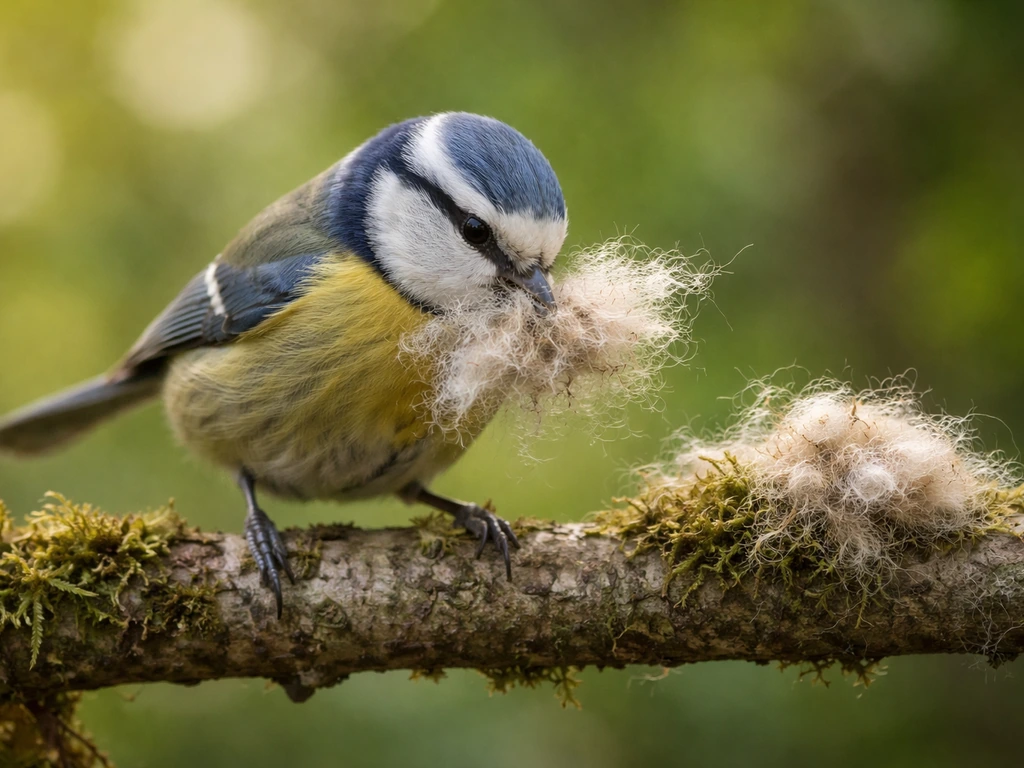
The single clearest sign is a bird carrying material in its bill. Birds almost never carry items in their bills outside of nesting season, with the narrow exception of food-caching species like jays or nuthatches. So if you see a bird picking up dry grass, moss, plant down, spiderweb silk, or strips of bark and flying off repeatedly in the same direction, that is nest-building behavior, full stop. Follow the direction of travel with your eyes and you'll often find the site.
Other behavioral cues worth watching for:
- Repeated trips to the same shrub, tree cavity, ledge, or corner within a short window of time
- A bird pressing or rotating its body into a spot (cup-shaping behavior, where the bird literally molds the nest bowl with its breast)
- Territorial singing or chasing near a specific zone, often from the same perch each time
- Two birds (in species where both sexes build) arriving and departing together or in sequence with material
- Small amounts of debris falling from a cavity entrance, a sign a bird is excavating or cleaning out an old nest
Compare this to what nest building is NOT: a bird scratching in leaf litter is foraging. A bird repeatedly visiting a feeder is foraging. A bird bathing in a puddle is maintenance behavior. The bill-carrying of non-food material is the key discriminator.
Identifying the nest stage and likely species from materials and location
Knowing the stage of nest building helps you gauge how much time you have before eggs appear and how cautious you need to be. Most small songbird nests take 3 to 12 days to complete, with bluebirds often finishing in as few as 3 to 4 days. Cup nests built by robins, thrushes, and warblers progress through a loose outer framework phase, a structural cup phase (when mud or plant fiber is added to bind the structure), and a lining phase (soft material like feathers, plant down, or animal hair added last). Once lining begins, egg-laying is usually only days away.
Cornell Lab identifies five main nest types that cover nearly all North American species. Knowing which type you're looking at, combined with location and materials, narrows your ID significantly:
| Nest Type | Typical Materials | Typical Location | Common Species Examples |
|---|---|---|---|
| Scrape | Bare ground, pebbles, shell fragments, minimal lining | Open ground, beach, gravel rooftop | Killdeer, Piping Plover, many shorebirds |
| Platform | Sticks, reeds, large plant stems | Tree forks, ledges, wetland vegetation | Osprey, Great Blue Heron, eagles |
| Cup | Grasses, mud, moss, plant down, spiderweb; lined with fine fibers or feathers | Fork of tree/shrub, ledge, exterior of building | American Robin, Song Sparrow, Yellow Warbler |
| Domed/Enclosed | Woven grasses or bark strips forming a roof; sometimes mud-reinforced | Dense shrubs, grass tussocks, tree cavities with added material | Marsh Wren, Ovenbird, some wrens |
| Cavity | Minimal to moderate lining of wood chips, feathers, moss inside a hole | Natural tree holes, nest boxes, building gaps | Eastern Bluebird, Chickadees, Tree Swallow, Woodpeckers |
Spiderweb silk as a primary binding material is a strong clue for small cup-nesters like hummingbirds or gnatcatchers. Large stick platforms built high in a dead snag almost always mean raptors or herons. A nest woven into a vertical tube suspended from a branch tip is almost certainly an oriole. Location matters as much as materials: each species places its nest in a characteristic spot type, and that consistency is part of the innate behavior package.
What to do when you find an active nest
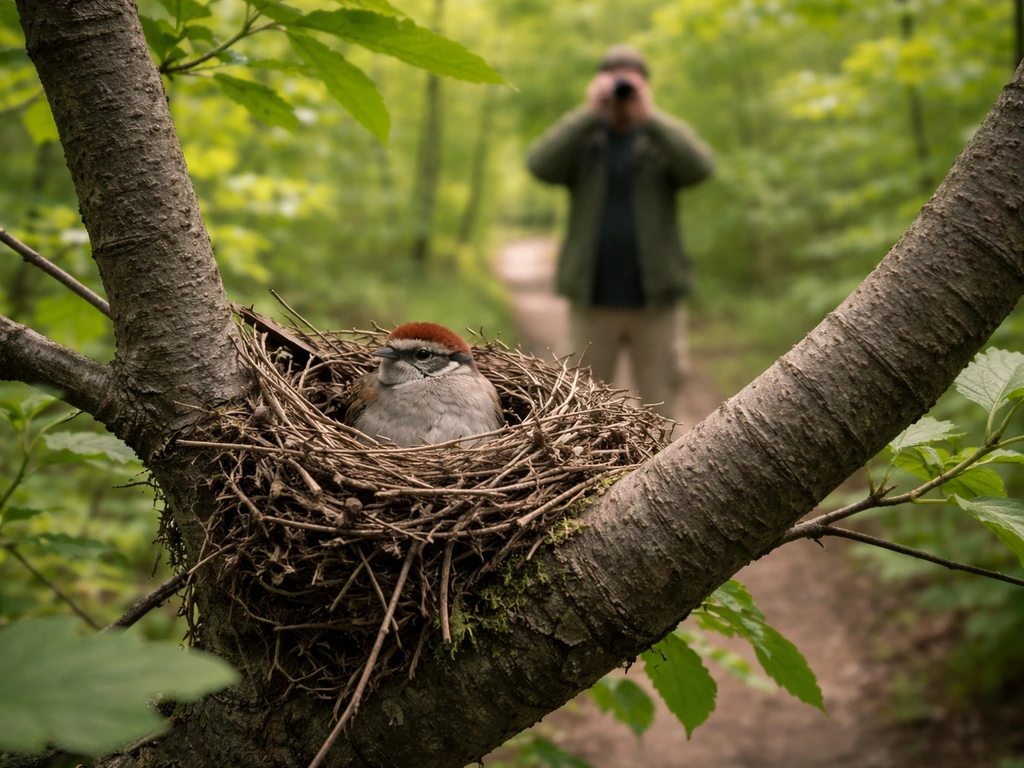
The best rule of thumb: watch from a distance that doesn't change the bird's behavior. Audubon's ethical photography guidelines use 25 yards as a benchmark minimum for sensitive species, but the real test is behavioral, not numerical. If your presence causes the bird to flush (fly away), freeze, alarm-call, or stop returning to the nest, you are too close. Back up until the bird resumes normal behavior.
If an hour or two passes with no parent at the nest during active egg-laying or incubation, that's a signal to retreat further. Your proximity may be preventing the parents from returning. Chilling of eggs during incubation can be fatal to developing embryos, so erring on the side of distance is always the right call.
A short do and don't list for active nest encounters:
- DO observe from a distance using binoculars or a long camera lens
- DO keep visits brief and infrequent, especially during incubation
- DO note the species, nest type, and stage in a field notebook or app
- DON'T touch the nest, eggs, or nestlings under any circumstances
- DON'T clear vegetation, trim branches, or remove debris near an active nest
- DON'T allow dogs or cats near the nest area
- DON'T share the exact GPS location publicly on social media during the active season
Legal protections every homeowner and birdwatcher needs to know
In the United States, the Migratory Bird Treaty Act (MBTA) protects roughly 1,100 native bird species, and that protection extends explicitly to their nests and eggs. It is illegal to collect, possess, or transfer possession of a migratory bird nest. Removal of an active nest (one with eggs or chicks) requires a federal permit from the U. S.
Fish and Wildlife Service. There is no "just moving it a few feet" legal exception for private citizens. If a nest is in a genuinely problematic location and is already active, the practical and legal answer from Audubon and USFWS is the same: [leave it alone until the chicks fledge or the nest fails naturally](https://www. audubon.
org/great-lakes/news/i-found-bird-nest-bad-location-what-can-i-do-help), then address the underlying access issue so it doesn't happen again next season.
The MBTA does not create an outright prohibition on nest destruction where no possession or take of birds or eggs is involved (for example, an empty, inactive nest from a previous season), but the line between active and inactive is easy to misjudge. If there is any chance eggs or nestlings are present, treat the nest as protected. Non-native species like European Starlings and House Sparrows are not covered by the MBTA, so the rules differ for those, but when in doubt, assume protection applies.
Practical next steps: documenting, reducing risks, and managing your yard
If you want to do something useful the moment you spot nest-building activity, documentation is your best immediate action. That includes the common scenario of when a bird builds a nest on your porch and you need to handle it responsibly nest-building activity. Take a photo from a safe distance that captures the nest's location relative to a fixed landmark (a fence post, a window, a specific branch), the approximate height, and any material you can identify.
Note the date and the behavior you observed. This becomes genuinely valuable data if you submit it to a citizen science platform like NestWatch, which uses standardized monitoring categories to track nesting outcomes across North America. The NestWatch Monitoring Manual emphasizes [standardized monitoring categories and consistent methods](https://nestwatch. org/wp-content/uploads/2020/01/NestWatchmanual20191106.
pdf) for recording nests while minimizing disturbance.
For yard management around an active nest, the priority is reducing disturbance and predator pressure during the nesting window, which typically spans 2 to 6 weeks from nest completion through fledging depending on the species:
- Pause or reschedule any lawn mowing, branch trimming, or construction work within 10 to 15 feet of the nest site until fledging is confirmed
- Keep cats indoors and dogs on a leash or away from the nest zone entirely
- Avoid using power tools or loud equipment near the site during the early morning hours when feeding activity is highest
- If the nest is on a porch or under an eave, resist the urge to clean or sweep the area until after fledging
- After the nest is confirmed empty and inactive, remove it if it's in a location likely to cause repeat problems, and then use exclusion methods (hardware cloth, caulk, or physical blocking) to prevent reuse in unwanted spots before the next breeding season
If you're trying to confirm whether you're looking at active nest building or just a bird exploring a site, watch for the return-trip pattern. A bird genuinely building will return to the exact same spot multiple times within an hour, usually carrying material. In many species, both parents may contribute, but the specific answer depends on the bird type. A bird simply investigating a potential site may visit once or twice without material and move on. The repetitive, material-carrying return is the definitive sign that construction has begun and that the nest deserves your full ethical attention from that point forward.
Understanding what nest-building behavior actually is, an innate, species-typical fixed action pattern refined by experience, gives you the context to appreciate what you're watching. And knowing the identification markers, the legal framework, and the practical yard steps means you can do right by the bird from the first moment you spot it gathering material.
FAQ
If a bird seems to build a nest in multiple locations, is it still instinctive behavior?
Yes, but you should distinguish between nest construction and site selection. Many species do preliminary “sampling” trips without carrying suitable nesting material, then commit once they repeatedly return to the same spot with bill-carrying items. The commitment phase is the fixed action pattern portion, while wandering is often exploratory or driven by changing external conditions (predation risk, weather, or material availability).
Can you call nest building “instinct” if the bird learns from other birds?
It is still instinctive in overall design, but learning can tune execution. Researchers often describe it as an innate program (architecture, placement tendencies, and the sequence of phases) that can be adjusted by experience, such as improving weaving tightness or adopting a locally successful material preference. Social learning affects details, not the fundamental drive and species-typical sequence.
What if the bird uses unusual materials or doesn’t follow the typical nest style?
Treat it as refinement rather than proof the behavior is not innate. Many species show flexibility in material choice, especially if typical fibers or grasses are scarce. A more reliable indicator is the stereotyped sequence (framework building, binding, then lining) and the repeated, material-carrying returns to one location, not the exact plant type used.
How can I tell nest building from regular food caching with the bill?
Food caching usually involves carrying items that can be eaten later and often uses ground or specific cache sites, not the same structure-building location. Nest building is characterized by repeated trips to one exact spot with non-food materials (dry grasses, moss, plant down, spiderweb silk, bark strips) that accumulate there, usually escalating in frequency as the phases progress.
Do both parents build nests, or is it usually one bird?
It depends on the species. In some songbirds, both sexes participate in construction, while in others one sex mainly builds and the other focuses on territory defense or feeding. A practical approach is to track which individuals bring material to the same exact site within short intervals, then note whether both do it across multiple visits.
My yard has a bird carrying soft materials like feathers, does that always mean eggs are coming soon?
Not always, but it strongly suggests you are in the later lining phase. Soft, fine materials added to the cup interior typically occur close to laying, often within days for many small songbirds. Still, timing varies by species and conditions like weather, so the safest next step is to keep your distance and monitor for continued material placement or first sightings of eggs rather than assuming the exact timeline.
What should I do if a nest is on my porch, in a planter, or near a door I need to use?
Avoid moving the nest and limit access so the parents can return normally. If the nest is active, the best practical solution is usually to change human routes (use an alternate entry, close a nearby door, or temporarily rearrange yard activity) until fledging. Document the situation from a safe distance, and if access truly cannot be managed, contact a local wildlife rehabilitator or appropriate authority for guidance on lawful, non-disturbing options.
Is it ever okay to relocate an inactive nest to fix a problem like a blockage?
Only if you are confident it is inactive and there is no chance eggs or chicks are present. The “inactive” determination is easy to get wrong because nests can be reused or a new clutch can begin quickly. If there is any uncertainty, treat it as protected and wait until the nesting season ends or the nest has clearly failed naturally.
If I can’t avoid looking at the nest, how far away is “safe” in practice?
Use behavior as the real measuring stick. If the parent stops returning, changes routes dramatically, alarms, or flushes repeatedly, you are too close. Increase distance gradually until normal visitation resumes, then keep that viewing distance or more. This matters because sensitive species may react to proximity even when you cannot measure the exact yards.
What are good signs that the nest is active versus an empty nest or early construction?
Active construction is strongly suggested by repeated visits to the same spot within an hour or two where the bird arrives with nesting material. Activity during incubation or feeding is suggested by consistent return trips even when the nest area is otherwise quiet. An empty-looking nest can still be in use if you see ongoing material addition or parent returns, so check for recent construction cues before assuming inactivity.
Are non-native birds treated differently under nesting rules?
Often, yes. Some non-native species are not covered by the same federal protections as migratory native birds, but rules can still vary by location and situation. Because it is easy to misclassify nests (especially when species identification is uncertain), the practical rule is to treat any nest with eggs or chicks as protected unless you confirm the species and applicable protections through local guidance.
What should I document if I want to report nest-building to a citizen science group?
Capture details that let others confirm identity and monitor outcomes: date, nest type and materials, precise location relative to a fixed landmark, approximate height, and behavioral notes (for example, “repeated bill-carrying to same spot,” “lining phase started,” or “incubation visits observed”). Avoid taking close-up photos that cause parent birds to change behavior.